The Oaxacan Hearth
A refined exploration of Mexican kitchen design, where traditional materials, handcrafted objects, and warm textures create a timeless, grounded culinary space inspired by regional heritage and modern restraint.
The comal in an Oaxacan kitchen has never needed a redesign. It's the same flat disc of clay or stone, set directly over open flame, that cooks here were using long before the Spanish arrived, and its job hasn't changed: char a chile or warm a tortilla, nothing else required. Its name comes straight from the Nahuatl word for it, comalli. The volcanic molcajete beside it is just as old, and gets its own full treatment elsewhere on this site.
That kind of continuity runs through the rest of the kitchen, in ways easy to miss if you're only looking for what changed.
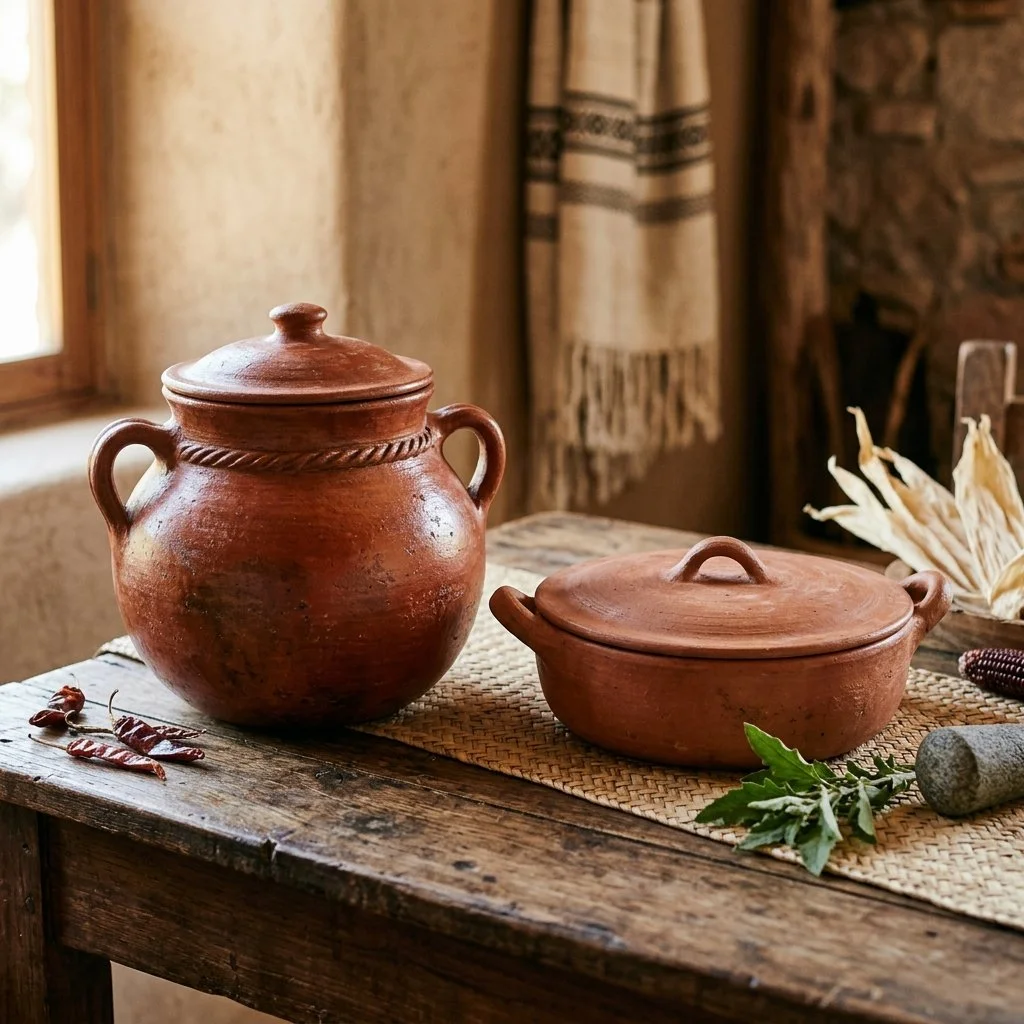
Handmade red clay olla and cazuela cookware from San Marcos Tlapazola.
The Village That Colors Everything Red
Not far from Tlacolula sits San Marcos Tlapazola, a Zapotec village where a few hundred women still work red clay entirely by hand, a craft passed mother to daughter for twenty generations. There's no wheel involved. Pieces are shaped using little more than a corn husk and a smooth stone. The clay comes from the hillsides above the village, rich in the iron oxide that gives it that unmistakable red once fired.
The clay is dug from the hillside and mixed with sand, then left in the sun for about a week. After that, it goes into an open pit and is fired over wood and kindling. Pieces meant for daily cooking are scraped and burnished nearly smooth first, so they hold up to years of stovetop use. Decorative pieces are left exactly as the fire leaves them, marked by smoke. This is the source I'd point a designer toward for a real olla or cazuela, not the glossy version made by machine and sold everywhere else.
The Other Red
There's a second red in Oaxaca that has nothing to do with clay, and it predates the Spanish by centuries. Cochineal, a tiny insect that lives on the nopal cactus, produces one of the most vivid reds ever found in nature once it's dried and crushed. Zapotec and Mixtec dyers in the Oaxaca Valley farmed it at least three hundred years before colonization and used it to color textiles and ceremonial objects. When the Spanish encountered it, they'd never seen anything like it in Europe, and it briefly became one of New Spain's most valuable exports after silver. It's the fact about this place I didn't expect: the deepest, most expensive red in the room might be the one made by a bug.
That same dye still colors woven table runners and linens found across Oaxacan households today, made the way it's always been made, and it never needed an invented backstory to be interesting.
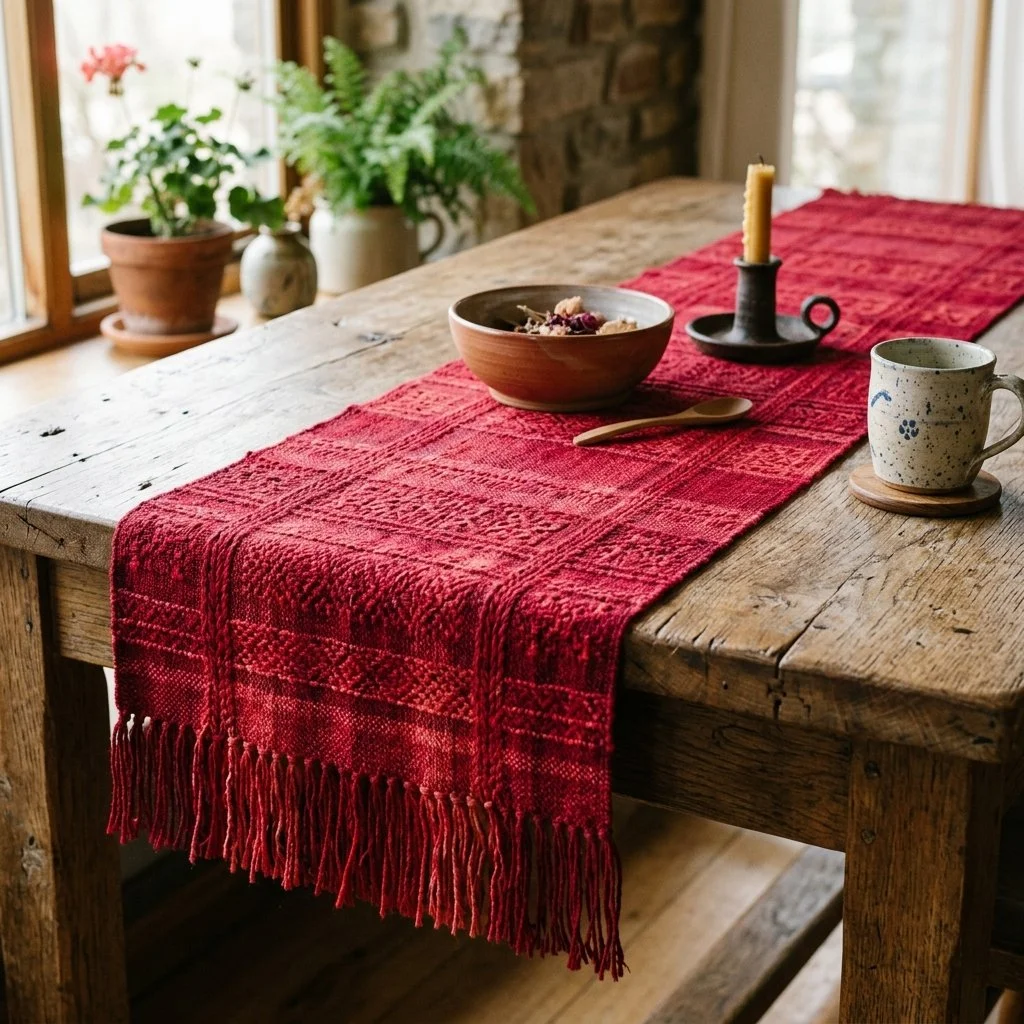
A handwoven table runner dyed in rich cochineal red rests on a rustic wood table.
What Four Centuries Added
Not everything on this table is this old. Quesillo, the stretched string cheese wound by hand into a ball, exists because Spanish ranchers found the Valley of Etla suited to raising cattle in the late 1500s, something the region never had before then. The molinillo works the same way: everyone assumes the carved whisk is purely indigenous, but it's a Spanish invention. The Mesoamerican method for foaming chocolate was to pour it back and forth between two vessels, not whisk it at all. Both arrived centuries after everything else in this kitchen, yet both were absorbed completely enough to read as native now.
What Never Left
Take away the cheese and the whisk, and everything else in this kitchen is standing exactly where it started. The comal is unchanged, and the red clay still comes from the same hillside it always has. The cochineal thread is dyed the way it's been dyed for centuries. A place doesn't prove its provenance by staying frozen. It proves it by absorbing four centuries of additions without losing the thing that was there first.
For a designer sourcing either: San Marcos Tlapazola's cooperative of red clay potters is the real channel for an olla or cazuela, and Teotitlán del Valle's natural dye weaving cooperatives, the ones still working only with cochineal and other plant dyes instead of synthetic ones, are the channel for cochineal dyed textiles.
Argentina Keeps Its Fire Honest
Argentinian kitchens are shaped by routine and togetherness rather than decoration. This guide explores how durable materials, communal cooking habits, and functional tableware create a space built for everyday use rather than display.
In the eighteenth century, the gauchos who worked Argentina's pampas lived mostly on beef, cooked over an open flame, because the plains gave them almost nothing else to eat and nothing to season it with. Mendoza still cooks this way today. The iron grate, and the vertical cross that came after it, both trace back to that same problem: one ingredient, one heat source, and however long it took to get it right.
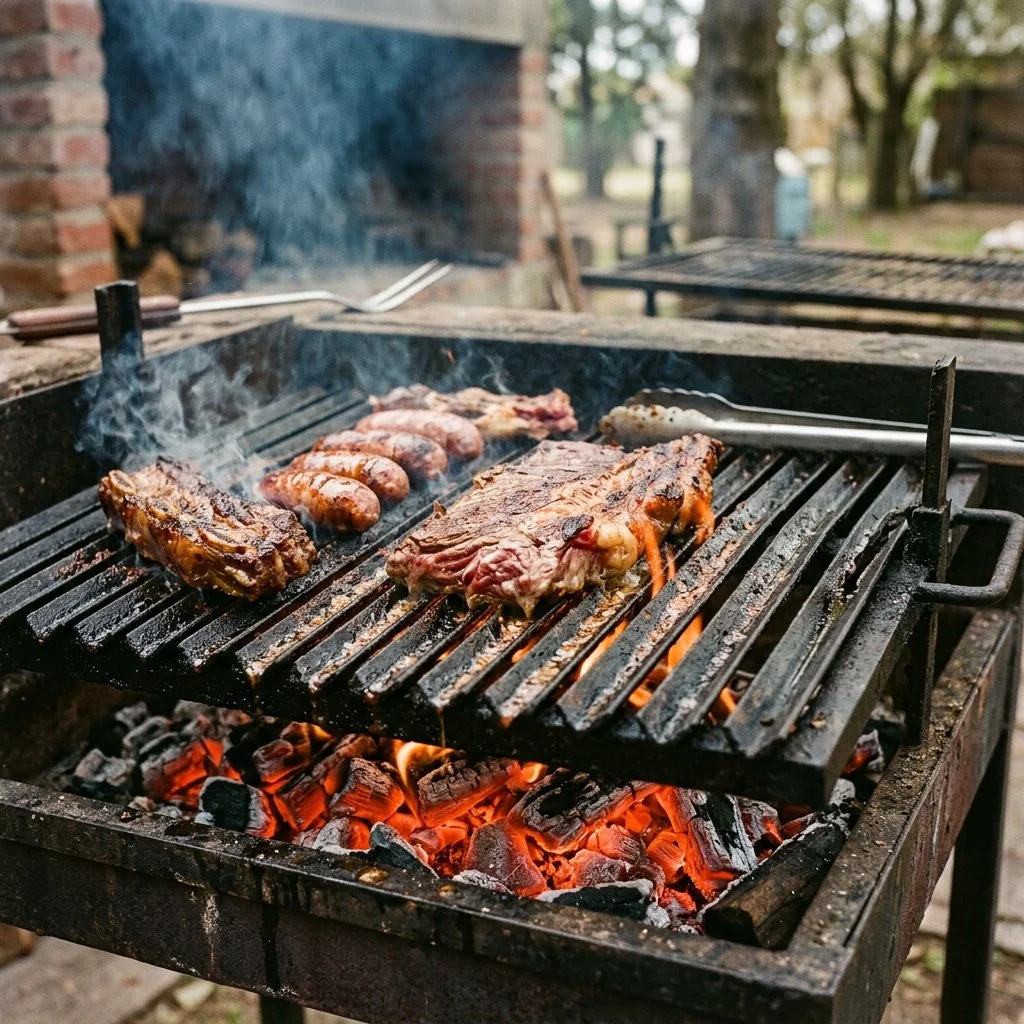
Dark V-shaped grates of an outdoor parrilla grill over glowing red charcoal coals.
The Fire Argentina Actually Built
The parrilla is the daily engine: a heavy iron grate with channels shaped like a V that let fat drain away from the coals instead of flaring them up. A wheel raises or lowers the whole grate, which is how an asador adjusts heat without touching the fire itself.
The cross, or cruz, is older and slower. Whole cuts, sometimes a whole lamb, are secured vertically on an iron frame and left leaning over the coals for hours, the hide sometimes still on to hold the juices in. It's Patagonia's method more than Mendoza's. In Chubut province, the same vertical technique carries traces of Welsh settlers and of the Tehuelche people who were roasting meat this way well before the Welsh or the Spanish showed up. Credit for the cross probably belongs to more hands than just the gauchos'.
One detail from the gauchos survives in every good asado today: burn quebracho wood if you can get it. It produces almost no smoke, which is the entire point when the meat sits inches from the flame for hours.
The Cut Nobody Gets Right
Ask for picanha in Mendoza and you'll get funny looks from anyone who takes the cut seriously. Picanha is the Portuguese name, Brazil's word for it. In Argentina, the same top sirloin cap, identified by its thick fat cap left untrimmed, is properly called tapa de cuadril, or colita de cuadril depending on the province. Argentina's own beef promotion board confirms the naming. The fat itself works exactly the way people assume: leave it on, and it renders slowly into a crust the fat bastes on its own, no marinade needed.
Chorizo sits at the same table but arrived by a different road. The pork and beef sausage came in with Spanish and later Italian immigration, brought by settlers rather than grown out of anything already here. Argentina adopted it so completely, as the traditional first bite before the heavier cuts, that almost nobody thinks of it as borrowed anymore.
Algarrobo, Named Twice
The wood most Argentine asado tables are built from is algarrobo, a Prosopis species that grows in the arid Gran Chaco region and can survive conditions most hardwoods can't. It's genuinely native. The name is not. Spanish settlers called it algarrobo because it reminded them of the European carob tree they already knew. Long before that naming, Guaraní speakers called it ibopé or igopé, and Quechua speakers simply called it yaná tacú, the tree, a name that says something about how central it was to daily survival for millennia before anyone Spanish showed up. Its pods were ground into flour for a dense cake called patay, and fermented on their own into a drink called aloja. Its wood holds heat without dulling a blade, which is exactly why it still ends up under a plate of meat.
What Actually Traveled to Get Here
Two objects on the Mendoza table have origin stories that surprise people who assume everything here is old and native.
Malbec is French. It came from the Cahors region in France. The agronomist Michel Aimé Pouget crossed the Andes from Chile in 1853 with French vine cuttings, to found an agricultural school in Mendoza. Most sources date Malbec's actual arrival to 1868, among the varieties introduced once the school was running. A few decades later, phylloxera nearly wiped Malbec out in its own country. Mendoza's dry soil, sitting at high altitude where the disease struggles to spread, protected it instead. The grape that France mostly abandoned became more Argentine than French in practice.
The pingüino, the ceramic penguin pitcher used to pour that same Malbec, is newer still. Italian immigrants popularized it in Argentina sometime in the 1930s, when bulk wine sold to neighborhood cantinas had to be poured again into something for the table before bottling regulations existed. Nobody is fully certain why the shape is a penguin. One theory, from a single Argentine source I couldn't independently confirm elsewhere, ties it to an American Art Deco silver cocktail shaker from 1936, shaped like a penguin for a World's Fair exhibit built around a shipment of real Antarctic penguins. It's a strange thread for an object that looks like it should have a tidy folk explanation, and I'd rather leave it unresolved than invent one.
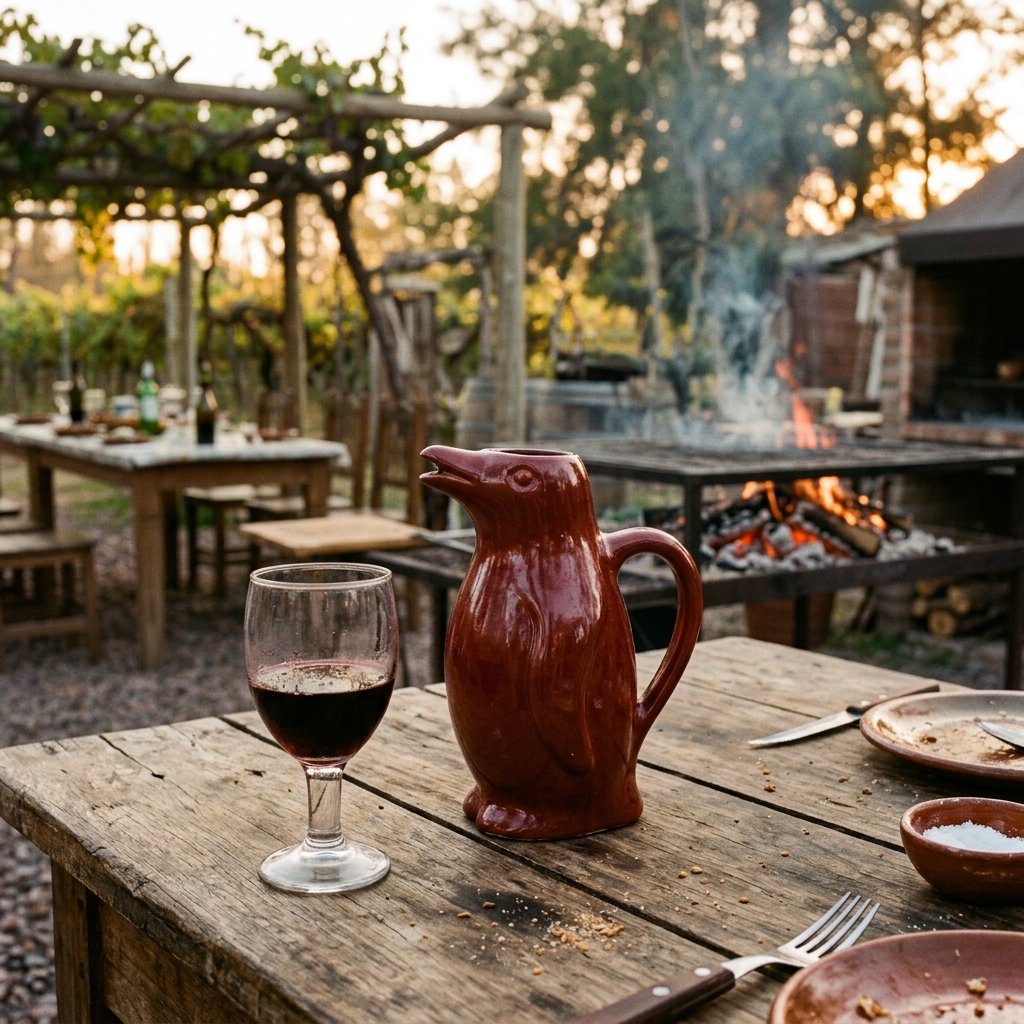
A ceramic pingüino pitcher and a glass of Malbec sit on a rustic wooden table.
What the Fire Refuses to Rush
Mate is the one object on this table that owes nothing to the fire. The Guaraní people of what is now Paraguay were cultivating and drinking it before any Spaniard arrived in South America. Even the word carries the layering: "mate" comes from the Quechua word for the gourd it's served in. "Yerba" is just the Spanish word for herb. The ritual underneath both words is centuries older than either label.
That's the real shape of this table. Argentina built its fire out of necessity and got its cut names crossed with its neighbors. It kept a wood the Spanish renamed but didn't create, and took in a grape and a pitcher that both started out belonging to someone else. Underneath all of it sits a drink the Guaraní were already sharing for centuries before anyone here was arguing about what to call the meat.
If you want to source any of this properly rather than buy it retail, two channels are worth knowing. Misiones province, in Argentina's northeast, is where yerba mate is actually grown, and cooperatives run by small producers there sell direct rather than through the mass brands most people know. And the ironwork itself, the parrillas and the crosses, is still forged by hand by blacksmiths working in Mendoza and further south in Patagonia, the same trade that's kept the gaucho's fire running for centuries.
In Ouro Preto, Brazil, People Cook in Stone
Brazilian kitchen design is shaped by rhythm, generosity, and everyday gathering. This guide explores how practical tableware, lived-in dining traditions, and warm functional essentials create kitchens designed for connection rather than display.
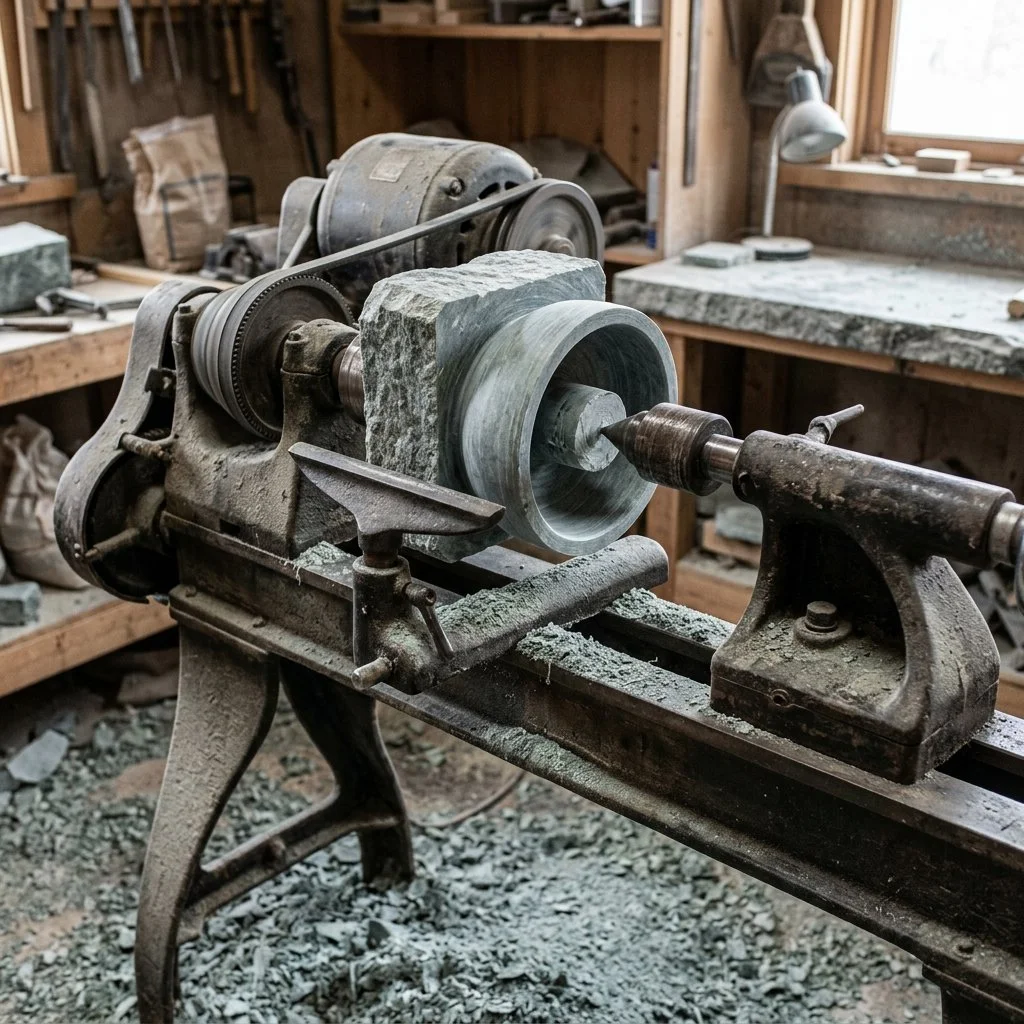
In 1927 a German chemist named Oskar von Burguer wrote up how the soapstone pots of Minas Gerais, Brazil, were made. A block of stone was clamped between two iron points on a horizontal lathe, and a waterwheel turned it through a wooden pulley. Those two points were the only iron anywhere on the machine.
By 2009 most of the working lathes in Cachoeira do Brumado, a district of Mariana, ran on electricity. A researcher named Vinícius Melquiades spent twenty days that July in the district's workshops and found only two still driven by water. Looking for the stone behind all of this because it turns up in two places I would never have put side by side: the Baroque churches of Minas Gerais and an ordinary stew pot.
Iron lathe holds a partially turned block of gray-green stone.
The Rock Itself
The rock is steatite, a metamorphic stone with varying amounts of talc, common across the iron belt of Minas Gerais that geologists call the Quadrilátero Ferrífero. It sits between 0 and 2 on the Mohs scale, soft enough to shape with hand tools. The maker cuts a block loose with a saw and an iron lever, then leaves a column of stone standing inside it so the block can be held between the two points and turned. The column comes out last.
The makers in Cachoeira do Brumado all name one problem, iron pyrite. It is far harder than the steatite around it, and a lump of it can tear loose and crack a pot on the lathe, so blocks are chosen at the outcrop and any stone with pyrite in it stays behind.
Laboratory tests on stone from four quarries in Bandeiras, in the Santa Rita district of Ouro Preto, found porosity of 0.4 percent at most. Every sample broke in the first or second round of a thermal shock test, which is a good reason to bring a pot up to heat slowly.
A Trade Nobody Registered
Gold brought the pot makers. In the first half of the 1700s, communities settled around Ouro Preto and Mariana to make these pots for the new mining towns and the roads between them. One of the first men to find gold in Minas Gerais founded Cachoeira do Brumado in that rush.
Colonial officials licensed and regulated trades like masonry and blacksmithing in detail. Melquiades found no reference to pot makers in the documents he consulted, and that gap is why he calls it an unofficial trade. Nearly every account of soapstone in Minas Gerais leads straight to Aleijadinho, and Melquiades argues that this gives the wrong picture of who made the pots. His reading of the evidence points to free colonists and to people who were enslaved or formerly enslaved. They worked the stone for sale in the towns and along the roads.
When von Burguer asked in Santa Rita whether the workshops made anything besides pots, he was shown, with obvious pride, a stemmed drinking glass cut from stone in the shape of an ordinary glass one.
One District, Two Markets
Santa Rita de Ouro Preto is called the capital of soapstone. The best stone from its quarries leaves as blocks for Europe and the United States, and the softer, lower grade rock goes to artisans for pots. I find it hard to read that split without noticing which end gets the better rock.
In the 1700s and 1800s the stone stood in for costly Italian and Portuguese limestone in Baroque work. Prominent among its uses are the sculptures at the Sanctuary of Bom Jesus de Matozinhos in Congonhas. The International Union of Geological Sciences designated Minas soapstone a heritage stone in 2026, and its entry notes that the cookware craft is recognized as intangible heritage in Ouro Preto and Mariana.
The work itself is hard. A 2023 study of the workshops calls it arduous and unhealthy. Raw stone is expensive, and the pots are hard to sell. In Cachoeira do Brumado the shallow deposits that artisans could dig by hand ran out once mining companies arrived in the 1970s and 1980s. Many makers now buy the waste rock those companies discard, and a few still extract by hand.
The Pots Rode the Mule Roads
The gold built the mule roads, and the pots went out on them. Muleteers called tropeiros hauled goods across the colonial interior, and near the waterfall in Cachoeira do Brumado a memorial honors the men who carried the pots on muleback for days. The dried staples they carried, beans and cassava flour among them, turned into feijão tropeiro, a dish still cooked across Minas. Cassava is the older ingredient. Farofa comes from the Indigenous way of turning manioc into flour, which was in Brazil long before any mule train.
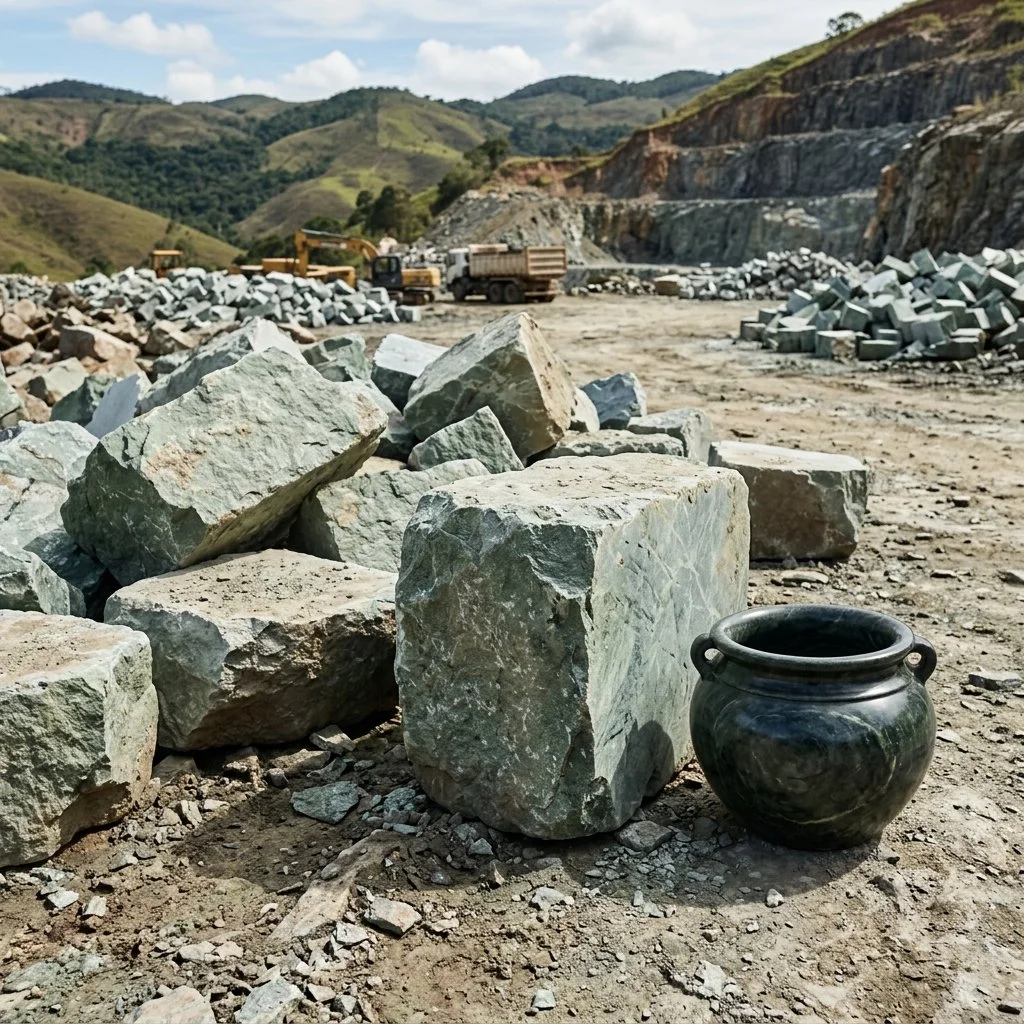
Raw, greenish gray steatite blocks in a Santa Rita de Ouro Preto quarry alongside a hand carved stone cookware pot.
The People at the Lathe
The stone that was carved for the churches of the gold towns also went on the stove, and the people who turned the stove pots barely appear in the records. That is why I would start with them. Cachoeira do Brumado has an artisans' association for its stone and sisal makers, and its residents' association runs a pot festival each July. In Ouro Preto, the soapstone fair at the Largo do Coimbra has been run since 1995 by an association of its own stallholders. Much of what it sells is made in Santa Rita, and soapstone shares the stalls with jewelry and souvenirs. Slab and blocks take a different route, through the quarry operators around Santa Rita who already ship both to Europe and the United States.
What Korean Tableware Is Made Of
Korean kitchens reflect a balance of restraint and ritual, where function leads design. This guide explores how Seoul dining culture shapes minimalist tools, intentional tableware, and everyday objects designed for quiet efficiency and shared meals.
A stone bowl of rice reaches a Korean table still crackling. The rice at the bottom is cooking against hot stone. The flavors of the meal started months earlier in a clay jar, and the dish is not done until the person eating finishes it.
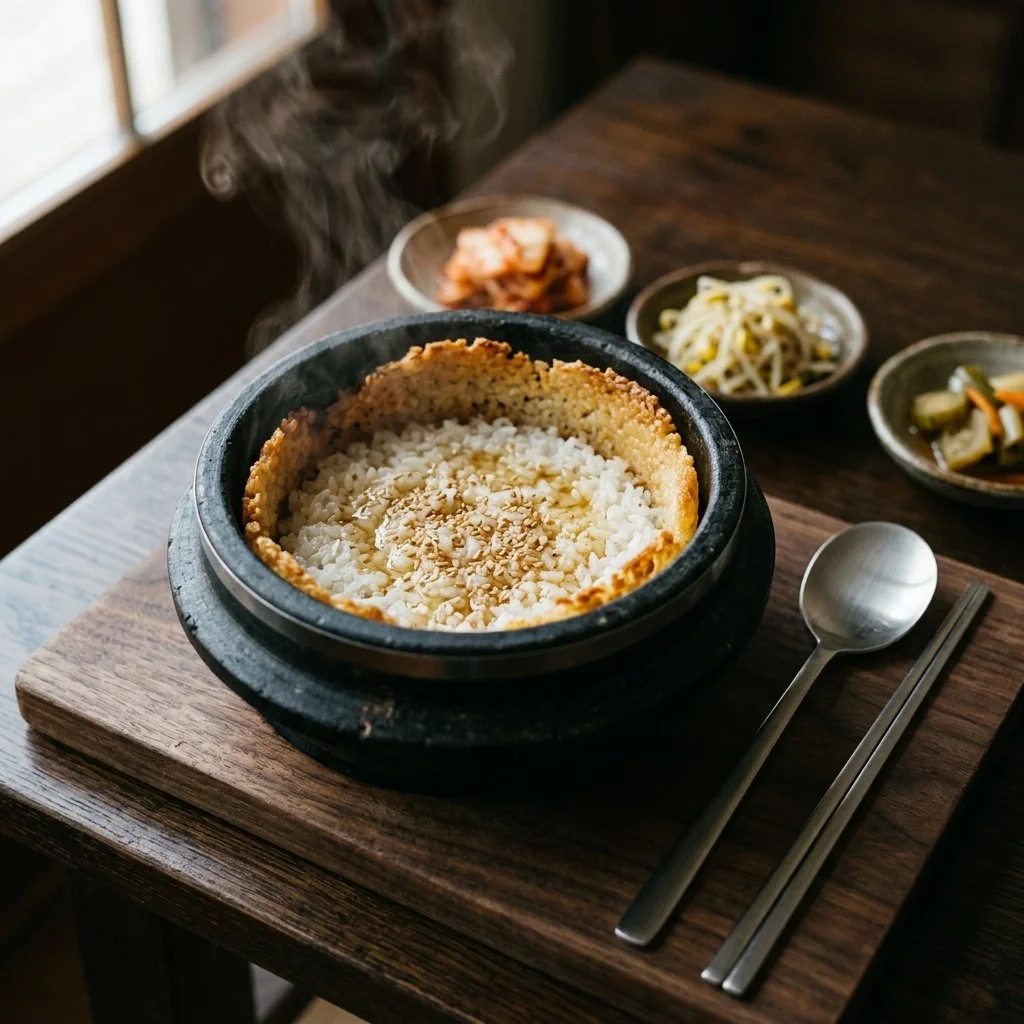
Black stone dolsot bowl filled with rice and a golden crisp crust, placed on a dark walnut board alongside steel utensils.
Months in the Yard
Korean cooking runs on fermentation, and the fermenting happens in onggi. Unglazed jars are fired at low temperatures, so the clay stays porous. Oxygen passes in and the liquid stays put. Glazed jars are coated in a dark brown mix of local clay and wood ash. Big jars sit in the yard or are buried, which is one way of controlling how fast the ferment runs. They hold the chili paste and soybean paste the cuisine is built on. Kimjang, the late autumn making of kimchi, went onto UNESCO's list of intangible cultural heritage in 2013.
Even the red in that chili paste has a disputed past. The usual account says the chili plant came from the Americas and reached Korea by way of Japan in the late 1500s. A Korean research team argues for a native pepper much older than that, and the question is still open.
The potters were often itinerant and worked at the edge of Korean society. Ralph Rinzler of the Smithsonian made a research trip in 1971 and likened the jars to the refrigerators found in every American home. The trade that produced them was barely documented outside Korea until then.
Heat That Stays on the Table
Retail listings often call a dolsot a granite bowl. I checked, and the Korean name says otherwise. Gopdolsot means agalmatolite pot, and agalmatolite is a soft stone that holds heat. The bowl keeps cooking the rice after it leaves the fire. Sesame oil goes into the hot bowl first and then the rice, and the bottom layer crisps against the stone. That crust is nurungji. In bibimbap, which means mixed rice, the spoon goes in hard to work the gochujang through the bowl and scrape up the crust. With plain rice the crust steeps into sungnyung, a hot infusion.
The king's table already had a fire on it: a pot heated by charcoal that usually held a casserole such as sinseollo. What changed is the fuel. Many restaurants in Korea now run hot pots and grilled meat on portable butane burners, and at those tables a canister does the work charcoal once did. In Seoul it sits between the guests, and they tend it themselves.
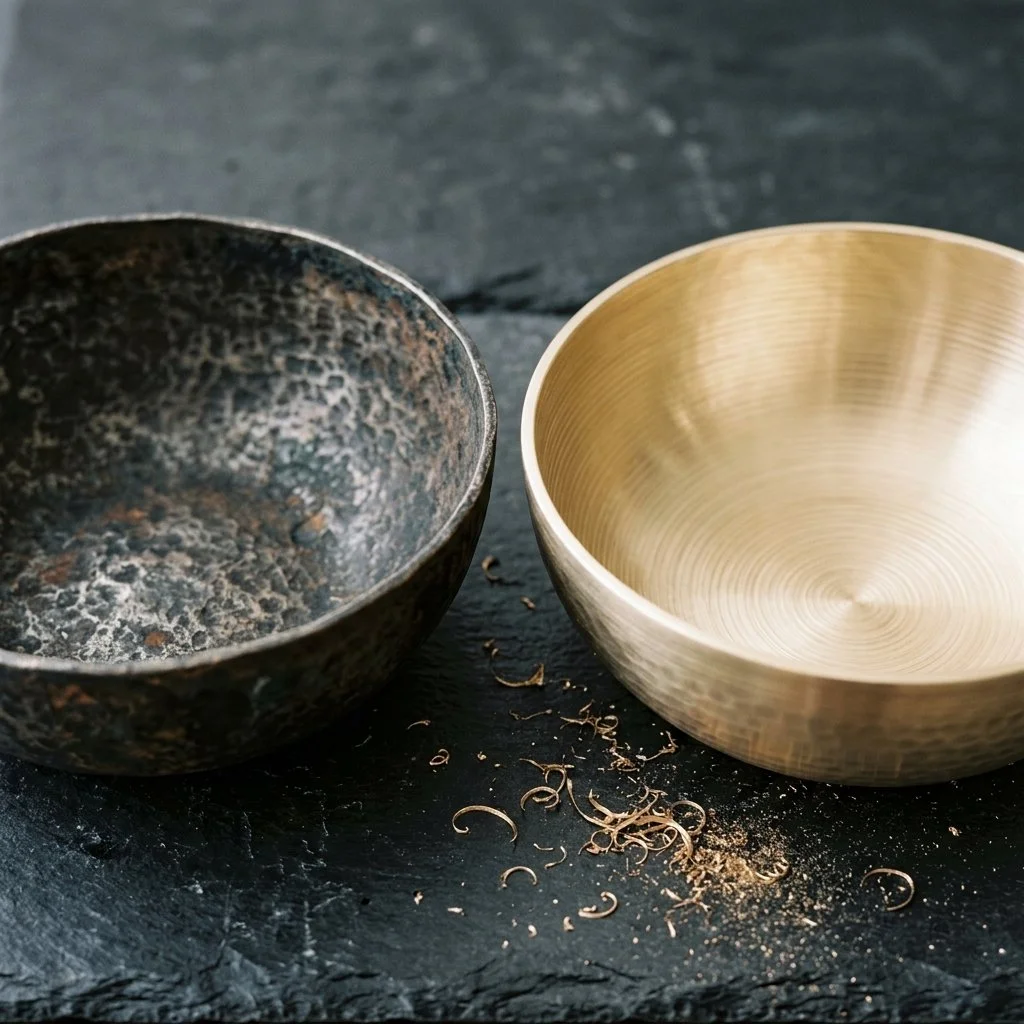
Two Korean bangjja bronze bowls, one raw and oxidized, the other shaved to a soft pale gold with visible lathe marks
In the Diner's Hand
Rice and soup go to each person, and the side dishes, banchan, sit in the middle to be shared. Whoever is eating builds each bite from them. Their number once carried rank, and the count, called cheop, leaves out kimchi. Nine cheop was as far as a noble family went, and twelve belonged to the king.
The tools for that work are metal. The oldest metal chopsticks on record in Korea came out of the tomb of King Muryeong of Baekje, who died in 523. There were two pairs, bronze and flat, each with a ring at the gripping end so a chain could join the two sticks. Korean has one word for the pair, sujeo, spoon and chopsticks together.
Before stainless steel, the metal for a fine table was bangjja, a bronze of 78 parts copper to 22 parts tin. A smith heats it and beats it over and over, tens of thousands of blows for a single piece. The finished piece goes into seawater, and the dark skin is shaved away to reach the bronze underneath. Royal tables used it, and South Korea designated the craft an Important Intangible Cultural Property in 1983. In 2022 Aesop planned a Chuseok display of work by Jiho Lee, the youngest of three generations of bangjja masters, in four of its Seoul stores. He uses a mechanized hammer for part of the work and keeps the method otherwise traditional.
The flat steel pair on a Seoul table today is much younger. It appeared in the 1960s, when Korea began making stainless steel at home, and it is flat because a pair cut from sheet metal was the cheapest shape to mass produce. The shape looks ancient, but it began as a manufacturing choice. It stayed because a meal with a dozen small dishes rewards a utensil that does not wear down and can pick up delicate food.
Who Still Makes the Table
The jar does its work over months, and the stone and the fire do theirs in front of you. The last step belongs to whoever is holding the spoon. The crafts behind the jar and the spoon are still active. Onggi come from potters in villages such as Oegosan, outside Ulsan. Anseong, in Gyeonggi Province, is one of the old brass centers, and its name became a Korean phrase for made to order, Anseong matchum. I did not find a maker for the stone bowl, so those two are the workshops I would send a designer to first.
How a French Kitchen Got Its Order
French kitchens are defined by restraint, rhythm, and respect for process. This guide explores how culinary tradition influences layout, tools, and everyday function, where elegance is found in practicality rather than decoration.
In 2010, UNESCO added "the gastronomic meal of the French" to its list of intangible cultural heritage, and the entry does something unusual for a food listing. It names an order. The meal starts with an apéritif and ends with liqueurs. In between come at least four courses: a starter, fish or meat with vegetables, cheese, and dessert.
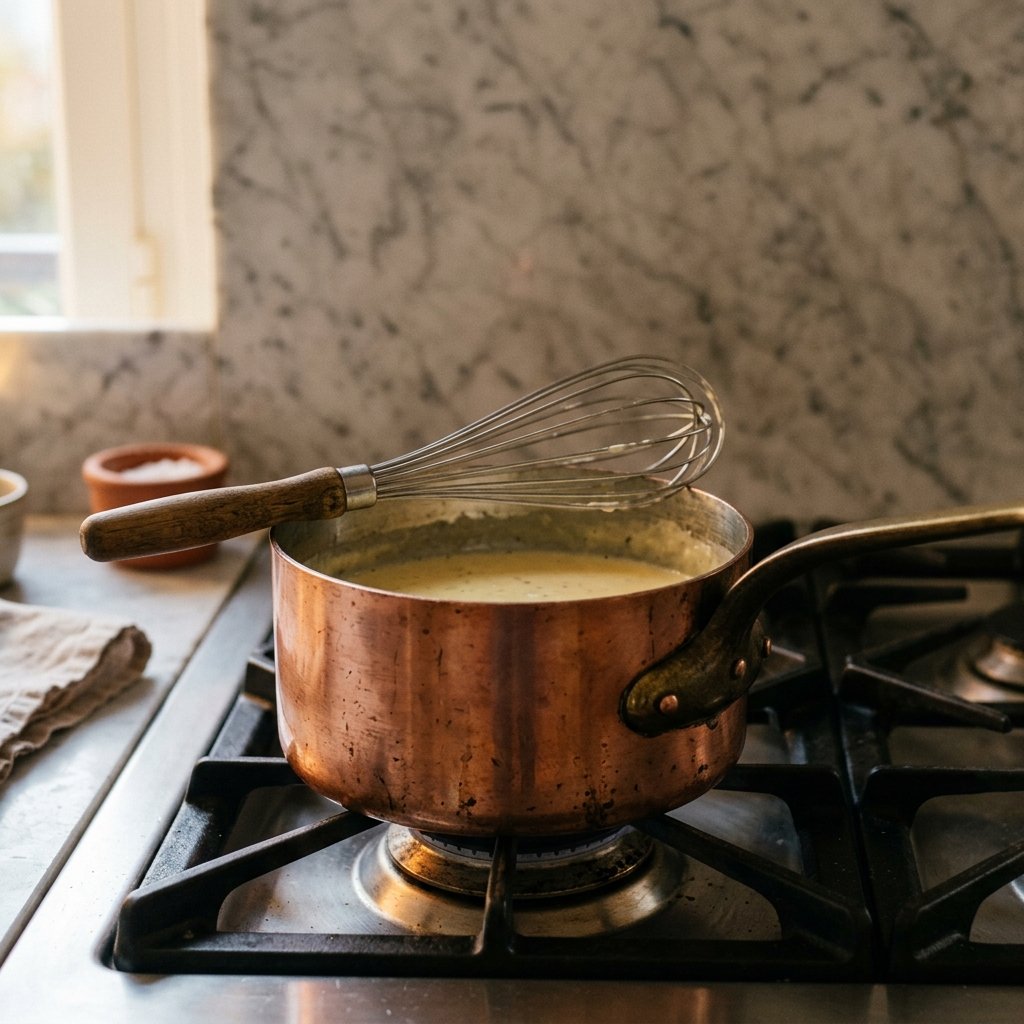
Copper saucier with a bronze handle sits on a gas range in a French kitchen.
What Escoffier Took From the Army
Auguste Escoffier cooked for the Army of the Rhine during the Franco Prussian War of 1870, and the army's structure shaped how he ran kitchens afterward. In the 1890s, at the Savoy in London, he split his cooks into stations. Each station had one job and a rank, and the rank names survive in restaurant kitchens today, sous chef and commis among them. Before that, the kitchens of large houses were divided loosely by type of food and, by most accounts, ran on disorder and duplicated work.
Dinner had also moved to service by the course. Each dish went out on its own instead of the whole spread arriving at once. A kitchen that has to build the next dish while the last one is being eaten has to divide the labor, and the brigade is that division. In 1903 he published Le Guide Culinaire. It ran to more than five thousand recipes and set out to fix French cooking in place.
The Sauce Cook and the Copper
The saucier makes the sauces and plates the dishes that carry them, and the job has a paper trail. Marie Antoine Carême sorted French sauces into four families in the early 1800s. Escoffier reworked the list. He added hollandaise and tomato and moved allemande down to a branch of velouté. That left five: béchamel, velouté, espagnole, hollandaise and tomate.
The pan for that work comes from Normandy. Villedieu-les-Poêles, a town near Mont-Saint-Michel, has worked copper since the twelfth century, when knights returning from the Crusades settled there and brought the trade with them. The name translates roughly as God's city of the pans. Copper moves heat far faster than stainless steel, so the pan answers when the flame drops. That matters for hollandaise and beurre blanc, which break when overheated. One Villedieu maker's main lines use walls between 1.5 and 2.5 millimeters. The thicker walls hold heat longer.
The townspeople are called Sourdins, from the French for deaf. The usual explanation is a workforce deafened by hammering, and one dictionary offers a local river named the Sourde as a rival theory.
The Workshops Still Open
Villedieu's copper trade has thinned, and it has not ended. One workshop there, founded in 1850, still hammers and tins copper by hand. It makes pieces to order, and in 2013 it shipped a bathtub to New York that took 250 hours of labor. Normandy's tourism board bills it as the last copper workshop in France, though a second maker has worked in the same town since 1830.
One Cook Doing Every Job
A home kitchen has one cook, so the whole brigade collapses into a single person walking between stations. What survives is the part Escoffier settled, which was who owns which job before service starts. When I look at a kitchen for someone who cooks seriously, I look for two of those places first: where the sauce gets made, and where the plate gets finished. I would take a small kitchen with clear stations over a large one where every job happens everywhere.
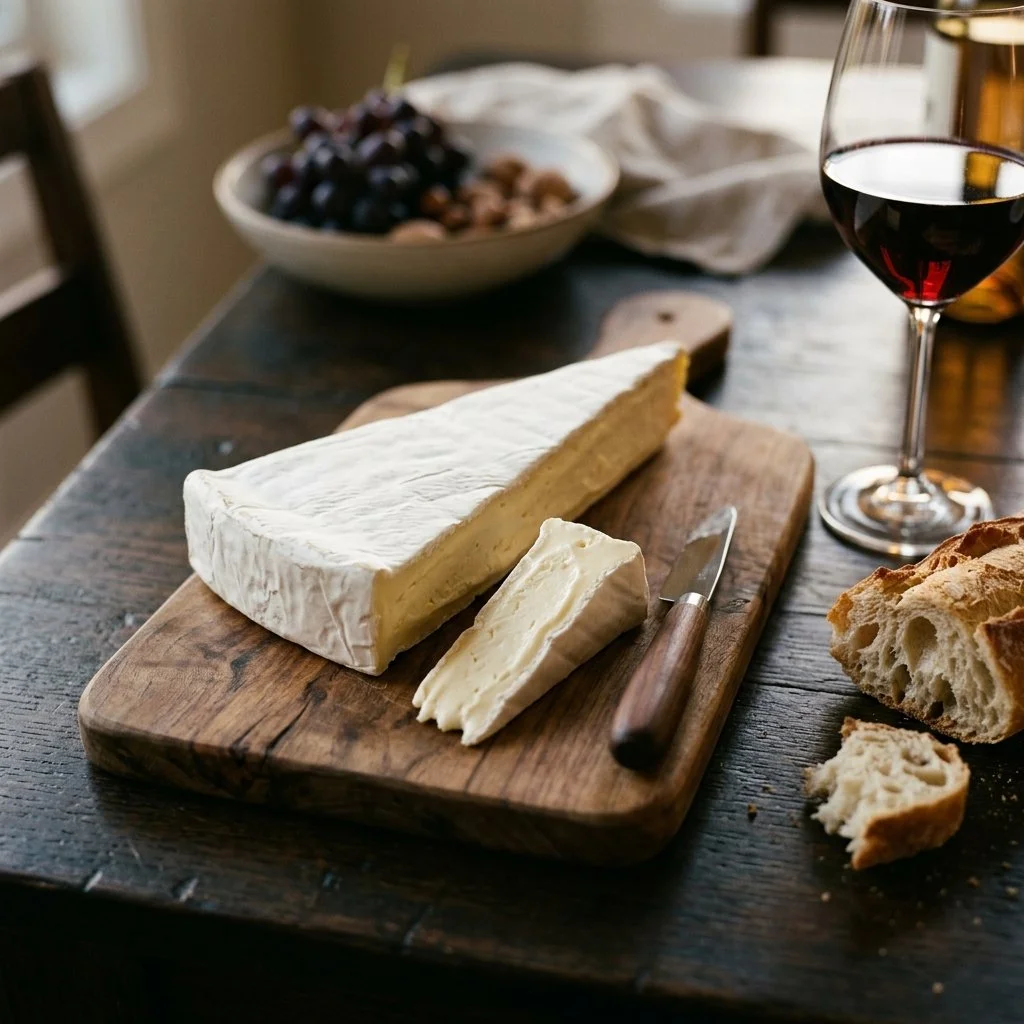
A wedge of Brie rests on a rustic wooden board alongside a freshly sliced piece, torn baguette, and a glass of red wine.
Cheese Before Dessert
One course in the UNESCO order needs no cooking at all. Cheese comes out on its own, before dessert, and the work happens an hour earlier, when someone takes it out of the fridge so the flavor can open. Slicing ahead is out, because cut faces dry. Each guest cuts according to the shape of the cheese, and the rule that survives every dinner is that nobody cuts the nose off a wedge. The tip of a Brie wedge is the best part, and taking it for yourself is a known offense.
Copper From Villedieu-les-Poêles
The order of a French meal and the station logic of a French kitchen cost nothing to borrow. The pan is different, because it comes from somewhere specific. If a client wants French copper, I'd send them to Villedieu-les-Poêles itself. Both workshops take visitors and have a shop on site, and one makes to order, so a designer can ask about a commission in person.
How a Swedish House Gets Through the Dark
At the winter solstice, Stockholm gets a little over six hours of daylight. The sun comes up shortly before nine and is gone before three. Sweden answered that with what it had, and most of it came out of a forest and a mine.
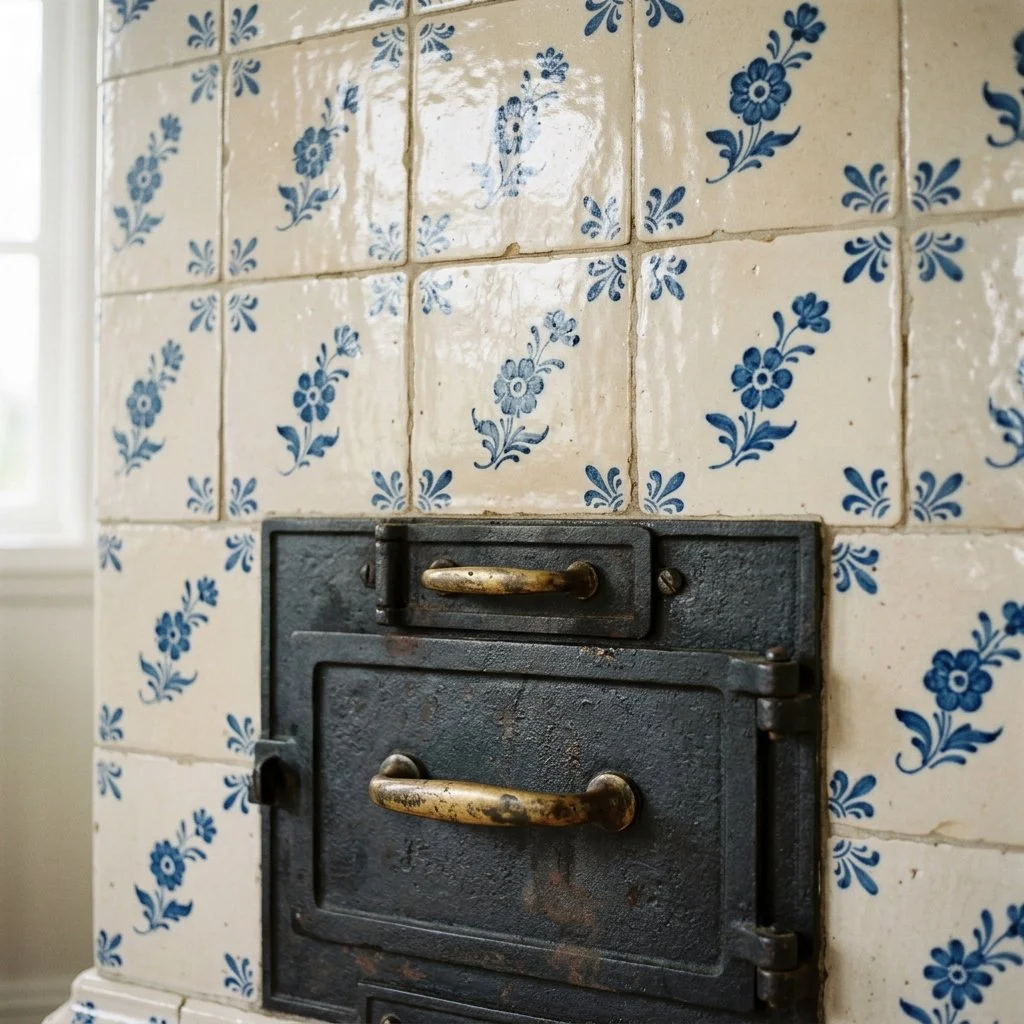
Cream glazed Swedish stove tiles with hand painted blue flowers, featuring two dark cast iron doors with worn brass handles.
A Stove Built for a Wood Shortage
By the eighteenth century Sweden's iron industry had used up so much wood that firewood ran short, and the country heated its rooms with tiled stoves that burned a lot of it. The tiled stove was not Swedish. It came up from southern Germany in the late Middle Ages, and the early ones lost much of their heat straight up the chimney.
A kakelugn is a tall brick stove covered in glazed ceramic tiles. In 1767 the architect Carl Johan Cronstedt, working with Fabian Wrede, presented a redesign. The smoke now ran through winding channels inside the brick, so the brick and the tiles took the heat that used to escape up the chimney and gave it back to the room slowly. One fire could keep a room warm for ten to twelve hours.
The tiles were also decoration. They were painted by hand with flowers and patterns to match the room, and Stockholm's Marieberg works on Kungsholmen, open from 1758 to 1788, made some of the most luxurious.
Central heating replaced them. Many stoves were torn out and thrown on the dump, and the removals went on into the 1980s. Stoves that have to go are taken out carefully now, and a few ceramists restore them and build new ones on the same principle.
One Mine Under the Brass and the Red Paint
In 1607 King Karl IX founded a brass works at Skultuna, outside Västerås, and the works say the copper mine at Falun supplied its raw material. Falun was then the largest copper mine in Europe. Sweden had run up debts to the Hanseatic League, and refining copper into brass meant fewer imports and more to sell. Among the first things the works made were chandeliers and candlesticks, and the oldest Skultuna chandelier that survives is dated 1619. The works are still there and hold a royal warrant.
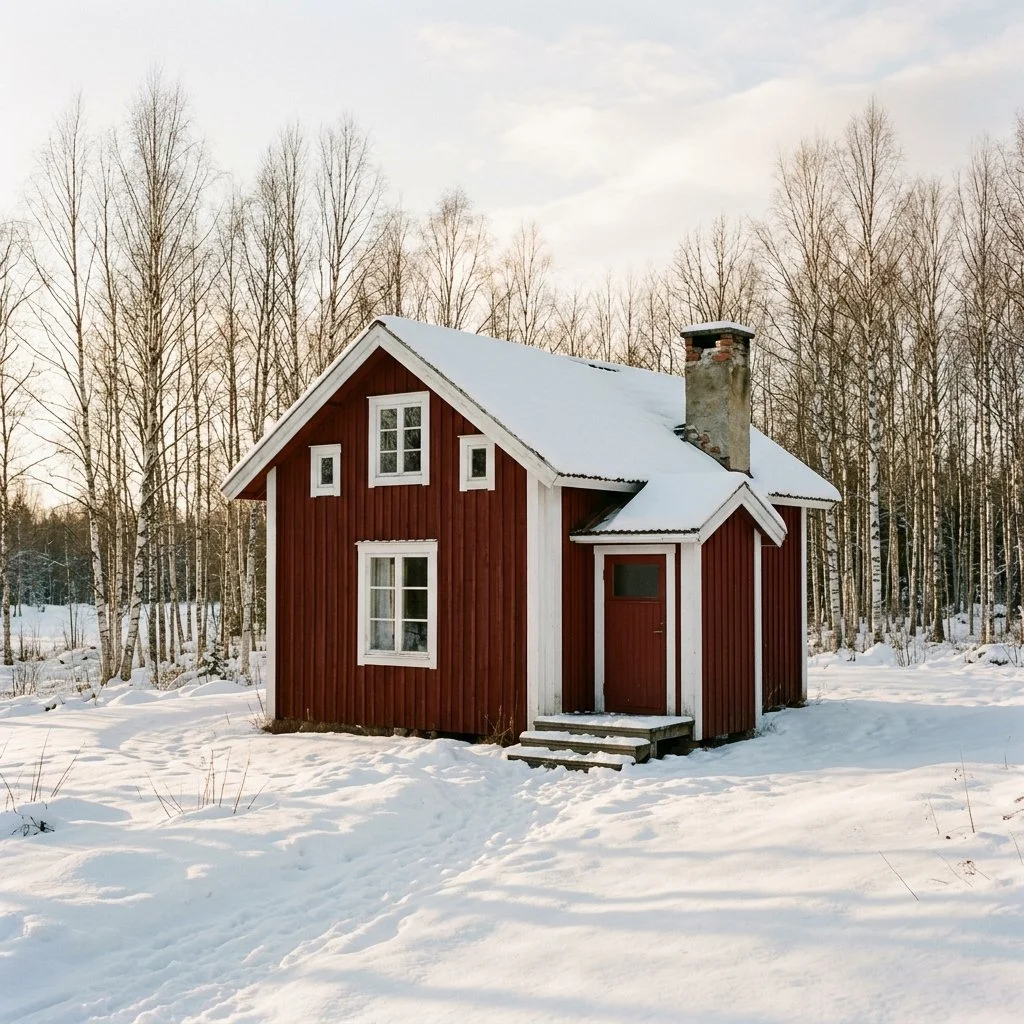
The same mine gave Sweden its red. By the sixteenth century the waste heaps had weathered into a red sludge, and heated and mixed with linseed oil and rye flour it made an excellent paint for wood. The paint company says King Johan III had the roofs of his Stockholm palace painted with it in 1573, and by 1764 the mine was making it on an industrial scale.
Timber house with white trim stands in a snow covered landscape framed by bare birch trees.
Glass Made Where the Wood Was
Kosta, the oldest glassworks still running in Sweden, was founded in 1742 by two officers who had served in Charles XII's army, on the site of an old ironworks. Some of the first workers came from Thuringia. Småland had the forest to feed the furnaces and sand in the ground, and at its peak the region had 45 glassworks. For its first 150 years Kosta made mostly plain utility glass, window panes among it. The region is called the Kingdom of Crystal now, and the regional tourist board counts thirteen glassworks and studio hot shops there. The big factory at Kosta is one. Some of the smallest have one or two glassmakers who also design their own work.
Made From What Sweden Had
The forest ran short and the mine lasted a thousand years, and each of these objects has a maker you can find. If I were sourcing any of it, I would start with the stove. A kakelugnsmakare is a maker of tiled stoves, and a few ceramists restore old stoves and build new ones on the eighteenth century principle. Glass comes from Småland, where the glassworks and studio hot shops of the Kingdom of Crystal let you stand next to the furnace. Skultuna is the address for brass. If a specification calls for Falu red, check the tin. Falu Rödfärg is a protected name for paint made with pigment from the Falun mine, and plain rödfärg can be any red iron oxide paint made with flour.
What Greek Food Is Stored and Cooked In
Greek kitchens reflect a slower rhythm of living, where meals are shared and materials are natural. This journal entry explores how Mediterranean traditions shape rustic ceramics, olive wood tools, and linen textures within timeless coastal interiors.
A Cretan household kept its oil and wine in a jar from Thrapsano. A Sifnian household baked its Sunday chickpeas overnight in a pot from Sifnos. Both objects came from village potters who worked by hand and went to their customers. This piece covers how those two villages made their pots and where their potters work today.
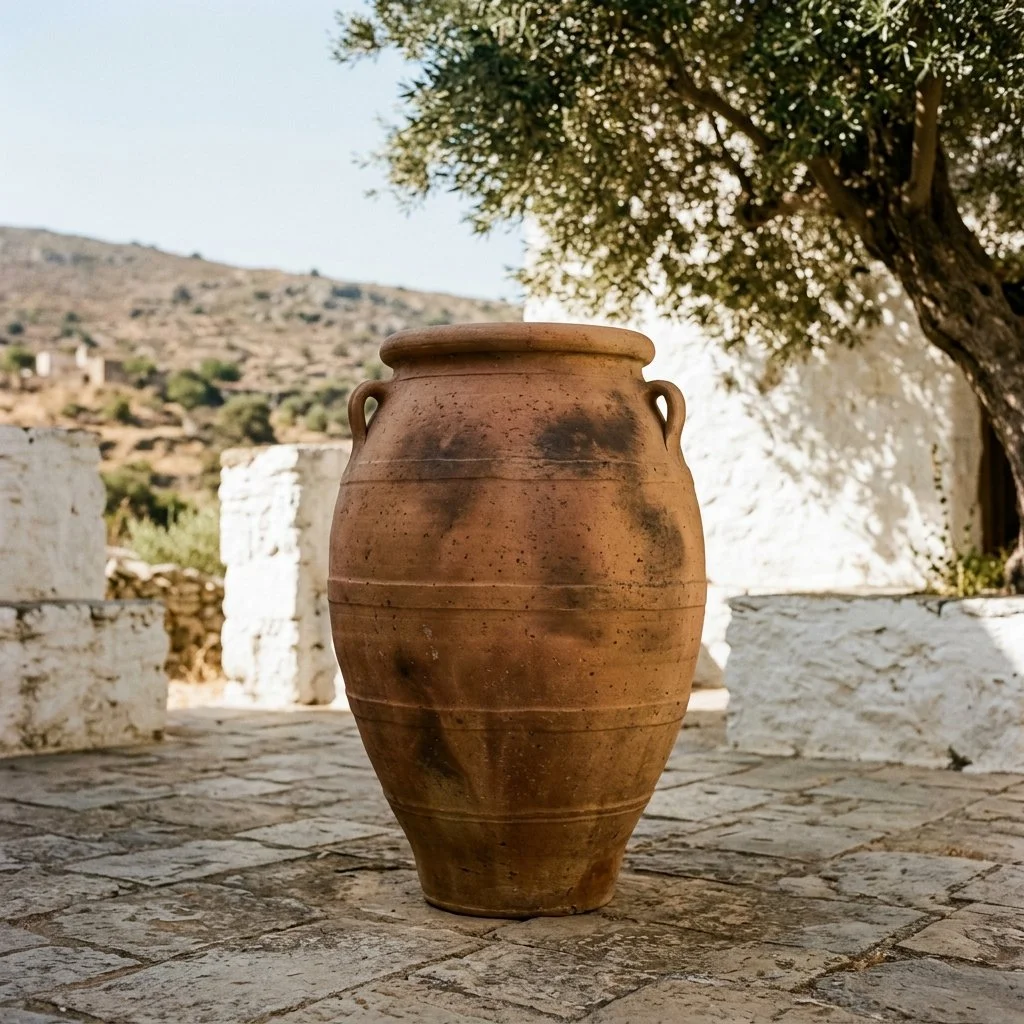
A large, unglazed Cretan terracotta storage jar with subtle coil marks and dark fire charring.
Building a Thrapsano Jar
The West Magazines at Knossos are nineteen long storerooms that once held an estimated four hundred giant jars, about a hundred and fifty of which survive. The Cretan Ethnology Museum says wine has been kept in jars like them since Minoan times, and it shows one made by Thrapsano potters in the sixteenth century. Thrapsano is a village about thirty kilometers from Heraklion, and for generations its men built storage jars by hand and sold them across much of the island.
A large jar went up in six sections: the base, the first brim, the round brim, the straight brim, the big brim and the lip. Each section had to dry before the next was added. One jar took about sixty kilograms of clay. The jars sat on a low turntable that one member of the guild turned by hand while the master built, and the turntable could not spin evenly. Maria Voyatzoglou recorded the method in the Penn Museum's Expedition magazine in 1974 and noted that a jar made this way is necessarily asymmetrical. After the kiln, the jar was filled with water and left for at least a month, until the walls became watertight.
A wine jar had a small hole low on the side for tapping and a clay lid over the mouth. Jars like it were in use until the middle of the twentieth century. Thrapsano's tourism pages call its potters the successors of the Minoans. The museum's sixteenth century jar is the oldest attributed to the village that I found. One oil jar in the Cretan Ethnology Museum carries its potter's name and village, pressed into the clay with a cylinder seal.
The Village That Was Supposed to Stop
In the old system the workshop moved to the clay. The season ran May 21 through September 14. Guilds of six left Thrapsano in different directions and set up wherever a rented field had clay and water. One member of each guild cut the firewood. They built a kiln and sold the jars they made to the district around them. About 180 of those seasonal kilns have been found across the island.
By 1974 only about ten master potters were left in the village, and three of them still made jars. Voyatzoglou expected no one in Thrapsano to carry the craft on. It carried on anyway. Family potteries on the edge of the village now build large unglazed jars from red clay and fire them in kilns fed with compressed olive pits. A potter who visited in 2018 found mostly family businesses and sons learning the trade. The clay now arrives crushed in sacks, where the guilds once dug their own.
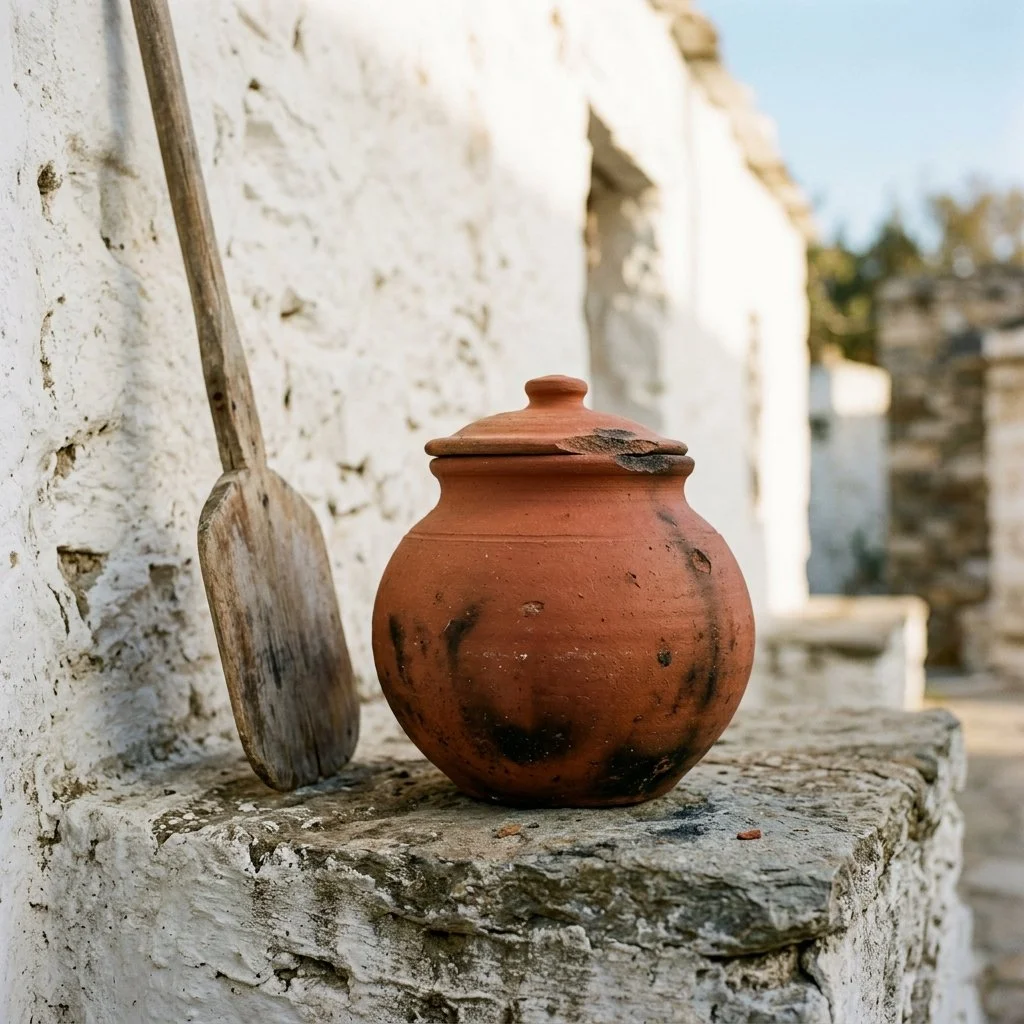
Round bellied red clay cooking pot with a small lid on a stone ledge.
The Pot Sifnos Exported
Sifnos is a small island in the western Cyclades. Pottery finds from the Middle Cycladic period, about 2000 to 1500 BC, are the earliest the Sifnos Pottery Museum records there, and the potters still prepare their own red clay, which stands up to fire. Their cooking pot, the tsoukali, was the main pot in Sifnian kitchens and the island's main export. The workshops became known as tsikalaria, and the island's name became tied to the pot. The museum records Tournefort, a French botanist, as the first to write about the pots, in the early eighteenth century.
Potters carried the trade with them. From the nineteenth century they sold across the nearby islands and farther, and the museum says a potter was called a Sifnios on many islands even when he came from somewhere else. The museum also records the first permanent Sifnian potter in Attica, Angelos Paleos, at Maroussi in 1833.
Sifnians still cook in the pot. Revithada, a chickpea stew, is baked overnight in a clay pot, and the mastelo is a large baking dish for the Easter lamb, made for wood ovens. The traditional potters throw on a wheel with simple tools, so a Sifnos pot is thrown where a Thrapsano jar is coiled.
Potters at Thrapsano and Sifnos
Households across Crete and much of the Aegean were stocked from villages like these. Both places still have working potters. The family potteries at the edge of Thrapsano make large unglazed jars in the traditional shapes, and the village holds a pottery festival every July with jar building demonstrations. Sifnos has potteries in Vathi and Kamares. A potters' association was founded there in 2001, and Artemonas has a pottery museum and hosts a gastronomy festival every September that includes pottery demonstrations.
If I were specifying one object from either place for a house, I would start with the Thrapsano jar. I did not confirm which potters take commissions or ship abroad, and the Sifnos Pottery Museum, which lists a contact address, is where I would begin asking.