What Greek Food Is Stored and Cooked In
A Cretan household kept its oil and wine in a jar from Thrapsano. A Sifnian household baked its Sunday chickpeas overnight in a pot from Sifnos. Both objects came from village potters who worked by hand and went to their customers. This piece covers how those two villages made their pots and where their potters work today.
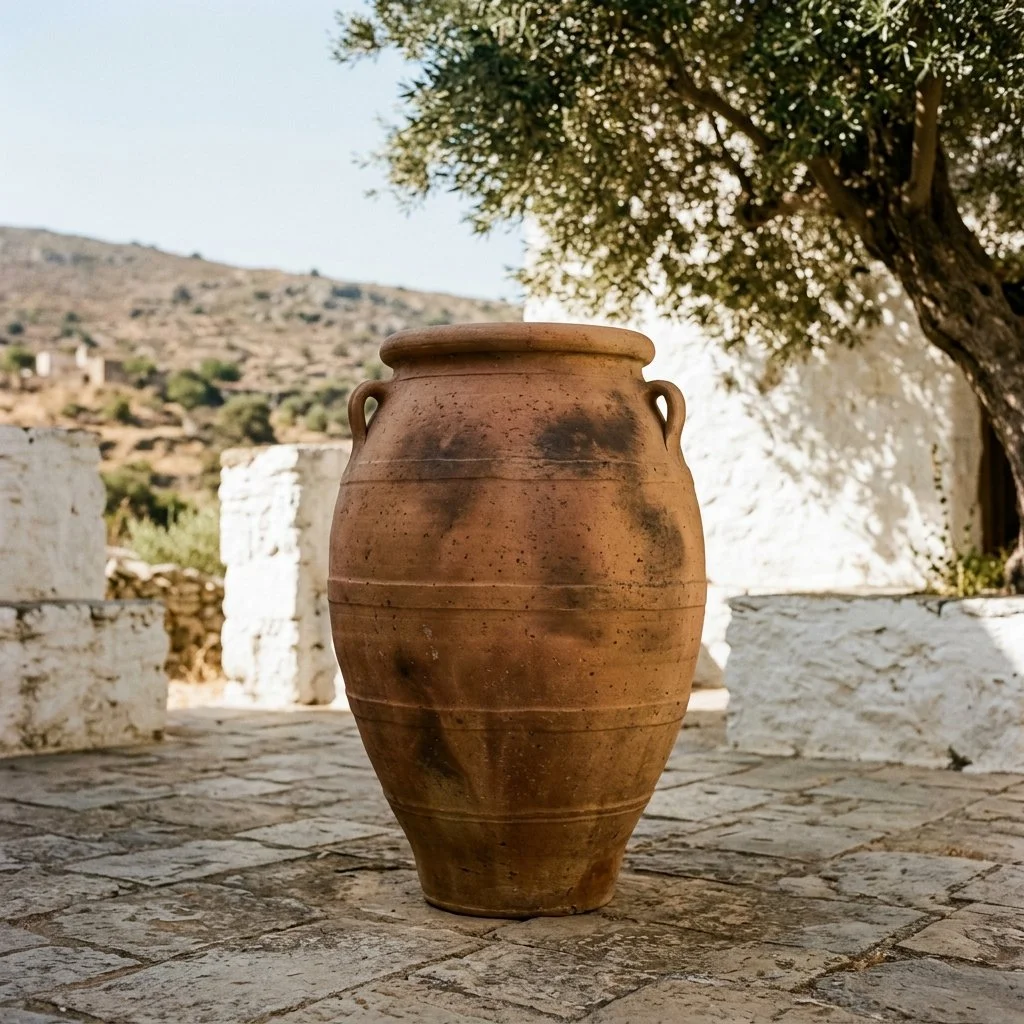
A large, unglazed Cretan terracotta storage jar with subtle coil marks and dark fire charring.
Building a Thrapsano Jar
The West Magazines at Knossos are nineteen long storerooms that once held an estimated four hundred giant jars, about a hundred and fifty of which survive. The Cretan Ethnology Museum says wine has been kept in jars like them since Minoan times, and it shows one made by Thrapsano potters in the sixteenth century. Thrapsano is a village about thirty kilometers from Heraklion, and for generations its men built storage jars by hand and sold them across much of the island.
A large jar went up in six sections: the base, the first brim, the round brim, the straight brim, the big brim and the lip. Each section had to dry before the next was added. One jar took about sixty kilograms of clay. The jars sat on a low turntable that one member of the guild turned by hand while the master built, and the turntable could not spin evenly. Maria Voyatzoglou recorded the method in the Penn Museum's Expedition magazine in 1974 and noted that a jar made this way is necessarily asymmetrical. After the kiln, the jar was filled with water and left for at least a month, until the walls became watertight.
A wine jar had a small hole low on the side for tapping and a clay lid over the mouth. Jars like it were in use until the middle of the twentieth century. Thrapsano's tourism pages call its potters the successors of the Minoans. The museum's sixteenth century jar is the oldest attributed to the village that I found. One oil jar in the Cretan Ethnology Museum carries its potter's name and village, pressed into the clay with a cylinder seal.
The Village That Was Supposed to Stop
In the old system the workshop moved to the clay. The season ran May 21 through September 14. Guilds of six left Thrapsano in different directions and set up wherever a rented field had clay and water. One member of each guild cut the firewood. They built a kiln and sold the jars they made to the district around them. About 180 of those seasonal kilns have been found across the island.
By 1974 only about ten master potters were left in the village, and three of them still made jars. Voyatzoglou expected no one in Thrapsano to carry the craft on. It carried on anyway. Family potteries on the edge of the village now build large unglazed jars from red clay and fire them in kilns fed with compressed olive pits. A potter who visited in 2018 found mostly family businesses and sons learning the trade. The clay now arrives crushed in sacks, where the guilds once dug their own.
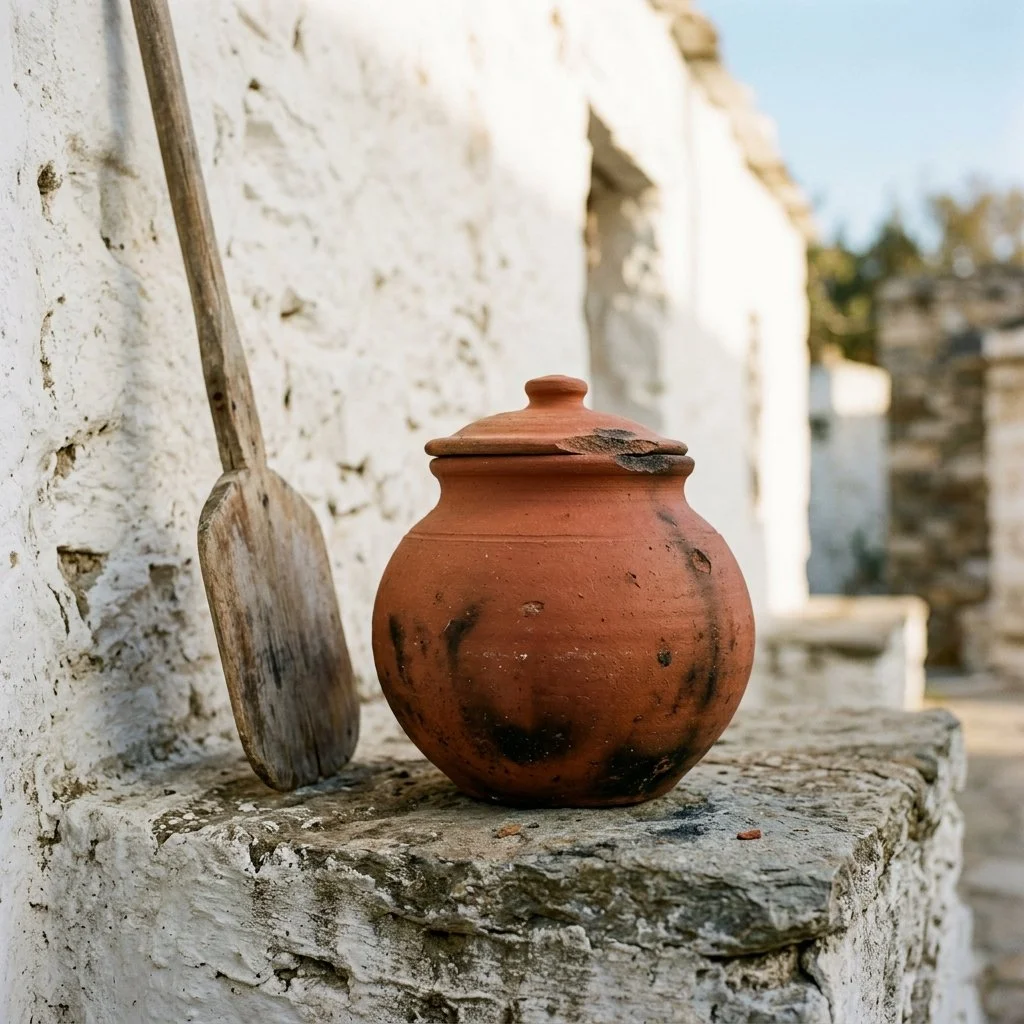
Round bellied red clay cooking pot with a small lid on a stone ledge.
The Pot Sifnos Exported
Sifnos is a small island in the western Cyclades. Pottery finds from the Middle Cycladic period, about 2000 to 1500 BC, are the earliest the Sifnos Pottery Museum records there, and the potters still prepare their own red clay, which stands up to fire. Their cooking pot, the tsoukali, was the main pot in Sifnian kitchens and the island's main export. The workshops became known as tsikalaria, and the island's name became tied to the pot. The museum records Tournefort, a French botanist, as the first to write about the pots, in the early eighteenth century.
Potters carried the trade with them. From the nineteenth century they sold across the nearby islands and farther, and the museum says a potter was called a Sifnios on many islands even when he came from somewhere else. The museum also records the first permanent Sifnian potter in Attica, Angelos Paleos, at Maroussi in 1833.
Sifnians still cook in the pot. Revithada, a chickpea stew, is baked overnight in a clay pot, and the mastelo is a large baking dish for the Easter lamb, made for wood ovens. The traditional potters throw on a wheel with simple tools, so a Sifnos pot is thrown where a Thrapsano jar is coiled.
Potters at Thrapsano and Sifnos
Households across Crete and much of the Aegean were stocked from villages like these. Both places still have working potters. The family potteries at the edge of Thrapsano make large unglazed jars in the traditional shapes, and the village holds a pottery festival every July with jar building demonstrations. Sifnos has potteries in Vathi and Kamares. A potters' association was founded there in 2001, and Artemonas has a pottery museum and hosts a gastronomy festival every September that includes pottery demonstrations.
If I were specifying one object from either place for a house, I would start with the Thrapsano jar. I did not confirm which potters take commissions or ship abroad, and the Sifnos Pottery Museum, which lists a contact address, is where I would begin asking.