How a French Kitchen Got Its Order
In 2010, UNESCO added "the gastronomic meal of the French" to its list of intangible cultural heritage, and the entry does something unusual for a food listing. It names an order. The meal starts with an apéritif and ends with liqueurs. In between come at least four courses: a starter, fish or meat with vegetables, cheese, and dessert.
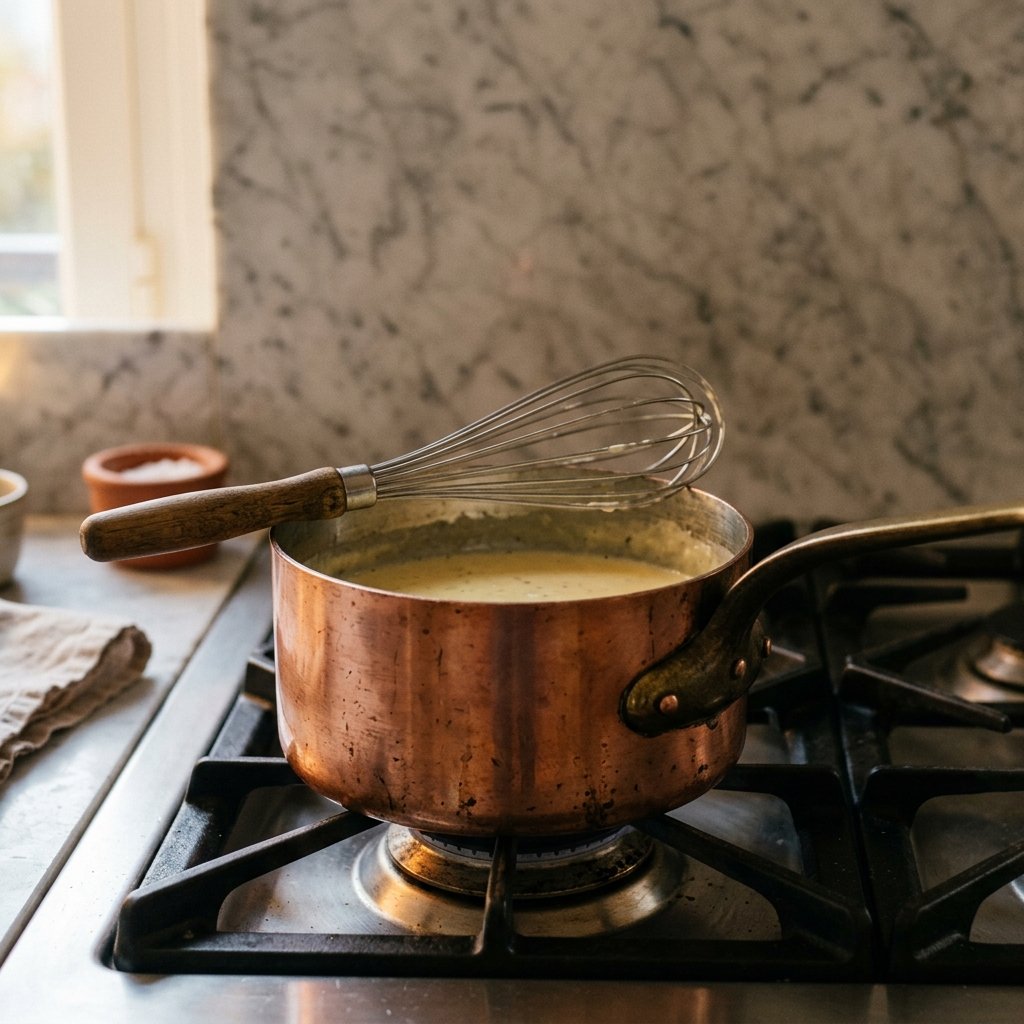
Copper saucier with a bronze handle sits on a gas range in a French kitchen.
What Escoffier Took From the Army
Auguste Escoffier cooked for the Army of the Rhine during the Franco Prussian War of 1870, and the army's structure shaped how he ran kitchens afterward. In the 1890s, at the Savoy in London, he split his cooks into stations. Each station had one job and a rank, and the rank names survive in restaurant kitchens today, sous chef and commis among them. Before that, the kitchens of large houses were divided loosely by type of food and, by most accounts, ran on disorder and duplicated work.
Dinner had also moved to service by the course. Each dish went out on its own instead of the whole spread arriving at once. A kitchen that has to build the next dish while the last one is being eaten has to divide the labor, and the brigade is that division. In 1903 he published Le Guide Culinaire. It ran to more than five thousand recipes and set out to fix French cooking in place.
The Sauce Cook and the Copper
The saucier makes the sauces and plates the dishes that carry them, and the job has a paper trail. Marie Antoine Carême sorted French sauces into four families in the early 1800s. Escoffier reworked the list. He added hollandaise and tomato and moved allemande down to a branch of velouté. That left five: béchamel, velouté, espagnole, hollandaise and tomate.
The pan for that work comes from Normandy. Villedieu-les-Poêles, a town near Mont-Saint-Michel, has worked copper since the twelfth century, when knights returning from the Crusades settled there and brought the trade with them. The name translates roughly as God's city of the pans. Copper moves heat far faster than stainless steel, so the pan answers when the flame drops. That matters for hollandaise and beurre blanc, which break when overheated. One Villedieu maker's main lines use walls between 1.5 and 2.5 millimeters. The thicker walls hold heat longer.
The townspeople are called Sourdins, from the French for deaf. The usual explanation is a workforce deafened by hammering, and one dictionary offers a local river named the Sourde as a rival theory.
The Workshops Still Open
Villedieu's copper trade has thinned, and it has not ended. One workshop there, founded in 1850, still hammers and tins copper by hand. It makes pieces to order, and in 2013 it shipped a bathtub to New York that took 250 hours of labor. Normandy's tourism board bills it as the last copper workshop in France, though a second maker has worked in the same town since 1830.
One Cook Doing Every Job
A home kitchen has one cook, so the whole brigade collapses into a single person walking between stations. What survives is the part Escoffier settled, which was who owns which job before service starts. When I look at a kitchen for someone who cooks seriously, I look for two of those places first: where the sauce gets made, and where the plate gets finished. I would take a small kitchen with clear stations over a large one where every job happens everywhere.
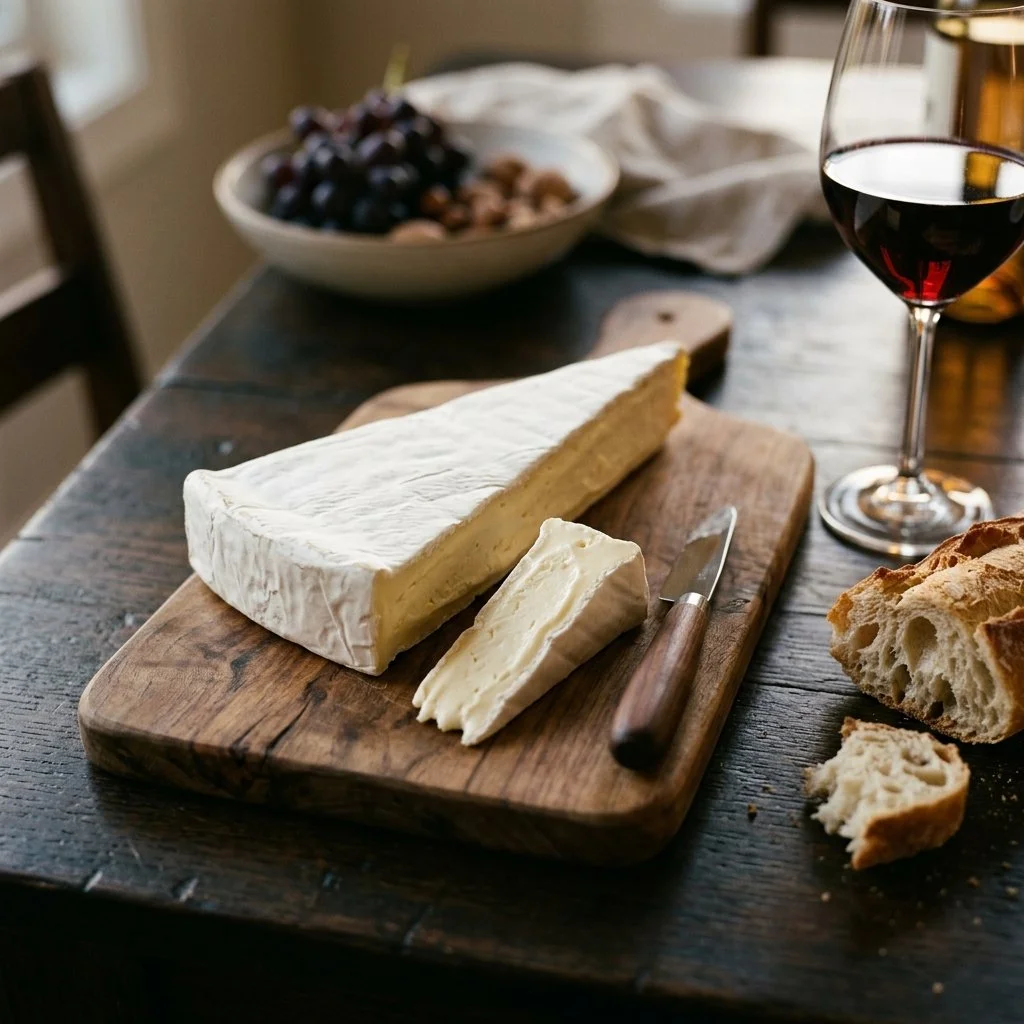
A wedge of Brie rests on a rustic wooden board alongside a freshly sliced piece, torn baguette, and a glass of red wine.
Cheese Before Dessert
One course in the UNESCO order needs no cooking at all. Cheese comes out on its own, before dessert, and the work happens an hour earlier, when someone takes it out of the fridge so the flavor can open. Slicing ahead is out, because cut faces dry. Each guest cuts according to the shape of the cheese, and the rule that survives every dinner is that nobody cuts the nose off a wedge. The tip of a Brie wedge is the best part, and taking it for yourself is a known offense.
Copper From Villedieu-les-Poêles
The order of a French meal and the station logic of a French kitchen cost nothing to borrow. The pan is different, because it comes from somewhere specific. If a client wants French copper, I'd send them to Villedieu-les-Poêles itself. Both workshops take visitors and have a shop on site, and one makes to order, so a designer can ask about a commission in person.