What Korean Tableware Is Made Of
A stone bowl of rice reaches a Korean table still crackling. The rice at the bottom is cooking against hot stone. The flavors of the meal started months earlier in a clay jar, and the dish is not done until the person eating finishes it.
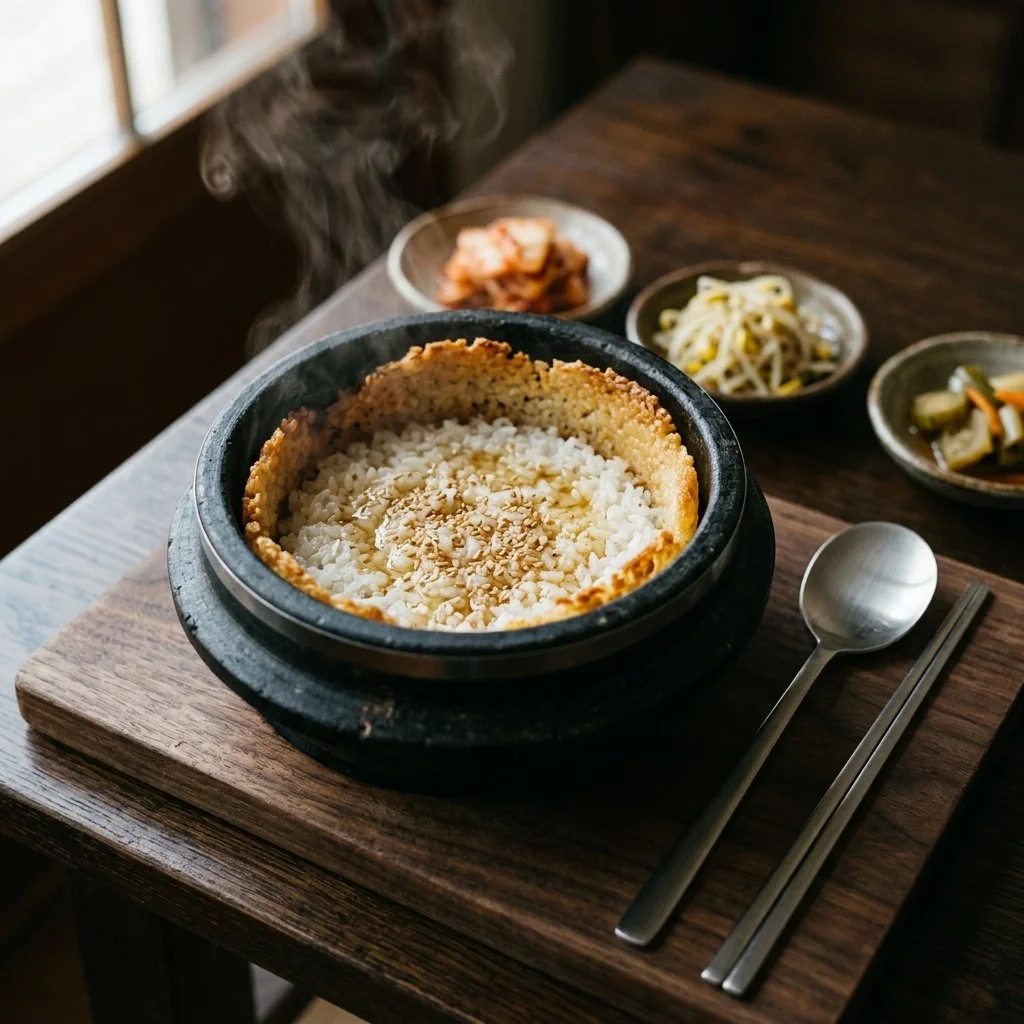
Black stone dolsot bowl filled with rice and a golden crisp crust, placed on a dark walnut board alongside steel utensils.
Months in the Yard
Korean cooking runs on fermentation, and the fermenting happens in onggi. Unglazed jars are fired at low temperatures, so the clay stays porous. Oxygen passes in and the liquid stays put. Glazed jars are coated in a dark brown mix of local clay and wood ash. Big jars sit in the yard or are buried, which is one way of controlling how fast the ferment runs. They hold the chili paste and soybean paste the cuisine is built on. Kimjang, the late autumn making of kimchi, went onto UNESCO's list of intangible cultural heritage in 2013.
Even the red in that chili paste has a disputed past. The usual account says the chili plant came from the Americas and reached Korea by way of Japan in the late 1500s. A Korean research team argues for a native pepper much older than that, and the question is still open.
The potters were often itinerant and worked at the edge of Korean society. Ralph Rinzler of the Smithsonian made a research trip in 1971 and likened the jars to the refrigerators found in every American home. The trade that produced them was barely documented outside Korea until then.
Heat That Stays on the Table
Retail listings often call a dolsot a granite bowl. I checked, and the Korean name says otherwise. Gopdolsot means agalmatolite pot, and agalmatolite is a soft stone that holds heat. The bowl keeps cooking the rice after it leaves the fire. Sesame oil goes into the hot bowl first and then the rice, and the bottom layer crisps against the stone. That crust is nurungji. In bibimbap, which means mixed rice, the spoon goes in hard to work the gochujang through the bowl and scrape up the crust. With plain rice the crust steeps into sungnyung, a hot infusion.
The king's table already had a fire on it: a pot heated by charcoal that usually held a casserole such as sinseollo. What changed is the fuel. Many restaurants in Korea now run hot pots and grilled meat on portable butane burners, and at those tables a canister does the work charcoal once did. In Seoul it sits between the guests, and they tend it themselves.
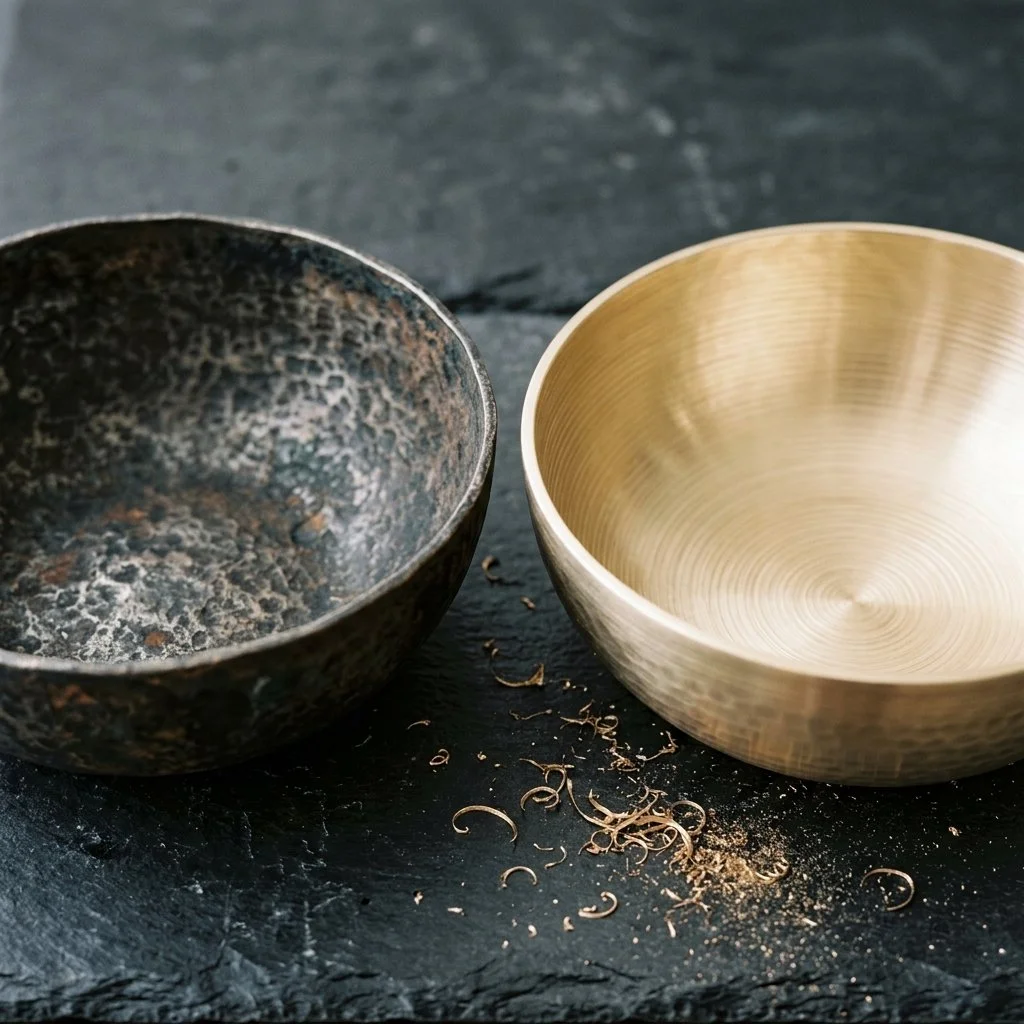
Two Korean bangjja bronze bowls, one raw and oxidized, the other shaved to a soft pale gold with visible lathe marks
In the Diner's Hand
Rice and soup go to each person, and the side dishes, banchan, sit in the middle to be shared. Whoever is eating builds each bite from them. Their number once carried rank, and the count, called cheop, leaves out kimchi. Nine cheop was as far as a noble family went, and twelve belonged to the king.
The tools for that work are metal. The oldest metal chopsticks on record in Korea came out of the tomb of King Muryeong of Baekje, who died in 523. There were two pairs, bronze and flat, each with a ring at the gripping end so a chain could join the two sticks. Korean has one word for the pair, sujeo, spoon and chopsticks together.
Before stainless steel, the metal for a fine table was bangjja, a bronze of 78 parts copper to 22 parts tin. A smith heats it and beats it over and over, tens of thousands of blows for a single piece. The finished piece goes into seawater, and the dark skin is shaved away to reach the bronze underneath. Royal tables used it, and South Korea designated the craft an Important Intangible Cultural Property in 1983. In 2022 Aesop planned a Chuseok display of work by Jiho Lee, the youngest of three generations of bangjja masters, in four of its Seoul stores. He uses a mechanized hammer for part of the work and keeps the method otherwise traditional.
The flat steel pair on a Seoul table today is much younger. It appeared in the 1960s, when Korea began making stainless steel at home, and it is flat because a pair cut from sheet metal was the cheapest shape to mass produce. The shape looks ancient, but it began as a manufacturing choice. It stayed because a meal with a dozen small dishes rewards a utensil that does not wear down and can pick up delicate food.
Who Still Makes the Table
The jar does its work over months, and the stone and the fire do theirs in front of you. The last step belongs to whoever is holding the spoon. The crafts behind the jar and the spoon are still active. Onggi come from potters in villages such as Oegosan, outside Ulsan. Anseong, in Gyeonggi Province, is one of the old brass centers, and its name became a Korean phrase for made to order, Anseong matchum. I did not find a maker for the stone bowl, so those two are the workshops I would send a designer to first.