What Holds Up a Good Sofa
In the 1820s, iron springs got cheap enough to put inside a couch or chair seat. A London maker named Samuel Pratt took out a patent on coil springs for couches and other seating in that decade. Upholsterers first set the coils in loose, and over time they shifted and slid out of place until the seat went lumpy. The fix was to stitch each spring to the webbing and tie the whole bed of them together with twine so they moved as one unit. That principle is the one showrooms now sell as eight way hand tied.
A sofa hides everything that decides how long it lasts. A showroom lets you judge the cover and the first minute of the sit. Everything structural sits under the fabric, and that is where I start.
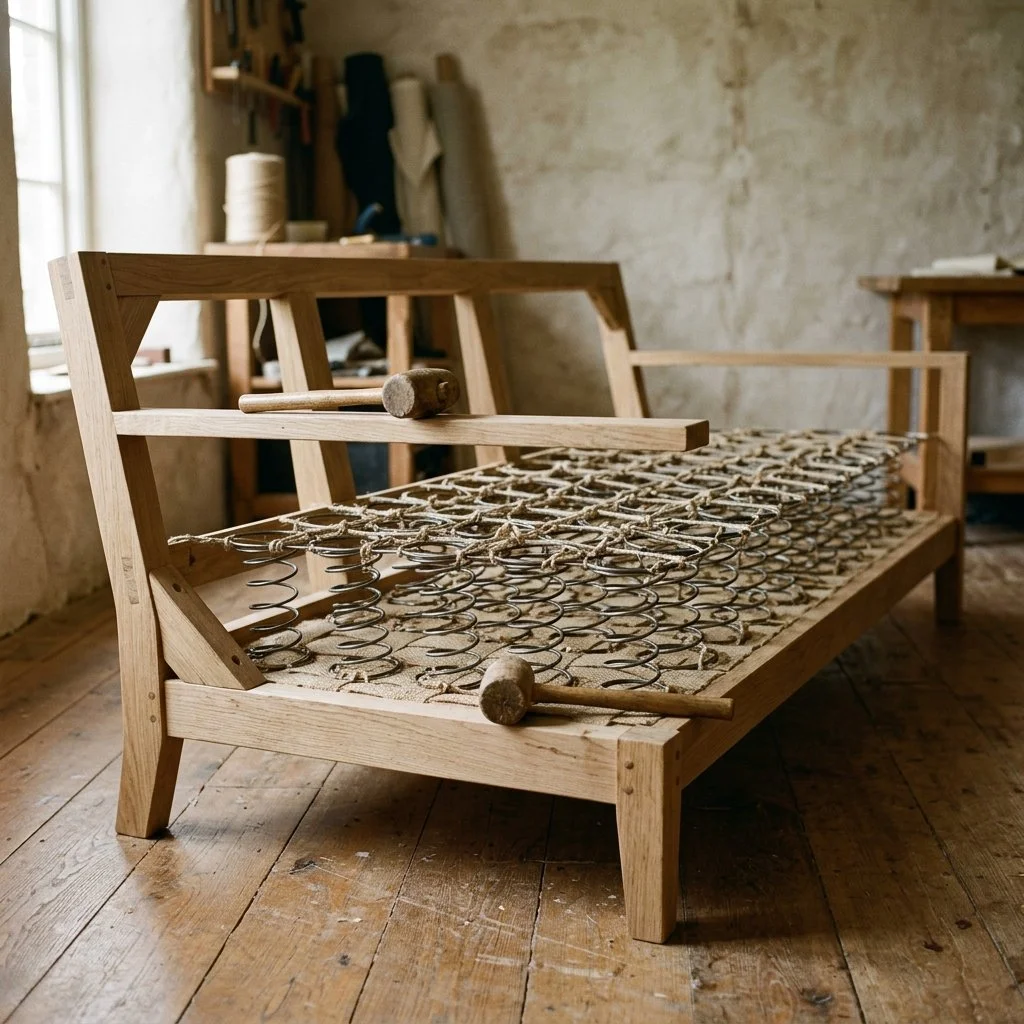
Bare hardwood sofa frame with coil springs tied together by hand with twine.
The Frame Has to Be Dry
Hardwood for furniture is kiln dried to a moisture content of 6 to 8 percent. Purdue's cooperative extension service describes that as the midpoint between the normal swings of indoor humidity. Wood dried to that point still moves with the seasons. Wood that went into the frame wetter keeps drying inside the finished sofa, where it shrinks and can warp, and a frame that shrinks pulls on every joint in it.
I expect the maker to name the hardwood, such as oak or maple. Then I ask how the corners are joined. Glued double dowels with corner blocks is the construction to look for. A frame held together by staples and nails alone will loosen under the plain work of people sitting down hard and standing up again.
Eight Directions of Twine
The eight in eight way hand tied counts the directions the twine runs, diagonals across the bed of coils included. It takes skilled labor and a lot of time, which is most of why it costs more.
The common alternative is sinuous spring, a heavy steel wire bent into a continuous S and run in rows that stretch front to back across the seat frame. It takes far less labor and shows up in most mid priced sofas. Upholsterers argue about how much longer hand tied really lasts, and that argument is not settled. The standard for a good sinuous system is clearer: 8 gauge wire, with tie wires running across the rows. For a sofa that gets sat on every day, hand tied is the suspension I ask for first.
What a Rub Count Measures
The number on a fabric's spec sheet comes from a machine. In the Martindale test, a disc of worsted wool travels over a stretched sample in a figure eight until two yarns break or the surface visibly changes. The machine stops to inspect every 5,000 rubs, so a fabric rated at 25,000 passed that mark and was not run through 30,000. Suppliers draw the lines differently. One major fabric house puts heavy residential use at 25,000 to 30,000, and for the sofa a family actually lives on, I don't go below 25,000.
In North America, Wyzenbeek is the usual standard, and it rubs the sample in a straight line back and forth. The residential figure there is 15,000 double rubs, and heavy duty starts at 30,000. No reliable formula converts one test into the other, so ask which machine produced the number you're looking at. Treat either one as a guide to where a fabric belongs. It cannot tell you how many years you'll get.
The Core and the Wrap
A good seat cushion is two materials with separate jobs. A foam core carries the weight and springs back when you stand up. A wrap of down or feathers around it gives the softer crown on top and the first inch of give.
Foam is specified by two numbers that get confused. Density is the weight of a cubic foot of the foam in pounds, and it is the usual guide to how long the foam holds its shape. Firmness is a separate figure called indentation load deflection, listed as ILD. The trade treats 1.8 pounds per cubic foot as the point where foam earns the phrase high density. The phrase gets used loosely enough that I ask for the actual number. Foam in more expensive residential furniture generally runs higher, around 2.2 to 2.5.
Your Legs Set the Seat Depth
Seat depth is ergonomics, and it depends on the person. The standard for sitting upright is 20 to 22 inches. Lounging starts around 23 and gets deep past 25, which suits taller people and leaves shorter ones with their feet off the floor. The test takes ten seconds. Sit all the way back. If your feet dangle, or the edge of the cushion presses behind your knees, the sofa is too deep for you, however it photographs.
Scale is the other half. Leave 30 to 36 inches for the main path through a room and about 18 between the sofa and the coffee table. Measure the doorways and the stairwell before you fall in love with a length.
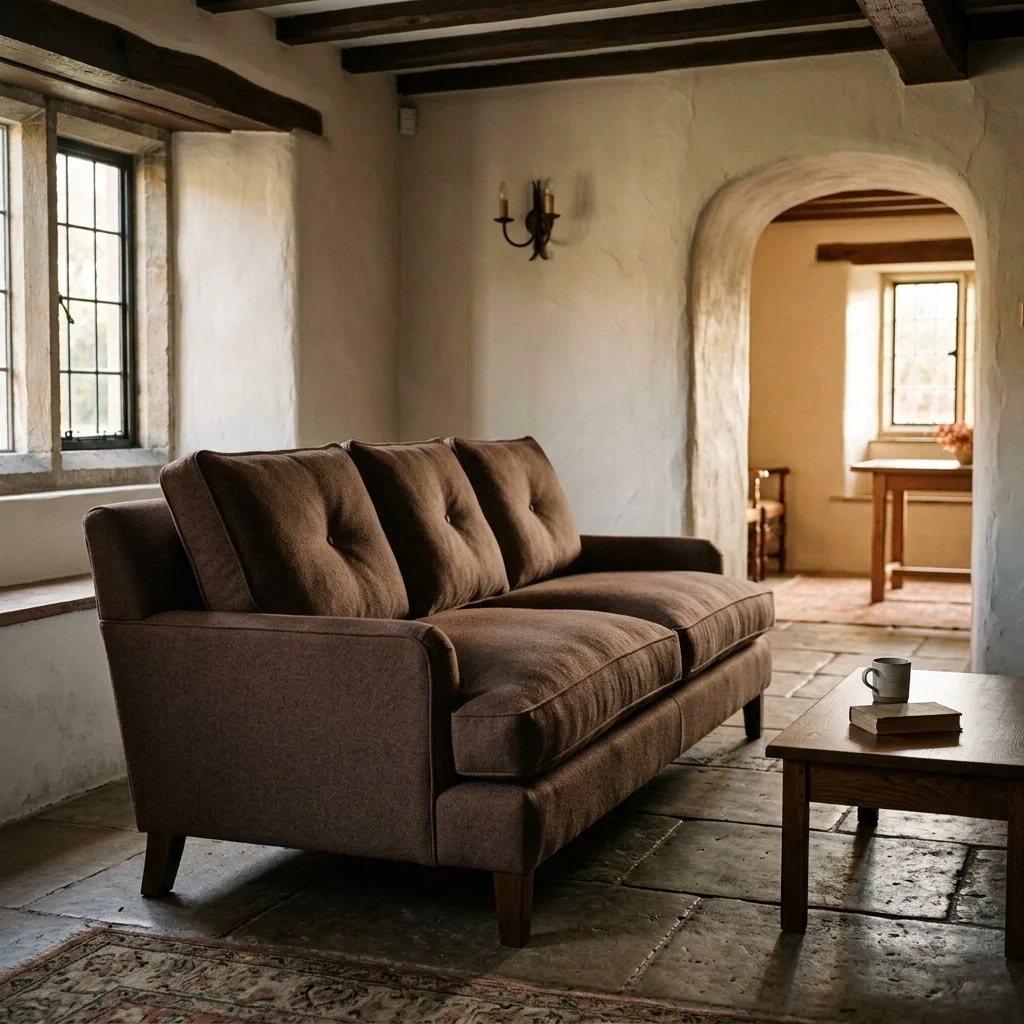
Upholstered sofa seen from the side.
Ready Made or Built for You
A ready made sofa from an established line has one great advantage. You can sit on the actual thing, and it arrives when they say it will. The tradeoff is that you get their dimensions and their range of covers, and depth is the dimension that matters most.
A custom sofa reverses that. You choose the dimensions and the cover, and you wait longer for it. Until it arrives the sofa exists as a written specification, so the specification has to name the wood, the suspension, the foam density, and the rub count. Ready made comes through a trade showroom or the maker's own floor. Custom comes from an independent upholstery workroom, and I would only commission from one that will show me a bare frame it has built.
The Weakest Layer Sets the Lifespan
The upholsterers who first tied their springs together were solving a problem of parts that didn't work as one, and a sofa still fails the same way. Its life is set by its weakest layer. A heavy duty fabric over springs that sag is money spent on the wrong layer. A well dried frame under thin foam gives you a good frame and a bad seat. When I compare two sofas, I compare the weakest layer of each and look at the cover last.