The Water That Runs the Day
Choosing the exact stone for a kitchen island or the right cut of oak for a floor can take weeks, and almost never with the same care for the material that actually keeps them alive. Water touches a person more directly than either one, and it usually gets less thought than the tile around it. The Intuitive System treats water as a designed layer of the house, the same way it treats light and air, not something that only gets attention when it runs low or looks strange.
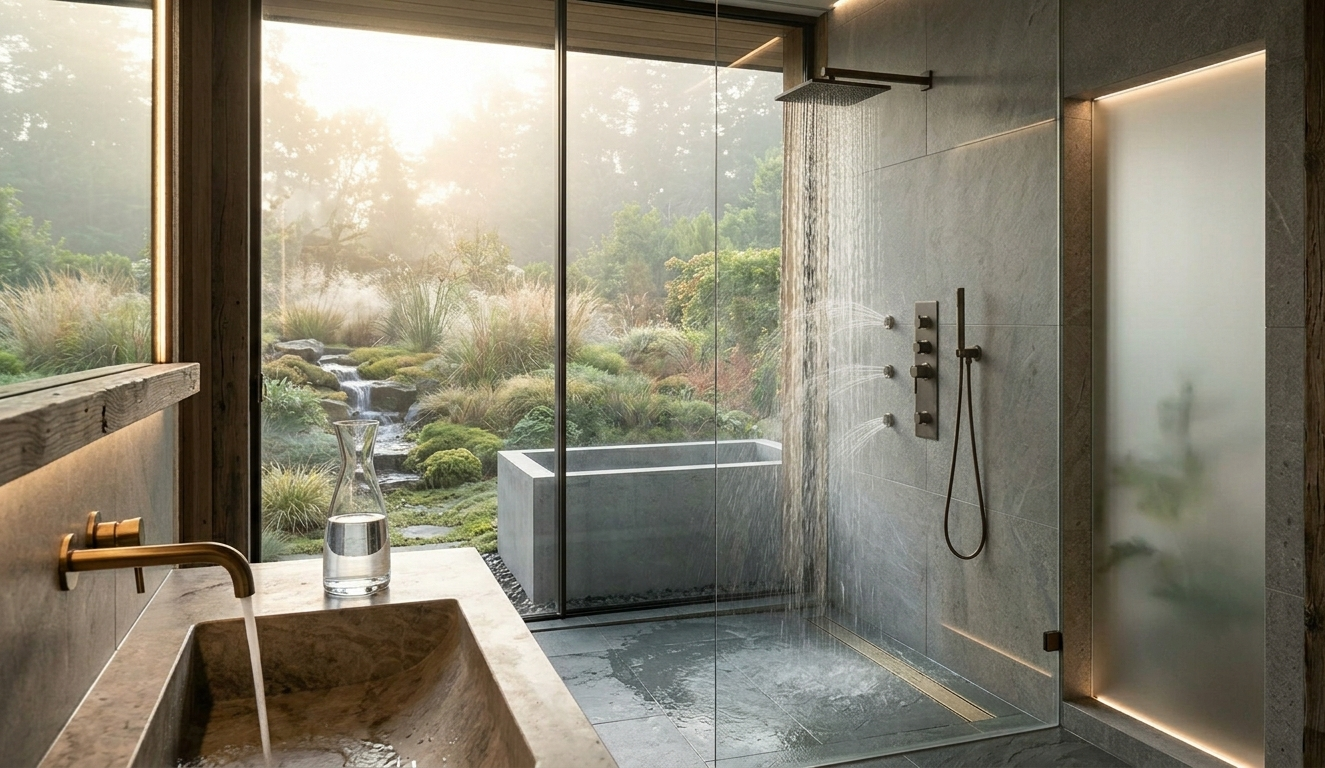
Integrated bathroom wet room, filtered water and a high flow multi jet shower.
What's Actually in the Water
Most whole house filtration is built around KDF-55, a copper zinc media that clears chlorine and dissolved heavy metals out of the water through a straightforward electron exchange. But a lot of municipalities have shifted from chlorine gas to chloramine as a disinfectant, because it holds up longer moving through pipes, and chloramine barely reacts to KDF media at all. I didn't realize how many houses have the whole house stage and skip the stage at the shower until someone explained what that gap actually means for chloramine specifically. A second filtration stage at the showerhead, using ascorbic acid, the same vitamin C people take for a cold, breaks chloramine down through an entirely different reaction. Skip that second stage and chloramine is still reaching skin every morning, whole house filter or not.
Drinking and cooking water usually go a step further, through reverse osmosis, which strips out nearly everything dissolved in it, including the calcium and magnesium that give water any flavor. A remineralization stage downstream of the membrane adds a small, controlled amount of those minerals back before the water reaches the tap, which is the real reason remineralization belongs in a filtration system rather than being a word attached to one.
Recovery Without a Dial
Wellness features that used to live at a spa are showing up in the primary suite now, and the market backs that up. The Global Wellness Institute puts the wellness real estate sector at roughly $584 billion in 2024, on a path toward $1.1 trillion by 2029, and separate luxury market research has found homes with real wellness infrastructure selling at a genuine premium over comparable homes without it. A cold plunge basin or a mechanically managed thermal soak isn't a novelty anymore. It's a specified system that holds an exact temperature and flow rate without anyone standing there to adjust a valve, which is exactly why it has to be planned into construction or a full remodel rather than added afterward.
What the House Manages on Its Own
Older leak protection relies on point sensors, small moisture pucks that have to actually get wet before they do anything. I used to think that was sufficient, until I saw how easily a slow leak inside a wall passes every one of those pucks by without touching one. A whole house, flow based valve works differently. It sits on the main line and learns what normal water use in that house looks like, so it can tell the difference between someone running a shower and water moving continuously through a pipe with nothing turned on. When it reads the second pattern, it shuts the water off on its own, which is what actually protects a floor or a ceiling from the kind of leak nobody notices until the finish is already ruined.
Water that's already been through real filtration doesn't need to just run down a drain once it's served its purpose. Routed underground through drip emitters buried six to ten inches below the surface, it reaches a plant's root zone directly, and the soil itself works as the final filter before anything moves deeper into the ground. There's no runoff and nothing lost to evaporation off a hot walkway.
Pumps and filtration hardware sit on mounts that isolate vibration, inside their own insulated utility room, so the mechanical side of all this stays out of the rooms people actually live in.
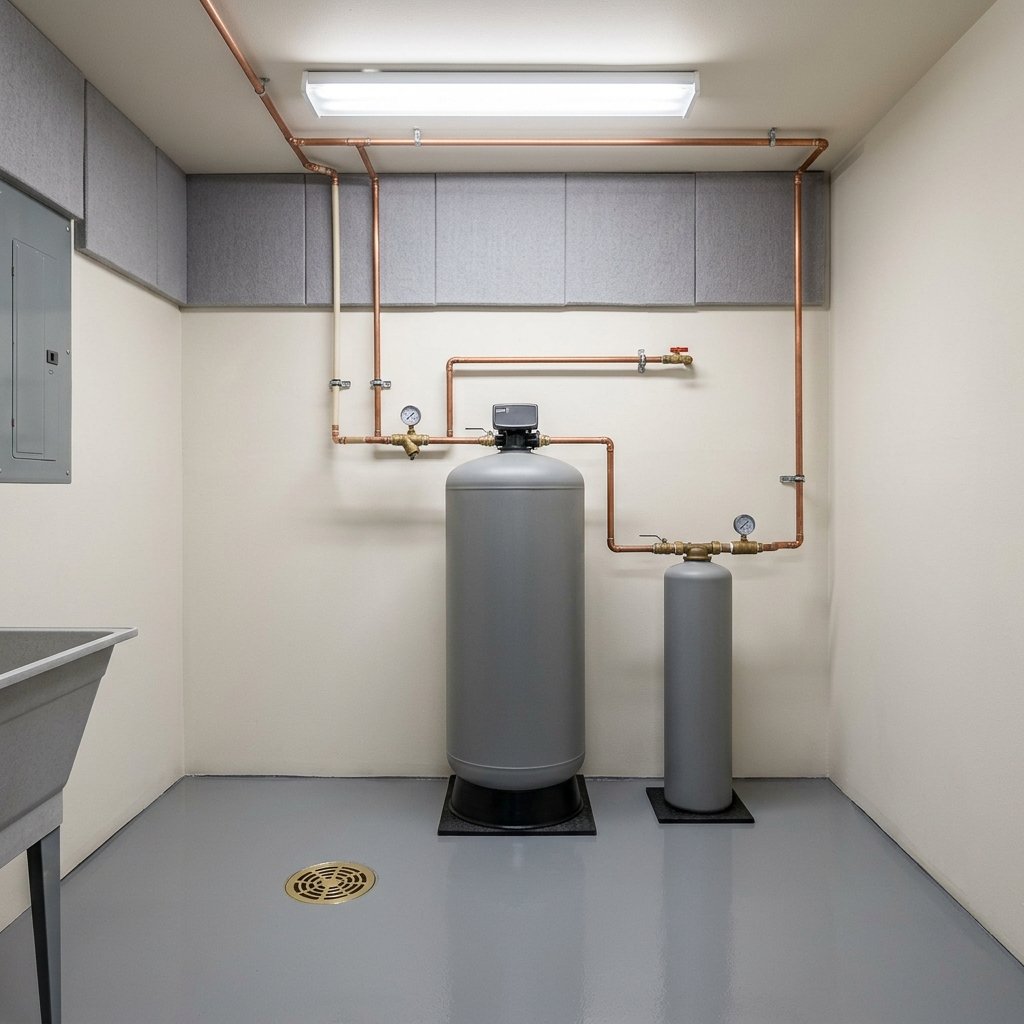
Mechanical utility room featuring a whole-house water filtration system and remineralization tank.
The Water That Doesn't Wait for the City
A private well used to be the default water source for most homes. It's showing up again now, deliberately, even on properties already connected to municipal water, because where local codes allow it, a well can serve as a genuine backup rather than the only source. The part that gets missed is the power behind it. A contractor pointed out that a working well and a dead well pump look identical from the yard, since the water's still down there either way. Most well pumps run on 220-volt service, and most portable backup generators only put out 110. Real water security during an outage needs either a generator sized to actually carry that pump or a small circuit built around solar panels and a battery, dedicated only to keeping the pump alive when the grid doesn't. That circuit gets planned in during construction and then forgotten about, right up until the day it matters.
Ask What It's Actually Rated to Remove
A house that filters for chlorine and never asks about chloramine hasn't solved the problem, it's addressed half of it. The concrete question worth asking a water treatment specialist isn't whether a system filters the water. It's which disinfectant the system is actually built to handle, since most municipal water carries one or the other now, not both the same way. That's the specification that decides whether a shower is doing what it was designed to do, or only doing half of it.