The Heavy Door
Most front doors announce themselves twice. Once when they close, and again a few months later, when they start to drag or bang against the frame. A door heavy enough to matter does neither. It closes low and even, with nothing hollow in the sound, and it swings the same way five years in that it did the day it was hung.
That's not a finish problem. It's a hardware problem, and it starts below the door, not on its face.
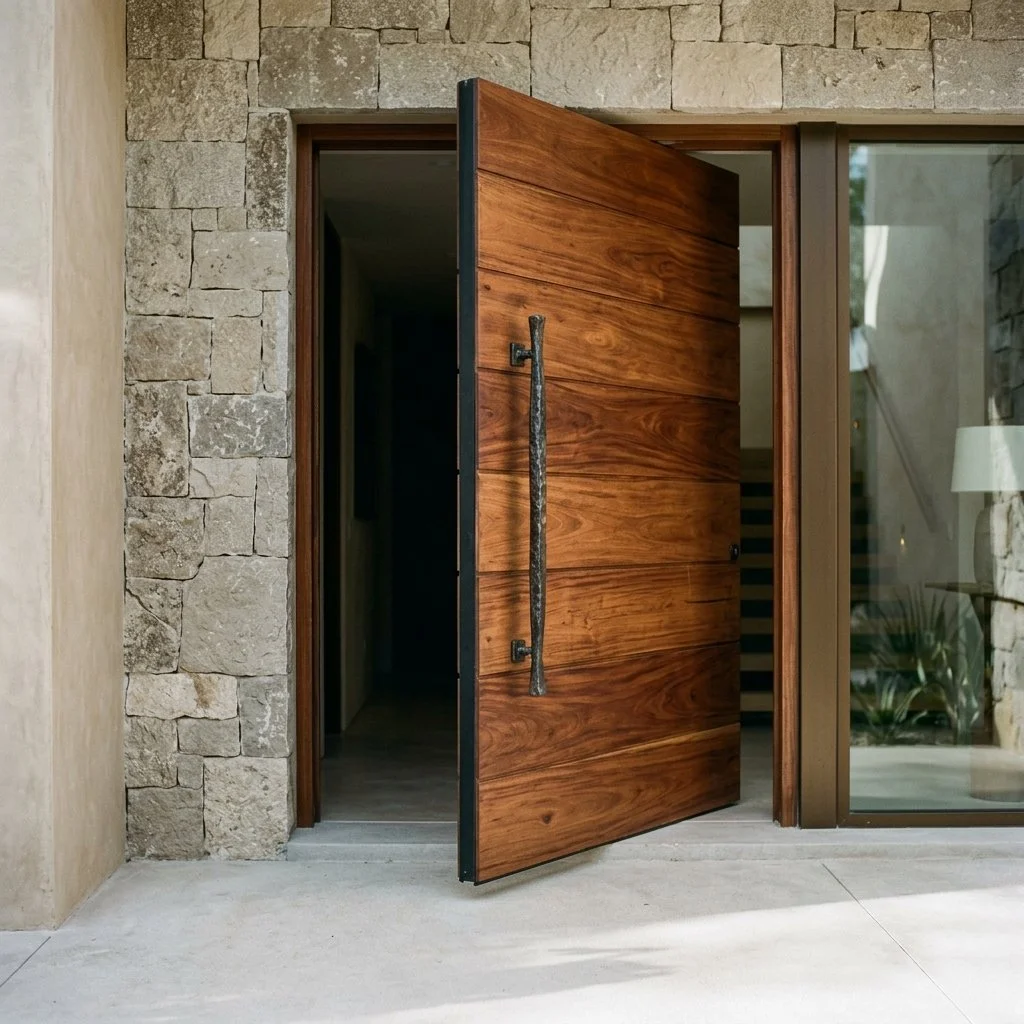
Wide plank Tzalam wood pivot entrance door open against a limestone facade, anchored by a forged blackened bronze handle.
What a Hinge Can't Carry
A standard butt hinge is mounted to the side of the frame, which means every pound of the door hangs off a few screws driven into wood. Past a certain width, usually around four feet, that frame starts losing the argument. The door sags at the top corner first, then drags at the bottom, then needs planing every year to keep closing at all.
A pivot solves the actual problem instead of masking it. It mounts at the top and bottom of the door rather than the side, and it sends the door's full weight straight down through a bearing set into the floor. Floor mounted pivot systems are rated for doors well past a thousand pounds, with no meaningful limit on width, because the floor is doing the work a frame was never built to do. That's how a slab of solid wood or stone that weighs close to five hundred pounds still opens with one finger and closes on its own with a soft, even thrum. Nothing about that is luck. It's the pivot, and it's the first hardware decision I make on any door wider than four feet, before wood or finish enters the conversation.
A Core Built Like a Wall
The other half of that sound is the door itself. A door with a hollow core reads as hollow no matter what veneer sits on the outside, because there's nothing behind the skin to absorb an impact. I check this with a knuckle before I ask what species the veneer is, because no finish fixes what's missing underneath. A real entrance door runs a solid core close to four inches thick, often built around an aluminum honeycomb structure for rigidity, then clad in heavy timber. The honeycomb keeps the door from twisting under its own weight. The timber gives it the mass that actually blocks sound.
An automatic drop seal finishes the job. It sits hidden inside the bottom of the door and stays retracted until the door closes, then lowers to meet the threshold and seals out draft and street noise. Light doesn't slip under it either. It's invisible when the door is open, which is exactly the point. A house doesn't decompress at the door if you can still hear the driveway through the gap underneath it.
Security That Doesn't Look Like Security
A visible keypad or a camera mounted on the trim tells a visitor two things at once: that the house is worth securing, and that the owner cared less about how it looked than about the fact that it was there. The better version hides the same technology inside parts of the door someone would touch anyway. A fingerprint reader built into the underside of a handle. Sensors set into the wood grain instead of bolted to the surface. The door still recognizes you. It just doesn't look like it's doing a job. Between the two, I'll always take the version a guest never notices over the one that makes a show of protecting them.
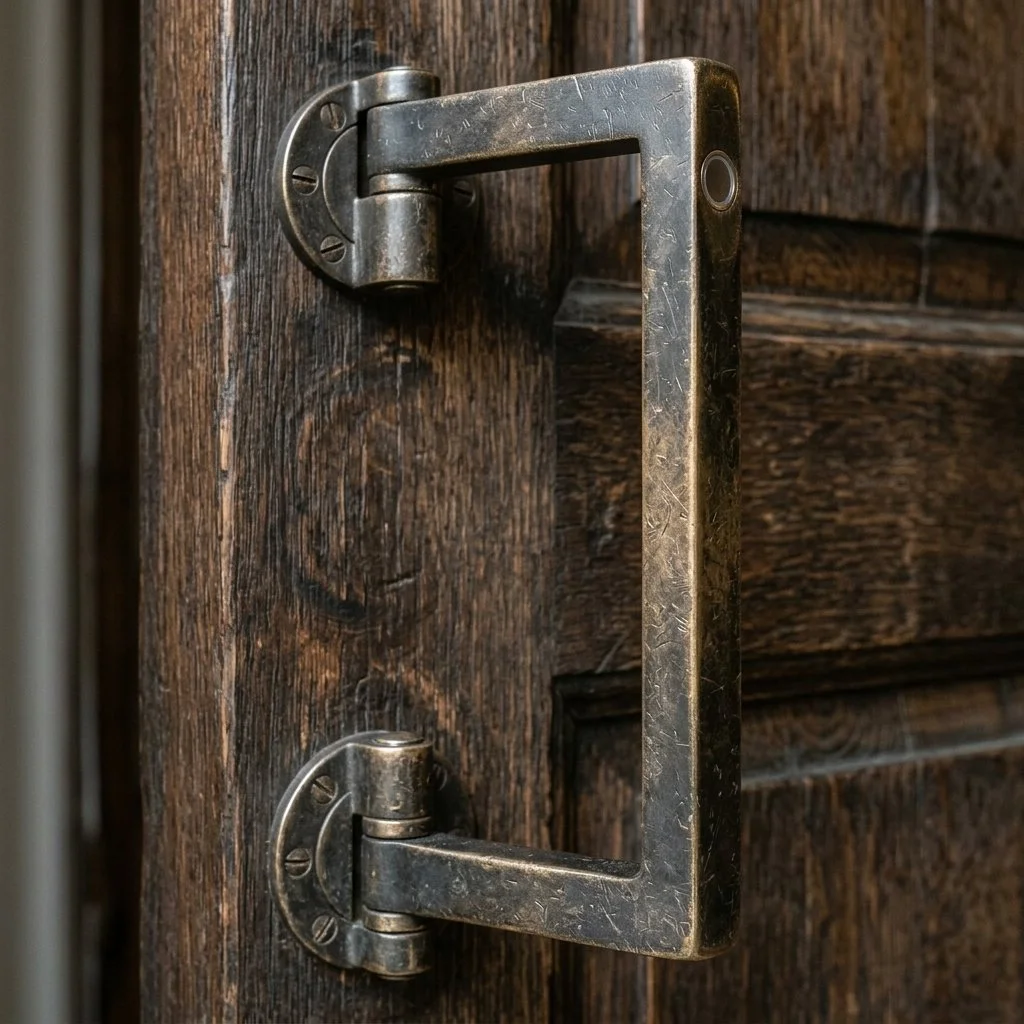
Vertical bronze pull handle on a massive dark wood pivot door, featuring a flush, integrated fingerprint reader set discreetly into the metal.
The Materials That Age Instead of Wearing Out
Tzalam, sometimes called Mayan walnut, runs harder than white oak on the Janka scale and carries a very high natural resistance to rot, which is why it holds up on an entrance that takes real sun and rain without warping or graying the way softer species do. Charred oak gets there a different way, through surface treatment rather than density, and reads darker and more matte against a stone or plaster facade. I reach for Tzalam whenever the design can carry real color instead of a uniform dark surface, and charred oak when the house wants something more restrained.
The handle is the one piece of hardware a person actually touches, which is exactly why I spec forged blackened bronze there even when I'd let something less expensive go elsewhere on the door. It stays cold against the hand the way plated hardware never does. It also changes over years of use. The oils in your skin build a patina on it that a static factory finish never develops.
The First Room in the House
I don't spec any of this to make a door look heavier than it is. The pivot, the core, the hidden lock, the bronze that changes with your hand: every one of them is real mechanical weight doing real mechanical work. A door that passes all four tests sets the standard the rest of the house has to meet. Walk through one that doesn't, and you already know, before you've seen a single room past it, exactly how much of the rest is real.
