The Grit of the Floor
A fabricator honing a slab doesn't grind until the stone looks good. They grind until they hit a number, then they stop. Most honed finishes end somewhere between 200 and 800 grit, commonly around 400. A polished finish keeps going, all the way to 1,500 or 3,000 grit, closing the stone's surface until it throws back a reflection. The difference between the two floors in your house isn't taste. It's where the machine stopped.
There is a common mistake in high end residential design: chasing the mirror finish because it photographs well and reads as expensive on a walkthrough. Polished stone at floor level is reflective and cold underfoot. Wet, it turns dangerously slick. Worse, it reads as commercial. It's a hotel lobby, an airport concourse, a space built for people passing through, not living in it.
I think a floor should be an anchor. It should have grit, both kinds. The literal kind, and the kind that means something has weight and won't be talked out of it.
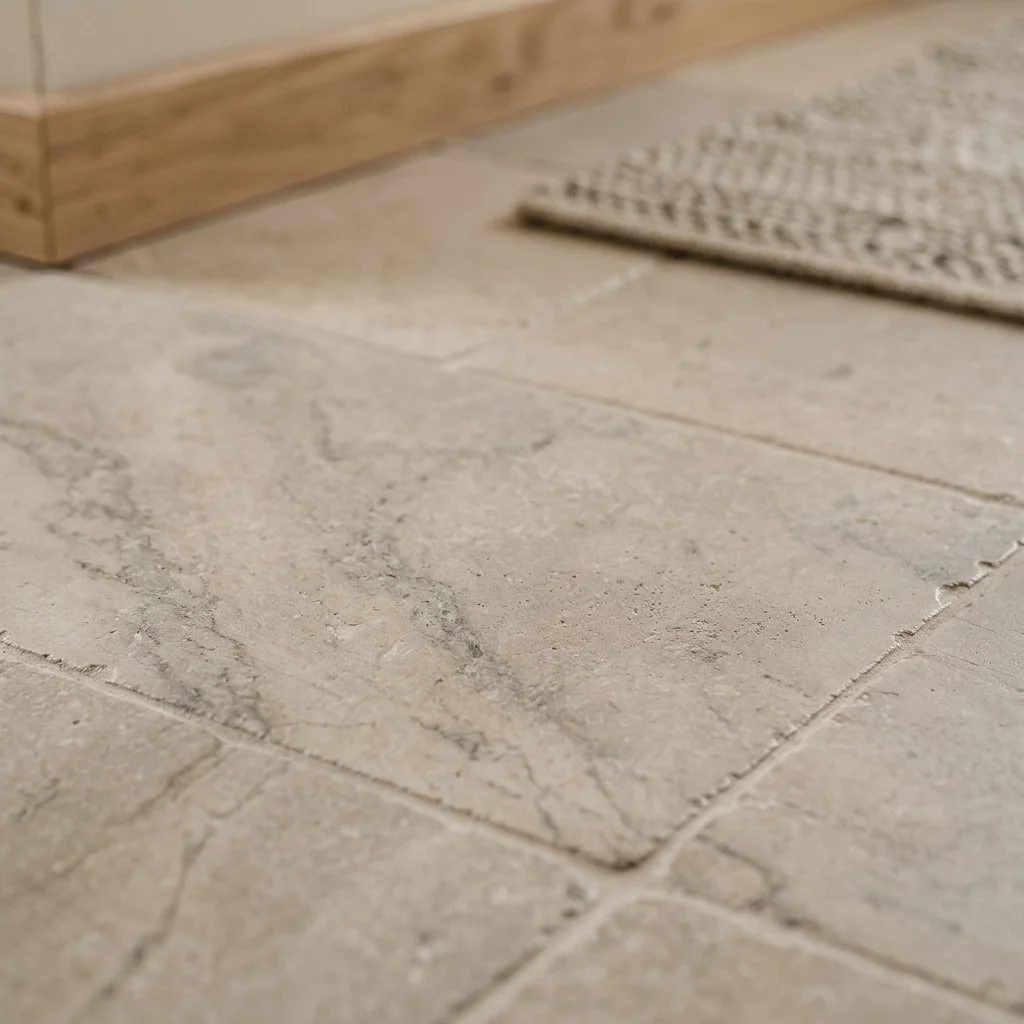
Honed limestone flooring highlighting its soft, matte surface and natural veining.
What the Foot Knows
Walk barefoot across a honed or leathered tipped floor and it feels like the earth, not a sheet of glass. That's not only sensation. Texture absorbs light instead of throwing it back, which is part of why a matte floor makes a room feel settled instead of staged. This is the same instinct that runs through the mineral palette of a house, where the raw, earthbound tones of a material are allowed to set the mood instead of getting polished out of it.
The Honed Finish
Honing is the baseline for a serious floor. A fabricator runs the slab through a sequence of progressively finer diamond abrasives and simply stops before the final burnishing stage that closes the stone's surface to a shine. The result is flat and matte, with none of the glare that would wash out a marble's veining or the fossil fragments locked into a limestone. It also feels different underfoot: soft, not slick. And it ages better. A polished surface shows every scuff against the gloss. A honed one absorbs them.
The Leathered Grain
Leathering goes a step further. Rotating diamond brushes wear into a stone's softer minerals and glide over the harder ones. What's left is a rippled, almost pebbled surface, the reason people reach for the word leather to describe it. It's the most forgiving floor there is. Fingerprints and water spots disappear into the texture, and so do the small scratches that come from actually living in a room. The grip underfoot is real, not decorative.
The Tumbled Edge
For the threshold between an interior room and a terrace, I look for a tumbled or brushed finish. Barrel tumbling with abrasive media and water rounds the edges and softens the face of the tile until it looks like it's been walked on for a century. It trades the precision of a fresh cut for something closer to the truth of a floor laid by hand.
Grip Before Gloss
Slip has a legal minimum, and a mirror polished floor often misses it. ANSI A137.1 sets the wet dynamic coefficient of friction, DCOF, at 0.42 minimum for a level interior floor that might get walked on wet. Anywhere bare feet are likely, a pool deck, a shower floor, a bath, the recommended minimum climbs to 0.60. A floor polished to a high shine routinely tests below that first number when wet. A honed or leathered surface tests well above it. This is the part of "grit" that has nothing to do with how a room photographs and everything to do with whether someone falls in it.
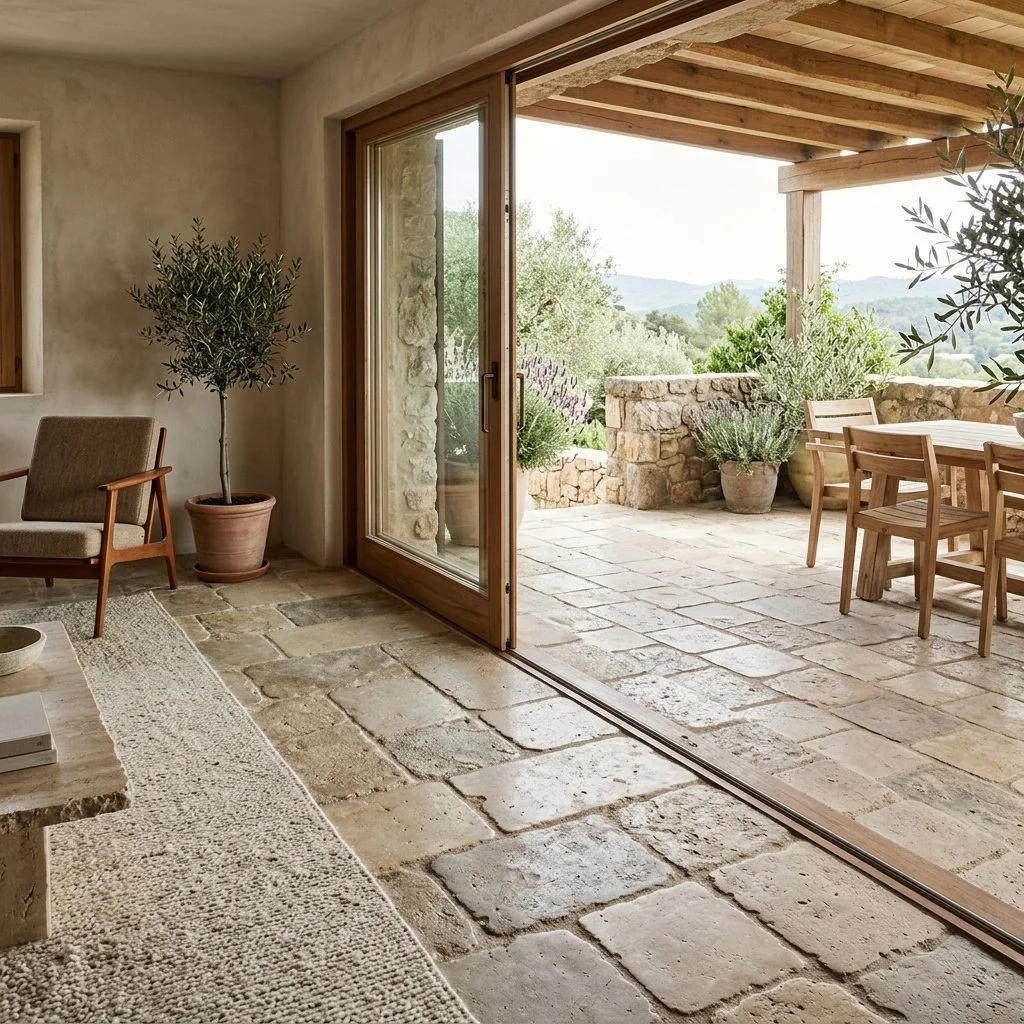
Tumbled stone floor tiles at the transition from an indoor living room to an outdoor terrace.
What Holds the Floor
Honed limestone is the standard I come back to. It's dense enough to perform, but the surface reads warm rather than clinical, which matters when it's the thing your feet meet first thing in the morning. Stone also carries real thermal mass, which is why it pairs so well with radiant heating systems: it absorbs warmth evenly and releases it slowly, instead of running hot in one spot and cold in the next.
Leathered basalt or granite earns its place in mudrooms and anywhere else that sees heavy daily traffic, but the two behave differently under a boot for a real reason. Basalt is an extrusive rock, formed at the surface as lava cools fast, which gives it a tight, even grain and a Mohs hardness around 5 to 6 across the whole slab. Granite is intrusive, cooled slowly underground, which lets its minerals grow large enough to see: hard quartz next to much softer mica and feldspar. That unevenness gives granite its movement, but it also means it can wear unevenly over decades. Basalt just wears the same, everywhere, for longer.
Honed, unfilled travertine is where I land for a floor that wants some age to it. The natural surface pitting comes from the same trapped gas that shaped the stone in a wet room built for the long term, but on a floor, left open and honed rather than filled and glossed, it does something different: it gives bare feet a texture to actually read, not just look at. Sealing a floor like this belongs to ongoing care, not to this conversation.
What You're Actually Standing On
A house is only as steady as the ground beneath it. Choose a floor with texture and you're choosing a material that's honest about where it came from and what it's made of. A polished floor is a display. A textured one is a foundation. I'll trade the shimmer of a trend for the grit of something that holds.
