Argentina Keeps Its Fire Honest
In the eighteenth century, the gauchos who worked Argentina's pampas lived mostly on beef, cooked over an open flame, because the plains gave them almost nothing else to eat and nothing to season it with. Mendoza still cooks this way today. The iron grate, and the vertical cross that came after it, both trace back to that same problem: one ingredient, one heat source, and however long it took to get it right.
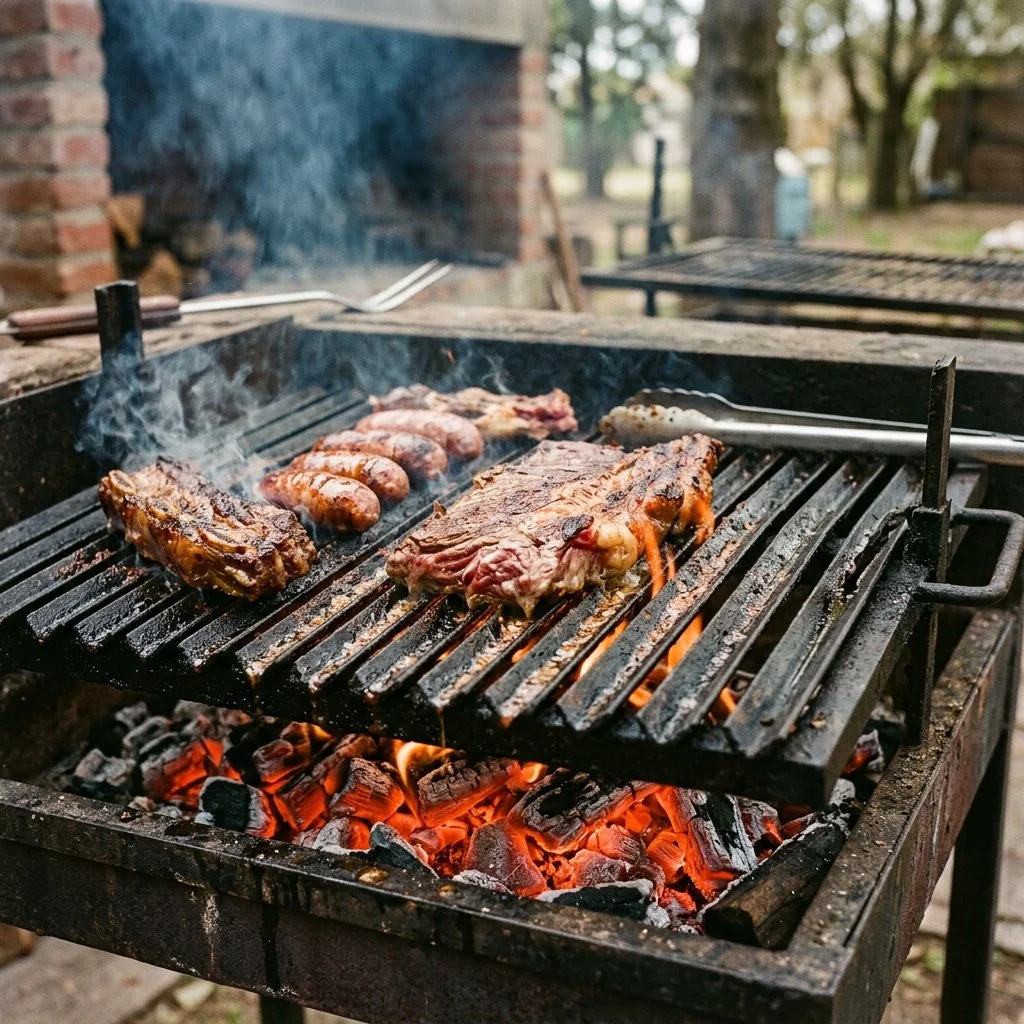
Dark V-shaped grates of an outdoor parrilla grill over glowing red charcoal coals.
The Fire Argentina Actually Built
The parrilla is the daily engine: a heavy iron grate with channels shaped like a V that let fat drain away from the coals instead of flaring them up. A wheel raises or lowers the whole grate, which is how an asador adjusts heat without touching the fire itself.
The cross, or cruz, is older and slower. Whole cuts, sometimes a whole lamb, are secured vertically on an iron frame and left leaning over the coals for hours, the hide sometimes still on to hold the juices in. It's Patagonia's method more than Mendoza's. In Chubut province, the same vertical technique carries traces of Welsh settlers and of the Tehuelche people who were roasting meat this way well before the Welsh or the Spanish showed up. Credit for the cross probably belongs to more hands than just the gauchos'.
One detail from the gauchos survives in every good asado today: burn quebracho wood if you can get it. It produces almost no smoke, which is the entire point when the meat sits inches from the flame for hours.
The Cut Nobody Gets Right
Ask for picanha in Mendoza and you'll get funny looks from anyone who takes the cut seriously. Picanha is the Portuguese name, Brazil's word for it. In Argentina, the same top sirloin cap, identified by its thick fat cap left untrimmed, is properly called tapa de cuadril, or colita de cuadril depending on the province. Argentina's own beef promotion board confirms the naming. The fat itself works exactly the way people assume: leave it on, and it renders slowly into a crust the fat bastes on its own, no marinade needed.
Chorizo sits at the same table but arrived by a different road. The pork and beef sausage came in with Spanish and later Italian immigration, brought by settlers rather than grown out of anything already here. Argentina adopted it so completely, as the traditional first bite before the heavier cuts, that almost nobody thinks of it as borrowed anymore.
Algarrobo, Named Twice
The wood most Argentine asado tables are built from is algarrobo, a Prosopis species that grows in the arid Gran Chaco region and can survive conditions most hardwoods can't. It's genuinely native. The name is not. Spanish settlers called it algarrobo because it reminded them of the European carob tree they already knew. Long before that naming, Guaraní speakers called it ibopé or igopé, and Quechua speakers simply called it yaná tacú, the tree, a name that says something about how central it was to daily survival for millennia before anyone Spanish showed up. Its pods were ground into flour for a dense cake called patay, and fermented on their own into a drink called aloja. Its wood holds heat without dulling a blade, which is exactly why it still ends up under a plate of meat.
What Actually Traveled to Get Here
Two objects on the Mendoza table have origin stories that surprise people who assume everything here is old and native.
Malbec is French. It came from the Cahors region in France. The agronomist Michel Aimé Pouget crossed the Andes from Chile in 1853 with French vine cuttings, to found an agricultural school in Mendoza. Most sources date Malbec's actual arrival to 1868, among the varieties introduced once the school was running. A few decades later, phylloxera nearly wiped Malbec out in its own country. Mendoza's dry soil, sitting at high altitude where the disease struggles to spread, protected it instead. The grape that France mostly abandoned became more Argentine than French in practice.
The pingüino, the ceramic penguin pitcher used to pour that same Malbec, is newer still. Italian immigrants popularized it in Argentina sometime in the 1930s, when bulk wine sold to neighborhood cantinas had to be poured again into something for the table before bottling regulations existed. Nobody is fully certain why the shape is a penguin. One theory, from a single Argentine source I couldn't independently confirm elsewhere, ties it to an American Art Deco silver cocktail shaker from 1936, shaped like a penguin for a World's Fair exhibit built around a shipment of real Antarctic penguins. It's a strange thread for an object that looks like it should have a tidy folk explanation, and I'd rather leave it unresolved than invent one.
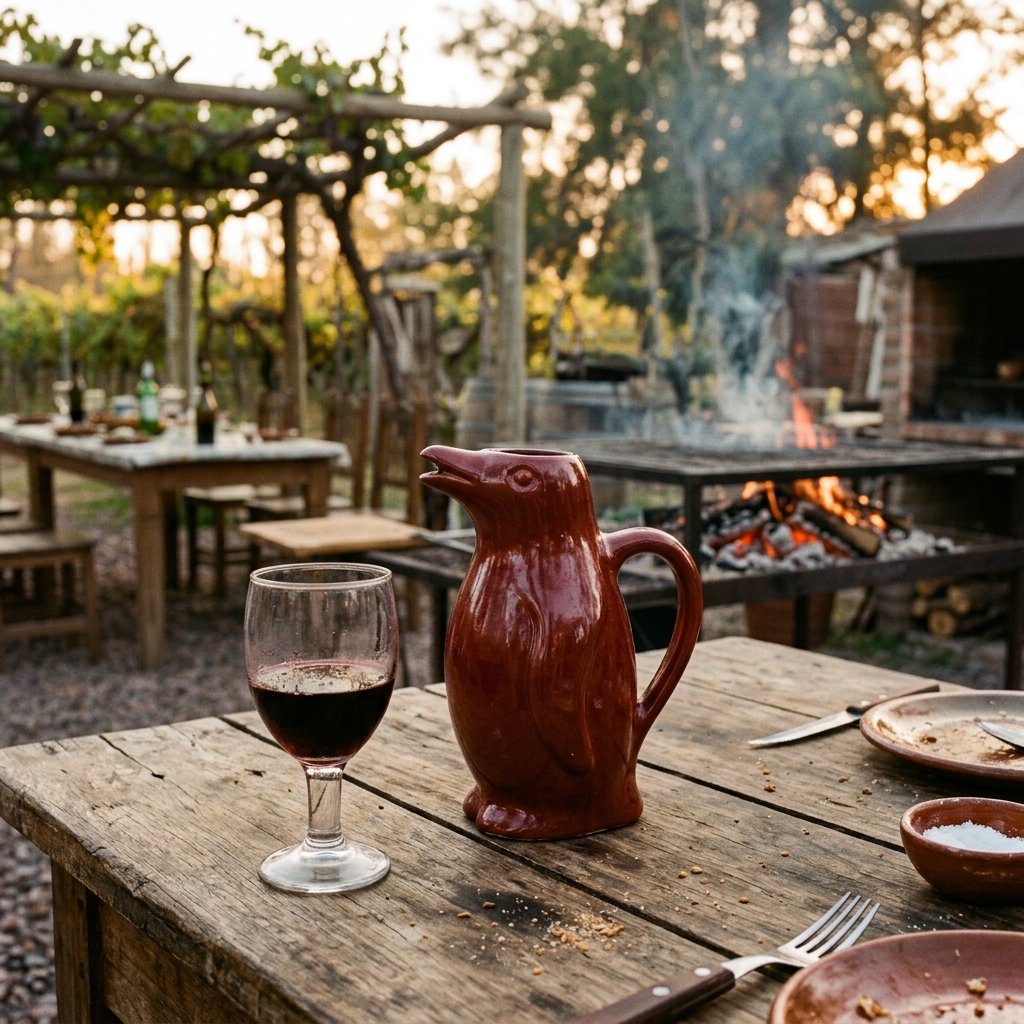
A ceramic pingüino pitcher and a glass of Malbec sit on a rustic wooden table.
What the Fire Refuses to Rush
Mate is the one object on this table that owes nothing to the fire. The Guaraní people of what is now Paraguay were cultivating and drinking it before any Spaniard arrived in South America. Even the word carries the layering: "mate" comes from the Quechua word for the gourd it's served in. "Yerba" is just the Spanish word for herb. The ritual underneath both words is centuries older than either label.
That's the real shape of this table. Argentina built its fire out of necessity and got its cut names crossed with its neighbors. It kept a wood the Spanish renamed but didn't create, and took in a grape and a pitcher that both started out belonging to someone else. Underneath all of it sits a drink the Guaraní were already sharing for centuries before anyone here was arguing about what to call the meat.
If you want to source any of this properly rather than buy it retail, two channels are worth knowing. Misiones province, in Argentina's northeast, is where yerba mate is actually grown, and cooperatives run by small producers there sell direct rather than through the mass brands most people know. And the ironwork itself, the parrillas and the crosses, is still forged by hand by blacksmiths working in Mendoza and further south in Patagonia, the same trade that's kept the gaucho's fire running for centuries.