In Ouro Preto, Brazil, People Cook in Stone
In 1927 a German chemist named Oskar von Burguer wrote up how the soapstone pots of Minas Gerais, Brazil, were made. A block of stone was clamped between two iron points on a horizontal lathe, and a waterwheel turned it through a wooden pulley. Those two points were the only iron anywhere on the machine.
By 2009 most of the working lathes in Cachoeira do Brumado, a district of Mariana, ran on electricity. A researcher named Vinícius Melquiades spent twenty days that July in the district's workshops and found only two still driven by water. Looking for the stone behind all of this because it turns up in two places I would never have put side by side: the Baroque churches of Minas Gerais and an ordinary stew pot.
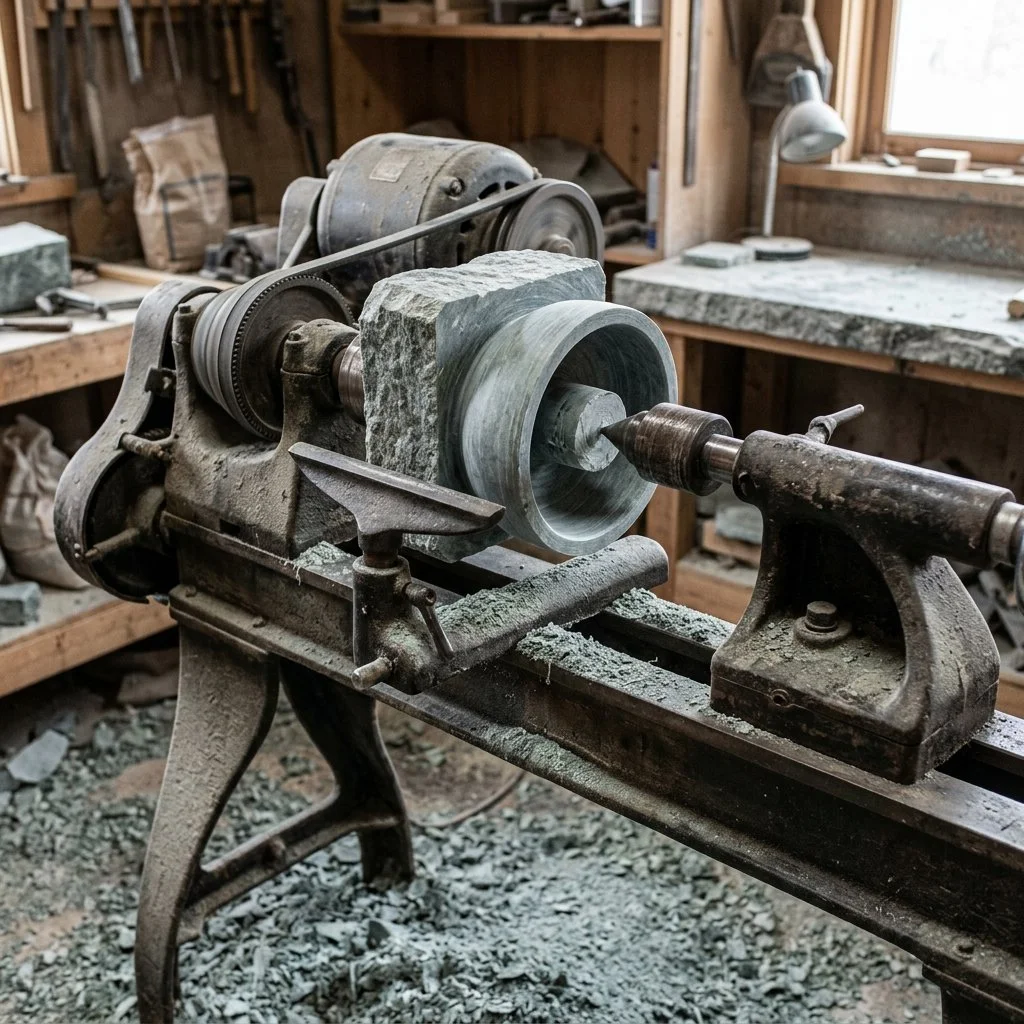
Iron lathe holds a partially turned block of gray-green stone.
The Rock Itself
The rock is steatite, a metamorphic stone with varying amounts of talc, common across the iron belt of Minas Gerais that geologists call the Quadrilátero Ferrífero. It sits between 0 and 2 on the Mohs scale, soft enough to shape with hand tools. The maker cuts a block loose with a saw and an iron lever, then leaves a column of stone standing inside it so the block can be held between the two points and turned. The column comes out last.
The makers in Cachoeira do Brumado all name one problem, iron pyrite. It is far harder than the steatite around it, and a lump of it can tear loose and crack a pot on the lathe, so blocks are chosen at the outcrop and any stone with pyrite in it stays behind.
Laboratory tests on stone from four quarries in Bandeiras, in the Santa Rita district of Ouro Preto, found porosity of 0.4 percent at most. Every sample broke in the first or second round of a thermal shock test, which is a good reason to bring a pot up to heat slowly.
A Trade Nobody Registered
Gold brought the pot makers. In the first half of the 1700s, communities settled around Ouro Preto and Mariana to make these pots for the new mining towns and the roads between them. One of the first men to find gold in Minas Gerais founded Cachoeira do Brumado in that rush.
Colonial officials licensed and regulated trades like masonry and blacksmithing in detail. Melquiades found no reference to pot makers in the documents he consulted, and that gap is why he calls it an unofficial trade. Nearly every account of soapstone in Minas Gerais leads straight to Aleijadinho, and Melquiades argues that this gives the wrong picture of who made the pots. His reading of the evidence points to free colonists and to people who were enslaved or formerly enslaved. They worked the stone for sale in the towns and along the roads.
When von Burguer asked in Santa Rita whether the workshops made anything besides pots, he was shown, with obvious pride, a stemmed drinking glass cut from stone in the shape of an ordinary glass one.
One District, Two Markets
Santa Rita de Ouro Preto is called the capital of soapstone. The best stone from its quarries leaves as blocks for Europe and the United States, and the softer, lower grade rock goes to artisans for pots. I find it hard to read that split without noticing which end gets the better rock.
In the 1700s and 1800s the stone stood in for costly Italian and Portuguese limestone in Baroque work. Prominent among its uses are the sculptures at the Sanctuary of Bom Jesus de Matozinhos in Congonhas. The International Union of Geological Sciences designated Minas soapstone a heritage stone in 2026, and its entry notes that the cookware craft is recognized as intangible heritage in Ouro Preto and Mariana.
The work itself is hard. A 2023 study of the workshops calls it arduous and unhealthy. Raw stone is expensive, and the pots are hard to sell. In Cachoeira do Brumado the shallow deposits that artisans could dig by hand ran out once mining companies arrived in the 1970s and 1980s. Many makers now buy the waste rock those companies discard, and a few still extract by hand.
The Pots Rode the Mule Roads
The gold built the mule roads, and the pots went out on them. Muleteers called tropeiros hauled goods across the colonial interior, and near the waterfall in Cachoeira do Brumado a memorial honors the men who carried the pots on muleback for days. The dried staples they carried, beans and cassava flour among them, turned into feijão tropeiro, a dish still cooked across Minas. Cassava is the older ingredient. Farofa comes from the Indigenous way of turning manioc into flour, which was in Brazil long before any mule train.
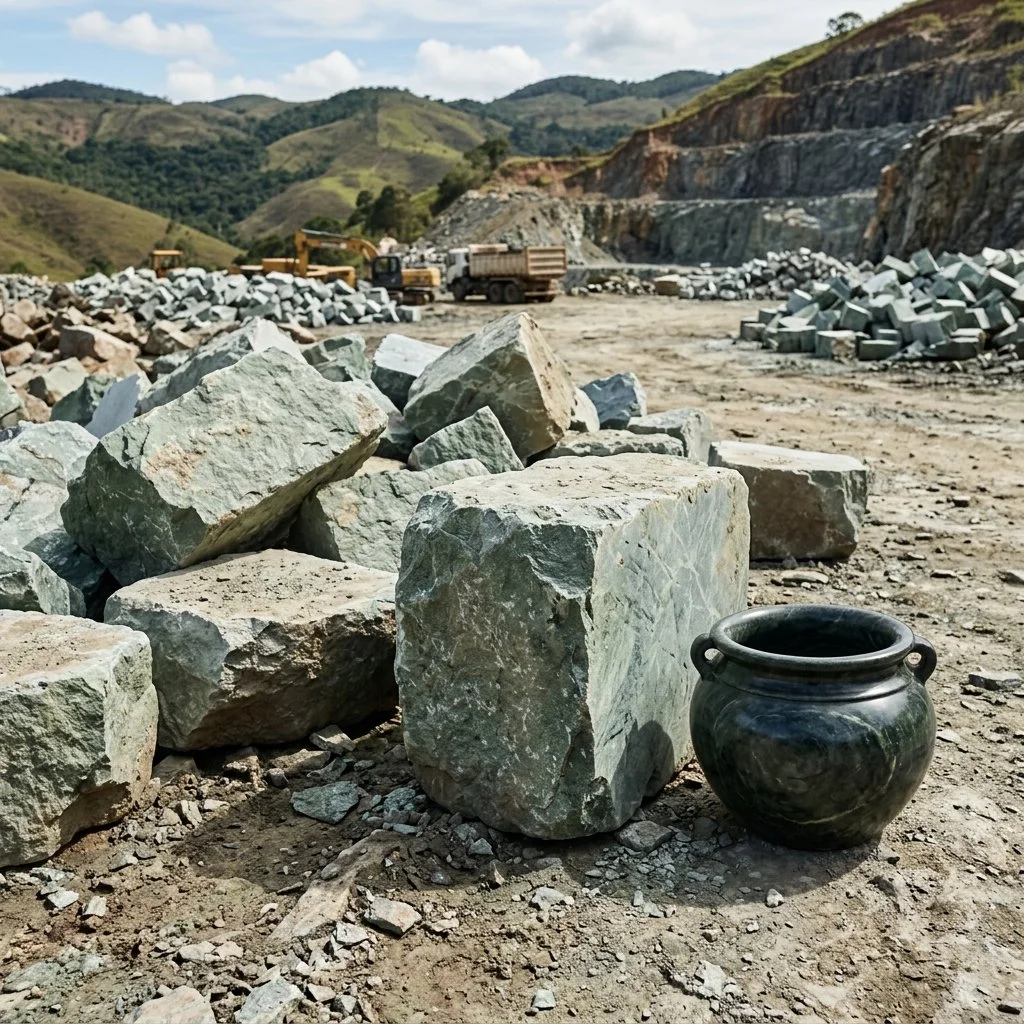
Raw, greenish gray steatite blocks in a Santa Rita de Ouro Preto quarry alongside a hand carved stone cookware pot.
The People at the Lathe
The stone that was carved for the churches of the gold towns also went on the stove, and the people who turned the stove pots barely appear in the records. That is why I would start with them. Cachoeira do Brumado has an artisans' association for its stone and sisal makers, and its residents' association runs a pot festival each July. In Ouro Preto, the soapstone fair at the Largo do Coimbra has been run since 1995 by an association of its own stallholders. Much of what it sells is made in Santa Rita, and soapstone shares the stalls with jewelry and souvenirs. Slab and blocks take a different route, through the quarry operators around Santa Rita who already ship both to Europe and the United States.