A Courtyard Has to Earn Its Keep
A courtyard house is one of the oldest architectural ideas people never stopped building. Archaeologists trace the form back roughly eight thousand years to Neolithic settlements in the Jordan Valley, and it turns up again centuries later in the Roman house, where the central opening had a name and a job: the impluvium, a shallow basin set to catch rainwater falling through a gap in the roof. When Roman building tradition met Islamic architecture in southern Spain, that opening became the Andalusian patio, the literal heart of the house rather than a leftover gap in the plan. Córdoba still holds a spring festival judging the best kept patios in the city, which tells you how seriously that tradition takes a space most modern houses treat as an afterthought. Spanish colonizers carried the same layout to the Americas centuries later, which is why a courtyard in Guadalajara and a patio in Córdoba are still, structurally, the same idea wearing different stone.
A courtyard survived eight thousand years of shifting architectural fashion because it did real work. It pulled light into the middle of a windowless house, and it let air move where a sealed room couldn't manage on its own. The privacy came free, since nobody on the street could see in. If your courtyard isn't doing any of that, filling it with beautiful things won't fix the plan underneath it.
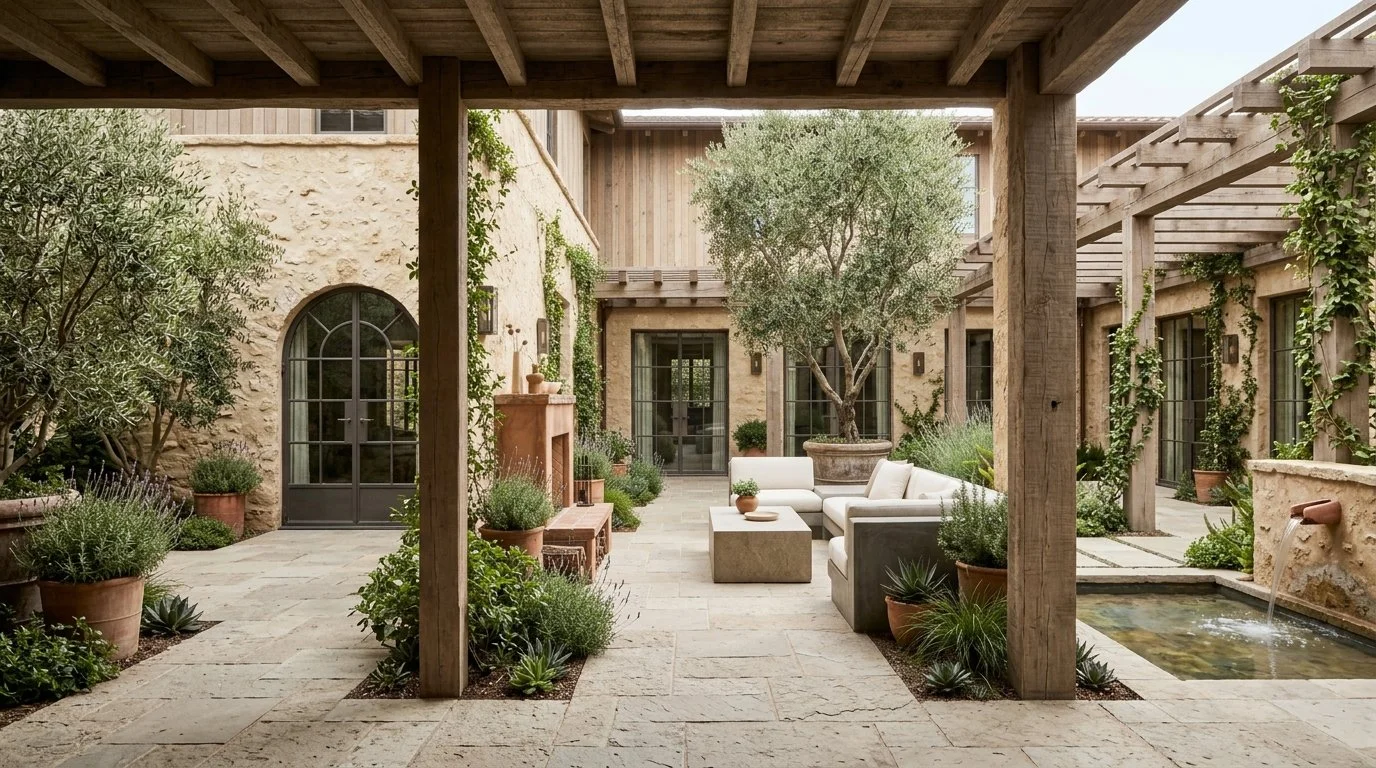
Courtyard with continuous stone flooring, outdoor seating, a central olive tree, a terracotta hearth, and a small water feature framed by wooden beams and stone walls.
The Fire Needs Clay, Not Iron
Once the courtyard exists, it needs a reason to hold people after dark, and a fire does that better than any light fixture. I steer people away from imported cast iron fire pits here and toward a fireplace or chiminea built from clay, shaped by hand and fired at high heat. Terracotta and metal behave completely differently around a flame. Metal heats and cools with the fire itself, throwing hard, uneven heat for as long as the flame lasts and almost none after. Clay absorbs heat slowly through the whole mass of the wall, then gives it back slowly too, so the warmth around a terracotta hearth outlasts the fire itself. That's thermal mass. It works the same way a courtyard's own stone floor and walls already do all day, just concentrated into one object.
The Bronze Doesn't Stay Bronze
Any bronze lantern or candlestick left outside starts changing the moment it's cast. Fresh bronze develops a thin reddish brown skin almost immediately on contact with air, a compound called cuprite. Left outdoors and exposed to rain and humidity, that skin keeps reacting, and the copper in the alloy slowly converts into a family of green toned compounds, mostly copper carbonates and sulfates, that collectors call verdigris. It's the same chemistry that turned the Statue of Liberty green over decades. A finisher who wants that color without waiting decades will accelerate it with heat and chemicals, then seal it under a thin coat of beeswax once it reaches the shade they're after. The wax isn't cosmetic. Without it, the same reaction that made the color keeps eating into the metal underneath.
Terracotta's Whole Argument Is That It Breathes
The planters holding a courtyard's trees do more work than they get credit for. Terracotta is a porous clay, unlike glazed ceramic or plastic, and that porosity lets air and moisture pass straight through the pot wall instead of pooling against the roots. An olive tree tolerates almost nothing worse than wet feet, so that single property matters more here than color or shape ever will. A well made terracotta pot is fired above 1,000 degrees Celsius specifically so the clay can survive freezing nights outdoors without cracking, which is why a pot thrown in Izmir or Tuscany can sit in a courtyard through winter instead of coming inside every October.
The Stone Doesn't Need to Prove Anything
Whatever surfaces you set between the seating, whether cut from volcanic rock or the same honed limestone running through the house, they should be solid enough that nobody mistakes them for patio furniture. A single heavy slab reads as architecture. A stack of thin, veneered pieces reads as something bought for a season. I'd rather spec one heavy slab than three matched pieces that all have to be replaced on the same schedule.
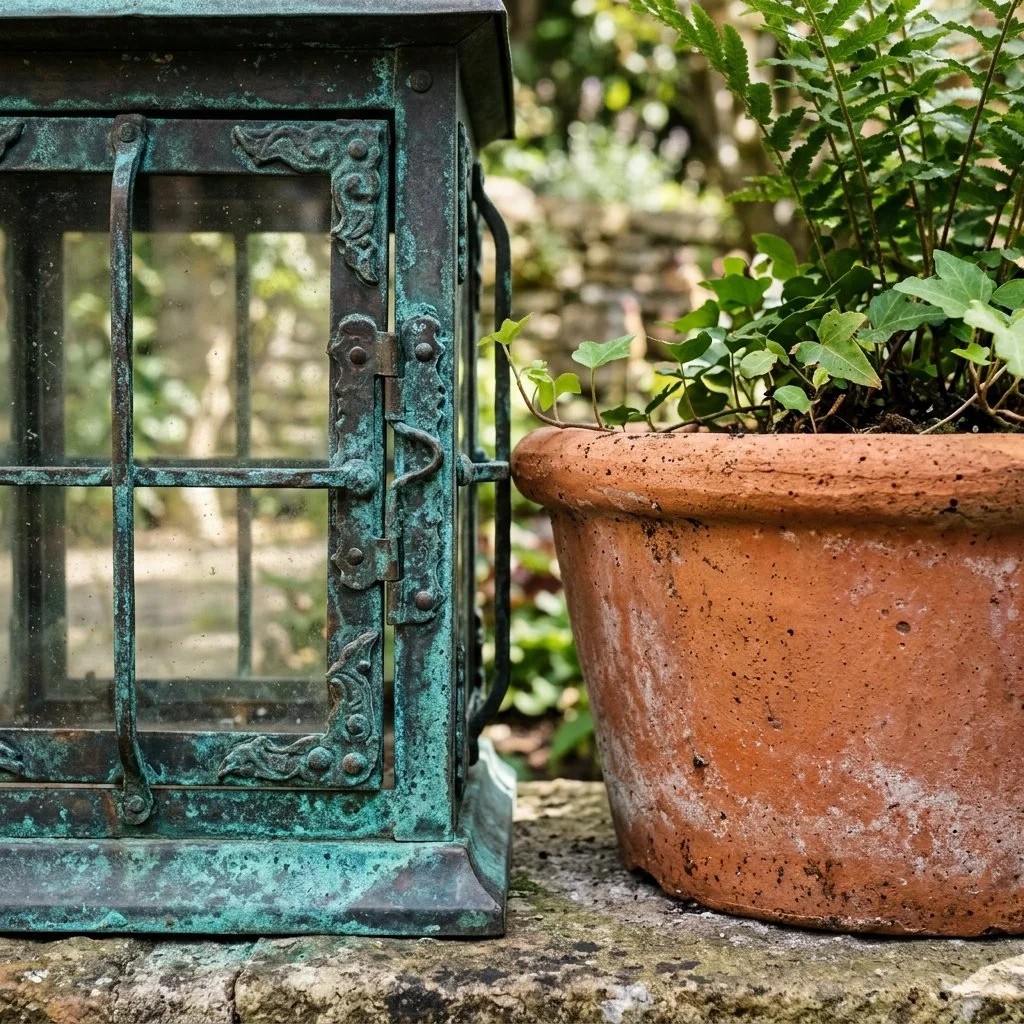
Aged bronze lantern displaying a rich verdigris green patina resting beside a weathered terracotta planter.
The Test Is Whether You Actually Sit There
A courtyard filled with the right materials and never used is just an expensive gap in the floor plan. Terracotta earns its place by keeping people warm after dark. Bronze earns its by aging instead of corroding, and stone earns its by refusing to look temporary. You now have a reason to stay outside.
