The Sky Level Window
Architects have been building rooms this way for four thousand years, and preservation had nothing to do with it at first. In the temples of ancient Egypt, builders left narrow gaps in the stone slabs above the roofline of the side aisles so light could reach the hall of columns without cutting into the outer wall's strength. Roman basilicas did the same thing with a raised upper wall pierced by windows. So did the naves of Gothic cathedrals centuries later. I hadn't expected a four thousand year old lighting problem when I started reading about high windows, but it changed how I think about placing them. The device has a name now: a clerestory, from the Old French for "clear story," a run of windows set high on a wall, above eye level. In a house, the appeal isn't cathedral drama. It's the same thing that made a temple builder cut those gaps in the first place. Light, without a direct hit.
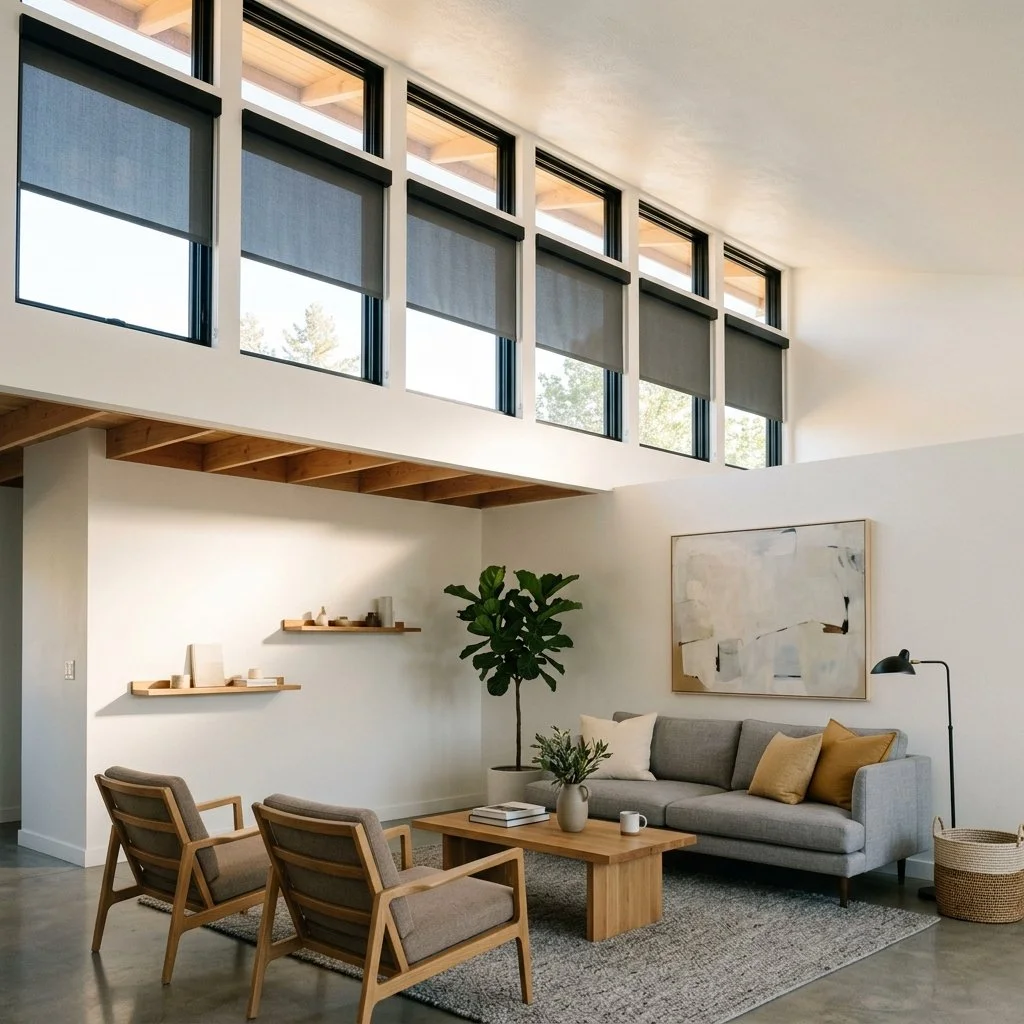
Living room features a row of high clerestory windows with partially lowered dark shades.
The Light Arrives Secondhand
A floor to ceiling window puts the sun's beam directly on whatever sits across from it, at exactly the height where your furniture lives. A clerestory changes the geometry. Light entering high on a wall travels across the ceiling and down the upper walls before it reaches the room. It arrives scattered, not as one hot, direct shaft. The room still reads as bright. It just isn't being hit.
The Air Moves Because the Heat Does
Warm air is lighter than cool air, and it rises looking for somewhere to go. An architect I spoke with put it simply: point where you want the heat to leave, then let the air do the rest of the work. Physicists call the result the stack effect, sometimes the chimney effect. The taller the space and the bigger the temperature difference between inside and out, the stronger the pull. Put an opening at the top of that column of air and warm air escapes through it. Pair that with an operable window down low and cooler air gets drawn in to replace it, no fan required. A clerestory placed correctly does both jobs. It lights the room and gives the heat an exit.
What Fifty Lux Actually Means
I hadn't thought about a fifty lux limit until I asked why museums bother measuring light at all. Conservators don't guess about exposure, they measure it. The standard most museums work from caps illumination on the most vulnerable materials, dyed leather and textiles among them, at 50 lux. Wood and upholstered furniture get more room, generally 150 to 200 lux, before the same clock starts running. Ultraviolet radiation alone accounts for roughly 40 percent of that damage, and it's cumulative. An hour at high intensity does the same harm as several hours at a lower one. The aniline leather I wrote about, the Tzalam heartwood in a piece of case furniture, none of it survives decades in raw, direct sun no matter how well it was made. It survives because someone decided, on paper, before the walls went up, not to let it sit in that light all day.
Glass That Changes Its Mind
A clerestory this high is usually out of reach, which makes it a natural place for glass that manages itself. Electrochromic glass carries a thin coating of metal oxide ions between two conductive layers. Apply a small, low voltage current and the ions migrate between the layers. The glass shifts from clear to tinted and back, with no moving parts at all. Most versions reach full tint in a few minutes and hold that state without drawing further power until the current reverses it. It's a genuinely different animal. That glass is set once, at manufacture. This kind changes its mind by the hour, in response to where the sun actually is.
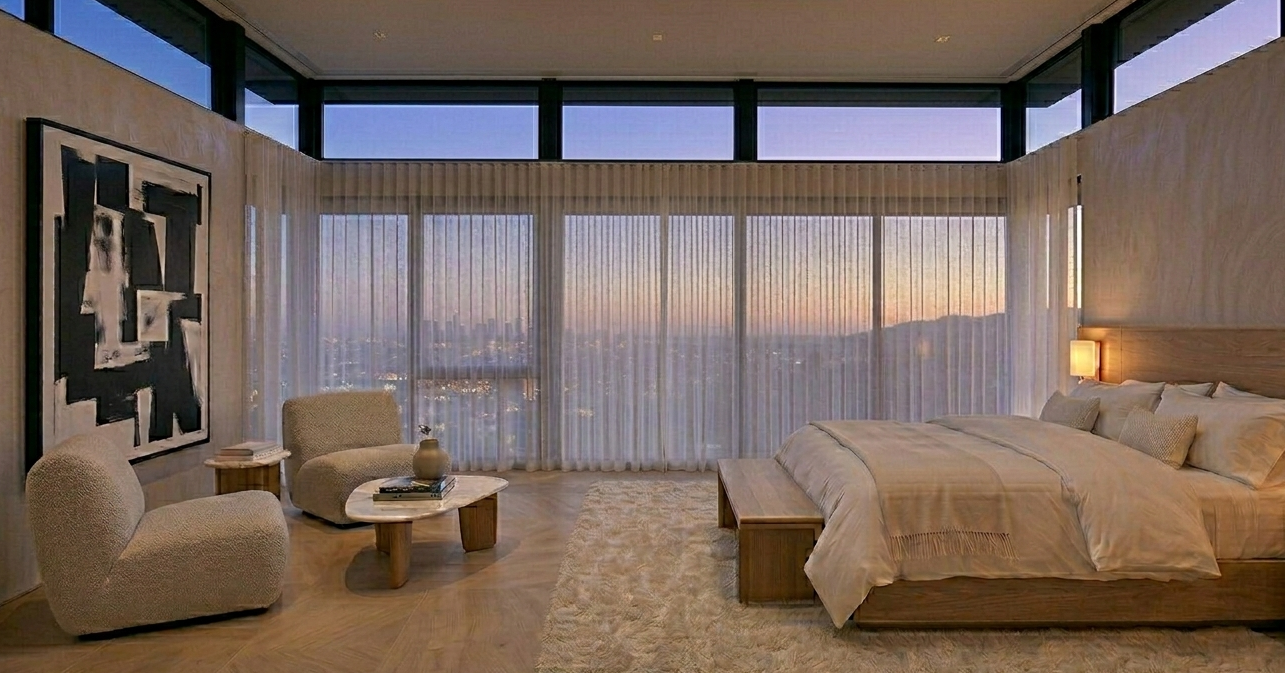
Bedroom at dusk, featuring clerestory windows and shear loomed curtains revealing a soft city skyline view.
When You Can't Move the Wall
Not every house has the ceiling height for a true clerestory, and the same protection can be approximated without touching the architecture. A tight, densely woven linen, hung high above the window frame and wide past its edges, blocks more UV than a loose or sheer weave does. It's the same principle behind sun protective fabric generally: density does the work. It breaks a direct beam into something softer before it reaches the room. The view stays intact.
An Old Idea With New Wiring
None of this is new engineering. It's the same gap a builder cut into a temple wall four thousand years ago, still doing the same two jobs. Bring in light. Keep out what damages what's underneath it. The only thing that's changed is the current wired into it.
