The Two Decisions That Actually Change How a Bed Feels
Ask ten showrooms what makes a sheet luxurious and eight will point to thread count. That number tells you almost nothing. I stopped trusting it years ago, back when I started handling raw greige goods before they ever hit a finishing mill. What actually changes how a bed feels comes down to two decisions: the weave, and the fill. Everything else is marketing dressed up as specification.
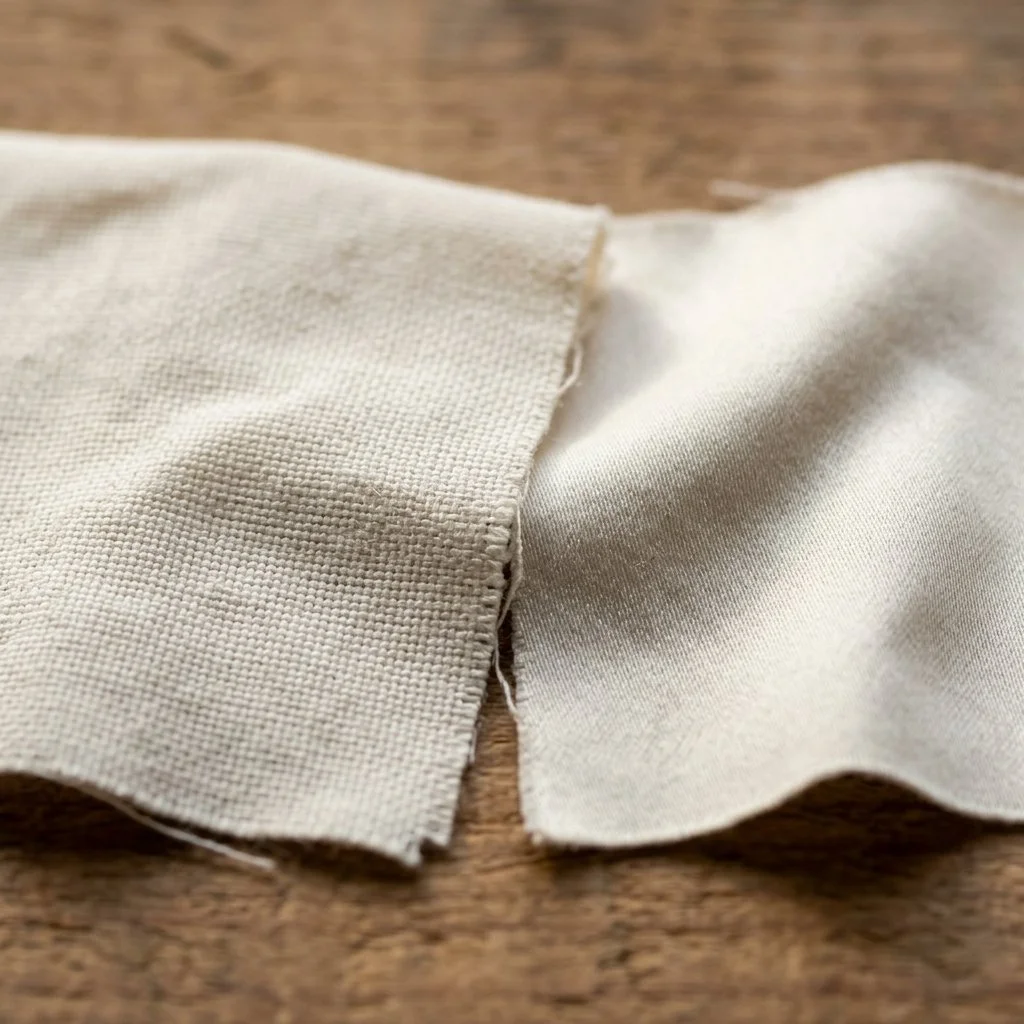
Two matching ivory cotton swatches side by side, showing a matte one over percale weave on the left and sateen weave on the right.
Thread Count Was Never the Real Number
Thread count measures density, not quality. Above roughly 400, manufacturers start plying multiple thin threads together and counting each strand separately, inflating the number without improving the fabric. You end up with a heavier, less breathable sheet sold as more luxurious. A well made 300 count percale will generally outperform an inflated 800 count sateen once it's actually on a bed.
The number worth asking about instead is weave.
Percale and Sateen Are Doing Different Jobs
Percale is a plain weave, one thread over, one thread under, in a tight grid. That structure is what gives it a crisp, matte hand and a cool surface. It's the weave behind most hospitality bedding for a reason: it holds up to industrial laundering without pilling, and it softens gradually with wear while keeping more of its structure than sateen does over the same years of use.
Sateen uses a four over, one under float weave, which puts more thread surface facing up. That's what creates the sheen and the softer, heavier drape. It runs warmer than percale, which is exactly the reason a client in Vermont and a client in Scottsdale should never be handed the same recommendation.
The Fill Is a Separate System Entirely
Duvet and pillow performance has nothing to do with the shell fabric. It comes down to fill power and construction.
Fill power measures loft, the volume one ounce of down occupies. European white goose down typically runs 600 to 800 fill power. Below 600, you're paying for warmth without much loft, and the duvet will feel flat and heavy rather than full. Above 700, you start getting genuine insulation with real weight savings, which is the difference a client actually feels when they pull a duvet up.
Construction matters just as much as the fill itself. A sewn through duvet, where the top and bottom fabric are stitched directly together in a grid, creates cold spots at every seam because there's no down there. A baffled construction, with internal fabric walls creating box shaped chambers, lets the down loft fully and stay put instead of shifting to the corners after six months of use. If a client is paying for a real down duvet, baffled construction is not optional.
Silk fill, less common but worth knowing, is measured in GSM rather than fill power, grams per square meter of the loose floss itself. A lightweight silk duvet runs around 175 to 250 GSM. A genuine winter weight runs 350 to 400 GSM or higher. This is a different number from momme, which measures woven silk fabric like a pillowcase or sheet, not loose fill, and the two get confused constantly in how these products are marketed. Silk fill is the better recommendation for a client who runs hot or has a wool allergy that rules out down entirely.
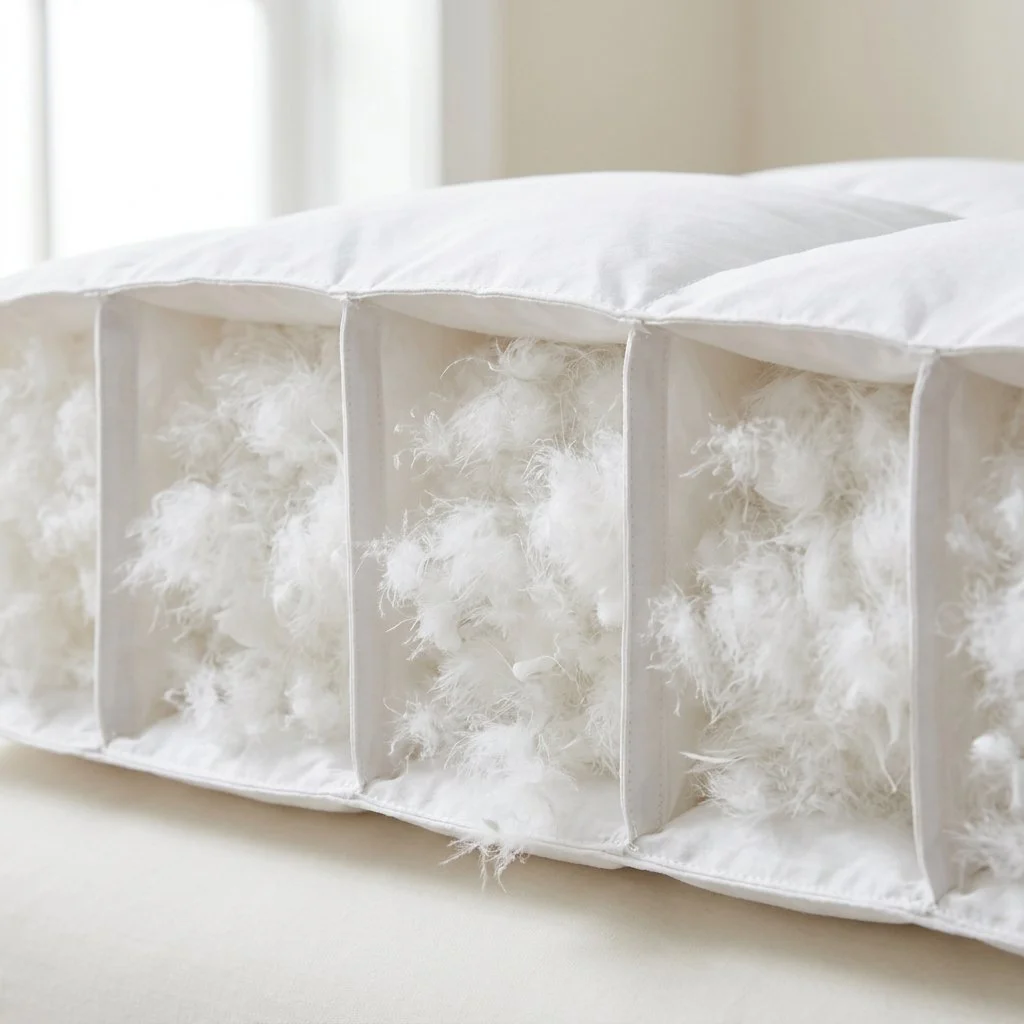
Cross section view of a baffle box duvet construction displaying individual fabric chambers filled with airy white down clusters.
Restraint Isn't the Same as Absence
The palette question comes after the material question, not before it. Ivory, oatmeal, sand, sage, softened charcoal, these read as restrained because they let the weave's texture do the visual work instead of competing with it. A sateen in oatmeal shows its sheen. A percale in the same tone shows its crispness. The color isn't the design decision. It's what makes the material decision visible.
Care technique for these fibers lives in its own place on this site rather than repeated here.
What a Trade Buyer Should Actually Specify
Start with weave, matched to the client's climate and hand feel preference. From there, ask what the fill actually is and how it's measured, since a duvet described only as "down" or "silk" with no fill power or GSM attached is a duvet nobody has actually specified. Thread count is the last thing worth checking, mainly as a sanity check against whatever weave and fill claims came with it. Get the weave and the fill right and the palette takes care of itself.
