How to Build a Glass Wine Room
A glass wine room has to hold cellar conditions behind its weakest wall. Here is where the vapor barrier goes, and why the serving bottles belong in a separate cabinet.
A glass wine room is a refrigerated room for aging wine with at least one wall of glass, and it has to hold the conditions of a cave inside a warm house. Wine Spectator puts those conditions at about 55°F and around 70 percent humidity, and it ranks a steady temperature above everything else. Glass makes both numbers harder to hold. The room only works when the glass and the walls around it are designed together with the cooling, before anyone picks a rack.
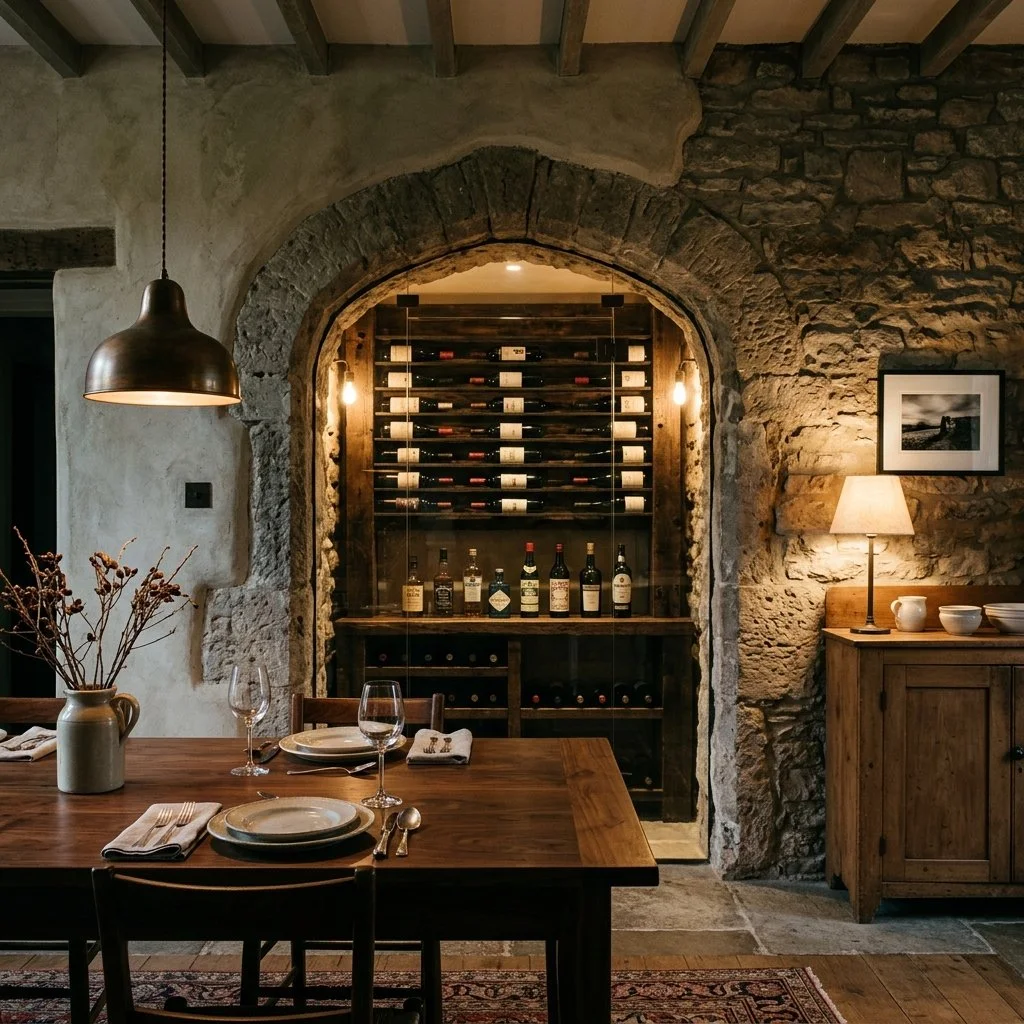
Glass wine room set into a stone arch beside a dining table, with wine on its side and spirits standing upright.
Where Does the Vapor Barrier Go in a Wine Room?
A wine room is cold and damp inside a house that is warmer, so moisture is always pushing toward the cold side. The vapor barrier stops it, and it belongs on the warm side of the insulation, facing the house. A trade report in ACHR News described what happens when a contractor puts it on the inside instead, moisture moving through the wall soaked the fiberglass and pooled in the ceiling. The rule of thumb in that report is blunt. No vapor barrier is better than one on the inside wall.
Glass is where that envelope is weakest. The cellar builder Vintage Cellars notes that even insulated glass with two panes is a poor insulator, so a glass room usually needs a bigger cooling unit than its size suggests. One Toronto builder lists condensation on the glass among the results of building the showpiece without upsizing the cooling. It’s the same physics that fogs a window in winter, working in reverse.
Buying the Glass as a System
There are two ways to get the glass. A glazier can cut insulated units for a custom room, or the glass can come as part of an enclosure engineered for wine. The Wine Square, a European maker, sells a prefabricated glass enclosure, and its own manual treats the glass as the weakest point of the room. Its glass comes in a double pane version and a triple pane version, and the maker says the third layer adds another air gap.
The same manual gives two numbers worth handing to a structural engineer early, plan for the glass at 10 pounds per square foot and each bottle at 3 pounds. A thousand bottles is a ton and a half of wine on one floor. A custom room can perform as well, but I’d ask the glazier for the glass’s insulating value in writing and give it to whoever sizes the cooling.
Where the Cooling Goes
The cooling decides more about how the room looks than most clients expect. In that enclosure, only a slim radiator mounted in the ceiling shows inside the room, according to the brand’s North American dealer, connected by insulated tubing and network cable to equipment that can sit up to 100 feet away. Ducted systems from other makers do something similar with a grille. Either way, the equipment needs a place to live and a way to get rid of its heat, and that place goes on the plan before the framing.
Two cooling makers, Wine Guardian and CellarPro, say the same thing about humidity, the unit doesn’t create it. Wine Guardian says a dry climate needs a humidifier, and the vapor barrier keeps outside moisture from overwhelming the room. Vigilant, another cellar maker, warns that a household air conditioner can’t reach 55°F and pulls humidity out of the room. I’d run the room’s temperature and humidity alerts into the alarm system the house already has, and if the house has backup power, the wine room belongs on the list the family ranks.
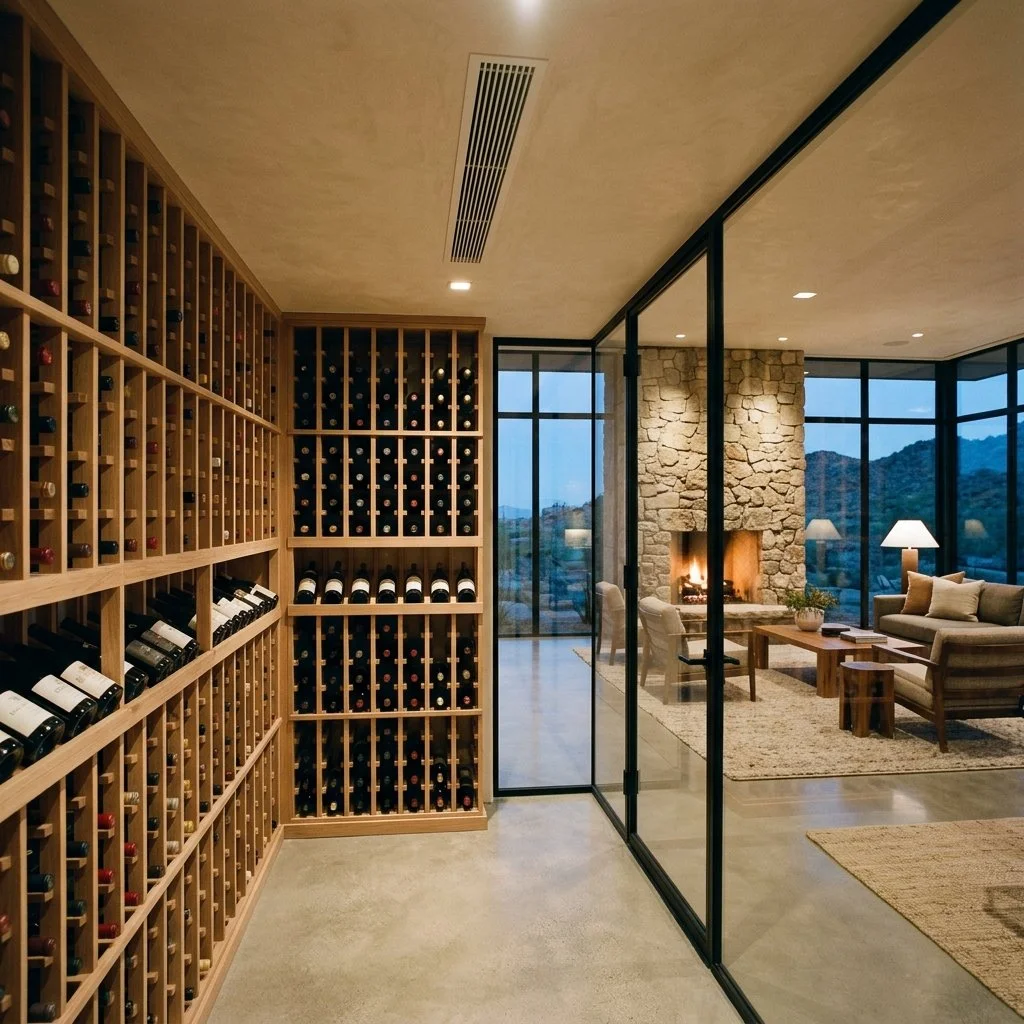
Inside a glass wine room with oak racks and a slim cooling grille set into the plaster ceiling.
Can You Store Whiskey in a Wine Room?
Yes, but not the way wine is stored. Corked wine lies on its side so the cork stays moist, while high proof spirits can break down a cork, so Club Oenologique recommends standing those bottles upright. The same piece suggests one shared humidity band of about 60 to 70 percent when wine and spirits live together. Wine under a screwcap can go either way, since a screwcap doesn’t need to stay wet, according to Wine Spectator.
That means one wall may need two kinds of racking, cradles for bottles on their sides and shelves tall enough for bottles standing up. I’d have the rack maker count the actual collection by closure before drawing anything. For a cellar in the thousands of bottles, RFID tags let someone count the whole room with one handheld sweep, according to the merchant Westgarth Wines. If you build racking that holds both well, I’d like to see it.
The Champagne Lives Somewhere Else
White and sparkling wine have taken a much larger share of fine wine trading since 2010, according to Liv-ex figures reported by Cellar Advisor. Those bottles are served far colder than any wine is aged. Dometic puts Champagne at 41 to 45°F (5 to 7°C), while the cellar maker Avintage puts storage near 54 to 57°F (12 to 14°C). Chilling part of the aging room to close that gap costs the room its humidity: the Le Cache cabinet line, sold by Vintage Cellars, warns that its dual zone kit drops humidity to around 40 percent and should be used for serving, not storage.
So the glass room does one job, holding steady for years, and a cold serving cabinet near the table does the other. Drawn that way from the start, the glass and the cooling only have to answer to the long hold. The rack only has to fit what’s actually in the collection.

How to Spec a Rumford Fireplace
A Rumford is a tall, shallow masonry fireplace that throws heat into the room instead of up the chimney. The code numbers to check, and the two details builders skip most.
A Rumford fireplace is a tall, shallow masonry firebox with side walls angled wide and a throat rounded so smoke slides up the chimney instead of tumbling back into the room. The angled walls throw heat forward as radiation, which is the whole reason the design exists. Benjamin Thompson, known as Count Rumford, published it in a 1796 essay on chimney fireplaces. The design stayed common until about 1850, when coal and gas heating took over. My interest in it is practical, where open fires are being restricted, a properly built Rumford may be one of the few a client can still light.
Tall, shallow wood fireplace with angled side walls in a heritage townhouse bedroom.
What Makes a Fireplace a Rumford
Rumford kept the back wall straight and vertical, and made it about a third as wide as the opening. The side walls, which he called covings, splay out from that narrow back, and he capped their angle at 135 degrees to the back. Above the fire he rounded the breast, the curved masonry that streamlines the throat so smoke moves through without turbulence.
Jim Buckley, whose company in Port Townsend, Washington, builds Rumford fireplaces and trains masons to build them, points out that many fireplaces called Rumfords have a back that slants forward partway up. He traces that version to a misreading of one small fireplace Rumford described as an exception. Thomas Jefferson built Rumfords at Monticello but widened the back to half the opening, writing in 1799 that Rumford’s proportions suited coal and were impractical for wood. His bedroom fireplaces measured three feet three inches across the front and three feet high. By Buckley’s reading, Jefferson kept the back straight and skipped the rounded breast.
How Shallow Can a Wood Burning Fireplace Be?
The International Residential Code, the model code most states build on, requires a masonry firebox at least 20 inches deep. Rumfords get their own exception. They can be as shallow as 12 inches, as long as the depth is at least a third of the opening’s width. The throat has to sit at least 12 inches above the lintel, and its area has to be at least one twentieth of the opening’s area. Local versions carry amendments, so the edition the building department adopted is the one that counts.
The tall opening has a second consequence that shows up on the floor plan. The required hearth extension steps up once the opening reaches six square feet, 16 inches in front and 8 at each side below that, 20 and 12 at or above it. A 36 inch square Rumford opening is nine square feet, so it takes the larger hearth even though the firebox behind it is shallow.
The Mantel Gets Less Room Than It Looks Like
The same code lets wood trim sit directly on the masonry face, but nothing combustible can sit within six inches of the opening. Above the opening and within 12 inches of it, a combustible piece can project only an eighth of an inch for every inch of distance, so a shelf 12 inches up can stick out an inch and a half. On a tall opening, that pushes any real wood mantel shelf high on the wall. The clean answer is a stone or plaster surround up to that line, with wood starting where the code gives it more room.

Close view of a masonry firebox with soot darkened firebrick.
Where an Open Fire Is Still Allowed
Air quality rules on new fireplaces tend to fall into two kinds. The San Francisco Bay Area’s air district bans wood burning devices in new houses outright, even ones that meet federal emission standards. Other places allow fireplaces that have been tested and certified under an emissions limit. Washington works this way. Rumford fireplaces built from components sold by Buckley’s company were tested by an EPA certified lab, came in under the state’s particulate limit, and are certified by the state. According to his installation manual, certified units can burn even on Stage I burn ban days. In a region with an outright ban, that certification changes nothing. The local air district decides whether there is a chimney to draw at all, and that’s worth checking before anyone sketches one.
Rumford’s 1798 Complaint Still Applies
Two years after his first essay, Rumford published a second one, written mostly to correct workmen who had skipped rounding the breast and pushed the covings wider than he allowed. Buckley still sees the missing curve today, along with the slanted backs. The code’s exception covers depth and throat size and says nothing about either, so the straight back and the rounded throat have to be asked for by name. If you’re a mason who still builds that curve, I’d like to see your work. The code will catch a firebox that’s too shallow. It won’t catch a throat with no curve.
What Holds Up a Good Sofa
Eight way hand tied comes from a fix for loose coil springs in the 1820s. How a sofa's frame, suspension, foam and fabric each set its lifespan, and what to put in the specification before you order.
In the 1820s, iron springs got cheap enough to put inside a couch or chair seat. A London maker named Samuel Pratt took out a patent on coil springs for couches and other seating in that decade. Upholsterers first set the coils in loose, and over time they shifted and slid out of place until the seat went lumpy. The fix was to stitch each spring to the webbing and tie the whole bed of them together with twine so they moved as one unit. That principle is the one showrooms now sell as eight way hand tied.
A sofa hides everything that decides how long it lasts. A showroom lets you judge the cover and the first minute of the sit. Everything structural sits under the fabric, and that is where I start.
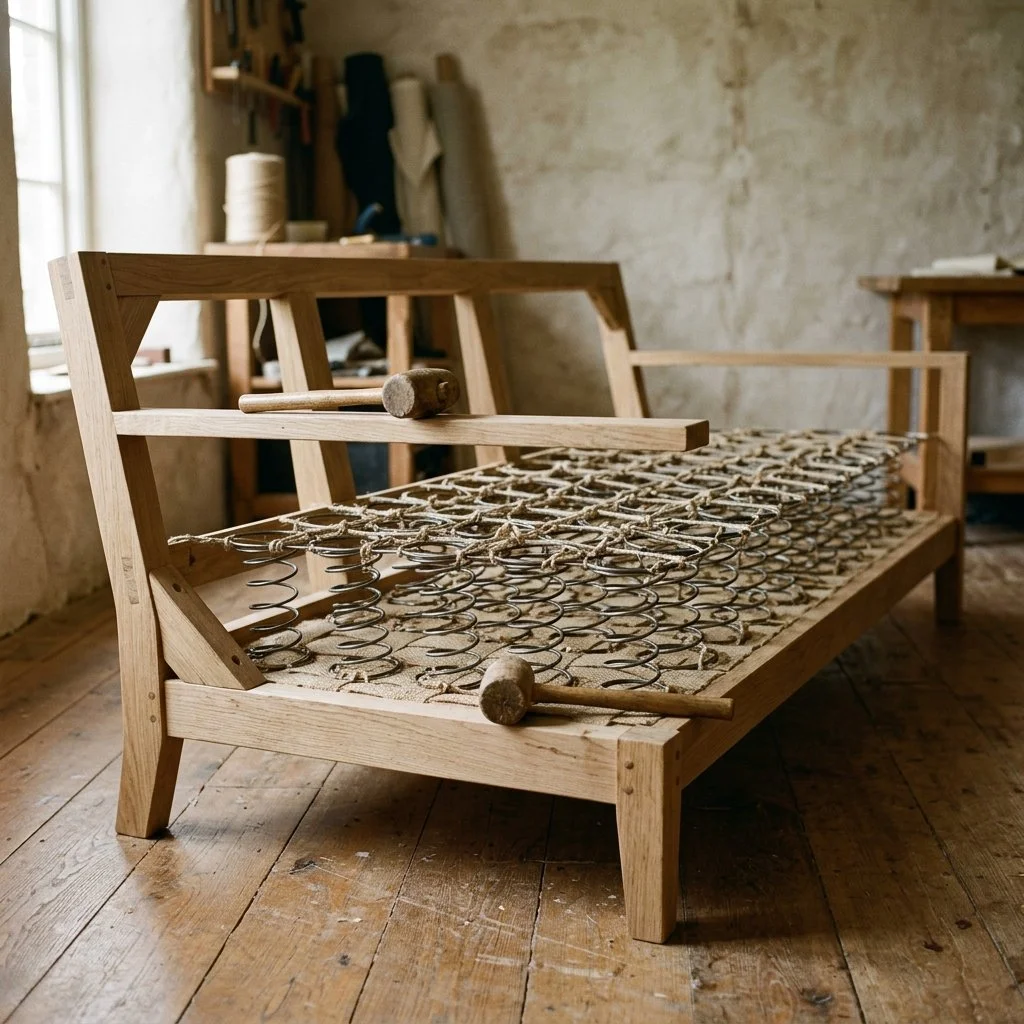
Bare hardwood sofa frame with coil springs tied together by hand with twine.
The Frame Has to Be Dry
Hardwood for furniture is kiln dried to a moisture content of 6 to 8 percent. Purdue's cooperative extension service describes that as the midpoint between the normal swings of indoor humidity. Wood dried to that point still moves with the seasons. Wood that went into the frame wetter keeps drying inside the finished sofa, where it shrinks and can warp, and a frame that shrinks pulls on every joint in it.
I expect the maker to name the hardwood, such as oak or maple. Then I ask how the corners are joined. Glued double dowels with corner blocks is the construction to look for. A frame held together by staples and nails alone will loosen under the plain work of people sitting down hard and standing up again.
Eight Directions of Twine
The eight in eight way hand tied counts the directions the twine runs, diagonals across the bed of coils included. It takes skilled labor and a lot of time, which is most of why it costs more.
The common alternative is sinuous spring, a heavy steel wire bent into a continuous S and run in rows that stretch front to back across the seat frame. It takes far less labor and shows up in most mid priced sofas. Upholsterers argue about how much longer hand tied really lasts, and that argument is not settled. The standard for a good sinuous system is clearer: 8 gauge wire, with tie wires running across the rows. For a sofa that gets sat on every day, hand tied is the suspension I ask for first.
What a Rub Count Measures
The number on a fabric's spec sheet comes from a machine. In the Martindale test, a disc of worsted wool travels over a stretched sample in a figure eight until two yarns break or the surface visibly changes. The machine stops to inspect every 5,000 rubs, so a fabric rated at 25,000 passed that mark and was not run through 30,000. Suppliers draw the lines differently. One major fabric house puts heavy residential use at 25,000 to 30,000, and for the sofa a family actually lives on, I don't go below 25,000.
In North America, Wyzenbeek is the usual standard, and it rubs the sample in a straight line back and forth. The residential figure there is 15,000 double rubs, and heavy duty starts at 30,000. No reliable formula converts one test into the other, so ask which machine produced the number you're looking at. Treat either one as a guide to where a fabric belongs. It cannot tell you how many years you'll get.
The Core and the Wrap
A good seat cushion is two materials with separate jobs. A foam core carries the weight and springs back when you stand up. A wrap of down or feathers around it gives the softer crown on top and the first inch of give.
Foam is specified by two numbers that get confused. Density is the weight of a cubic foot of the foam in pounds, and it is the usual guide to how long the foam holds its shape. Firmness is a separate figure called indentation load deflection, listed as ILD. The trade treats 1.8 pounds per cubic foot as the point where foam earns the phrase high density. The phrase gets used loosely enough that I ask for the actual number. Foam in more expensive residential furniture generally runs higher, around 2.2 to 2.5.
Your Legs Set the Seat Depth
Seat depth is ergonomics, and it depends on the person. The standard for sitting upright is 20 to 22 inches. Lounging starts around 23 and gets deep past 25, which suits taller people and leaves shorter ones with their feet off the floor. The test takes ten seconds. Sit all the way back. If your feet dangle, or the edge of the cushion presses behind your knees, the sofa is too deep for you, however it photographs.
Scale is the other half. Leave 30 to 36 inches for the main path through a room and about 18 between the sofa and the coffee table. Measure the doorways and the stairwell before you fall in love with a length.
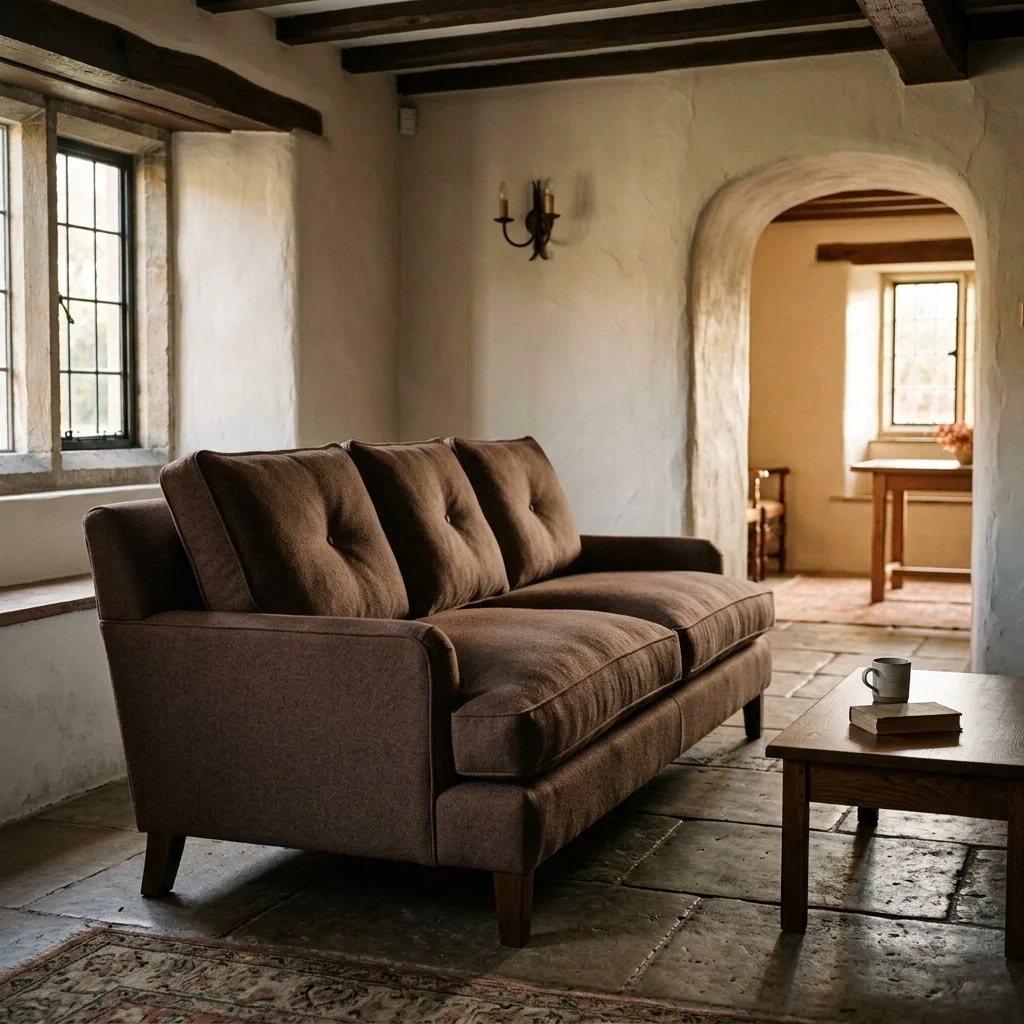
Upholstered sofa seen from the side.
Ready Made or Built for You
A ready made sofa from an established line has one great advantage. You can sit on the actual thing, and it arrives when they say it will. The tradeoff is that you get their dimensions and their range of covers, and depth is the dimension that matters most.
A custom sofa reverses that. You choose the dimensions and the cover, and you wait longer for it. Until it arrives the sofa exists as a written specification, so the specification has to name the wood, the suspension, the foam density, and the rub count. Ready made comes through a trade showroom or the maker's own floor. Custom comes from an independent upholstery workroom, and I would only commission from one that will show me a bare frame it has built.
The Weakest Layer Sets the Lifespan
The upholsterers who first tied their springs together were solving a problem of parts that didn't work as one, and a sofa still fails the same way. Its life is set by its weakest layer. A heavy duty fabric over springs that sag is money spent on the wrong layer. A well dried frame under thin foam gives you a good frame and a bad seat. When I compare two sofas, I compare the weakest layer of each and look at the cover last.
The Elemental Kitchen
A molcajete is cured with rice and salt before its first use, and a copper pot needs its tin lining renewed about once a decade. The kitchen tools that improve with use, and the Mexican workshops that still make them.
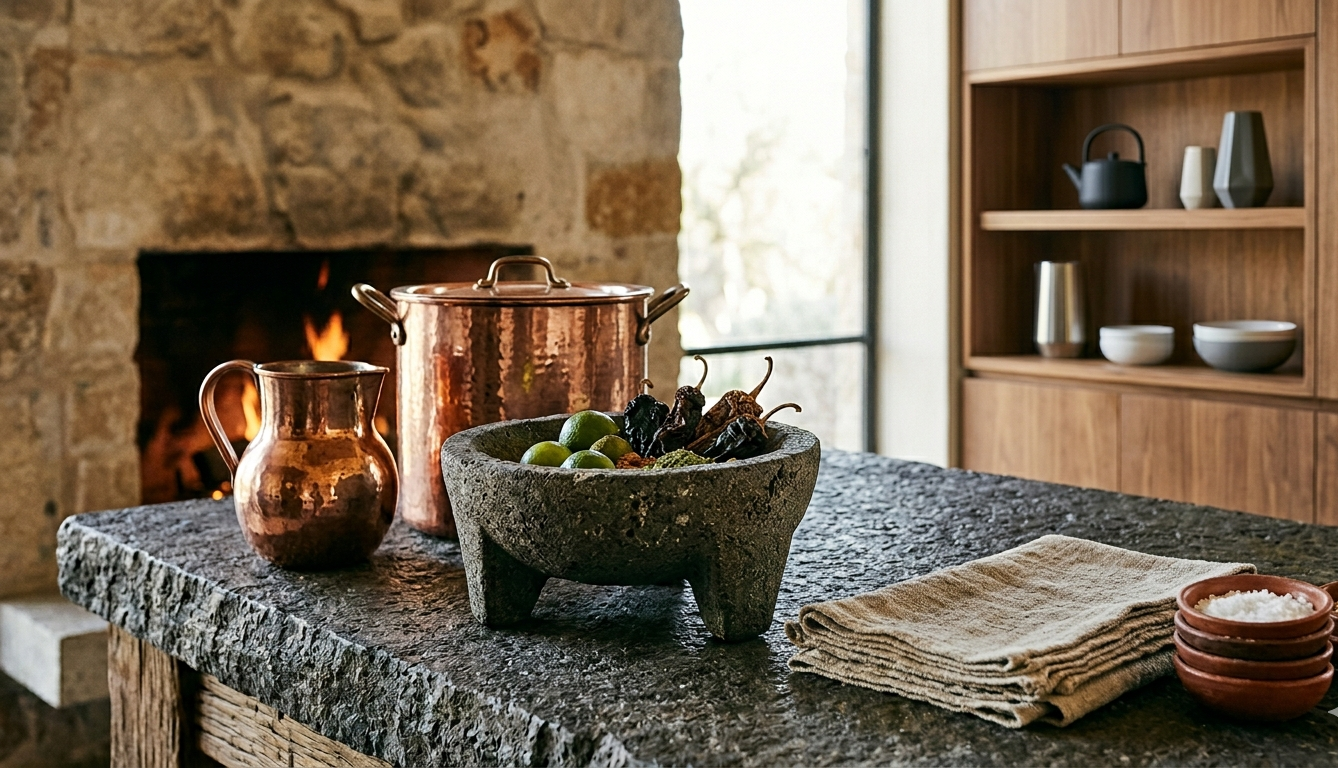
Before a new molcajete ever touches a chile or a clove of garlic, it gets a rougher job first. Grind a handful of raw white rice and a spoonful of salt against the stone, over and over, until the grit stops running gray. That first grinding scrapes off the loose grains left behind by the carving, the ones that would otherwise turn up in your salsa. It's not a step you skip if you want the stone to actually work. That's the real difference between a permanent kitchen and a convenient one. Permanence asks something of you first.
Basalt molcajete and copper cookware on a dark stone counter in a modern kitchen with a warm hearth.
The Stone That Grinds, Not Blends
A molcajete is carved from a single block of vesicular basalt, the kind full of tiny air pockets left behind when volcanic rock cools fast. Mine came out of workshops in Puebla and Jalisco, where the craft goes back to the Aztec and Maya, who ground the same way in the same material long before a Spanish kitchen ever asked for one. The porous surface does something a blender can't. Grinding ruptures the cell walls of a chile or a clove of garlic instead of slicing through them, and that releases oils and aromatics a blade cuts past without touching. The stone doesn't dull the way a blade does either. As the tiny bubbles at the surface wear down with use, they expose fresh texture underneath, so a molcajete worked for twenty years grinds better than one still in its box.
The Copper That Answers to Heat
Copper conducts heat at roughly 392 watts per meter kelvin, which is why a copper pot heats faster and more evenly than almost anything else you can put on a burner, and why a sauce reduces without the scorched ring that shows up in a heavier stainless pan. I don't spec copper for a kitchen unless it's actually going on the stove, not just sitting out to be looked at, because the metal only earns its place in real heat. Coppersmiths in Santa Clara del Cobre, Michoacán, have hammered the metal by hand since before the Spanish arrived. The Purépecha worked copper there long before the town had its current name, and in 1538 the bishop organizing the region's crafts assigned coppersmithing to Santa Clara specifically, so neighboring villages wouldn't compete for the same trade. The copper mines nearby ran dry decades ago. What the workshops hammer today is mostly recycled scrap, old wire and cable pulled apart and melted down again. Every copper pot needs a lining, usually tin, because copper reacts with anything acidic, and a tomato sauce or a squeeze of lime will turn both the food and the metal the wrong direction. Tin starts to soften above roughly 425 degrees, so a copper pot that's had years of real use eventually goes back to be relined, maybe once a decade with real care. The one place copper works fine bare is sugar and egg work, since neither reacts with it, which is why confectioners kept unlined kettles long after everyone else moved on.
The Press That Works on Leverage
A cast iron tortilla press is two flat plates hinged at the back, with a lever that turns a small amount of hand pressure into the even, downward force it takes to flatten a ball of masa into a perfect round. Before the press existed, that same flattening happened by hand, clapped rapidly between the palms or rolled thin the way you'd roll pastry, both slower and less even. The mechanics are simple but easy to miss. A wider plate spreads the same force over more surface, which is why a larger press leaves a tortilla the same thickness at the center as at the edge instead of thick in the middle and ragged at the rim. The same leverage handles anything else that calls for uniform, heavy pressure, seed crackers or heritage flatbreads, whatever the kitchen needs that day.
The Wood That Takes the Oil, Not the Sealant
I keep coming back to Tzalam for anything that touches the hand directly, a rolling pin or a spoon with a long handle, since its density and rot resistance are already established in what I've written about doors and floors. What changes here is the finish. Furniture gets sealed. A tool that touches food gets oiled instead, food grade mineral oil worked into the grain by hand and reapplied as the wood absorbs it, never a topcoat that would seal the surface shut. The wood keeps breathing. That's the whole reason to choose it here instead of somewhere it would only sit and be looked at.

A hand hammered copper pot with visible mallet marks and a rustic patina.
The Clay That Pulls Moisture the Wrong Way
Terracotta means baked earth in Italian, and the name describes exactly what it is: clay fired at a relatively low temperature so it stays porous instead of vitrifying shut. Salt kept in wood or plastic pulls moisture from the air and clumps. Salt kept in unglazed terracotta doesn't, because the clay's own pores draw that moisture out of the salt and hold it in the vessel wall, where it evaporates off the outside instead.
The Kitchen That Gets Better With Use
Every one of these pieces improves with exactly the use that would ruin something cheaper. The molcajete grinds better once its surface has been worked in. The copper needs its lining renewed every decade because it's actually being used for what it's for. The press wears smooth at the hinge. The wood darkens and takes the oil more evenly the longer it's handled. The terracotta keeps doing its job precisely because it stays unglazed. None of that is an argument for buying less. It's an argument for buying the kind of thing that was built to be used constantly rather than protected. For the stone, I still go back to the same carvers in Puebla and Jalisco. They quarry and shape basalt the same way they always have. For the copper, it's worth seeking a piece that actually came out of a workshop in Michoacán, hammered by hand, rather than one that only looks like it was.

Where the Kitchen Ends and the Dinner Begins
Open plan kitchens tend to fail the night guests arrive. How a partition of Tzalam slats and Chukum plaster separates cooking from dinner, and why the right builder is often the one who already knows the house.
A pan dropped mid plating, four burners running while someone's still hunting for the good napkins. Open plan kitchens are built for a family's Tuesday morning, not the twenty minutes before people arrive for dinner. The room that felt generous all day suddenly has nowhere for the work to hide.
Designing kitchens with an actual boundary in mind, one that has nothing to do with square footage and everything to do with what a guest is allowed to see.
Central slatted Tzalam screen, serves as the primary visual shield, between the kitchen and dining area.
A Screen That Reads as Architecture, Not a Curtain
A floor to ceiling Tzalam screen is my usual answer. Vertical slats block the direct sightline into the work zone while still letting light and conversation pass through the gaps. Tzalam's grain is straight and clearly defined, so each slat reads as its own line rather than a repeated pattern, which matters when you're looking at forty of them at once.
For a softer version, I like heavy tanned leather panels instead. They do for sound what the screen does for sight: a soft surface between the two rooms instead of hard ones knocking noise back and forth. I've also started specifying Henequen, the plant fiber native to the Yucatan that the Maya call Ki. It's the same fiber that built enormous fortunes across the region in the nineteenth century, when the world's ships ran on henequen rope and a war overseas cutting off the competing supply sent prices soaring. Most people still picture it as coarse cordage. A few artisans in Yucatan are weaving it finely enough now that it reads as a textile, set into dark timber frames, with none of the rope like weight the material's history suggests.
The Facade That Hides the Work Behind It
The most effective partition doesn't feel like a partition at all. I like a Cantera stone pantry or prep wall, the same volcanic stone I've used elsewhere as carved objects, here doing the opposite job: a solid, upright mass instead of a shaped one. Clad in it, the working side of the kitchen reads as a permanent part of the house rather than a functional add on.
The detail that actually gets noticed up close is the hardware. Hand forged iron pulls or sandcast bronze handles turn utilitarian cabinetry into the one piece of jewelry the wall is wearing. Neither needs to explain itself. They just need to feel like they were made by someone's hands, because they were.
Light That Chooses What You See
Lighting does more of this work than people expect. I keep the kitchen itself low and amber, almost a background hum, while the dining table gets a warm, sharp pool of light from a low slung, oxidized bronze pendant. The eye follows the brightest point in the room. Put it over the table and the kitchen edges out of view on its own.
Where I want the whole room to feel handmade rather than built, I turn to Chukum, a lime plaster the Maya have used for centuries, made by boiling the bark of the Havardia albicans tree until it releases a tannin rich resin, then mixing that resin with limestone. The result is genuinely waterproof, historically used to line hacienda cisterns and ponds, and it dries to a matte, faintly uneven finish that no machine applied plaster can fake. Its color depends on which of the region's bark varieties went into the mix and how finely the limestone was ground: sometimes a pale beige, sometimes a deeper, almost ash grey. On the wall behind a partition, it gives the room a texture that looks touched rather than sprayed.
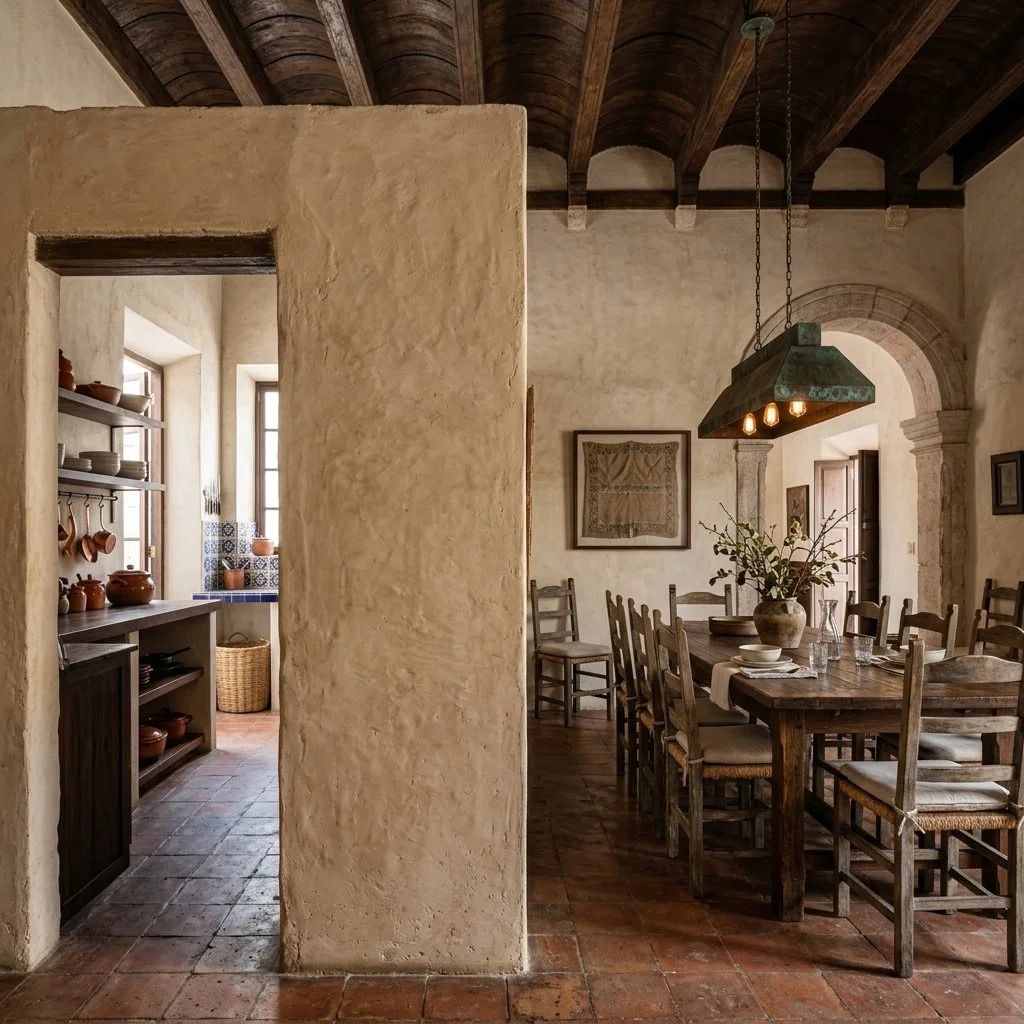
A freestanding Chukum plastered partition divides a dining area from a glimpsed kitchen.
The Work Happens Somewhere Else
The kitchen doesn't disappear behind any of this. What disappears is the fifteen minutes between courses, the plate cleared and the next one set down, happening somewhere the conversation can't see it. That reset is what the partition actually protects.
A partition like this is rarely part of the original plan. It shows up later, once a house has been lived in long enough for someone to admit the layout doesn't work for how they actually host. That makes it exactly the kind of project for whoever already knows your house, the carpenter who built your cabinets, the mason who laid your floors, not a new specialist. You already have the person. You just haven't given them this idea yet.

The Vessel That Holds the Room
Visual weight comes from size, darkness, contrast and texture, which is why one object can hold a whole room. Barro Negro from San Bartolo Coyotepec and Cantera stone carved near Guadalajara, and why the older matte black clay is the one to choose.
I didn't expect to find design theory backing up something I already do by instinct, but there's an actual term for it: visual weight. A dark, textured object reads as physically heavier than a pale, smooth one the same size, even though nothing about its real mass has changed. Photographers, painters, and graphic designers use this on purpose, to control where the eye lands first and how long it stays there. A living room works the same way. Give one object enough visual weight, and it becomes the thing everything else in the room organizes around, without you doing anything else to earn it.
A large, matte black Barro Negro pottery vessel sits centered on a weathered, rough hewn wooden console table.
The Eye Reads Weight Before It Reads Detail
Size is still the biggest factor, but color and finish do real work too. A dark, matte surface absorbs light instead of bouncing it back, so the object holds its own edges instead of blending into whatever sits behind it. That's why a single black clay bowl the size of a dinner plate can outweigh, visually, a whole shelf of smaller pale ceramics. I keep coming back to two materials that do this without trying: matte black clay from Oaxaca, and volcanic stone quarried across central Mexico.
A Craft Two Thousand Years Older Than the Trend
Barro negro, black clay, comes from San Bartolo Coyotepec in Oaxaca, where Zapotec and Mixtec potters have worked the same local clay for roughly 2,500 years. For most of that history it fired matte, in tones of black and gray, sturdy enough to survive being knocked around as an actual working jar. In the 1950s, a potter named Doña Rosa discovered that burnishing the nearly dry clay with a smooth stone before firing produced a glossy, mirror black finish instead. It's the version most people picture now, and it's also more fragile and more porous than the traditional matte form. For an object meant to live in a room and get handled, the older, unburnished version is the one worth owning. It takes daily use without wearing down, and its surface does exactly what a heavy anchor piece needs: it absorbs the light in the room instead of throwing it back. Some of the same families in San Bartolo Coyotepec still fire it in pit kilns dug into the ground, the way their grandparents did.
The Stone Colonial Mexico Was Built From
Cantera is a volcanic tuff. The word itself just means "quarry" in Spanish, which tells you how central it's been to Mexican building for centuries. It's the stone behind the cathedrals and haciendas of Guadalajara and Querétaro, carved into columns, fountains, and church façades that are still standing. It's also genuinely porous and light for a stone, which is what lets it be carved into a real vessel without the crushing weight of granite or basalt. The color shifts by quarry, running gray in one region and gold in another. Oaxaca's version is different: a distinct green, the result of volcanic ash settling into a silt bed before it hardened. A single Cantera vessel carries that same architectural lineage indoors.
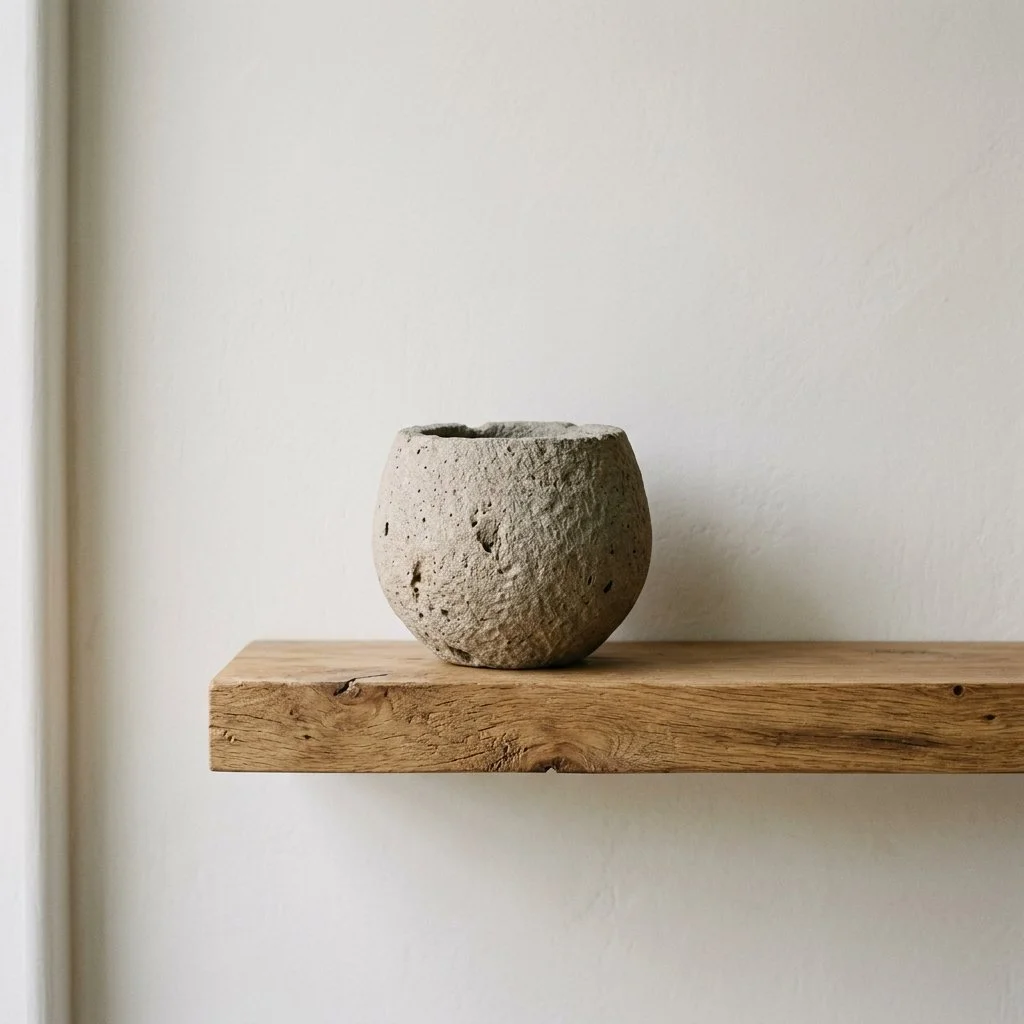
Hand carved porous Cantera stone vessel resting on a rustic, floating solid wood shelf.
Where One Object Does the Most Work
In the kitchen: a matte black clay bowl against a stone island reads as texture against texture, not competition.
In the bedroom: a small Cantera vessel on a timber ledge gives a lighter textile palette one grounded point.
In the entryway: a tall black clay jar sets the material tone of the whole house from the moment someone walks in.
A Courtyard Has to Earn Its Keep
The courtyard house is about 8,000 years old, and the Roman impluvium leads straight to the Andalusian patio and colonial Mexico. What makes terracotta and bronze worth putting in one, and the simple test of whether anyone sits there.
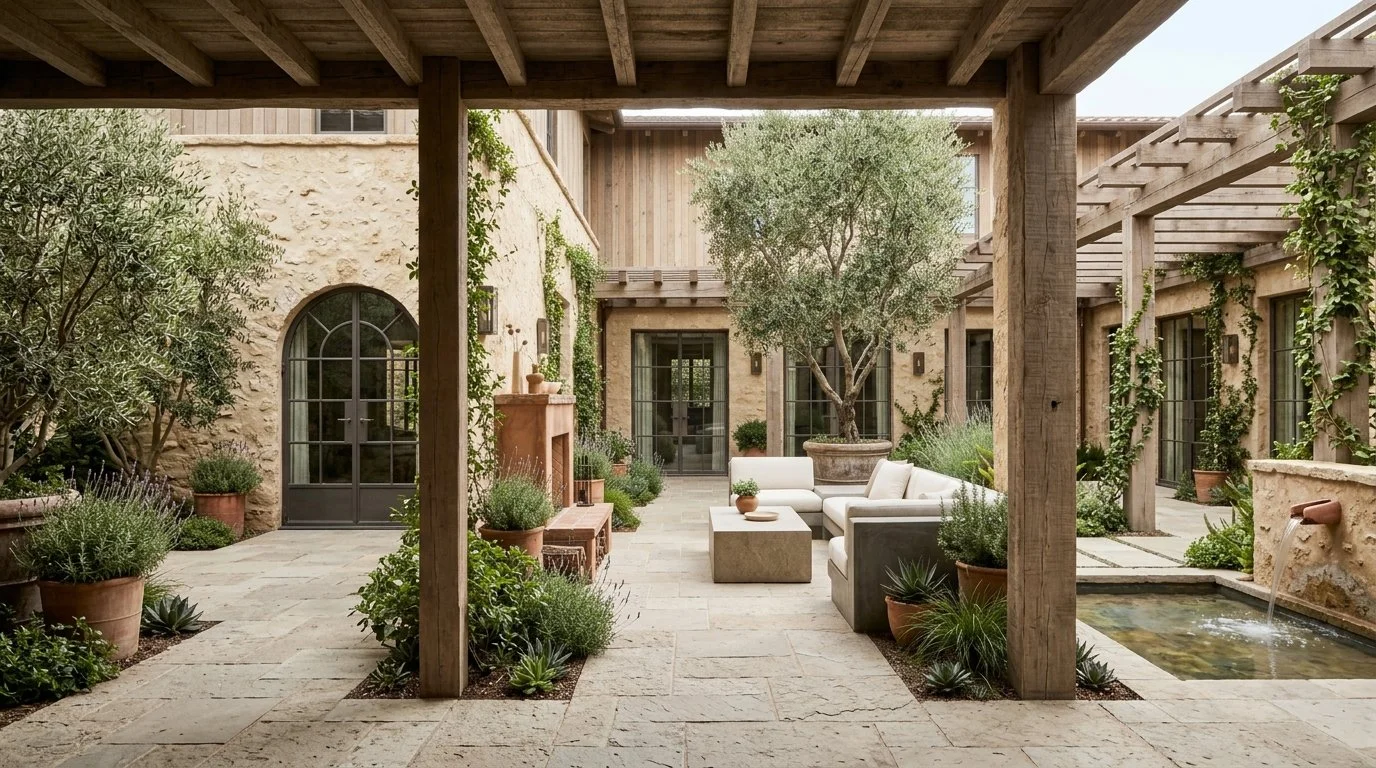
A courtyard house is one of the oldest architectural ideas people never stopped building. Archaeologists trace the form back roughly eight thousand years to Neolithic settlements in the Jordan Valley, and it turns up again centuries later in the Roman house, where the central opening had a name and a job: the impluvium, a shallow basin set to catch rainwater falling through a gap in the roof. When Roman building tradition met Islamic architecture in southern Spain, that opening became the Andalusian patio, the literal heart of the house rather than a leftover gap in the plan. Córdoba still holds a spring festival judging the best kept patios in the city, which tells you how seriously that tradition takes a space most modern houses treat as an afterthought. Spanish colonizers carried the same layout to the Americas centuries later, which is why a courtyard in Guadalajara and a patio in Córdoba are still, structurally, the same idea wearing different stone.
A courtyard survived eight thousand years of shifting architectural fashion because it did real work. It pulled light into the middle of a windowless house, and it let air move where a sealed room couldn't manage on its own. The privacy came free, since nobody on the street could see in. If your courtyard isn't doing any of that, filling it with beautiful things won't fix the plan underneath it.
Courtyard with continuous stone flooring, outdoor seating, a central olive tree, a terracotta hearth, and a small water feature framed by wooden beams and stone walls.
The Fire Needs Clay, Not Iron
Once the courtyard exists, it needs a reason to hold people after dark, and a fire does that better than any light fixture. I steer people away from imported cast iron fire pits here and toward a fireplace or chiminea built from clay, shaped by hand and fired at high heat. Terracotta and metal behave completely differently around a flame. Metal heats and cools with the fire itself, throwing hard, uneven heat for as long as the flame lasts and almost none after. Clay absorbs heat slowly through the whole mass of the wall, then gives it back slowly too, so the warmth around a terracotta hearth outlasts the fire itself. That's thermal mass. It works the same way a courtyard's own stone floor and walls already do all day, just concentrated into one object.
The Bronze Doesn't Stay Bronze
Any bronze lantern or candlestick left outside starts changing the moment it's cast. Fresh bronze develops a thin reddish brown skin almost immediately on contact with air, a compound called cuprite. Left outdoors and exposed to rain and humidity, that skin keeps reacting, and the copper in the alloy slowly converts into a family of green toned compounds, mostly copper carbonates and sulfates, that collectors call verdigris. It's the same chemistry that turned the Statue of Liberty green over decades. A finisher who wants that color without waiting decades will accelerate it with heat and chemicals, then seal it under a thin coat of beeswax once it reaches the shade they're after. The wax isn't cosmetic. Without it, the same reaction that made the color keeps eating into the metal underneath.
Terracotta's Whole Argument Is That It Breathes
The planters holding a courtyard's trees do more work than they get credit for. Terracotta is a porous clay, unlike glazed ceramic or plastic, and that porosity lets air and moisture pass straight through the pot wall instead of pooling against the roots. An olive tree tolerates almost nothing worse than wet feet, so that single property matters more here than color or shape ever will. A well made terracotta pot is fired above 1,000 degrees Celsius specifically so the clay can survive freezing nights outdoors without cracking, which is why a pot thrown in Izmir or Tuscany can sit in a courtyard through winter instead of coming inside every October.
The Stone Doesn't Need to Prove Anything
Whatever surfaces you set between the seating, whether cut from volcanic rock or the same honed limestone running through the house, they should be solid enough that nobody mistakes them for patio furniture. A single heavy slab reads as architecture. A stack of thin, veneered pieces reads as something bought for a season. I'd rather spec one heavy slab than three matched pieces that all have to be replaced on the same schedule.
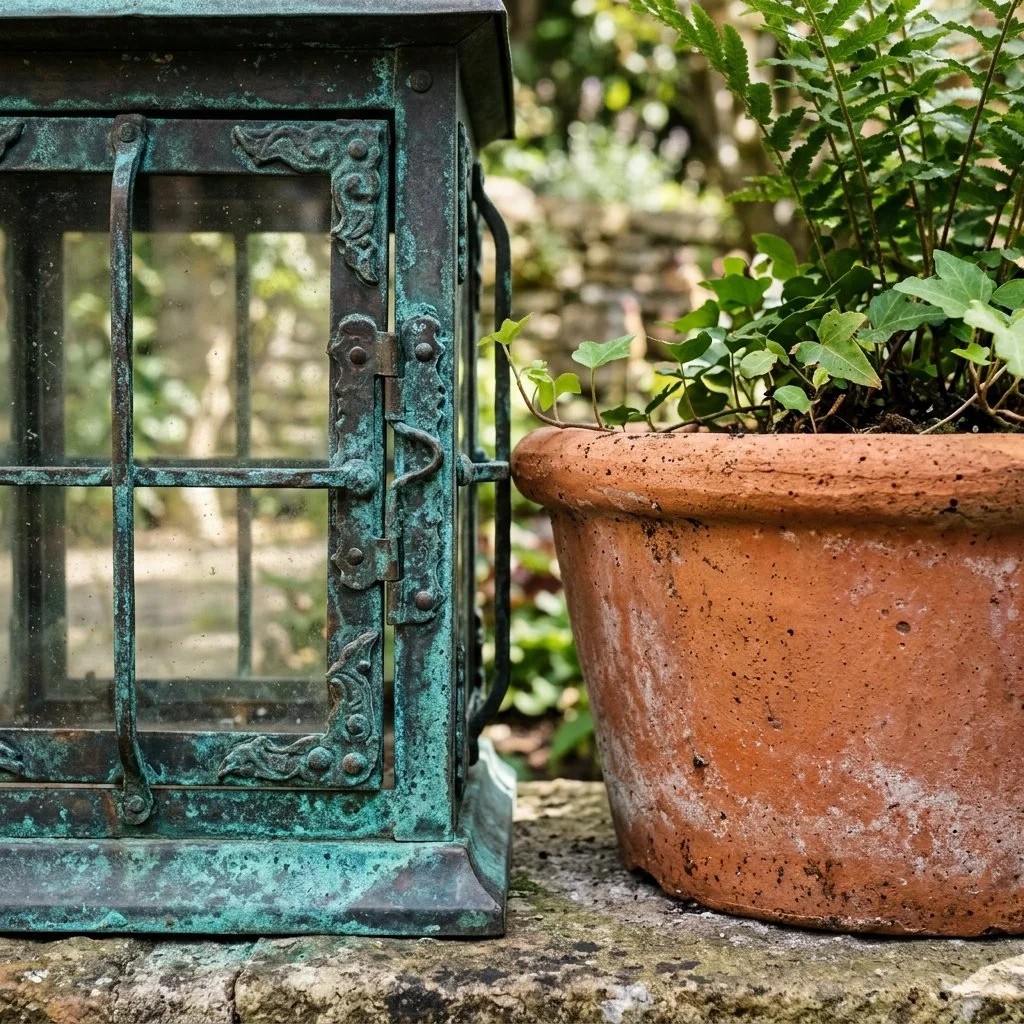
Aged bronze lantern displaying a rich verdigris green patina resting beside a weathered terracotta planter.
The Test Is Whether You Actually Sit There
A courtyard filled with the right materials and never used is just an expensive gap in the floor plan. Terracotta earns its place by keeping people warm after dark. Bronze earns its by aging instead of corroding, and stone earns its by refusing to look temporary. You now have a reason to stay outside.
The Kitchen Anchor
A mitered edge makes a three quarter inch slab read as a solid block. How a kitchen island is built around a stone like Calacatta Viola from the Apuan Alps, and where the seams should fall.
A mitered edge is a small trick of geometry that fools almost everyone. Two pieces of stone, each about three quarters of an inch thick, get cut at a matching angle of forty five degrees and glued together at the corner. What you see afterward reads as four solid inches, sometimes more, with no seam in sight. Fabricators call the result an apron, and I've watched one built in under a minute. It's the same instinct behind every kitchen I'd actually call an Anchor.
An Anchor is what happens when a kitchen stops being a workspace with appliances plugged into it and starts reading as one fixed piece of the house. Not a set of cabinets and countertops assembled to fit a floor plan. Something built into the architecture that isn't going anywhere.
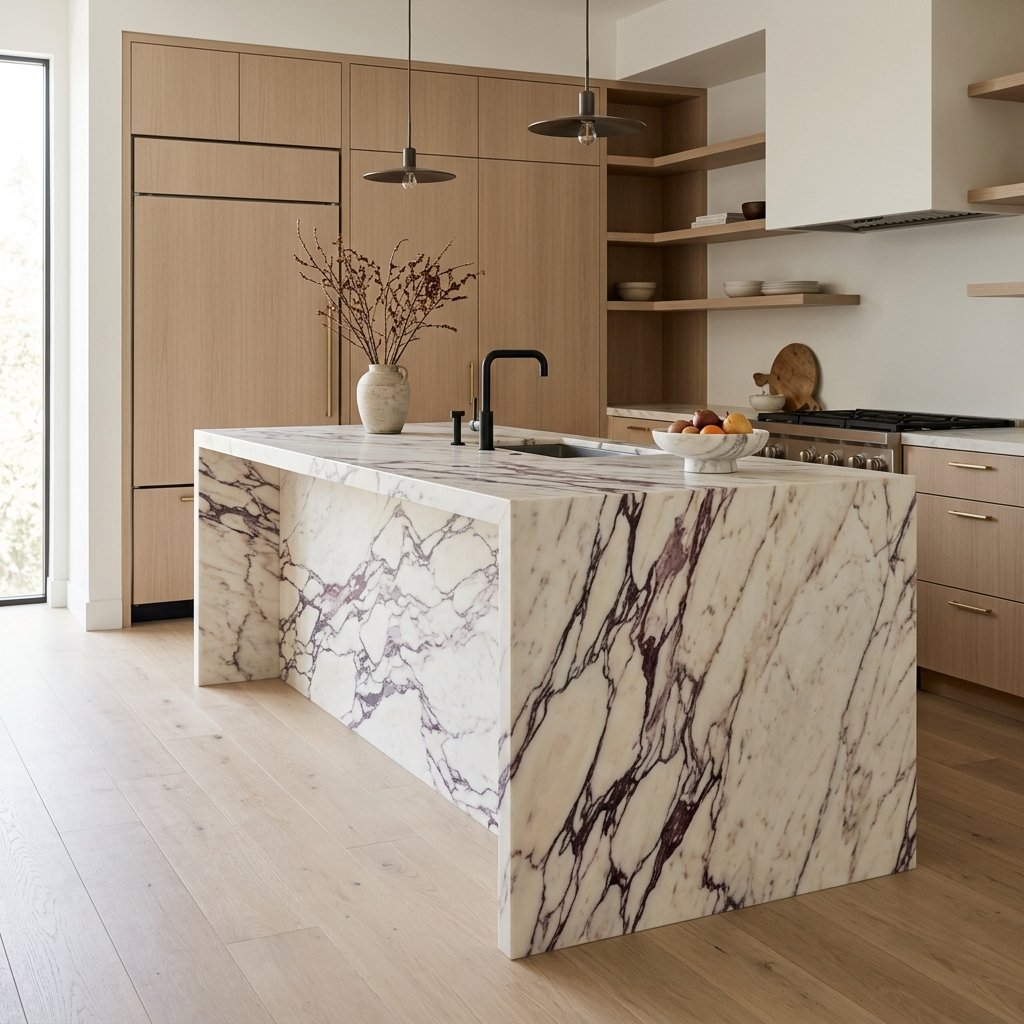
Kitchen featuring a monolithic, honed Calacatta Viola marble island with dramatic violet veining and a seamless waterfall edge, set against custom white oak cabinetry.
Where the Weight Actually Comes From
A twelve foot island that looks carved from one uninterrupted mass, in stone, concrete, or heavy timber, does something specific to a room. It reads as structural the way a fireplace does, whether or not it's technically load bearing.
Real continuity is the whole test, not the appearance of it from a single angle. A slab that wraps the island without a visible break at the corner is doing real work. A slab that's continuous on the front and stops cold at a butt joint on the side isn't, and anyone who's spent time on a job site can spot the difference walking past.
Site cast concrete earns this for less money than most stone, because it's poured in place and can run straight from the floor into the island base as one tonal surface. Stone gets there through the miter above, or through a waterfall edge, where the top of the slab is bookmatched to the vertical side so the veining appears to pour over the corner instead of stopping at it. It's the hardest cut a fabricator makes, and it's worth finding a shop that's done it before you fall for a slab.
What I Keep Out of Sight
The mechanical half of a kitchen works against the Anchor if you let it. My rule is simple. If it isn't the counter or the cabinetry, it doesn't get to show. The architecture is the one exception, because the architecture is the point.
Refrigeration and dishwashing units go panel ready. They arrive with a bare front, built to accept a custom cover from the cabinetmaker instead of the appliance company. Done well, a panel ready refrigerator disappears into the run of cabinetry completely enough that guests open what they assume is a pantry door.
Small appliances get the same treatment. A pocket door or a compartment faced in stone holds the coffee maker and the stand mixer, everything a working kitchen actually needs but has no business being visible in one that's trying to look permanent.
Choosing a Material That Can Carry It
Not every material earns the word Anchor. I look for real physical mass first. Then a finish that reads as a choice rather than a default. The fabricator matters just as much as either one, because the best slab in the world means nothing in unpracticed hands.
Honed stone is the finish I specify most, not polished. A honed surface has been ground flat and stopped there, without the final buffing that brings up a mirror shine, so the eye settles into the stone's actual pattern instead of the light bouncing off it. It also asks more of the person who owns it. Honed marble shows a lemon juice etch faster than polished marble does, which is either a real commitment or a real deal breaker depending on the client.
Calacatta Viola is the marble I reach for when a kitchen needs actual drama instead of a safe neutral. It comes out of the Apuan Alps around Carrara, the same quarries that supplied the Medici family five centuries ago, and its violet and burgundy veining runs through the stone rather than sitting on top of it, which is why it survives being cut into a bookmatched pair without losing the pattern that made it worth buying. When a room needs less noise, a paler, more restrained travertine, Silver among them, does the same structural job without the same visual weight.
Wood belongs in this conversation on the same terms as stone. Charred or fumed oak, matched board to board across an entire run of cabinetry, works on the same logic that makes a solid walnut tabletop worth its price over a veneer imitation. Break the match anywhere along the face and the illusion collapses the moment someone stands in front of it.
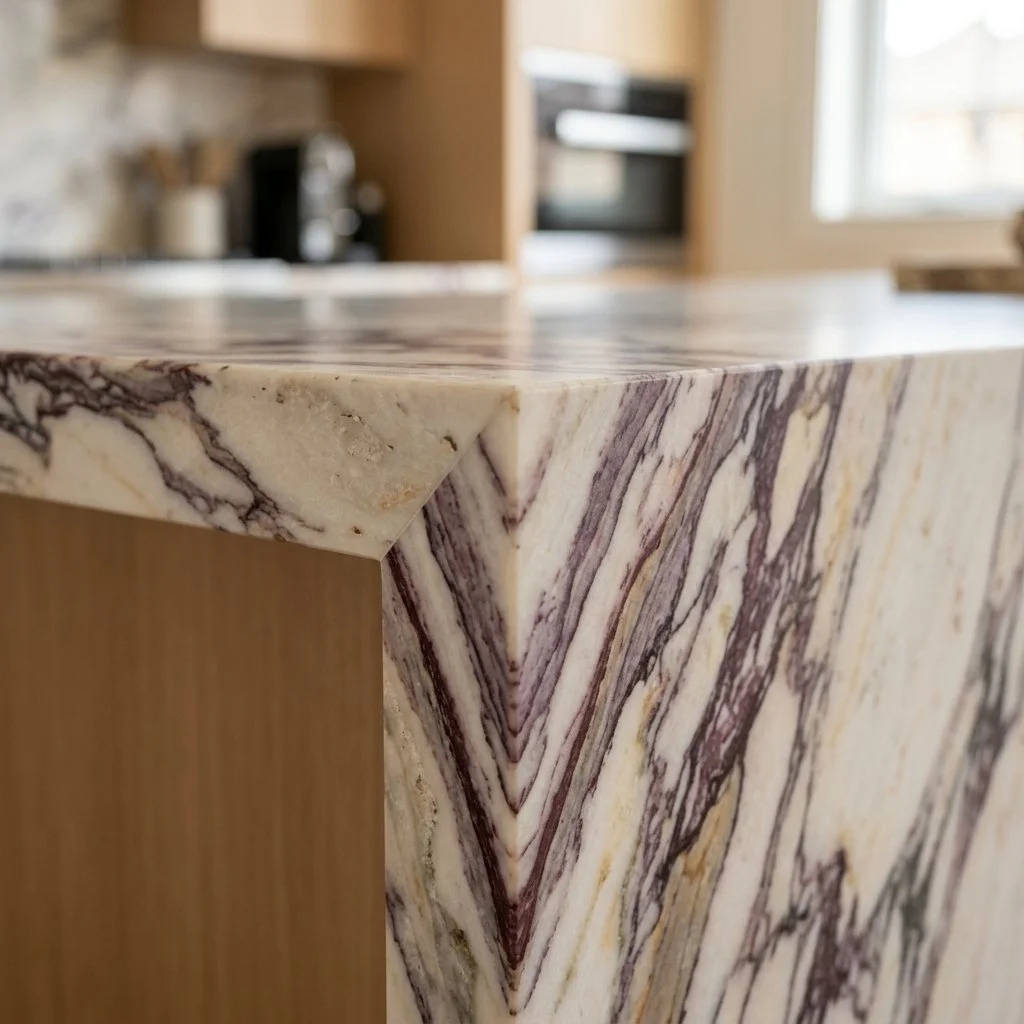
Honed Calacatta Viola marble kitchen island corner featuring a seamless 45-degree miter joint.
Where the Seam Falls
Every fabricator places a seam somewhere, on purpose or by accident. A shop that's cut its share of miters and waterfall edges can point to it without pausing, because they planned it there before the stone was ever cut. A shop that hedges when you ask is telling you something real: the Anchor you pictured and the one they can actually build aren't quite the same object.
I look at that seam longer than most clients think is reasonable. It's the one place on the whole island where the illusion could fail, which makes it the one place worth caring about most.
This isn't a piece with one place to send you. A mitered slab and a bookmatched cabinetry face come out of entirely different corners of the trade, a stone yard on one side, a mill or cabinet shop on the other. What matters more than the channel is whether whoever you're standing in front of has actually cut the joint before, not just quoted it.