The Geometry of Light
A shadow cutting across the top of a painting tells me the fixture was switched on, never actually aimed. A bedside lamp that blinds instead of glows tells me it was guessed at, never measured. Both come from the same mistake: treating placement as an afterthought to the fixture itself, when it's the whole decision.
Move an accent fixture from twelve inches off a wall to thirty, and the wall changes character completely. Close in, aimed at a narrow angle, the light rakes across stone or plaster and turns every ridge into a shadow. Pulled back and widened, that same beam smooths the surface into an even, unbroken wash. Same wall, same bulb. The eighteen inches in between decided everything.
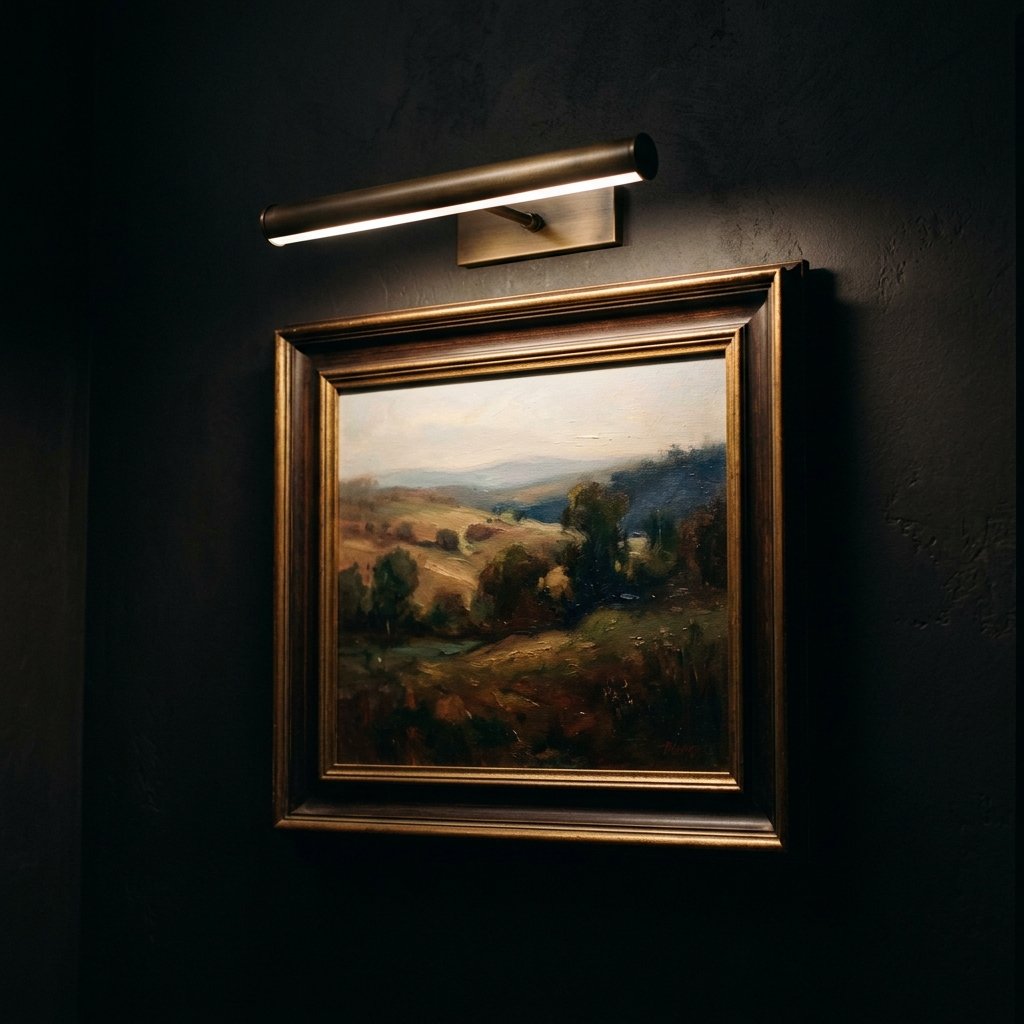
Aged brass picture light mounted on a dark wall casts a soft, warm glow downward across a framed painting.
Finding the Point Worth Lighting
Effective accent light runs three to five times brighter than the ambient level around it. That contrast, not the fixture itself, is what tells the eye where to look. Undershoot the ratio and the highlighted piece disappears back into the room. Overshoot it and the piece reads as spotlit rather than considered, more showroom than home.
For a painting or a piece of sculpture, angle matters as much as intensity. A picture light aimed at roughly 30 degrees off vertical lights the surface evenly and keeps the beam from bouncing straight back into the room as glare off glass or varnish. Steeper than that and the top of the frame goes dark. Flatter and the reflection lands exactly where a viewer would stand to look at it.
Building Height Into the Room
A room lit from one point never feels finished, no matter how good that point is. Cinematographers solved this generations ago, not with one dominant light but with sources set at different heights and angles that work against each other on purpose. Residential lighting borrows the same logic without the vocabulary: a floor lamp at knee height and a sconce aimed at art or millwork at shoulder height put light into a room from different elevations than an overhead fixture ever will. Light entering a room from several elevations reads as depth to the eye. One central fixture, however handsome, flattens everything beneath it into the same plane.
Skimming a Surface Versus Smoothing It
Grazing and washing get confused constantly because they use the same equipment aimed differently. Grazing places the fixture close, six to twelve inches off the wall, with a narrow beam of fifteen to twenty five degrees. At that distance and angle, light rakes across the surface and throws shadow into every imperfection, which is exactly the point on rough plaster, stacked stone, or reclaimed wood. Washing pulls the same fixture back to two or three feet and widens the beam to forty or sixty degrees, and the shadows disappear. What's left is even coverage, the right choice for a smooth wall meant to read as a backdrop rather than a surface with texture of its own. Choosing between the two isn't really a style decision. It's a measurement.
The Sanctuary Standard
Nowhere does placement matter more than beside a bed. A sconce mounted at the standard living room height of five feet off the floor sits nowhere near where a reader's shoulder actually ends up once they're propped against pillows. The number that works instead is measured from the mattress, not the floor: thirty to thirty six inches above the mattress top, six to twelve inches out from its edge. That range puts the light source above shoulder height when sitting up, low enough to fall across a page, and out of the sightline when lying back down to sleep. Get it right and nobody notices the sconce is there. Get it wrong and either the bulb stares back at whoever is trying to sleep, or the light never quite reaches the book.
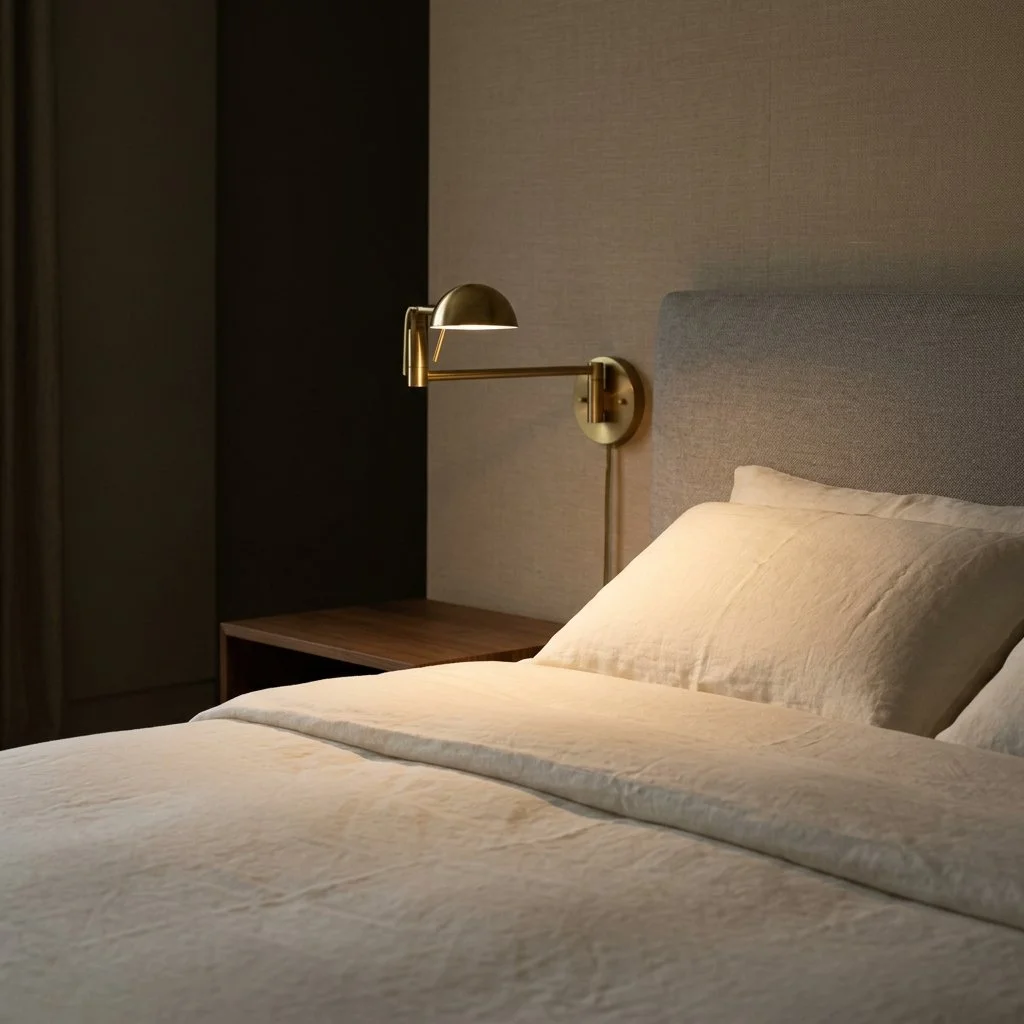
An articulating brass sconce casts soft downward light over a crisp linen bed.
The Planning Sequence
None of this gets decided fixture by fixture in a showroom. It starts with mapping what each zone in a room is actually for before a single light gets chosen, then layering the three tones described in The Composition of Light with intention instead of symmetry. A dining table and a reading chair eight feet apart rarely need identical treatment, even inside the same room. The last check is simpler than either of those: stand in the doorway with everything switched on and ask whether the room still has somewhere for the eye to rest, or whether every surface is doing something at once.
Measure First, Buy Second
A house full of beautiful fixtures can still feel wrong if none of them sit where the room actually needs them. I'd rather walk a room with a tape measure than a catalog. The distance off a wall, the angle off vertical: that's what turns good equipment into a room that works. Buy the fixture last.