The Leather Patina
Most leather sold for furniture has been engineered to do the opposite of what leather actually does. The hide gets sanded down to erase its own marks, a uniform grain is pressed back into the surface, and a pigment coat goes over the top. What's left behind can sit in a showroom for a decade without visibly changing. That is the entire point of the process, and it is exactly why that leather will never develop the kind of surface that gets better instead of worse.
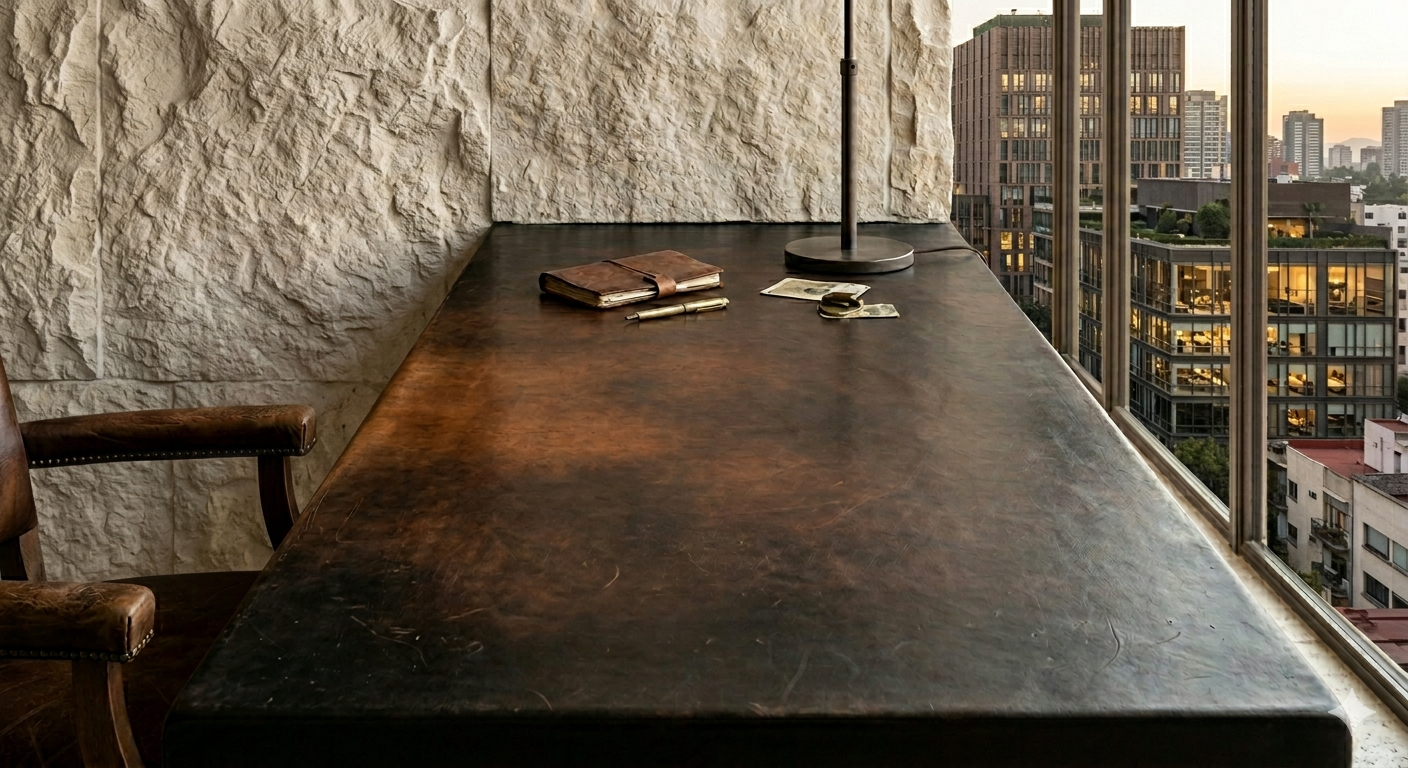
Dark leather wrapped desk.
The Hide That's Allowed to Show Its Age
The leather I use for the surfaces you actually touch, desk tops, door pulls, bench seating, is dyed with soluble aniline dyes rather than coated in pigment. Nothing sits on top of the hide to hide it. Scars, insect bites, faint wrinkles from the animal's own skin stay visible, because there's no artificial layer built to cover them. That openness is also why the surface can keep changing for decades after it leaves the tannery. Corrected leather, sanded, embossed, and finished with a coat of pigment, is what fills most standard showrooms. The layer reacting to your hand there is a manufactured skin sitting on top of the real one.
What Touch Actually Does
Rest your hand on a leather desktop often enough and something starts happening to it that goes deeper than the surface. The oils in your skin work into the open pore structure and deepen the color underneath your palm. Sunlight slowly oxidizes the natural tannins across the whole surface, warming a lighter hide toward amber over a matter of years, not days. And the physical contact itself, the pull of a handle, the drag of a forearm across a desk, polishes the surface smooth at a level you'd need a microscope to actually see happening.
Tanned to Age, Not Just to Last
The leathers that do this best are tanned with bark tannins, oak, chestnut, quebracho, in a process that hasn't changed much in centuries. The tannins bind directly to the hide's fibers, which is why vegetable tanned leather darkens and softens with use instead of simply wearing out. Chrome tanned leather, treated with mineral salts, gets soft faster on the shelf but never develops that same depth of color. It stays close to whatever shade it started at.
For the pieces built to carry real weight, a desk edge, a bench seat, a stair railing, I look for saddle leather specifically, hide cut thick from the sturdiest part of the animal, historically reserved for harness and tack because it had to hold up under load for years without failing. The palette stays narrow on purpose. A pale tan can read as merely faded after a few years of light. A deep, cured hide in burnt honey or blackened espresso reads as older instead, which is a different thing entirely.
Leather merchants in Florence have an old habit. They leave new wallets in the shop window for weeks before selling them, so the sun starts the aging process before a buyer ever touches it. Nobody asked them to do that. It's just what the material rewards.
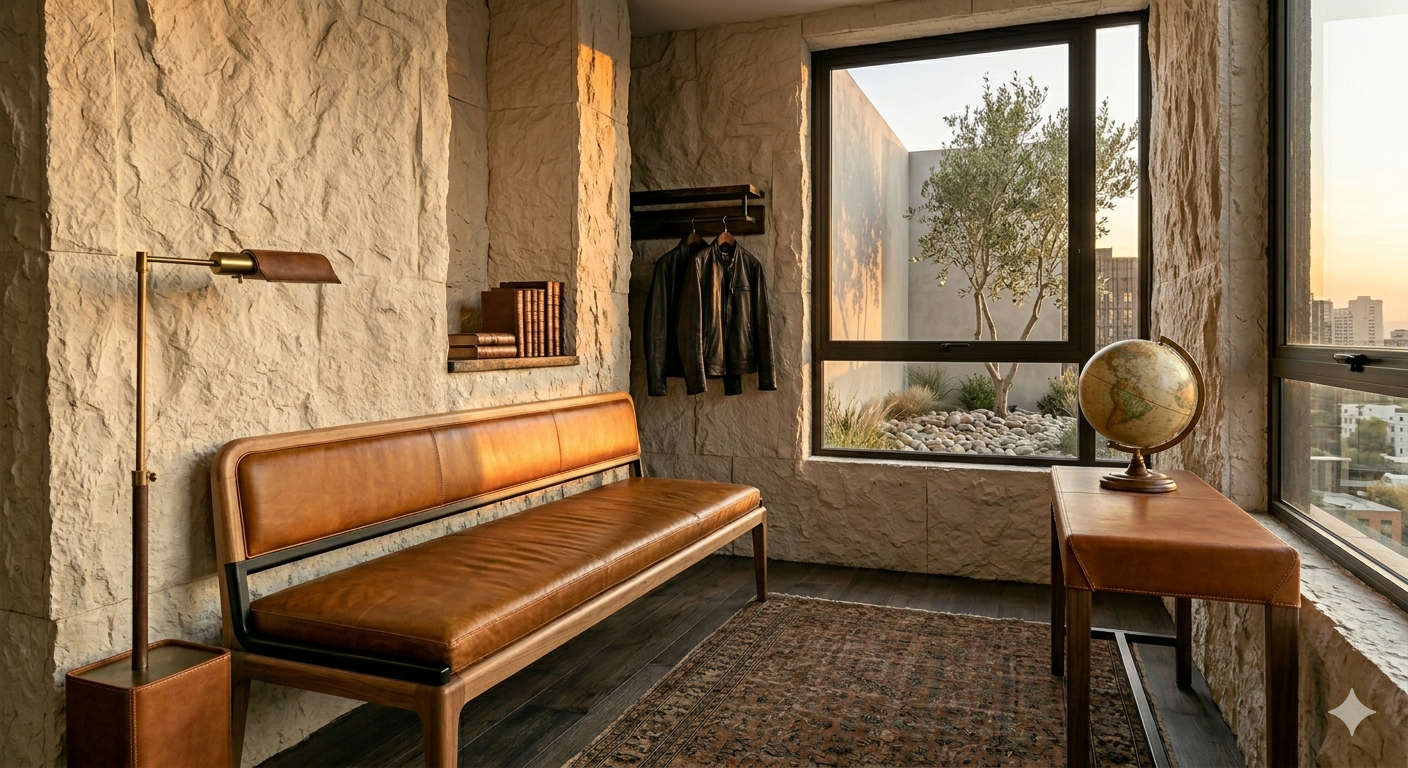
Leather sitting bench in a burnt honey color.
Wear It In
Most of the industry still treats a decade of scuffing as something to hide. I treat it as the whole point. A leather railing or library chair that's been used hard for a decade develops a depth of color no tannery can replicate in a vat, no matter how good the dye. It stops behaving like a product somewhere in that decade and starts behaving like an heirloom, the kind of object a house accumulates rather than furnishes with. Choosing this leather means treating your own house like something you live in, not something you're borrowing. Your life is what finishes the piece.
