The Mineral Palette
I used to think a mineral palette meant a mood board of stone photos: bone, sand, silt, done. Then I started asking why those colors actually happen, and the answer kept coming back to the same word.
Pure limestone is white. Calcite, its main mineral, carries no color of its own. Every buff, tan, and honeyed tone you've ever called "natural stone" got there because something else rode along in the rock for a few million years: iron.
Rust on a nail and warmth in a limestone slab are the same chemical event. Iron reacts with oxygen and turns some shade of red, orange, or brown. How dark it goes depends on how much oxygen it got and how long it had. Once you know to look for it, the same reaction turns up in fired clay and troweled plaster as often as it does in stone. A mineral palette isn't dozens of unrelated materials that happen to look good together. Most of the warmth in it is one element, working the same job in different disguises.
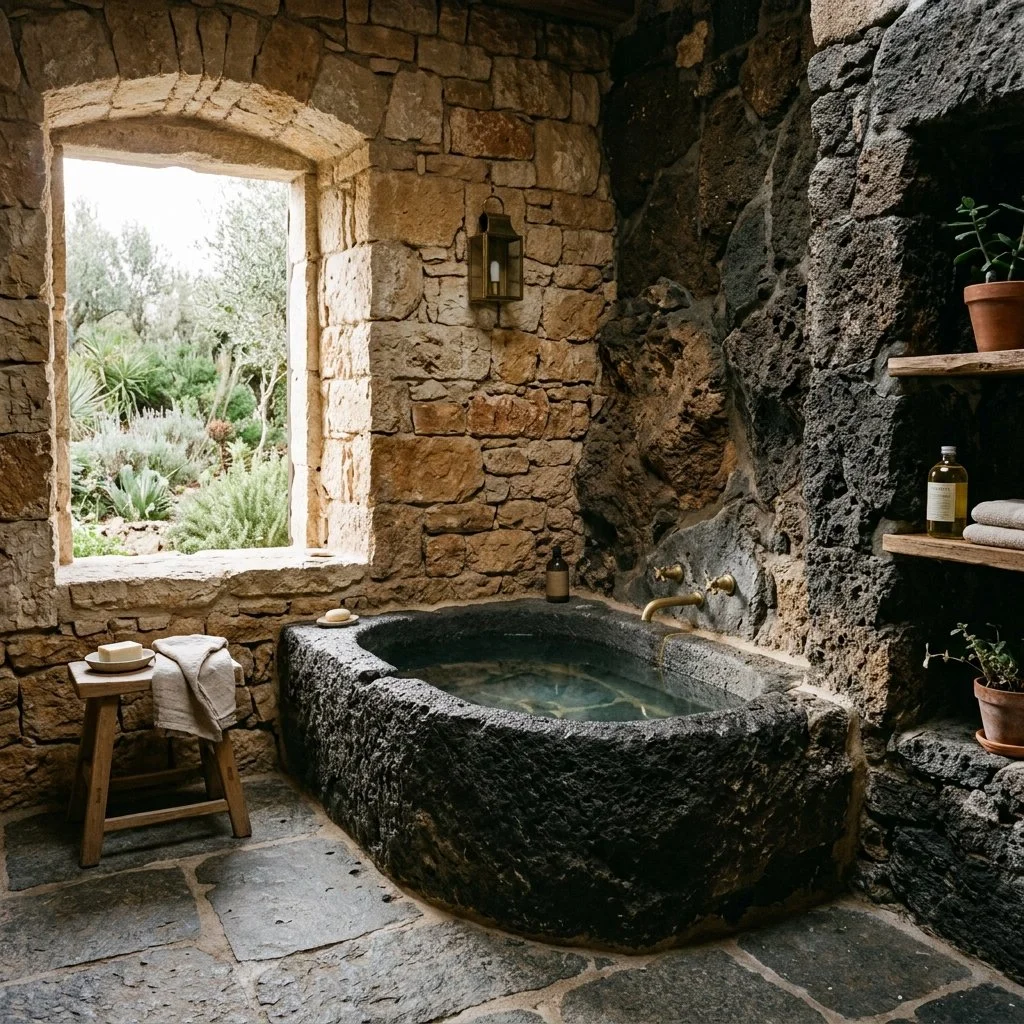
Stone bathroom, volcanic rock, carved bath, with limestone walls.
What the Same Reaction Looks Like in Three Materials
In limestone and travertine, iron oxide is an impurity, not the main event. The base rock is mostly calcium carbonate; a small amount of hematite or goethite mixed through it pushes the color toward buff, gold, or a deep reddish brown. Organic matter trapped in the same layer pulls it the other way, toward gray and black instead. Two slabs from the same quarry can read completely differently. It comes down to which one happened to trap more of each.
Basalt starts out dark, colored by the same iron and magnesium minerals that make it dense. Left outside, it weathers. The iron in it oxidizes into hematite, and the surface slowly turns brown. It's the identical chemistry as a limestone's warm streak. This time it's just running on stone that started dark instead of light.
Terracotta gets its red the same way, on purpose. Potters choose a clay body high in iron because firing it in a kiln rich with oxygen turns that iron a deep rust red. Starve the same clay of oxygen during the firing, or start with a body low in iron, and the color shifts toward gray or black instead. The kiln isn't creating a color. It's deciding how much of the iron already in the clay gets to show.
It even turns up somewhere you wouldn't expect: the aubergine veining running through Calacatta Viola marble is the same iron oxide, distributed as fine mineral streaks instead of a uniform stain.
What Happens When Iron Isn't the Story
Not every dark or cool tone traces back to an absence of iron. Obsidian is volcanic glass, cooled from lava so fast that no crystal structure ever forms. Its black has nothing to do with oxidation. It comes from the glass itself, the way a dark beer bottle is dark without any iron involved. But even obsidian isn't immune to the pattern. Mahogany obsidian gets its swirl of red and black from the exact same hematite inclusions, proof that iron finds its way into almost anything molten enough to carry it.
In limestone and marble, the cooler grays and near black tones usually trace back to carbon and organic matter trapped during formation, not to iron's absence. Two impurities, two directions. One warms the stone. One cools it. Most quarries carry some of each in the same face.
Why Lime Plaster Actually Glows
The claim that limewash "glows" usually gets left as decorating language, but there's a real mechanism behind it. Limewash cures through carbonation: calcium hydroxide reacts with carbon dioxide in the air and forms calcite crystals directly on the wall. Those crystals have a dual refractive index. Light entering one gets split and reflected back twice. Ordinary paint just bounces light off a pigment particle once. That's the actual source of the glow people notice on a limewashed wall at dusk. It isn't a metaphor. It's a different physical process than the one happening on a painted wall beside it.
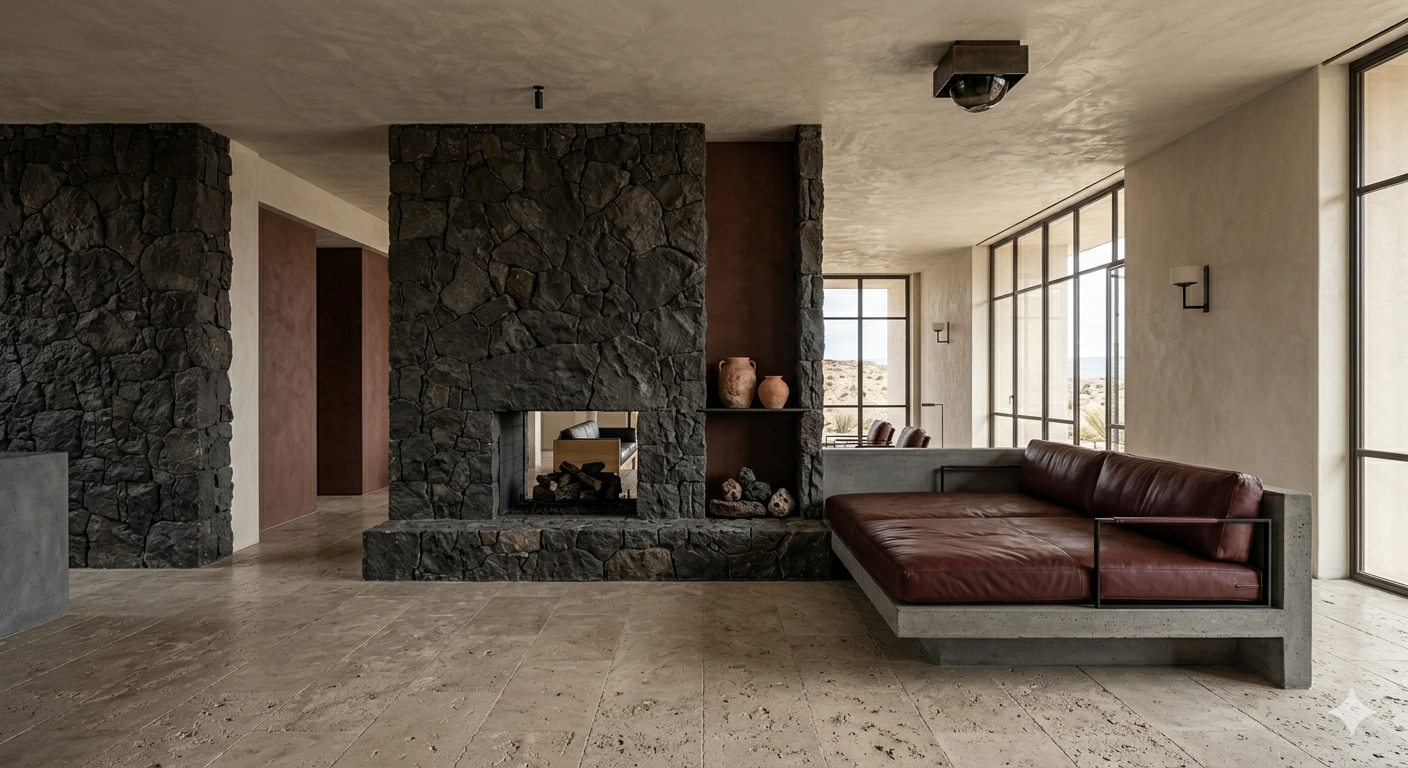
Expansive living area, stone floors, volcanic rock fireplace, limestone walls and celling.
Consistency Is a Chemistry Decision, Not a Mood Board One
Once you can see iron oxide, or its absence, as the actual variable, matching materials gets simpler. I look at a room's materials and ask one question first: what's actually coloring each one. A room built from stone, clay, and plaster all warmed by iron stays in one family no matter how many different materials are on the list, because they're all running on the same underlying chemistry. Mix in a marble darkened by carbon, or a true black basalt, and you've introduced a genuinely different mineral story, not just a darker paint chip. That's the real reason some earthy rooms feel coherent and others feel matched by eye against a fan deck. One is tracking an actual element through different materials. The other is guessing.
Match the Chemistry, Not the Chip
Strip away the marketing language and a mineral palette comes down to minerals doing what they've always done. Iron reacts with oxygen and warms whatever it touches. Carbon does the opposite; trapped in stone, it darkens instead. Calcite splits light because of its own crystal shape, which is the real reason plaster glows and paint doesn't. None of that was designed to feel expensive. It's old enough, and consistent enough, to read as inevitable in a room. Before matching two materials on a mood board, I want to know what's actually coloring each one. Materials running on the same iron reaction hold together no matter how different they look on paper. Pair iron against carbon, and no amount of squinting at swatches will make them agree.
