Commissioning a Custom Light Fixture
Commissioning a custom light fixture means taking it through a maker from sketch to installation. The steps are a brief, shop drawings, a prototype when the design calls for one, fabrication, and delivery. The making usually goes well. What catches designers out is the label an inspector looks for and the contract clause about who owns the shape. A fixture made for one room is the part of this trade I most want to show, so the process is worth knowing well.
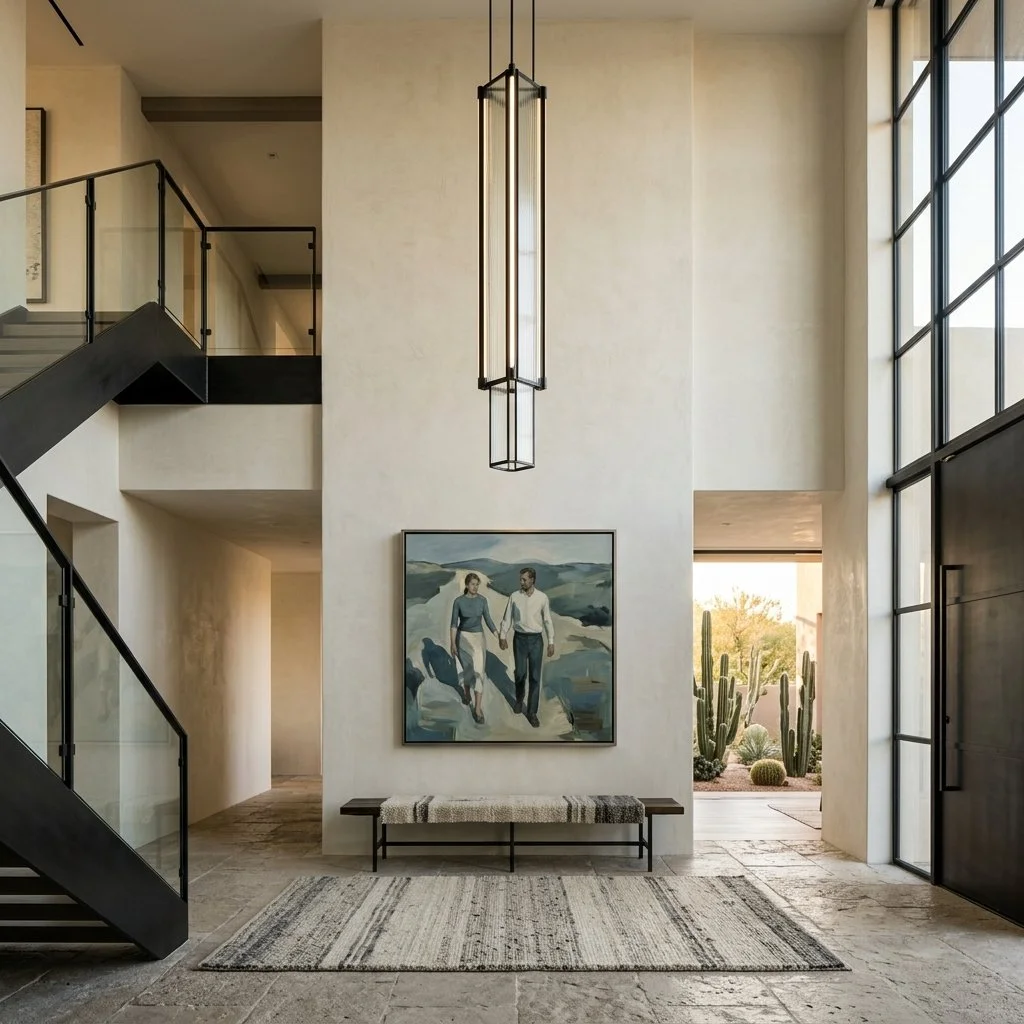
A long blackened metal and glass pendant hangs through a double height entry in a desert modern home with plaster walls and a stone floor.
What the Maker Needs Before Drawing
A maker can start from a napkin sketch or a finished CAD file. One American custom shop told a trade magazine that both are routine. What a maker can't start without is the room, the ceiling height, what the fixture hangs from, the light output the space needs, and how it will be dimmed. If a lighting designer is on the project, the fixture already has a line on the luminaire schedule, and that sheet is the one to hand over. I'd settle the driver with the maker at this stage too, before the electrician has to match one later.
Makers handle the drawings differently. Sattler, a German manufacturer, doesn't produce detailed CAD until the order is placed, to avoid unnecessary work early in a project. Hammerton supplies full scale drawings set into the architectural plans, so the fixture can be judged in place. Either way, the shop drawing is the document that counts. Once it's signed, it is the fixture.
Where the Prototype Fits
Dernier & Hamlyn, a British bespoke lighting manufacturer, prints prototypes in 3D in its own studio, so a client can see the form of a shade or a canopy before it's fabricated. Some of those printed parts end up in the finished fixture. Sattler says a prototype is sometimes needed to check that a design can be made in practice. For a pendant scaled to one particular stair void, I would ask for one even when it isn't offered.
When the Clock Actually Starts
Lead time runs from written approval of the final drawings and the deposit. The first meeting doesn't count. Hammerton releases a design to production only once both are in hand, and only after materials and finish samples have been signed off. Sattler's production time depends on how new the design is, so a change to an existing fixture moves faster than one developed from nothing. Ask the maker for the lead time in writing, counted from the approval date. Put that date on the project schedule and work backward from the day the ceiling closes. Every week spent revising the drawing comes off the end.
Does a Custom Light Fixture Need to Be UL Listed?
The National Electrical Code requires luminaires to be listed, and a one of a kind fixture usually isn't. Randy Hunter, a master electrician and electrical code instructor, wrote in IAEI Magazine that custom units are typically not listed by a nationally recognized testing laboratory and usually need a field evaluation. He called out fixtures from foreign makers unfamiliar with American certification as the common case. He also advised inspectors to tell contractors at the start of a job, before the products arrive, that they will be checking.
A field evaluation inspects that one fixture for the place it will hang. UL Solutions does them, and anyone involved in the project can request one. The result is a UL Evaluated label rather than a UL Listing, and the local inspector still makes the final decision. UL's own literature recommends scheduling the evaluation before an inspector rejects the installation, not after.
The question for the maker, before any deposit, is this fixture listed, and if it isn't, who arranges the field evaluation and who pays for it?
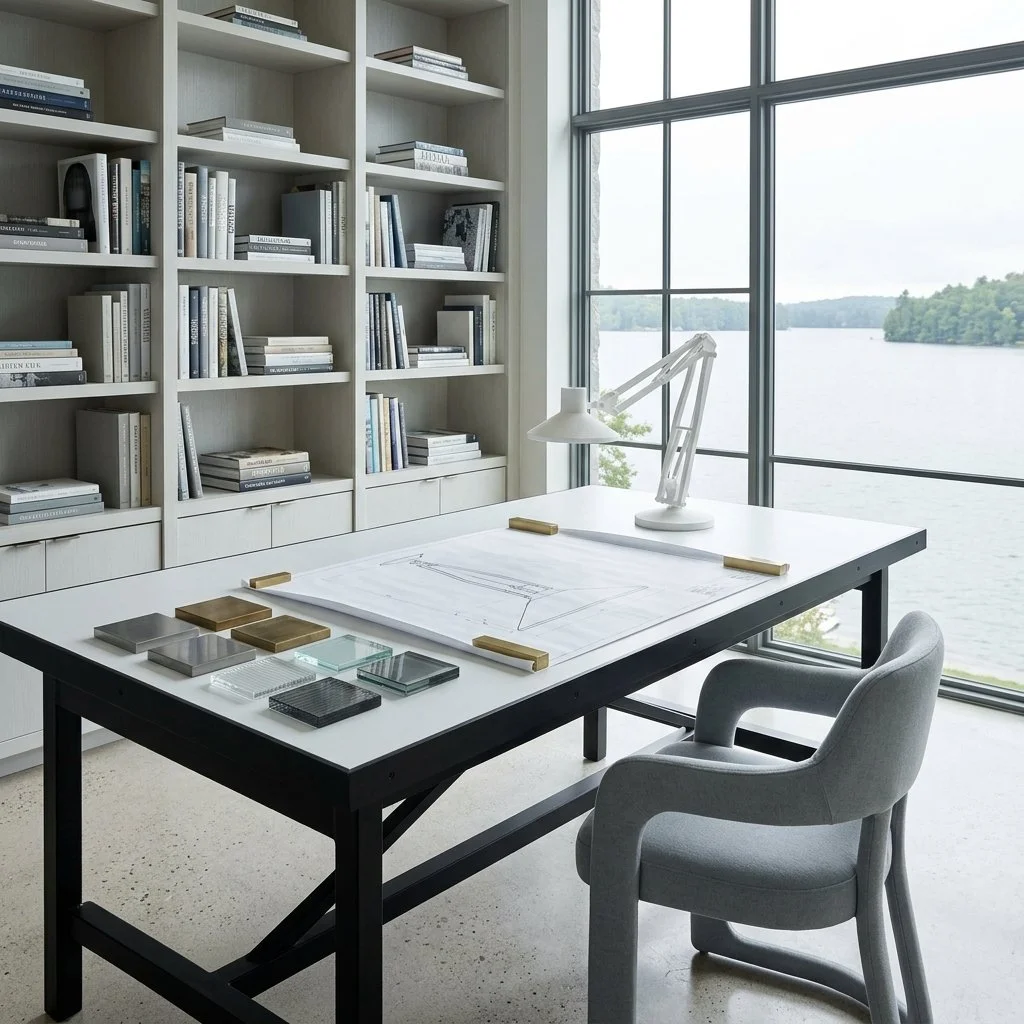
A scale drawing of a pendant light, metal and glass finish samples, laid out on a work table in a study.
Who Owns a Custom Fixture's Design
An Architect magazine article on design ownership pointed out that clients often assume they own what they paid for, and that they may not. Without a written agreement, an independent designer generally keeps the copyright on the drawings. That article was about lighting plans. A fixture brings in a second party with a stake. A trade magazine profile of American custom lighting makers noted that custom pieces often end up in a maker's standard collection. Some makers file design patents on a fixture's ornamental shape, and a design patent runs 15 years.
That is how a maker builds a line, and there's nothing underhanded about it. But a client who paid for a pendant shaped to their staircase may not expect to find it in a catalog two years later. If exclusivity matters, it has to be written into the contract. A contract like that deserves a read by an attorney who knows intellectual property.
A Good Maker Has the Answers Ready
Serious makers have been asked about the label and the ownership many times. A shop that knows its listing status, and has a clear position on whether a commissioned piece can join its collection, has done this before. Hesitation on either one tells you something.
To the makers reading this, if you have good answers to both, I'd like to hear from you.