Wood Furniture Fails From Neglect, Not Age
Two bottles both labeled "wood oil" work by opposite chemistry, and a white water ring means something very different from a black one. What walnut and oak each actually need, and how often to do it.
Two bottles on a hardware store shelf both say "wood oil." One is mineral oil, the kind sold for butcher blocks. The other is tung or linseed oil, sold for furniture. They look almost identical and do opposite things. Mineral oil never hardens. It sits in the wood's pores as a liquid indefinitely, which is exactly what you want on a cutting board you'll re-oil for the rest of its life. Tung and linseed oil cure. Exposed to air, their molecules cross link into a solid film inside the wood itself, the same reaction that dries a coat of paint, and once that film has fully hardened it actually resists water and wear instead of just temporarily repelling it. Use the wrong one on a table and you'll spend years reapplying something that was never going to build up, or wonder why a "protective" oil never actually protected anything.
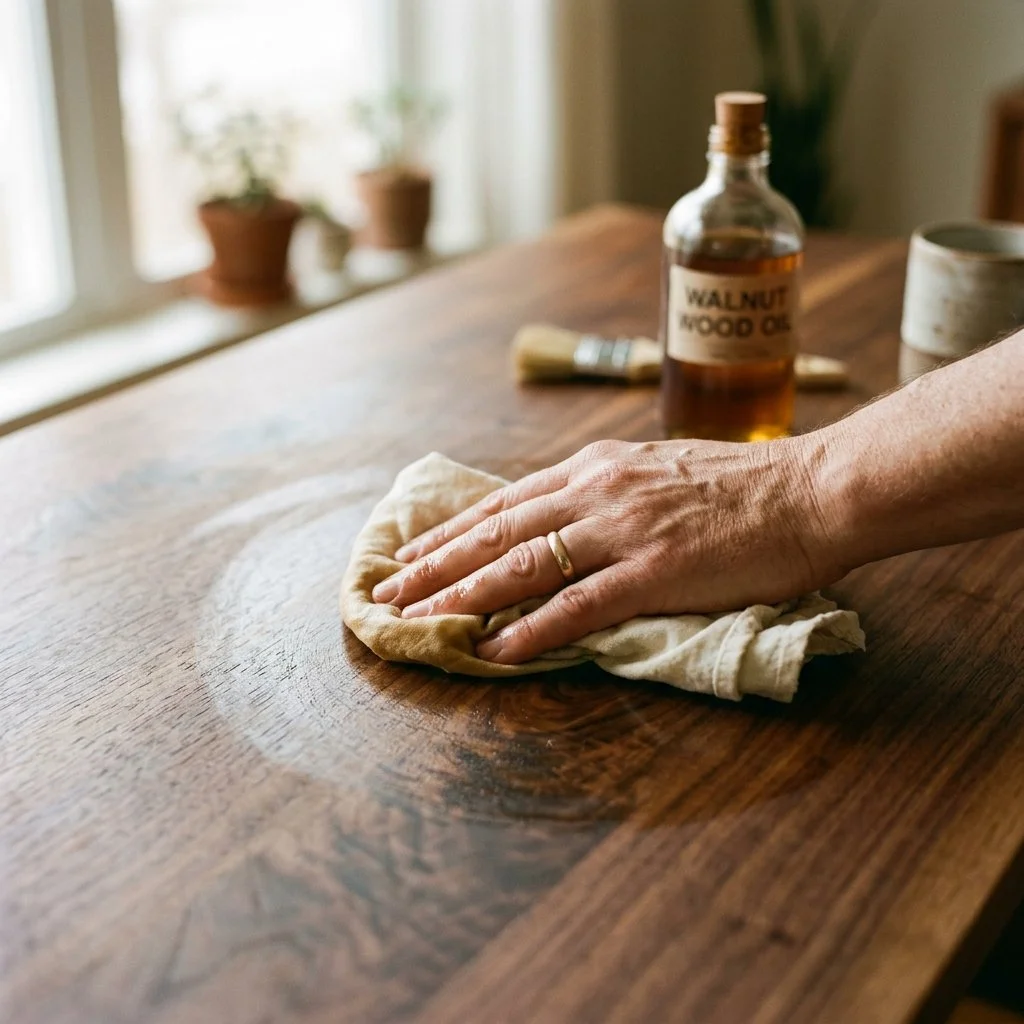
A hand applying oil to a wood tabletop with a soft cloth.
Humidity Moves the Wood Before You See a Crack
Wood is hygroscopic. It pulls moisture from the air in summer and gives it back in winter, and the wood itself expands and contracts with that exchange whether or not you notice. Most guidance settles on keeping indoor humidity between 40 and 60 percent for solid wood furniture. Below that, the wood shrinks and finish cracks appear at the joints first, since that's where two pieces of wood are fighting each other for space. Above it, finishes soften and mold risk climbs. A drawer that suddenly sticks in August or a tabletop that opens a hairline seam in January isn't a defect. It's the wood doing what wood does, and a humidifier in winter does more for a piece's long term health than any amount of oil.
Read the Ring Before You Reach for Anything
A cloudy white ring under a glass and a dark brown or black one are not the same injury. White means the moisture only got as far as the finish. It's trapped in the lacquer or varnish layer, hasn't touched the wood, and usually lifts with gentle heat, a hairdryer held low and moving, or a warm iron over a folded cloth. A dark ring means water pushed all the way through the finish and into the wood fibers, where it reacted with the wood's own tannins. That one needs sanding and refinishing, not a hairdryer. The color tells you which repair you're actually facing before you touch anything.
Walnut and Oak Ask for Different Things
Walnut is one of the softer hardwoods used in furniture, which is part of why it takes an oil finish so well: the oil penetrates easily and the wood forgives the occasional dent. That's the piece that wants oiling worked in roughly once a year, more in a dry climate or near a heat vent, less if the room stays humid. White oak is denser, and its pores are naturally water resistant, so it tolerates a paste wax finish that simply sits on the surface rather than soaking in. Trying to oil a wax finished piece, or wax an oil finished one, mostly just builds up residue neither wood asked for.
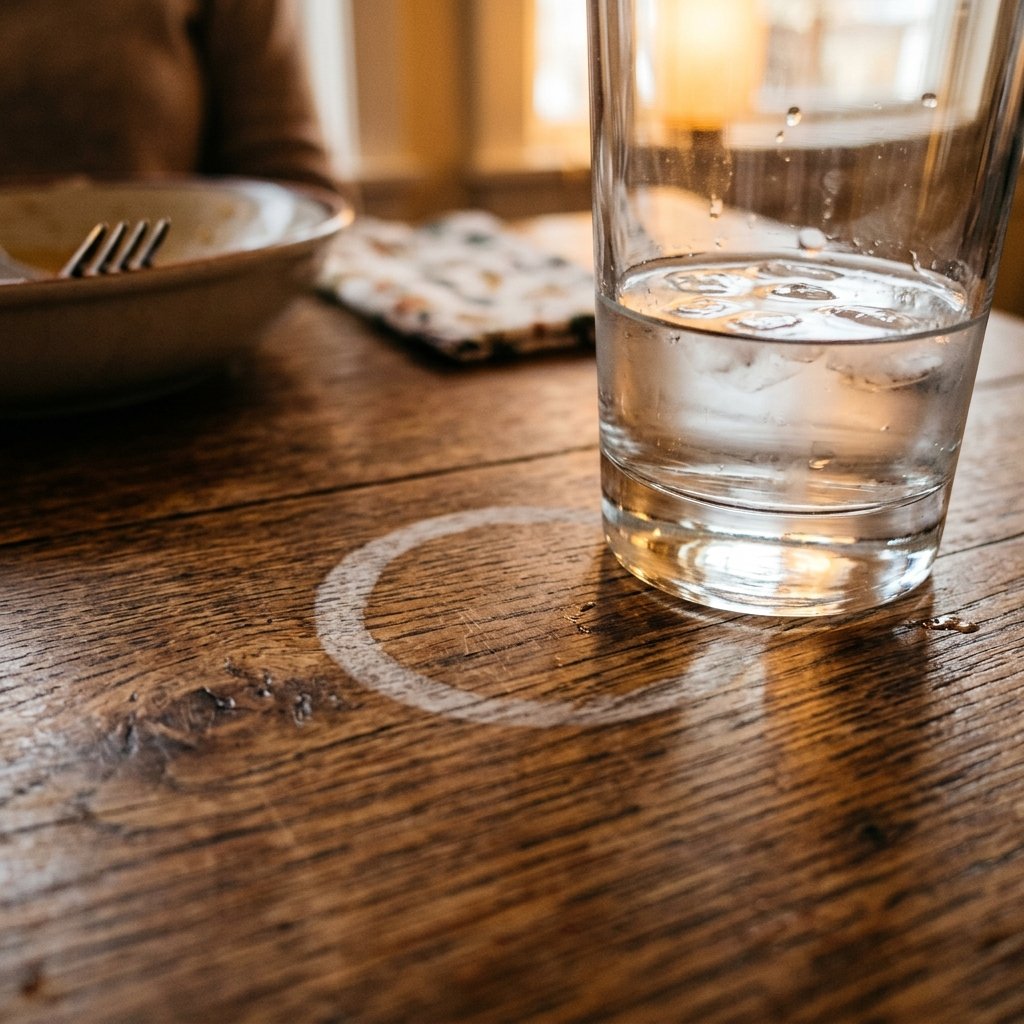
Wood table surface with a faint water ring near a glass.
A Six Month Habit, Not a Sunday Project
Dust weekly with a dry or barely damp cloth. Wipe with the grain, not against it. Skip ammonia and silicone based polishes. They clean well the first time and leave a cloudy buildup that eventually needs stripping off with mineral spirits before anything looks right again. Keep the piece out of direct, sustained sunlight, since UV fades color and can craze a finish over years the same way it darkens a walnut floor unevenly under a rug. Every six months to a year, depending on how hard the piece is used, oil or wax again, whichever the finish calls for. That's the whole schedule. It's shorter than most people expect, and most of the damage I've read about in wood happens between reapplications, from a house that stays too dry all winter, not from the wood simply getting old.
Aging and Failing Are Not the Same Thing
Solid wood is built to change. A joint gives slightly with the seasons, and the color shifts in ways that have nothing to do with dirt. That's aging, and it's the reason solid wood earns the word heirloom in the first place. A joint that's cracked from a winter with no humidifier and a black ring from a glass left out overnight are a different thing entirely. That's neglect, and neither one was inevitable. The wood was never asking for much. It wanted the air kept steady and the right oil or wax applied on schedule, not attention only once something had already gone wrong.
A Stone Sealer Stops Stains, Not Etching
A sealer slows stains but does nothing about etching, and sources disagree on how often to apply it. How to test the seal with water, what finish hides what, and what to do about a stain that has set.
Pour a puddle of water about three inches wide on a stone counter and leave it. Stone care companies and suppliers both describe this as the test for whether a seal is still working, and they do not agree on a date. One stone care company says a good sealer lasts three to five years on a stone floor. A supplier says a marble counter wants sealing about once a year. Part of the gap is that one is describing a floor and the other a counter, and no calendar knows how a particular slab is used.
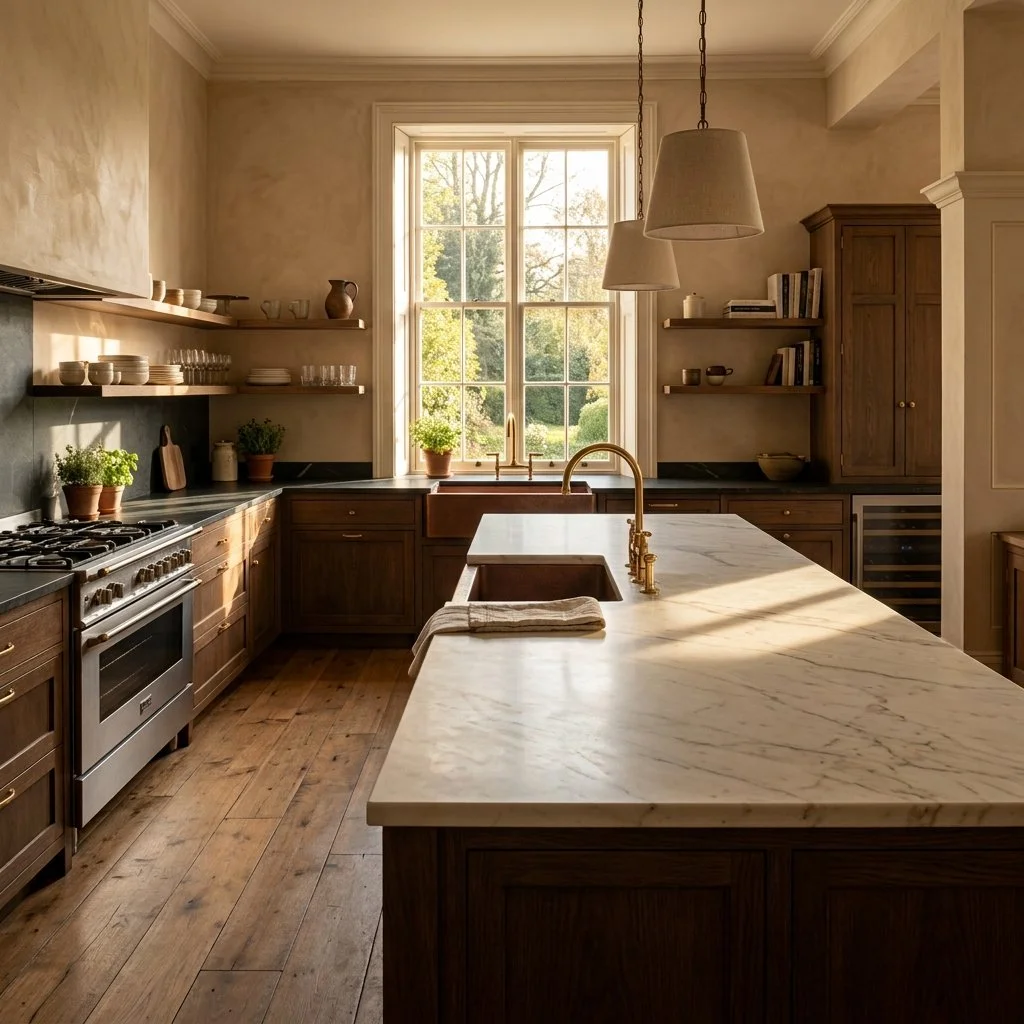
A large kitchen with a light stone island and dark stone counters in warm afternoon light.
How the Puddle Test Works
Clean the stone and let it dry first, because soap residue and cooking oil skew the result. Test several spots, since a seal wears unevenly across a slab. The sources I read give a wait of ten to thirty minutes. Water that holds a rounded bead means the sealer is working. A dark ring means the stone is taking it in and needs sealing again. One guide adds a few drops of mineral oil left for ten minutes, because some stones shed water and still drink oil.
Look for a penetrating sealer. It soaks into the pores and leaves no film, so the stone keeps its finish. Topical coatings sit on the surface instead, and stone care sites warn that they change the look of the stone and have to be stripped before the next coat. A stone guide notes that a new counter may have no sealer at all, or only a light coat from the fabricator. I would ask what was used and run the puddle test the week the slab goes in.
Stain and Etch Are Different Damage
A stain is color that has moved into the pores. Etching is a chemical change. Acid meets the calcium carbonate in marble or limestone and dissolves a thin layer of the surface. What is left is a dull, lighter patch.
A sealer fills the pores, so it slows staining and gives a spill time to be wiped up. It cannot touch etching, which happens on the surface the moment the acid lands. A sealed slab etches as readily as a bare one, and even the companies that sell sealer say so.
Finish decides how much of the damage shows. Honed marble hides etching and scratches because a matte surface already scatters light, but it is more porous, so it stains sooner and wants sealing more often. Polished marble stains more slowly, and every etch shows as a dull patch against the gloss. A stone expert quoted by Houzz summed up the tradeoff as less staining and more etching for polished.
A light etch on polished marble can sometimes be buffed out with a polishing powder. A deeper one needs a stone restorer to hone the surface again, which removes a thin layer of the stone itself.
A Poultice Draws the Stain Back Out
When a spill happens, blot it and do not wipe, since wiping spreads it. Plain water and mild soap, rinsed several times, is the first step. For a stain that has set, the Natural Stone Institute describes a poultice: a liquid chemical mixed into a white absorbent powder such as kaolin or diatomaceous earth until it is as thick as peanut butter. It goes on up to half an inch thick under a cover of plastic and sits for a day or two while it draws the stain up out of the stone. Some stains need repeat rounds, and some never come out completely.
The chemical has to match the stain, and the Institute's guide sorts stains by type. A restorer quoted by This Old House has seen a light yellow stain turn deep purple under the wrong chemical, and he tests every poultice on a hidden spot first.
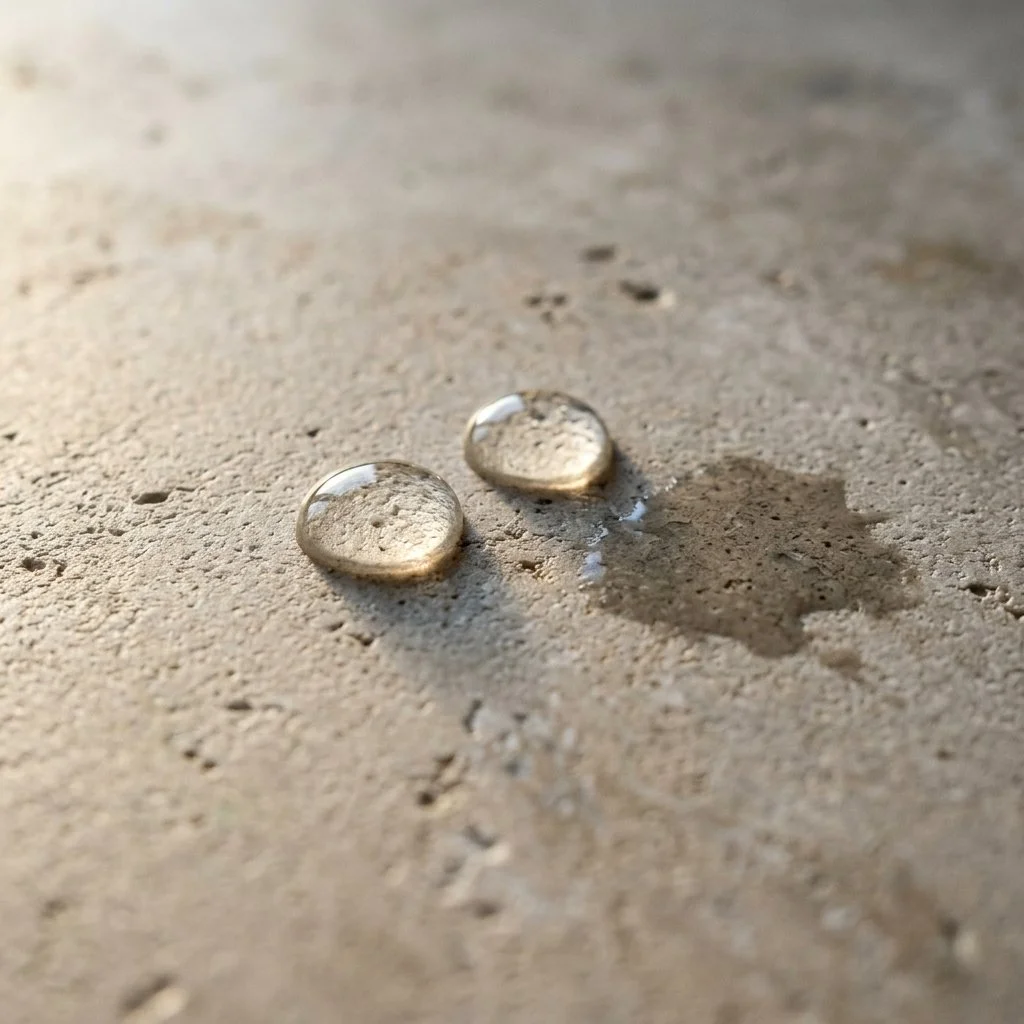
Stone counter with two rounded water beads and one darker patch where water has soaked in.
Soapstone Skips Most of This
Soapstone is a metamorphic rock rich in talc, and most guides call it dense enough that it never needs sealing. Acid does not etch it, which is why science labs have used it for counters. It scratches easily, though one guide says the scratches sand out in an afternoon.
The oil is where sources disagree. Rubbed in, mineral oil darkens soapstone toward charcoal and evens the color. A fabricator's guide calls that purely cosmetic and says the stone darkens on its own within months or a couple of years. A sealer maker says the stone lightens without regular oiling and wants heavy coats at least every six months. I read it as a look you choose.
Choose the Mark You Can Live With
Every stone here gets marked somehow, and the choice is which mark. One supplier's guide says polished white marble in a heavily used kitchen will have etch marks within weeks, and that honed is the alternative. The same polished stone as a bathroom vanity or fireplace surround sees little acid and is far more forgiving. That is the conversation to have with a client before the slab is cut, since a sealer will not have it for them.
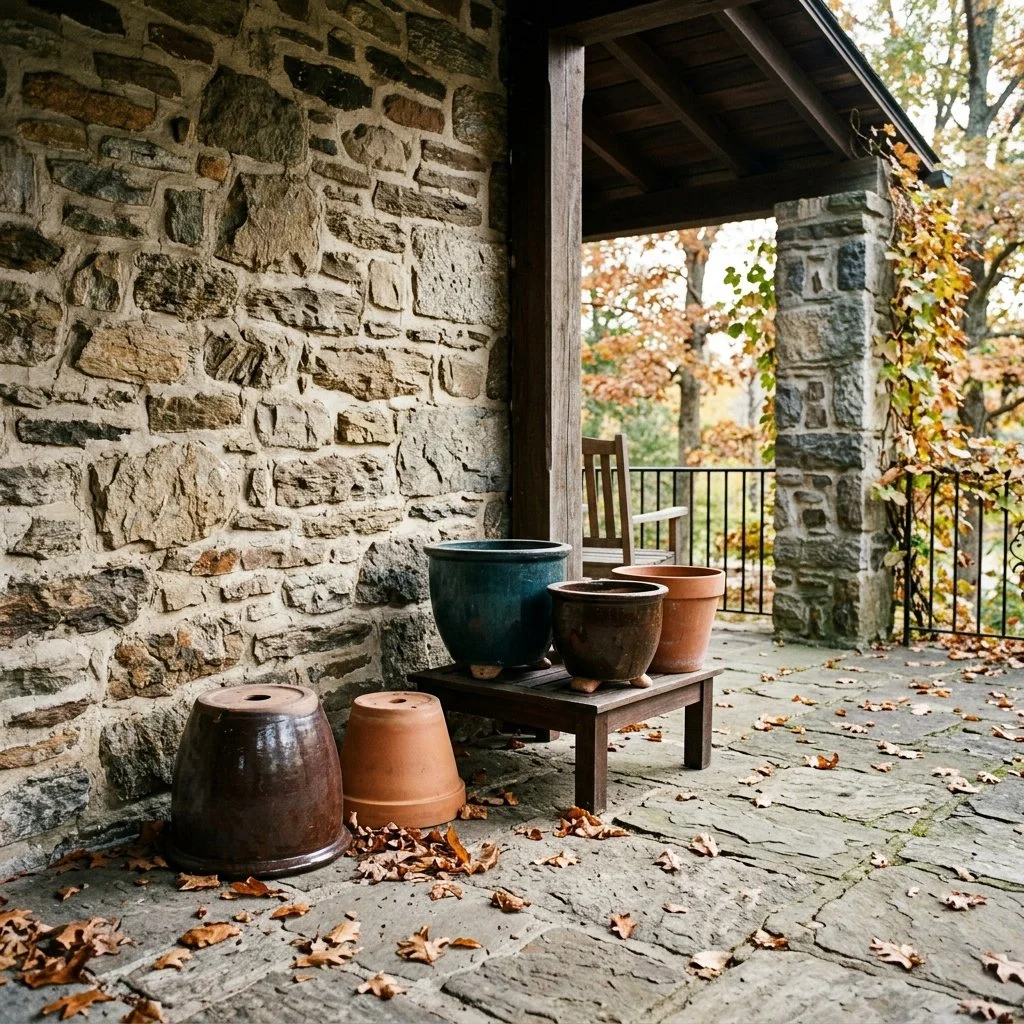
What Outdoor Pieces Need Before the First Frost
Most damage to outdoor pieces starts with water sitting where it shouldn't. What to do about planters, glass tops, teak, iron, and bronze before the first frost, and what comes indoors.
Most damage to outdoor pieces starts with water sitting where it shouldn't, and fall is when it gets the chance. I read care sheets from furniture makers, a bronze foundry, and garden suppliers before writing this. They disagree about teak. On almost everything else they say the same few things.
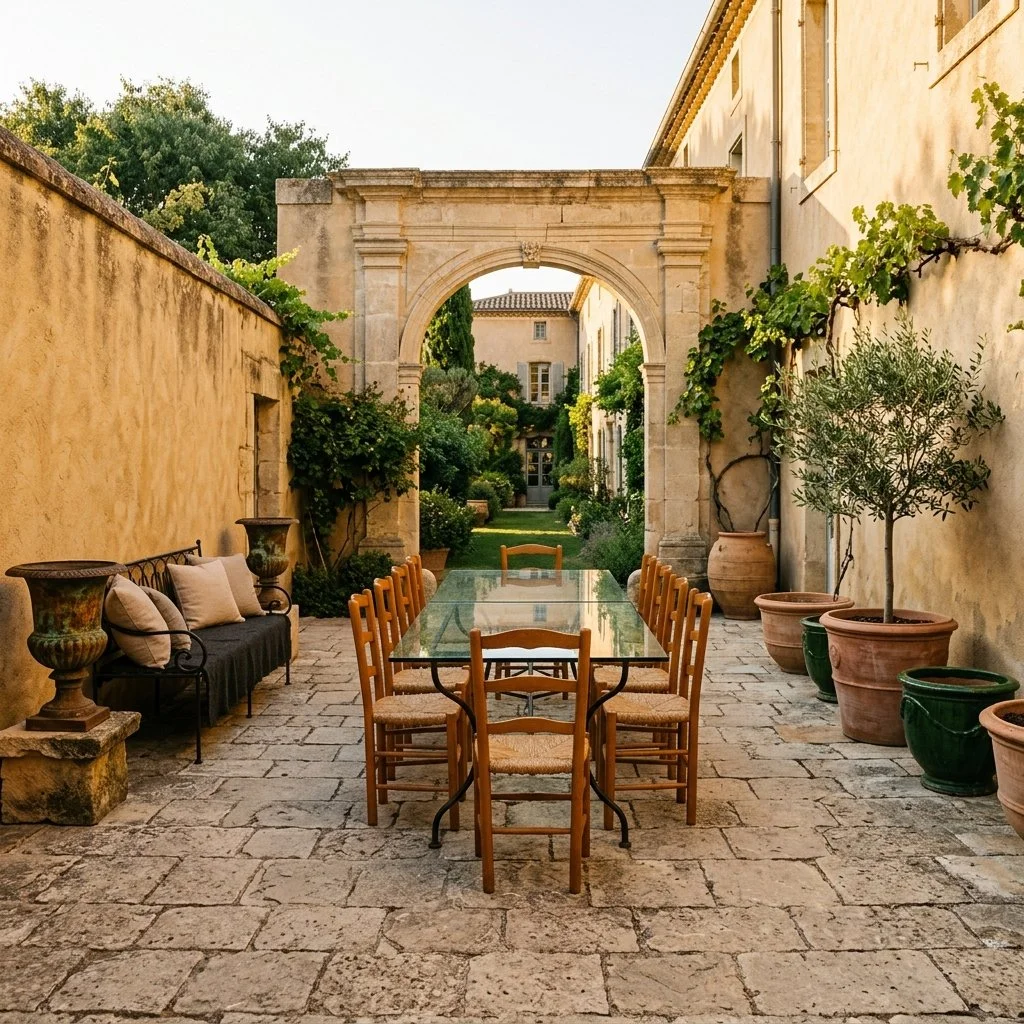
Courtyard featuring ochre walls, a stone archway, a glass top table with honey brown wood chairs, and potted olive trees along a stone paved floor.
A Pot Cracks When the Water Inside the Clay Freezes
Terracotta takes on water the way a hard sponge does, and when that water freezes it expands and cracks the wall. The advice is consistent. Empty the pots in fall and store them upside down where rain can't collect. A pot that has to stay outside goes up on feet or bricks with the drainage hole left open, because a pot standing wet can freeze to the ground and break when you lift it.
Glazed planters follow the same rules. Makers of glazed pots fired at high heat say in their own care pages that no planter is completely frostproof, and the ones that survive winter are the ones that drain. The fine cracks that can show in a glaze are surface deep, according to one supplier, and don't weaken the pot.
Glass Needs Air Under the Cover
Tempered glass tops need very little. The makers I read say to wipe them with a mild cleaner and a soft cloth, dry them after rain, and skip cream cleaners, which scratch. One maker's guide points out that a potted plant set on the glass can leave scratches or lime deposits, and that a mild vinegar solution lifts the deposits. A scratch from dragging something rough across the top can't be removed. A cover helps in winter, but the same guide says to hold it up off the glass, since condensation trapped underneath grows mildew.
Teak Needs a Decision
Left alone outdoors, teak turns silver grey within about a year, according to the sellers I read. They also say the change doesn't affect how long the wood lasts, and that the small surface cracks that appear are cosmetic. Keeping the honey brown means a sealer or teak oil once or twice a year, with sanding first. One woodworker on a trade forum warned that once you stop renewing a finish, the wood spends a few bad years black and mildewed. Choose before the first winter.
Iron and Bronze Get a Thin Coat Twice a Year
Most care sheets for wrought iron are written for painted frames, and they agree that a chip is where rust starts. Touch it up right away with a rust inhibiting primer, then paint, and never leave the frame standing in water. For raw or blackened iron, one hardware maker recommends wax or oil in spring and fall.
Outdoor bronze follows the same calendar. One sculpture foundry recommends a coat of wax in early fall and again in late spring, and another says once a year is the minimum. Wax slows the way a patina changes outdoors, and one seller notes it can be skipped if you want the natural patina. Bird droppings and tree resin harm the surface, so they come off promptly with warm water and a soft cloth. Skip the pressure washer and any wax that contains silicone. Polishing bronze to a shine works against a patina that is meant to look dull outdoors.
Empty planters on a covered porch, one turned upside down, others raised on feet.
What Comes Indoors
Cushions go in clean and completely dry, in breathable bags or a lidded box off the floor, because damp fabric closed up for months grows mildew. Wool throws go in clean too, since moths go for body oils and food stains, and a block of cedar in the bag helps.
Two Dates a Year
Nearly all of this fits into two dates. In early fall, the pots get emptied and the metal gets waxed. In spring, everything comes out from storage for a look at chips before summer. Before you specify any of it for a client, ask the maker for the care sheet in writing and read what it says about frost.
Chukum Plaster Starts With a Tree
Chukum plaster is lime mixed with the bark water of a Yucatán tree, and what goes into a bag today depends on who mixed it. The lab evidence for why it works, and what to ask for before it goes on a wall.
I started with one plain question: what is in a bag of chukum? The sources I read agree on part of the answer and split on the rest.
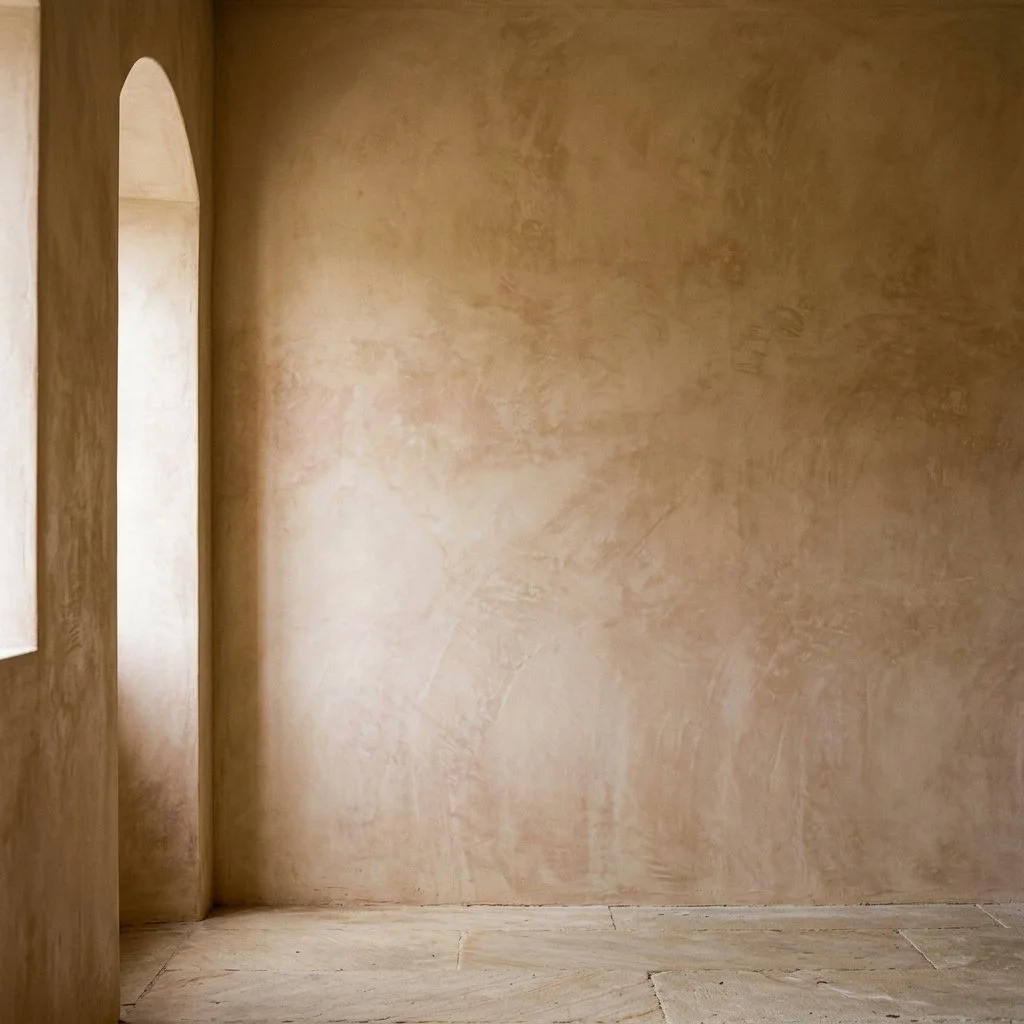
Burnished plaster wall in warm earth tones lit from the side.
The Bark Water Does the Work
Chukum takes its name from a tree, Havardia albicans, native to the Yucatán Peninsula. The plaster is lime mixed with water drawn from that tree's bark instead of plain water. Diego de Landa, a Spanish bishop of Yucatán, wrote in the sixteenth century that the upper part of Maya buildings was a strong limewashed mortar roof, made as it still was in his day with water from a tree's bark.
The best explanation I found for why it works came from a mineralogy lab at the University of Granada in 2023. The researchers analyzed lime plasters from the Maya city of Copán, in Honduras, and found organic molecules locked inside the calcite crystals, an arrangement that resembles seashell. To test the cause, they followed the advice of local masons who descend from the Maya builders and mixed new lime mortar with bark extracts from chukum and from a second native tree, jiote. The replicas showed the same features as the old plaster. The extracts are mostly polysaccharides, and in the set plaster they let the mortar give a little before it breaks and slow its chemical breakdown.
The accounts differ on preparation. The Granada team steeped bark in water for 48 hours. An architecture journal says the bark is boiled twice. The same journal credits an architect, Salvador Reyes Ríos, with reviving the plaster in 1996, after which his firm spent about fifteen years experimenting with mixtures.
Lime or Cement Depends on the Bag
The Granada study used lime. It says nothing about cement. One supplier describes its modern method as a paste of cement and fine limestone powder mixed with bark water. A builder in Tulum writes that chukum contains no cement at all. Both use the same name. The journal's account describes two routes to a chukum wall: the firm that revived it mixes chukum from scratch for each project, it says, while limestone cement and bark water are now available to buy.
Lime hardens by taking carbon dioxide from the air and turning back into calcite, the mineral the Granada team examined. Cement hardens by reacting with water. Those make different walls, and a specification that says only "chukum" lets two bidders price and build different ones. I would want the binder named in writing before I compared any two quotes.
How It Goes on the Wall
Chukum goes onto porous surfaces such as concrete or brick. A scratch coat goes on first for grip. One or more body coats follow, and the final surface is finished by hand, burnished or sponged depending on the texture wanted. One supplier sells a coarser mix for exteriors and wet areas and a finer one for smooth interior walls.
The Tulum builder says an exterior wall takes five to seven days to cure and needs protection from direct sun and rain in the early stages. Its page stresses that the finish depends heavily on who applies it, and it puts the cost at two to four times cement render and paint.
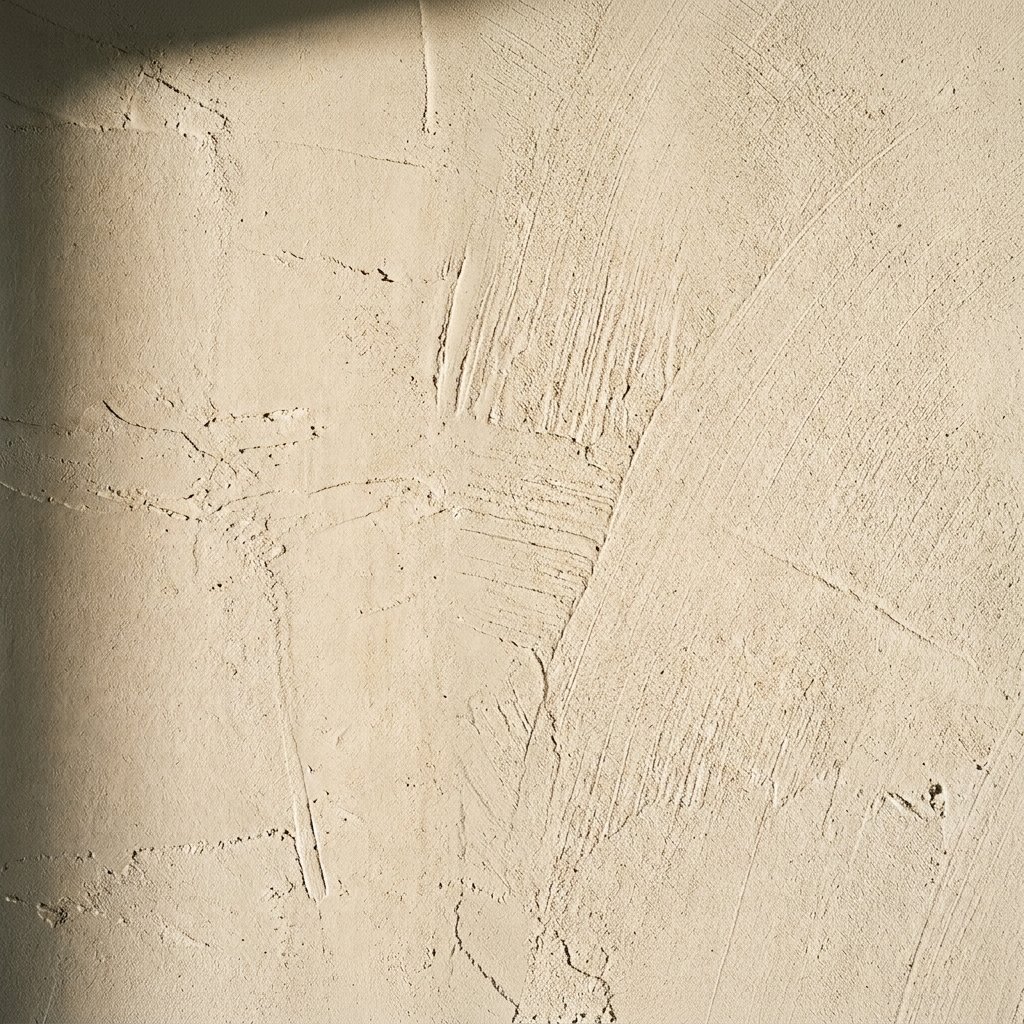
Close view of a plaster wall with a soft tonal change where two coats meet.
A Wall Meant to Change
Suppliers describe marbling and patina developing after installation, and some architects use that on purpose. At Por Ahí, a house in Mérida, the facades were applied at different times so the surface would come out mottled. At Niop Hacienda in Champotón, the architects finished the sounder walls in chukum and let the areas that had lost their old finish read as marks of age beside them.
Upkeep advice conflicts too. The builder recommends sealing exterior walls each year with wax or a breathable sealant, while a supplier says chukum needs no sealer. The builder adds that a skilled applicator can repair a damaged patch and match it without a visible line.
A Sample Board Shows Only the First Day
Marbling and patina develop over time, and a sample board cannot show them. Before I specified chukum, I would ask for two things. The first is the binder, in writing, from whichever route the crew takes. The second is a finished wall from the same crew and the same mix that has weathered for at least a year.
The name is old and the recipe has a documented history, but what goes into any one bag is still up to whoever mixed it. A weathered wall shows you the result.

The Smart Bedroom
A truly luxurious smart bedroom does not feel digital or distracting. It feels effortless. By hiding automation behind architecture, integrated lighting, concealed charging, and silent climate control, the bedroom transforms into a deeply restorative environment designed to support better sleep, clearer mornings, and uninterrupted calm.
I started with one question: who is responsible for the ceiling pocket a motorized shade rolls up into? On the spec sheet I read from one motorized shade manufacturer, the answer is the main contractor, not the shade installer. The installer arrives late in the build. If nobody framed that pocket by then, the shade goes up in front of the window with its brackets showing. Everything else that makes a bedroom smart follows the same rule. It gets built in while the walls are open, or it gets stuck on afterward and stays visible.
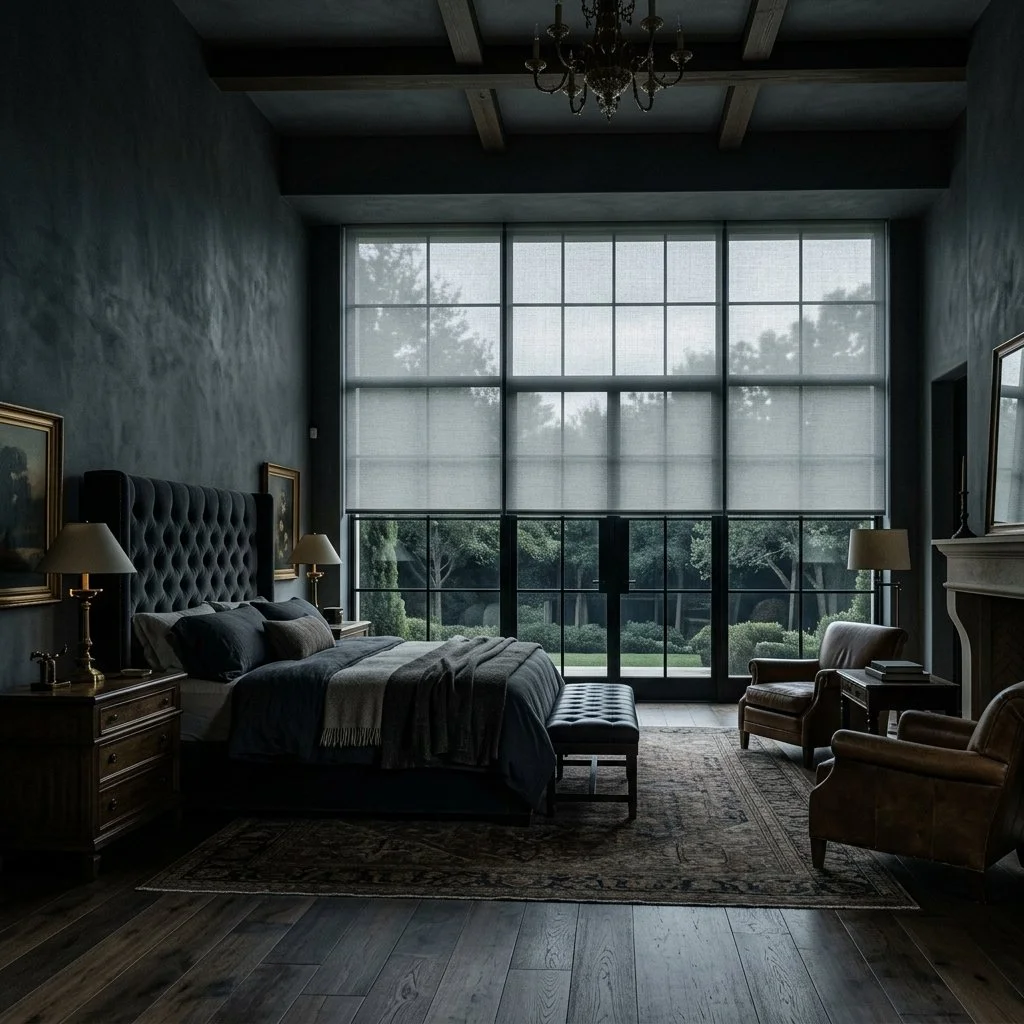
Large primary bedroom with tall windows, a sheer shade lowered, and no shade hardware visible at the ceiling
The Shade Goes in the Ceiling
A recessed pocket lets a rolled up shade vanish into the ceiling line, and it has to be framed to the size of the housing it holds. That manufacturer's dual system, the one that carries two fabrics, needs a 7 inch housing, the tallest size it lists. The pocket is a framing decision made before anyone chooses a fabric.
The two fabrics do different work. The blackout layer runs in side channels, aluminum tracks with pile inserts that stop light leaking along the edges. A plain roller shade leaks there first. The sheer lowers during the day to soften the sun and keep the room from being seen into.
Battery powered versions exist. For a bedroom I'd still run the wire, since a battery is one more thing that eventually needs attention, and the motor sits behind a ceiling pocket. Wired shades need the power run and the conduit to the pocket before the ceiling closes.
The Nightstand Starts in the Wall
Power built into a nightstand drawer only looks like a feature of the furniture. It comes from a receptacle in the wall behind it, set at drawer height, with a hole cut in the drawer back to meet it. That receptacle gets placed while the wall is open, which means the nightstand's width and height have to be chosen first. A nightstand bought after the drywall is finished has to line up with an outlet placed for someone else's idea of one. The strip inside charges a phone and a watch out of sight, and nothing sits on the surface but the lamp.
The lamp cord follows the same logic. The furniture maker cuts a grommet hole in the top and runs a channel down the back leg before the finish goes on, and the cord drops to a floor receptacle behind the bed. I'd put cord management on the electrician's drawing.
65 Degrees by Bedtime
The Sleep Foundation puts the best bedroom temperature at 65 to 68 degrees Fahrenheit and says a cooler room makes it easier to fall and stay asleep. Core body temperature falls through the evening ahead of sleep, and a room in that range lets the body shed heat instead of fighting it. REM is the stage where the body regulates its own temperature worst, so a room that runs too hot or too cold breaks REM up.
A house thermostat that drops at bedtime does the job late and in every room. A bedroom on its own zone, with its own damper and thermostat, can start cooling well before bed, so the room is already at temperature when you walk in. How long that takes depends on the room and the season. An hour is where I'd start.
Air With Nothing to Look At
Ventilation belongs in the mechanical system, with a linear grille set flush in the ceiling plaster as the only sign of it in the room. Filtration is messier. HEPA is a legal rating, and true HEPA filters generally can't run through residential ductwork without changes to it, so a bedroom that needs one usually gets a standalone unit. "Medical grade" gets used on these units, but as far as I could find the FDA doesn't certify a medical grade HEPA filter, so the phrase adds nothing to a HEPA rating. The design work is placing that unit where air moves freely around it, in an alcove or against a clear wall, and not inside a closed cabinet.
Smart bedroom with bedside control panel.
One Button at the Bed
The fixtures in the room have to dim toward amber, or there is nothing warm to fade to at night. With that in place, one keypad at the door and one at the pillow replace a bank of switches. The button labeled Sleep runs a scene: the overhead lights go off and the blackout shades come down. The bedside lamps stay at their lowest amber setting, and I'd have the systems integrator program them to fade out on their own after a few minutes. A room that has been fully blacked out shouldn't glow all night.
The keypad is a light source too, so its backlight should dim, and its wall box sits at pillow height.
The Order Things Get Built In
A smart bedroom gets built in a fixed order. Framing settles the ceiling pocket and the wall the nightstand stands against. While the walls are open, the electrician places the shade wiring and the drawer height receptacle, and the bedroom's own duct and thermostat wire run alongside them. The keypad box goes in at the pillow. Drywall closes all of it up, and what comes after is finish work, the fabric and the lamps.
A bedroom that skips that order can still be automated later. The brackets and the cords just stay on the surface.
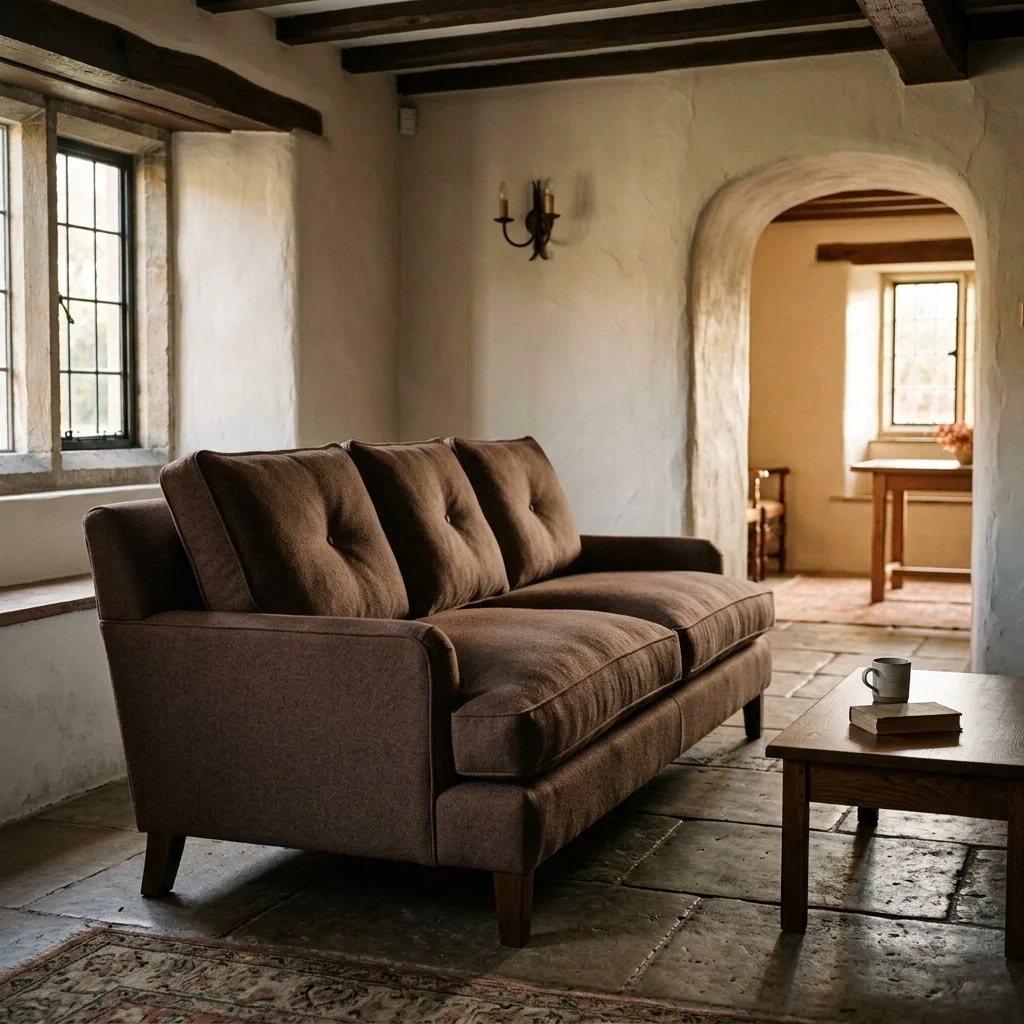
What Holds Up a Good Sofa
The lifespan of a sofa is determined by what is hidden beneath the fabric. From kiln dried hardwood frames to the gold standard of hand tied springs, you must evaluate furniture based on internal engineering rather than silhouette. Here we break down the material specs and dimensional accuracy required to acquire a sofa that functions as a permanent structural anchor.
In the 1820s, iron springs got cheap enough to put inside a couch or chair seat. A London maker named Samuel Pratt took out a patent on coil springs for couches and other seating in that decade. Upholsterers first set the coils in loose, and over time they shifted and slid out of place until the seat went lumpy. The fix was to stitch each spring to the webbing and tie the whole bed of them together with twine so they moved as one unit. That principle is the one showrooms now sell as eight way hand tied.
A sofa hides everything that decides how long it lasts. A showroom lets you judge the cover and the first minute of the sit. Everything structural sits under the fabric, and that is where I start.
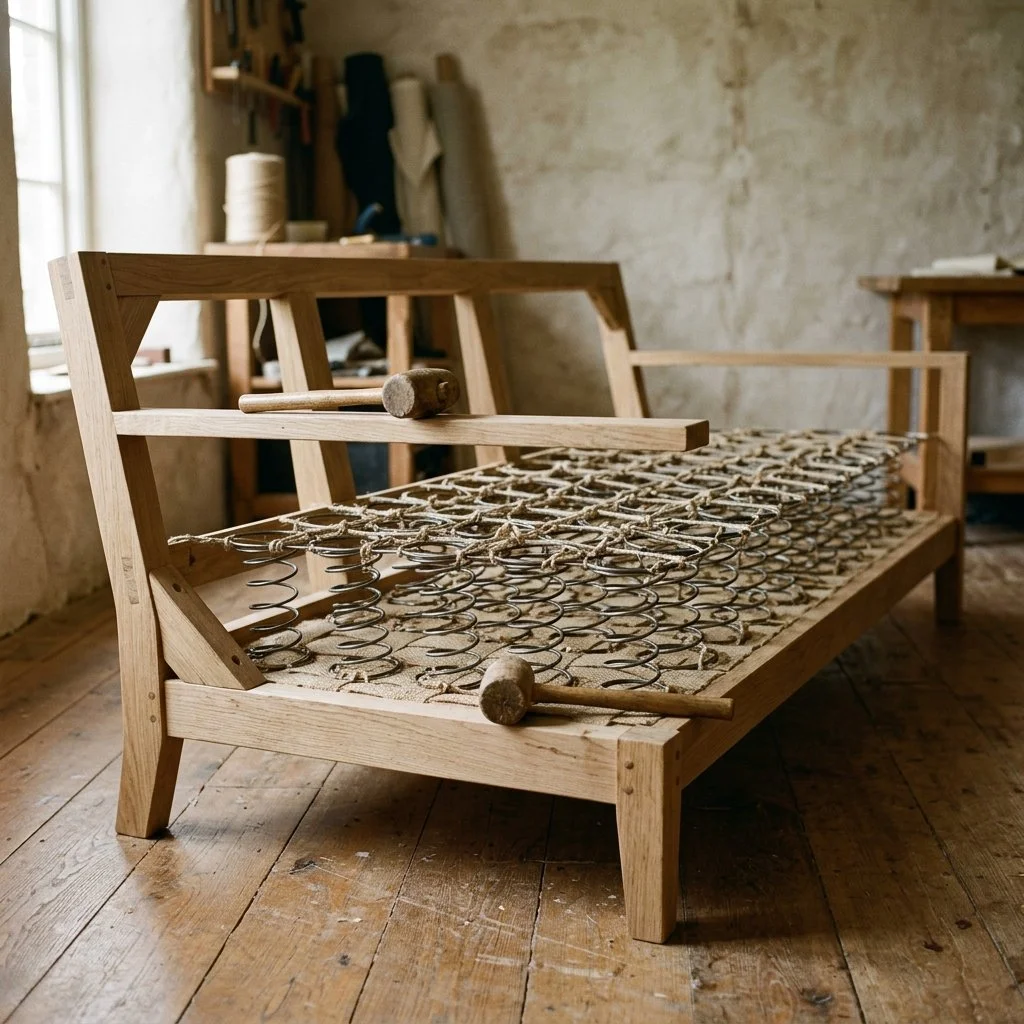
Bare hardwood sofa frame with coil springs tied together by hand with twine.
The Frame Has to Be Dry
Hardwood for furniture is kiln dried to a moisture content of 6 to 8 percent. Purdue's cooperative extension service describes that as the midpoint between the normal swings of indoor humidity. Wood dried to that point still moves with the seasons. Wood that went into the frame wetter keeps drying inside the finished sofa, where it shrinks and can warp, and a frame that shrinks pulls on every joint in it.
I expect the maker to name the hardwood, such as oak or maple. Then I ask how the corners are joined. Glued double dowels with corner blocks is the construction to look for. A frame held together by staples and nails alone will loosen under the plain work of people sitting down hard and standing up again.
Eight Directions of Twine
The eight in eight way hand tied counts the directions the twine runs, diagonals across the bed of coils included. It takes skilled labor and a lot of time, which is most of why it costs more.
The common alternative is sinuous spring, a heavy steel wire bent into a continuous S and run in rows that stretch front to back across the seat frame. It takes far less labor and shows up in most mid priced sofas. Upholsterers argue about how much longer hand tied really lasts, and that argument is not settled. The standard for a good sinuous system is clearer: 8 gauge wire, with tie wires running across the rows. For a sofa that gets sat on every day, hand tied is the suspension I ask for first.
What a Rub Count Measures
The number on a fabric's spec sheet comes from a machine. In the Martindale test, a disc of worsted wool travels over a stretched sample in a figure eight until two yarns break or the surface visibly changes. The machine stops to inspect every 5,000 rubs, so a fabric rated at 25,000 passed that mark and was not run through 30,000. Suppliers draw the lines differently. One major fabric house puts heavy residential use at 25,000 to 30,000, and for the sofa a family actually lives on, I don't go below 25,000.
In North America, Wyzenbeek is the usual standard, and it rubs the sample in a straight line back and forth. The residential figure there is 15,000 double rubs, and heavy duty starts at 30,000. No reliable formula converts one test into the other, so ask which machine produced the number you're looking at. Treat either one as a guide to where a fabric belongs. It cannot tell you how many years you'll get.
The Core and the Wrap
A good seat cushion is two materials with separate jobs. A foam core carries the weight and springs back when you stand up. A wrap of down or feathers around it gives the softer crown on top and the first inch of give.
Foam is specified by two numbers that get confused. Density is the weight of a cubic foot of the foam in pounds, and it is the usual guide to how long the foam holds its shape. Firmness is a separate figure called indentation load deflection, listed as ILD. The trade treats 1.8 pounds per cubic foot as the point where foam earns the phrase high density. The phrase gets used loosely enough that I ask for the actual number. Foam in more expensive residential furniture generally runs higher, around 2.2 to 2.5.
Your Legs Set the Seat Depth
Seat depth is ergonomics, and it depends on the person. The standard for sitting upright is 20 to 22 inches. Lounging starts around 23 and gets deep past 25, which suits taller people and leaves shorter ones with their feet off the floor. The test takes ten seconds. Sit all the way back. If your feet dangle, or the edge of the cushion presses behind your knees, the sofa is too deep for you, however it photographs.
Scale is the other half. Leave 30 to 36 inches for the main path through a room and about 18 between the sofa and the coffee table. Measure the doorways and the stairwell before you fall in love with a length.
Upholstered sofa seen from the side.
Ready Made or Built for You
A ready made sofa from an established line has one great advantage. You can sit on the actual thing, and it arrives when they say it will. The tradeoff is that you get their dimensions and their range of covers, and depth is the dimension that matters most.
A custom sofa reverses that. You choose the dimensions and the cover, and you wait longer for it. Until it arrives the sofa exists as a written specification, so the specification has to name the wood, the suspension, the foam density, and the rub count. Ready made comes through a trade showroom or the maker's own floor. Custom comes from an independent upholstery workroom, and I would only commission from one that will show me a bare frame it has built.
The Weakest Layer Sets the Lifespan
The upholsterers who first tied their springs together were solving a problem of parts that didn't work as one, and a sofa still fails the same way. Its life is set by its weakest layer. A heavy duty fabric over springs that sag is money spent on the wrong layer. A well dried frame under thin foam gives you a good frame and a bad seat. When I compare two sofas, I compare the weakest layer of each and look at the cover last.
How to Tell When Furniture Is Really Well Made
Material density and engineering are the true markers of a high end home. Analyze the technical requirements of quality furniture. Learn to identify the engineering that defines a high quality investment and build your living room studio on a foundation.
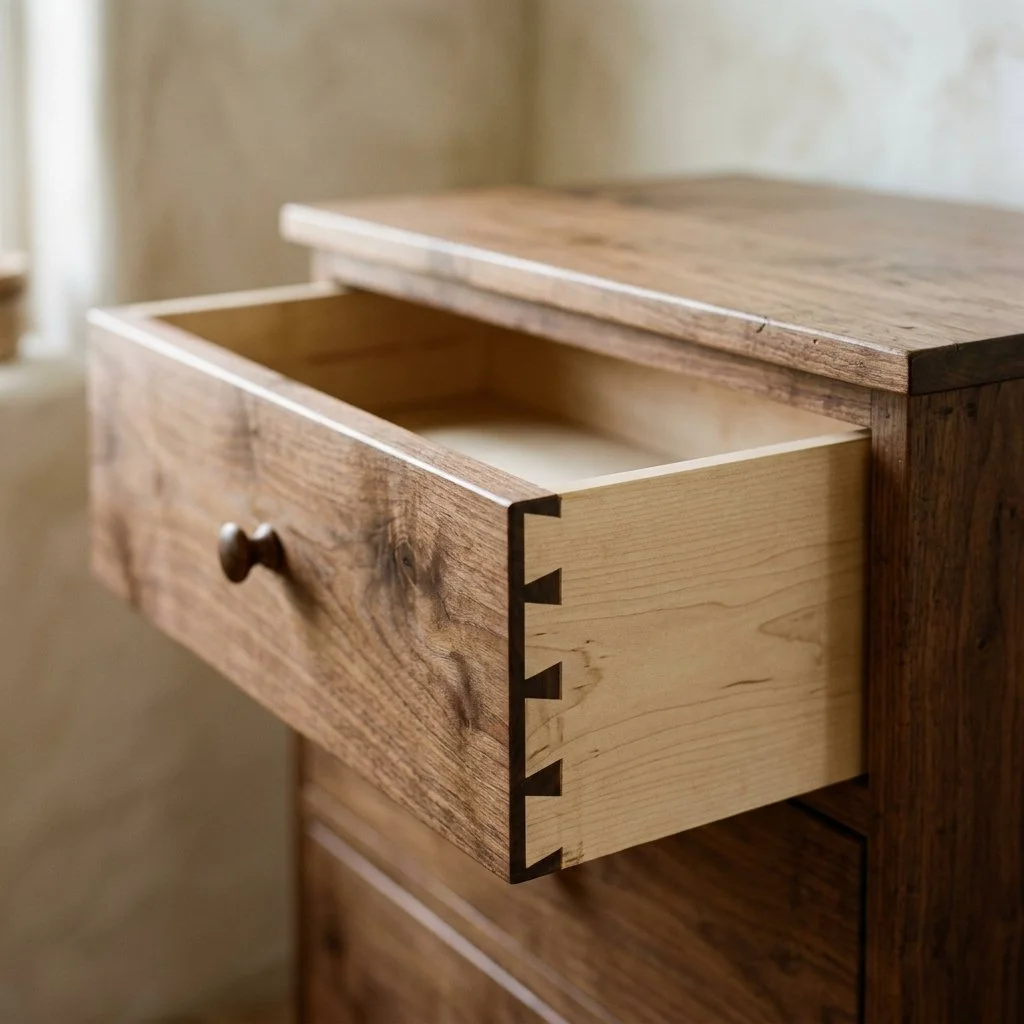
Dovetails are reported in furniture from Egyptian tombs of the First Dynasty, close to 5,000 years ago. The tails are cut as trapezoids that lock against the direction a drawer front gets pulled, and glue makes the joint close to impossible to separate. The English name comes from the shape of a dove's tail. It is still the first joint I would check on any case piece.
Walnut drawer pulled out, showing tightly fitted dovetail joints at the corner where the front meets the pale maple side.
The Drawer Corner
Pull a drawer all the way out and look at where the front meets the side. Interlocking pins and tails hold that corner together in the wood itself, which lets a drawer front take a hand on its pull every day for years. Each pin sits tight in its tail with no gap showing.
What Holds a Leg to a Rail
A chair leg takes sideways force every time someone leans back, and the joint built for that is the mortise and tenon. Bed frames from First Dynasty tombs at Tarkhan already had them. A tongue on the rail fits a slot in the leg, so glue meets wood along the grain on every face of the tenon. Glue grips long grain far better than end grain, which is why a pair of dowels in the same space holds less. Woodworkers who repair chairs describe the same failure on doweled joints. The glue survives and the wood around the dowel tears out.
Solid Wood Moves
Wood takes on and gives up moisture with the seasons. It changes far more across its width than along its length, and kiln dried boards keep moving after they reach a house. A well made piece is built to allow that. In frame and panel construction the center panel floats in its groove, unglued, so it can widen in humid months without splitting the frame. A solid tabletop with breadboard ends is pinned at the center, while the outer pins pass through oval holes so the top can expand and shrink. In one season the ends sit slightly proud of the tabletop, and in another slightly short. That is what a correctly built solid top does. A slab fastened rigidly to its base can split, and no glue is strong enough to hold wood that wants to move.
Hardware That Can Be Adjusted
Concealed hinges adjust in all three directions after installation, so a door that shifts a millimeter can be brought back without being taken off. That matters on a piece that will spend decades in changing humidity. Undermount slides with soft close come with a published load rating that varies by model, and it is worth asking for.
Makers argue about whether slides belong in fine furniture at all. Waxed wooden runners are the traditional answer, but they can bind when humidity swells them and they wear with use. Metal slides give full extension and can be adjusted. Some makers refuse to put metal in anything traditional, and others use it everywhere. The drawer should run straight and sit with an even gap all the way around.
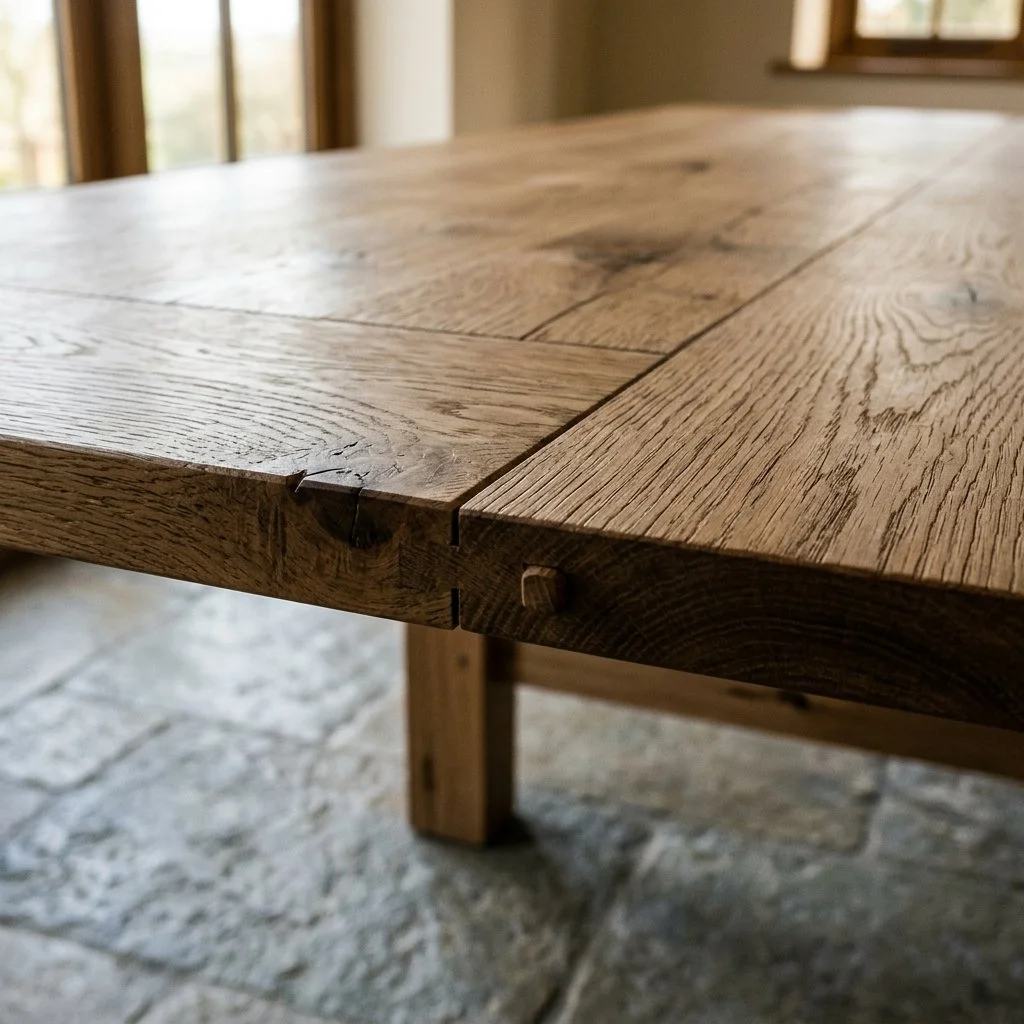
Solid oak tabletop with a breadboard end, side grain shows through the thin finish, with a wooden peg visible at the joint.
A Finish You Can See Into
A good finish lets the grain show through it. French polish is the far end of that idea. It is shellac, which comes from a scale insect native to Asia, worked on with a cloth pad in many thin coats, a method in use since the 1600s. It is softer than modern varnish and marks white when water or alcohol sits on it, so it suits a bedroom chest better than a bar. Open grain woods like walnut and mahogany need their pores filled first, one more step that takes time. Shellac can also be repaired easily.
Turn the piece so light rakes across the surface. The grain should appear to move under the finish.
The Hours Nobody Sees
Someone cut and fitted each joint and left the panels room to move. Someone built the finish coat by coat and waited for each one to dry. A piece that skipped all of it can look identical from across a room, and identical in a listing photo. A specification that names the joinery and the finish gives a workshop something to be held to.

The Oaxacan Hearth
A refined exploration of Mexican kitchen design, where traditional materials, handcrafted objects, and warm textures create a timeless, grounded culinary space inspired by regional heritage and modern restraint.
The comal in an Oaxacan kitchen has never needed a redesign. It's the same flat disc of clay or stone, set directly over open flame, that cooks here were using long before the Spanish arrived, and its job hasn't changed: char a chile or warm a tortilla, nothing else required. Its name comes straight from the Nahuatl word for it, comalli. The volcanic molcajete beside it is just as old, and gets its own full treatment elsewhere on this site.
That kind of continuity runs through the rest of the kitchen, in ways easy to miss if you're only looking for what changed.
Handmade red clay olla and cazuela cookware from San Marcos Tlapazola.
The Village That Colors Everything Red
Not far from Tlacolula sits San Marcos Tlapazola, a Zapotec village where a few hundred women still work red clay entirely by hand, a craft passed mother to daughter for twenty generations. There's no wheel involved. Pieces are shaped using little more than a corn husk and a smooth stone. The clay comes from the hillsides above the village, rich in the iron oxide that gives it that unmistakable red once fired.
The clay is dug from the hillside and mixed with sand, then left in the sun for about a week. After that, it goes into an open pit and is fired over wood and kindling. Pieces meant for daily cooking are scraped and burnished nearly smooth first, so they hold up to years of stovetop use. Decorative pieces are left exactly as the fire leaves them, marked by smoke. This is the source I'd point a designer toward for a real olla or cazuela, not the glossy version made by machine and sold everywhere else.
The Other Red
There's a second red in Oaxaca that has nothing to do with clay, and it predates the Spanish by centuries. Cochineal, a tiny insect that lives on the nopal cactus, produces one of the most vivid reds ever found in nature once it's dried and crushed. Zapotec and Mixtec dyers in the Oaxaca Valley farmed it at least three hundred years before colonization and used it to color textiles and ceremonial objects. When the Spanish encountered it, they'd never seen anything like it in Europe, and it briefly became one of New Spain's most valuable exports after silver. It's the fact about this place I didn't expect: the deepest, most expensive red in the room might be the one made by a bug.
That same dye still colors woven table runners and linens found across Oaxacan households today, made the way it's always been made, and it never needed an invented backstory to be interesting.
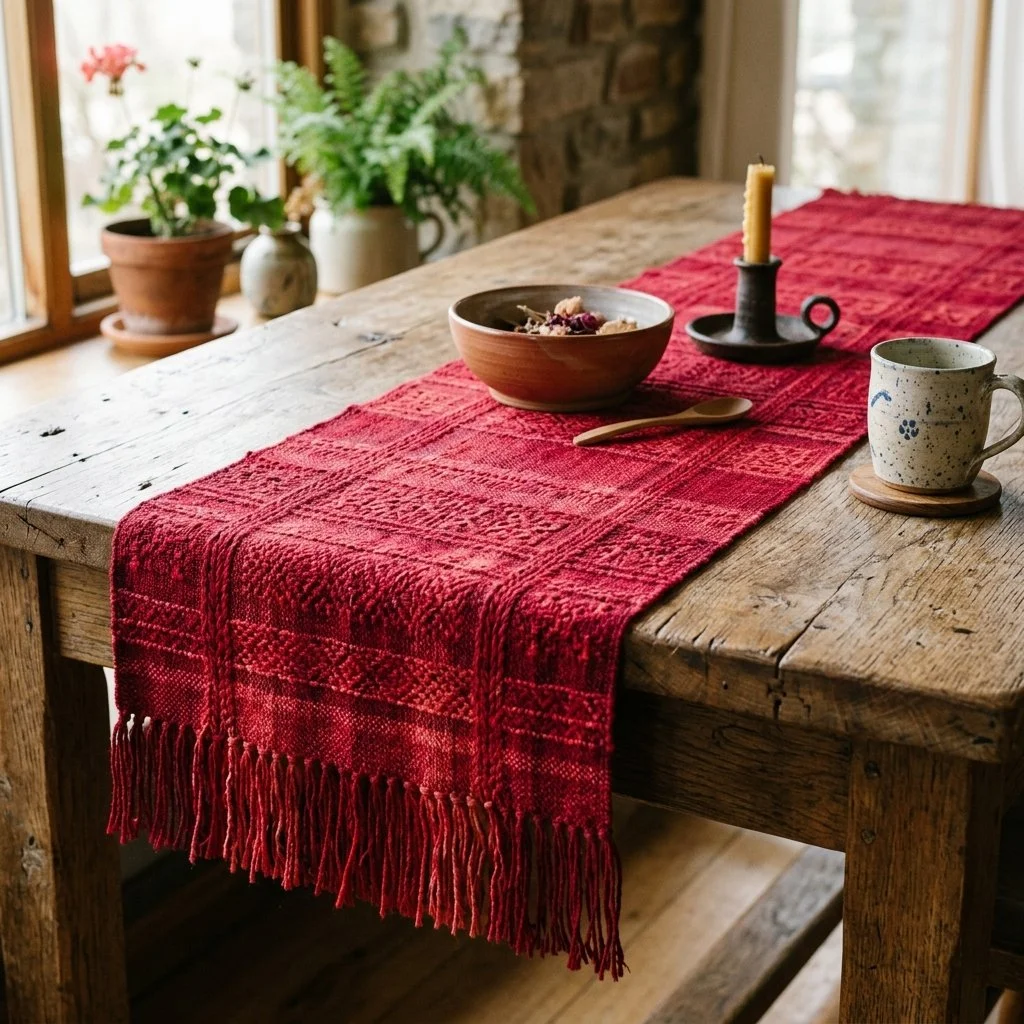
A handwoven table runner dyed in rich cochineal red rests on a rustic wood table.
What Four Centuries Added
Not everything on this table is this old. Quesillo, the stretched string cheese wound by hand into a ball, exists because Spanish ranchers found the Valley of Etla suited to raising cattle in the late 1500s, something the region never had before then. The molinillo works the same way: everyone assumes the carved whisk is purely indigenous, but it's a Spanish invention. The Mesoamerican method for foaming chocolate was to pour it back and forth between two vessels, not whisk it at all. Both arrived centuries after everything else in this kitchen, yet both were absorbed completely enough to read as native now.
What Never Left
Take away the cheese and the whisk, and everything else in this kitchen is standing exactly where it started. The comal is unchanged, and the red clay still comes from the same hillside it always has. The cochineal thread is dyed the way it's been dyed for centuries. A place doesn't prove its provenance by staying frozen. It proves it by absorbing four centuries of additions without losing the thing that was there first.
For a designer sourcing either: San Marcos Tlapazola's cooperative of red clay potters is the real channel for an olla or cazuela, and Teotitlán del Valle's natural dye weaving cooperatives, the ones still working only with cochineal and other plant dyes instead of synthetic ones, are the channel for cochineal dyed textiles.

Argentina Keeps Its Fire Honest
Argentinian kitchens are shaped by routine and togetherness rather than decoration. This guide explores how durable materials, communal cooking habits, and functional tableware create a space built for everyday use rather than display.
In the eighteenth century, the gauchos who worked Argentina's pampas lived mostly on beef, cooked over an open flame, because the plains gave them almost nothing else to eat and nothing to season it with. Mendoza still cooks this way today. The iron grate, and the vertical cross that came after it, both trace back to that same problem: one ingredient, one heat source, and however long it took to get it right.
Dark V-shaped grates of an outdoor parrilla grill over glowing red charcoal coals.
The Fire Argentina Actually Built
The parrilla is the daily engine: a heavy iron grate with channels shaped like a V that let fat drain away from the coals instead of flaring them up. A wheel raises or lowers the whole grate, which is how an asador adjusts heat without touching the fire itself.
The cross, or cruz, is older and slower. Whole cuts, sometimes a whole lamb, are secured vertically on an iron frame and left leaning over the coals for hours, the hide sometimes still on to hold the juices in. It's Patagonia's method more than Mendoza's. In Chubut province, the same vertical technique carries traces of Welsh settlers and of the Tehuelche people who were roasting meat this way well before the Welsh or the Spanish showed up. Credit for the cross probably belongs to more hands than just the gauchos'.
One detail from the gauchos survives in every good asado today: burn quebracho wood if you can get it. It produces almost no smoke, which is the entire point when the meat sits inches from the flame for hours.
The Cut Nobody Gets Right
Ask for picanha in Mendoza and you'll get funny looks from anyone who takes the cut seriously. Picanha is the Portuguese name, Brazil's word for it. In Argentina, the same top sirloin cap, identified by its thick fat cap left untrimmed, is properly called tapa de cuadril, or colita de cuadril depending on the province. Argentina's own beef promotion board confirms the naming. The fat itself works exactly the way people assume: leave it on, and it renders slowly into a crust the fat bastes on its own, no marinade needed.
Chorizo sits at the same table but arrived by a different road. The pork and beef sausage came in with Spanish and later Italian immigration, brought by settlers rather than grown out of anything already here. Argentina adopted it so completely, as the traditional first bite before the heavier cuts, that almost nobody thinks of it as borrowed anymore.
Algarrobo, Named Twice
The wood most Argentine asado tables are built from is algarrobo, a Prosopis species that grows in the arid Gran Chaco region and can survive conditions most hardwoods can't. It's genuinely native. The name is not. Spanish settlers called it algarrobo because it reminded them of the European carob tree they already knew. Long before that naming, Guaraní speakers called it ibopé or igopé, and Quechua speakers simply called it yaná tacú, the tree, a name that says something about how central it was to daily survival for millennia before anyone Spanish showed up. Its pods were ground into flour for a dense cake called patay, and fermented on their own into a drink called aloja. Its wood holds heat without dulling a blade, which is exactly why it still ends up under a plate of meat.
What Actually Traveled to Get Here
Two objects on the Mendoza table have origin stories that surprise people who assume everything here is old and native.
Malbec is French. It came from the Cahors region in France. The agronomist Michel Aimé Pouget crossed the Andes from Chile in 1853 with French vine cuttings, to found an agricultural school in Mendoza. Most sources date Malbec's actual arrival to 1868, among the varieties introduced once the school was running. A few decades later, phylloxera nearly wiped Malbec out in its own country. Mendoza's dry soil, sitting at high altitude where the disease struggles to spread, protected it instead. The grape that France mostly abandoned became more Argentine than French in practice.
The pingüino, the ceramic penguin pitcher used to pour that same Malbec, is newer still. Italian immigrants popularized it in Argentina sometime in the 1930s, when bulk wine sold to neighborhood cantinas had to be poured again into something for the table before bottling regulations existed. Nobody is fully certain why the shape is a penguin. One theory, from a single Argentine source I couldn't independently confirm elsewhere, ties it to an American Art Deco silver cocktail shaker from 1936, shaped like a penguin for a World's Fair exhibit built around a shipment of real Antarctic penguins. It's a strange thread for an object that looks like it should have a tidy folk explanation, and I'd rather leave it unresolved than invent one.
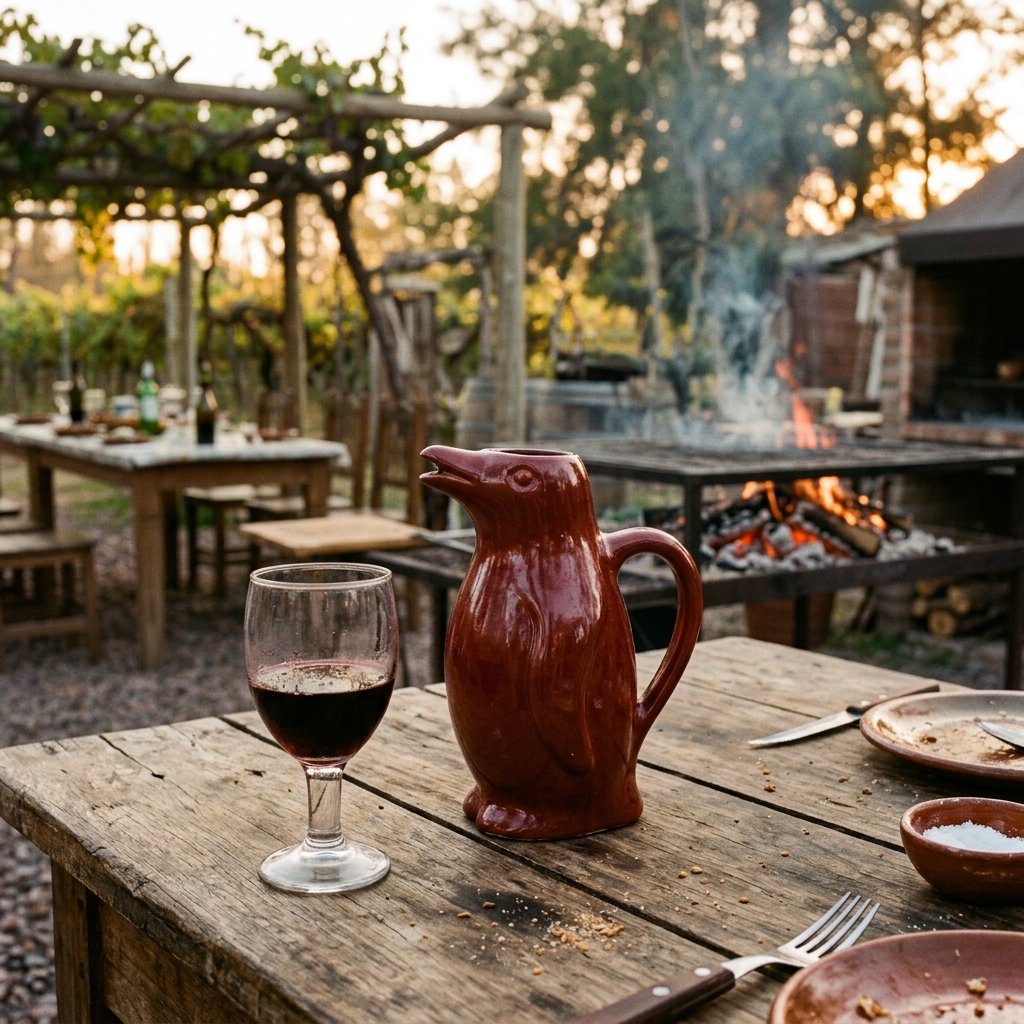
A ceramic pingüino pitcher and a glass of Malbec sit on a rustic wooden table.
What the Fire Refuses to Rush
Mate is the one object on this table that owes nothing to the fire. The Guaraní people of what is now Paraguay were cultivating and drinking it before any Spaniard arrived in South America. Even the word carries the layering: "mate" comes from the Quechua word for the gourd it's served in. "Yerba" is just the Spanish word for herb. The ritual underneath both words is centuries older than either label.
That's the real shape of this table. Argentina built its fire out of necessity and got its cut names crossed with its neighbors. It kept a wood the Spanish renamed but didn't create, and took in a grape and a pitcher that both started out belonging to someone else. Underneath all of it sits a drink the Guaraní were already sharing for centuries before anyone here was arguing about what to call the meat.
If you want to source any of this properly rather than buy it retail, two channels are worth knowing. Misiones province, in Argentina's northeast, is where yerba mate is actually grown, and cooperatives run by small producers there sell direct rather than through the mass brands most people know. And the ironwork itself, the parrillas and the crosses, is still forged by hand by blacksmiths working in Mendoza and further south in Patagonia, the same trade that's kept the gaucho's fire running for centuries.
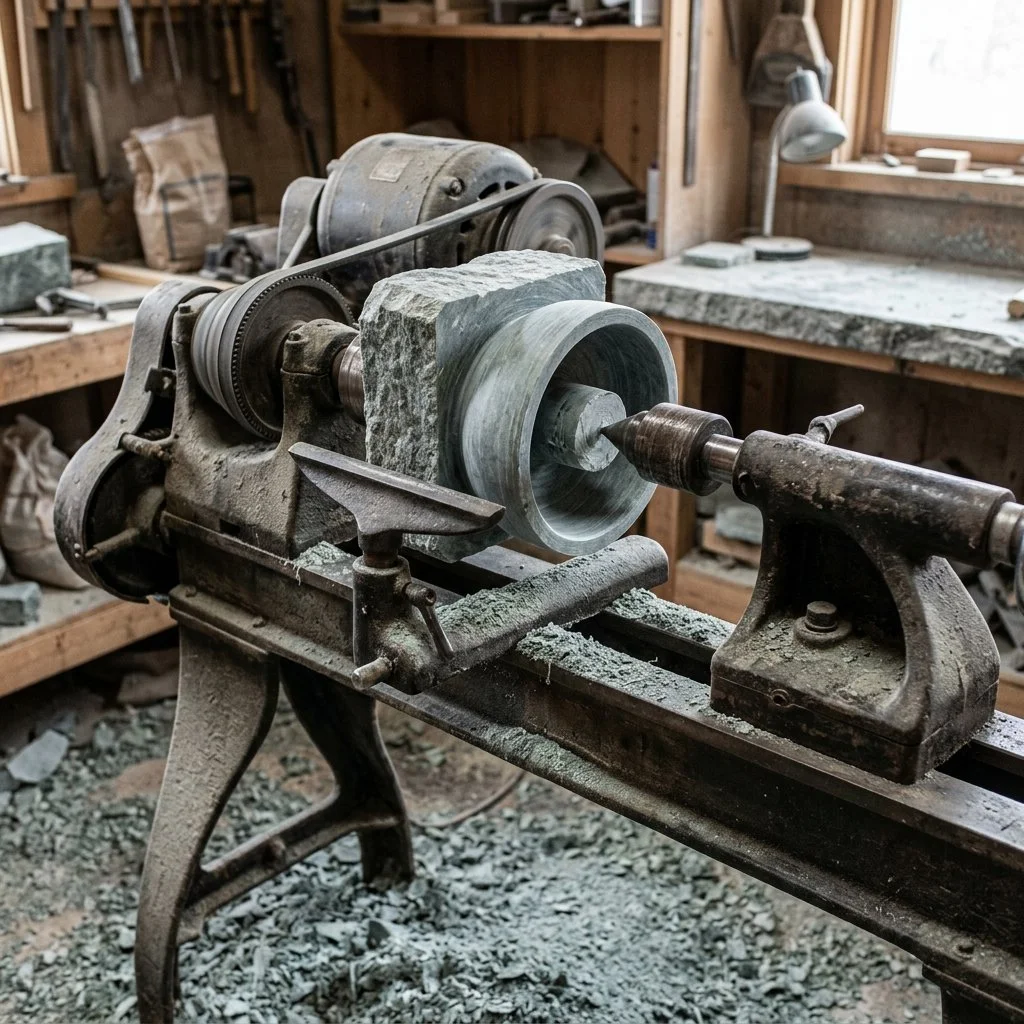
In Ouro Preto, Brazil, People Cook in Stone
Brazilian kitchen design is shaped by rhythm, generosity, and everyday gathering. This guide explores how practical tableware, lived-in dining traditions, and warm functional essentials create kitchens designed for connection rather than display.
In 1927 a German chemist named Oskar von Burguer wrote up how the soapstone pots of Minas Gerais, Brazil, were made. A block of stone was clamped between two iron points on a horizontal lathe, and a waterwheel turned it through a wooden pulley. Those two points were the only iron anywhere on the machine.
By 2009 most of the working lathes in Cachoeira do Brumado, a district of Mariana, ran on electricity. A researcher named Vinícius Melquiades spent twenty days that July in the district's workshops and found only two still driven by water. Looking for the stone behind all of this because it turns up in two places I would never have put side by side: the Baroque churches of Minas Gerais and an ordinary stew pot.
Iron lathe holds a partially turned block of gray-green stone.
The Rock Itself
The rock is steatite, a metamorphic stone with varying amounts of talc, common across the iron belt of Minas Gerais that geologists call the Quadrilátero Ferrífero. It sits between 0 and 2 on the Mohs scale, soft enough to shape with hand tools. The maker cuts a block loose with a saw and an iron lever, then leaves a column of stone standing inside it so the block can be held between the two points and turned. The column comes out last.
The makers in Cachoeira do Brumado all name one problem, iron pyrite. It is far harder than the steatite around it, and a lump of it can tear loose and crack a pot on the lathe, so blocks are chosen at the outcrop and any stone with pyrite in it stays behind.
Laboratory tests on stone from four quarries in Bandeiras, in the Santa Rita district of Ouro Preto, found porosity of 0.4 percent at most. Every sample broke in the first or second round of a thermal shock test, which is a good reason to bring a pot up to heat slowly.
A Trade Nobody Registered
Gold brought the pot makers. In the first half of the 1700s, communities settled around Ouro Preto and Mariana to make these pots for the new mining towns and the roads between them. One of the first men to find gold in Minas Gerais founded Cachoeira do Brumado in that rush.
Colonial officials licensed and regulated trades like masonry and blacksmithing in detail. Melquiades found no reference to pot makers in the documents he consulted, and that gap is why he calls it an unofficial trade. Nearly every account of soapstone in Minas Gerais leads straight to Aleijadinho, and Melquiades argues that this gives the wrong picture of who made the pots. His reading of the evidence points to free colonists and to people who were enslaved or formerly enslaved. They worked the stone for sale in the towns and along the roads.
When von Burguer asked in Santa Rita whether the workshops made anything besides pots, he was shown, with obvious pride, a stemmed drinking glass cut from stone in the shape of an ordinary glass one.
One District, Two Markets
Santa Rita de Ouro Preto is called the capital of soapstone. The best stone from its quarries leaves as blocks for Europe and the United States, and the softer, lower grade rock goes to artisans for pots. I find it hard to read that split without noticing which end gets the better rock.
In the 1700s and 1800s the stone stood in for costly Italian and Portuguese limestone in Baroque work. Prominent among its uses are the sculptures at the Sanctuary of Bom Jesus de Matozinhos in Congonhas. The International Union of Geological Sciences designated Minas soapstone a heritage stone in 2026, and its entry notes that the cookware craft is recognized as intangible heritage in Ouro Preto and Mariana.
The work itself is hard. A 2023 study of the workshops calls it arduous and unhealthy. Raw stone is expensive, and the pots are hard to sell. In Cachoeira do Brumado the shallow deposits that artisans could dig by hand ran out once mining companies arrived in the 1970s and 1980s. Many makers now buy the waste rock those companies discard, and a few still extract by hand.
The Pots Rode the Mule Roads
The gold built the mule roads, and the pots went out on them. Muleteers called tropeiros hauled goods across the colonial interior, and near the waterfall in Cachoeira do Brumado a memorial honors the men who carried the pots on muleback for days. The dried staples they carried, beans and cassava flour among them, turned into feijão tropeiro, a dish still cooked across Minas. Cassava is the older ingredient. Farofa comes from the Indigenous way of turning manioc into flour, which was in Brazil long before any mule train.
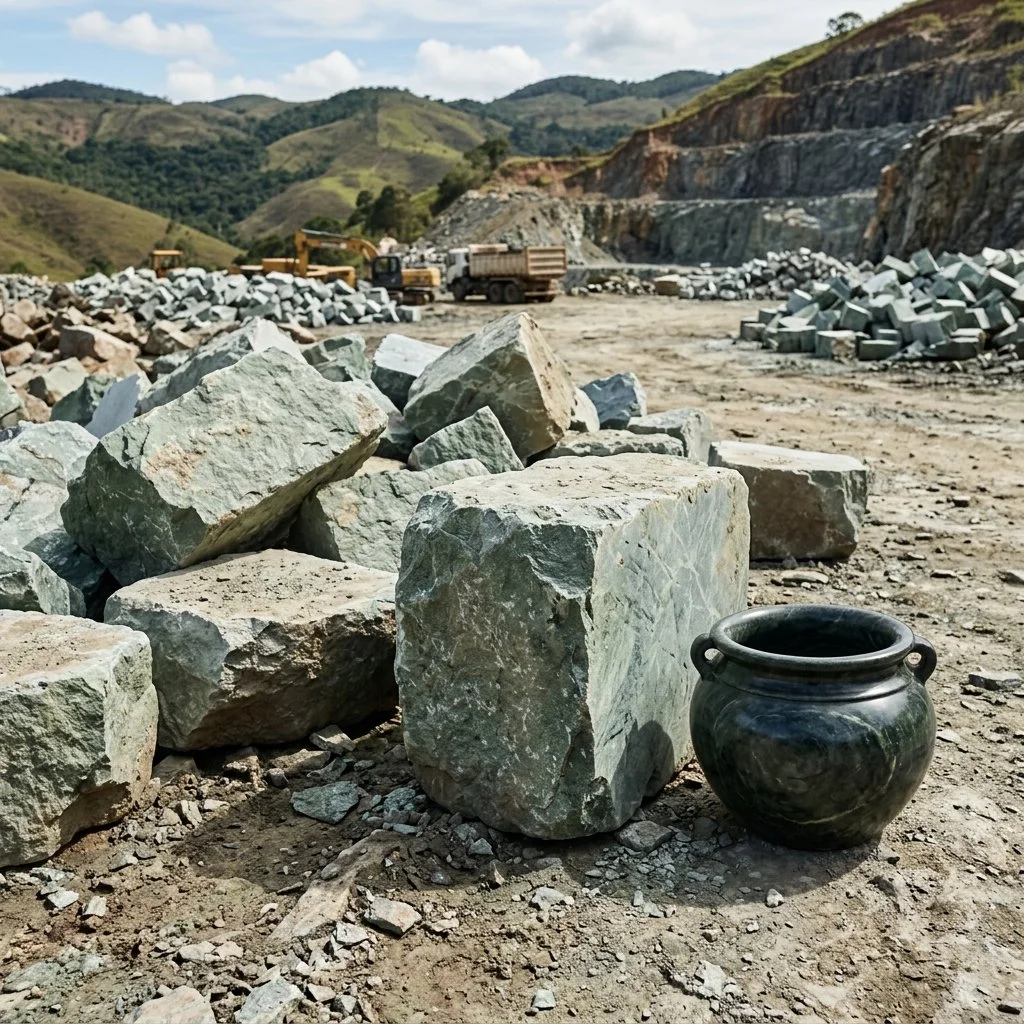
Raw, greenish gray steatite blocks in a Santa Rita de Ouro Preto quarry alongside a hand carved stone cookware pot.
The People at the Lathe
The stone that was carved for the churches of the gold towns also went on the stove, and the people who turned the stove pots barely appear in the records. That is why I would start with them. Cachoeira do Brumado has an artisans' association for its stone and sisal makers, and its residents' association runs a pot festival each July. In Ouro Preto, the soapstone fair at the Largo do Coimbra has been run since 1995 by an association of its own stallholders. Much of what it sells is made in Santa Rita, and soapstone shares the stalls with jewelry and souvenirs. Slab and blocks take a different route, through the quarry operators around Santa Rita who already ship both to Europe and the United States.
What Korean Tableware Is Made Of
Korean kitchens reflect a balance of restraint and ritual, where function leads design. This guide explores how Seoul dining culture shapes minimalist tools, intentional tableware, and everyday objects designed for quiet efficiency and shared meals.
A stone bowl of rice reaches a Korean table still crackling. The rice at the bottom is cooking against hot stone. The flavors of the meal started months earlier in a clay jar, and the dish is not done until the person eating finishes it.

Black stone dolsot bowl filled with rice and a golden crisp crust, placed on a dark walnut board alongside steel utensils.
Months in the Yard
Korean cooking runs on fermentation, and the fermenting happens in onggi. Unglazed jars are fired at low temperatures, so the clay stays porous. Oxygen passes in and the liquid stays put. Glazed jars are coated in a dark brown mix of local clay and wood ash. Big jars sit in the yard or are buried, which is one way of controlling how fast the ferment runs. They hold the chili paste and soybean paste the cuisine is built on. Kimjang, the late autumn making of kimchi, went onto UNESCO's list of intangible cultural heritage in 2013.
Even the red in that chili paste has a disputed past. The usual account says the chili plant came from the Americas and reached Korea by way of Japan in the late 1500s. A Korean research team argues for a native pepper much older than that, and the question is still open.
The potters were often itinerant and worked at the edge of Korean society. Ralph Rinzler of the Smithsonian made a research trip in 1971 and likened the jars to the refrigerators found in every American home. The trade that produced them was barely documented outside Korea until then.
Heat That Stays on the Table
Retail listings often call a dolsot a granite bowl. I checked, and the Korean name says otherwise. Gopdolsot means agalmatolite pot, and agalmatolite is a soft stone that holds heat. The bowl keeps cooking the rice after it leaves the fire. Sesame oil goes into the hot bowl first and then the rice, and the bottom layer crisps against the stone. That crust is nurungji. In bibimbap, which means mixed rice, the spoon goes in hard to work the gochujang through the bowl and scrape up the crust. With plain rice the crust steeps into sungnyung, a hot infusion.
The king's table already had a fire on it: a pot heated by charcoal that usually held a casserole such as sinseollo. What changed is the fuel. Many restaurants in Korea now run hot pots and grilled meat on portable butane burners, and at those tables a canister does the work charcoal once did. In Seoul it sits between the guests, and they tend it themselves.
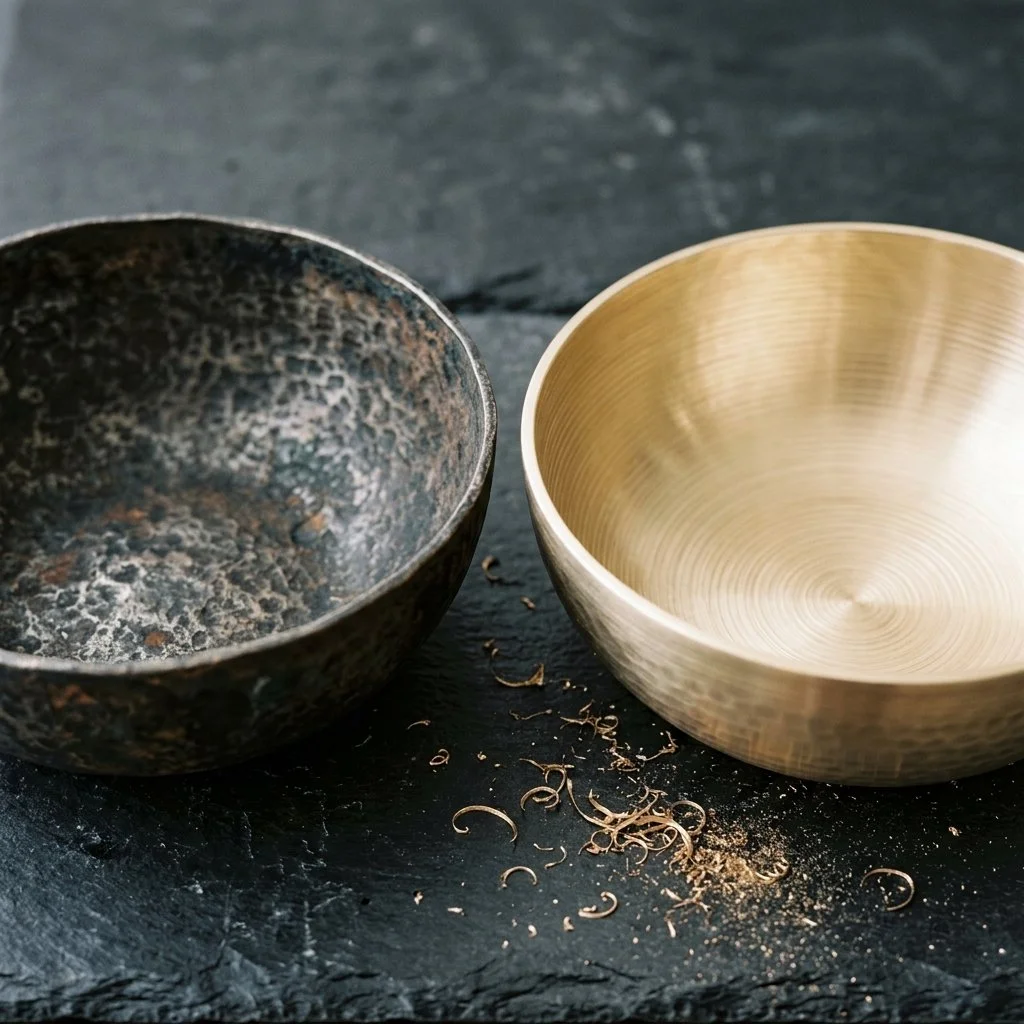
Two Korean bangjja bronze bowls, one raw and oxidized, the other shaved to a soft pale gold with visible lathe marks
In the Diner's Hand
Rice and soup go to each person, and the side dishes, banchan, sit in the middle to be shared. Whoever is eating builds each bite from them. Their number once carried rank, and the count, called cheop, leaves out kimchi. Nine cheop was as far as a noble family went, and twelve belonged to the king.
The tools for that work are metal. The oldest metal chopsticks on record in Korea came out of the tomb of King Muryeong of Baekje, who died in 523. There were two pairs, bronze and flat, each with a ring at the gripping end so a chain could join the two sticks. Korean has one word for the pair, sujeo, spoon and chopsticks together.
Before stainless steel, the metal for a fine table was bangjja, a bronze of 78 parts copper to 22 parts tin. A smith heats it and beats it over and over, tens of thousands of blows for a single piece. The finished piece goes into seawater, and the dark skin is shaved away to reach the bronze underneath. Royal tables used it, and South Korea designated the craft an Important Intangible Cultural Property in 1983. In 2022 Aesop planned a Chuseok display of work by Jiho Lee, the youngest of three generations of bangjja masters, in four of its Seoul stores. He uses a mechanized hammer for part of the work and keeps the method otherwise traditional.
The flat steel pair on a Seoul table today is much younger. It appeared in the 1960s, when Korea began making stainless steel at home, and it is flat because a pair cut from sheet metal was the cheapest shape to mass produce. The shape looks ancient, but it began as a manufacturing choice. It stayed because a meal with a dozen small dishes rewards a utensil that does not wear down and can pick up delicate food.
Who Still Makes the Table
The jar does its work over months, and the stone and the fire do theirs in front of you. The last step belongs to whoever is holding the spoon. The crafts behind the jar and the spoon are still active. Onggi come from potters in villages such as Oegosan, outside Ulsan. Anseong, in Gyeonggi Province, is one of the old brass centers, and its name became a Korean phrase for made to order, Anseong matchum. I did not find a maker for the stone bowl, so those two are the workshops I would send a designer to first.
How a French Kitchen Got Its Order
French kitchens are defined by restraint, rhythm, and respect for process. This guide explores how culinary tradition influences layout, tools, and everyday function, where elegance is found in practicality rather than decoration.
In 2010, UNESCO added "the gastronomic meal of the French" to its list of intangible cultural heritage, and the entry does something unusual for a food listing. It names an order. The meal starts with an apéritif and ends with liqueurs. In between come at least four courses: a starter, fish or meat with vegetables, cheese, and dessert.
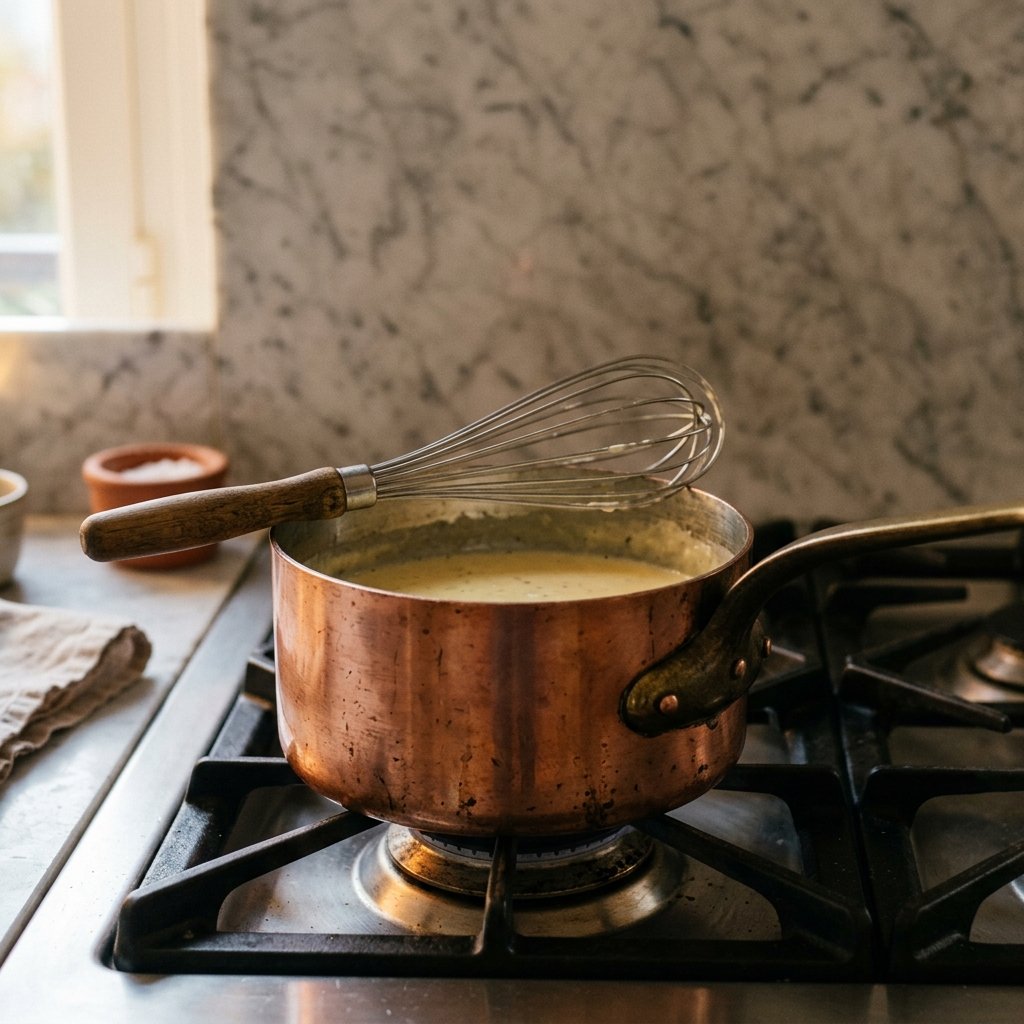
Copper saucier with a bronze handle sits on a gas range in a French kitchen.
What Escoffier Took From the Army
Auguste Escoffier cooked for the Army of the Rhine during the Franco Prussian War of 1870, and the army's structure shaped how he ran kitchens afterward. In the 1890s, at the Savoy in London, he split his cooks into stations. Each station had one job and a rank, and the rank names survive in restaurant kitchens today, sous chef and commis among them. Before that, the kitchens of large houses were divided loosely by type of food and, by most accounts, ran on disorder and duplicated work.
Dinner had also moved to service by the course. Each dish went out on its own instead of the whole spread arriving at once. A kitchen that has to build the next dish while the last one is being eaten has to divide the labor, and the brigade is that division. In 1903 he published Le Guide Culinaire. It ran to more than five thousand recipes and set out to fix French cooking in place.
The Sauce Cook and the Copper
The saucier makes the sauces and plates the dishes that carry them, and the job has a paper trail. Marie Antoine Carême sorted French sauces into four families in the early 1800s. Escoffier reworked the list. He added hollandaise and tomato and moved allemande down to a branch of velouté. That left five: béchamel, velouté, espagnole, hollandaise and tomate.
The pan for that work comes from Normandy. Villedieu-les-Poêles, a town near Mont-Saint-Michel, has worked copper since the twelfth century, when knights returning from the Crusades settled there and brought the trade with them. The name translates roughly as God's city of the pans. Copper moves heat far faster than stainless steel, so the pan answers when the flame drops. That matters for hollandaise and beurre blanc, which break when overheated. One Villedieu maker's main lines use walls between 1.5 and 2.5 millimeters. The thicker walls hold heat longer.
The townspeople are called Sourdins, from the French for deaf. The usual explanation is a workforce deafened by hammering, and one dictionary offers a local river named the Sourde as a rival theory.
The Workshops Still Open
Villedieu's copper trade has thinned, and it has not ended. One workshop there, founded in 1850, still hammers and tins copper by hand. It makes pieces to order, and in 2013 it shipped a bathtub to New York that took 250 hours of labor. Normandy's tourism board bills it as the last copper workshop in France, though a second maker has worked in the same town since 1830.
One Cook Doing Every Job
A home kitchen has one cook, so the whole brigade collapses into a single person walking between stations. What survives is the part Escoffier settled, which was who owns which job before service starts. When I look at a kitchen for someone who cooks seriously, I look for two of those places first: where the sauce gets made, and where the plate gets finished. I would take a small kitchen with clear stations over a large one where every job happens everywhere.

A wedge of Brie rests on a rustic wooden board alongside a freshly sliced piece, torn baguette, and a glass of red wine.
Cheese Before Dessert
One course in the UNESCO order needs no cooking at all. Cheese comes out on its own, before dessert, and the work happens an hour earlier, when someone takes it out of the fridge so the flavor can open. Slicing ahead is out, because cut faces dry. Each guest cuts according to the shape of the cheese, and the rule that survives every dinner is that nobody cuts the nose off a wedge. The tip of a Brie wedge is the best part, and taking it for yourself is a known offense.
Copper From Villedieu-les-Poêles
The order of a French meal and the station logic of a French kitchen cost nothing to borrow. The pan is different, because it comes from somewhere specific. If a client wants French copper, I'd send them to Villedieu-les-Poêles itself. Both workshops take visitors and have a shop on site, and one makes to order, so a designer can ask about a commission in person.
How a Swedish House Gets Through the Dark
At the winter solstice, Stockholm gets a little over six hours of daylight. The sun comes up shortly before nine and is gone before three. Sweden answered that with what it had, and most of it came out of a forest and a mine.
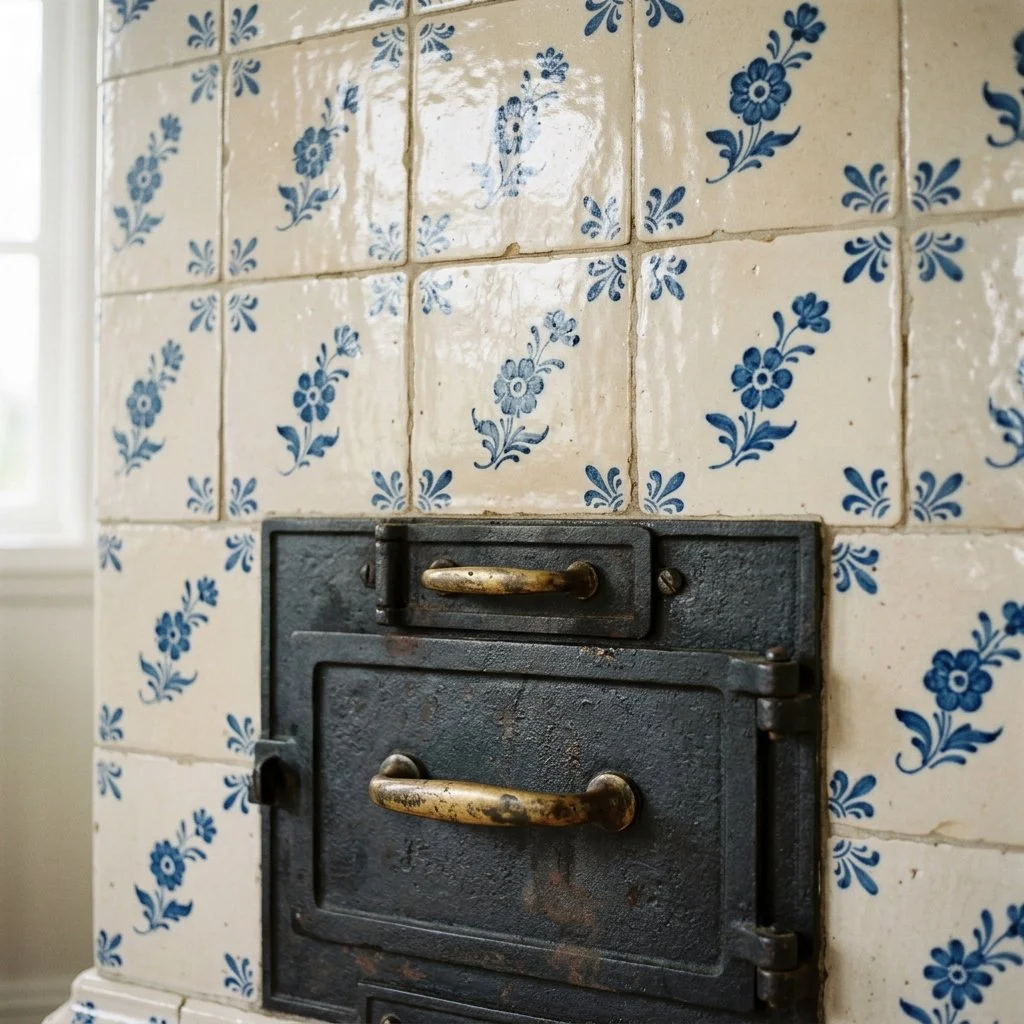
Cream glazed Swedish stove tiles with hand painted blue flowers, featuring two dark cast iron doors with worn brass handles.
A Stove Built for a Wood Shortage
By the eighteenth century Sweden's iron industry had used up so much wood that firewood ran short, and the country heated its rooms with tiled stoves that burned a lot of it. The tiled stove was not Swedish. It came up from southern Germany in the late Middle Ages, and the early ones lost much of their heat straight up the chimney.
A kakelugn is a tall brick stove covered in glazed ceramic tiles. In 1767 the architect Carl Johan Cronstedt, working with Fabian Wrede, presented a redesign. The smoke now ran through winding channels inside the brick, so the brick and the tiles took the heat that used to escape up the chimney and gave it back to the room slowly. One fire could keep a room warm for ten to twelve hours.
The tiles were also decoration. They were painted by hand with flowers and patterns to match the room, and Stockholm's Marieberg works on Kungsholmen, open from 1758 to 1788, made some of the most luxurious.
Central heating replaced them. Many stoves were torn out and thrown on the dump, and the removals went on into the 1980s. Stoves that have to go are taken out carefully now, and a few ceramists restore them and build new ones on the same principle.
One Mine Under the Brass and the Red Paint
In 1607 King Karl IX founded a brass works at Skultuna, outside Västerås, and the works say the copper mine at Falun supplied its raw material. Falun was then the largest copper mine in Europe. Sweden had run up debts to the Hanseatic League, and refining copper into brass meant fewer imports and more to sell. Among the first things the works made were chandeliers and candlesticks, and the oldest Skultuna chandelier that survives is dated 1619. The works are still there and hold a royal warrant.
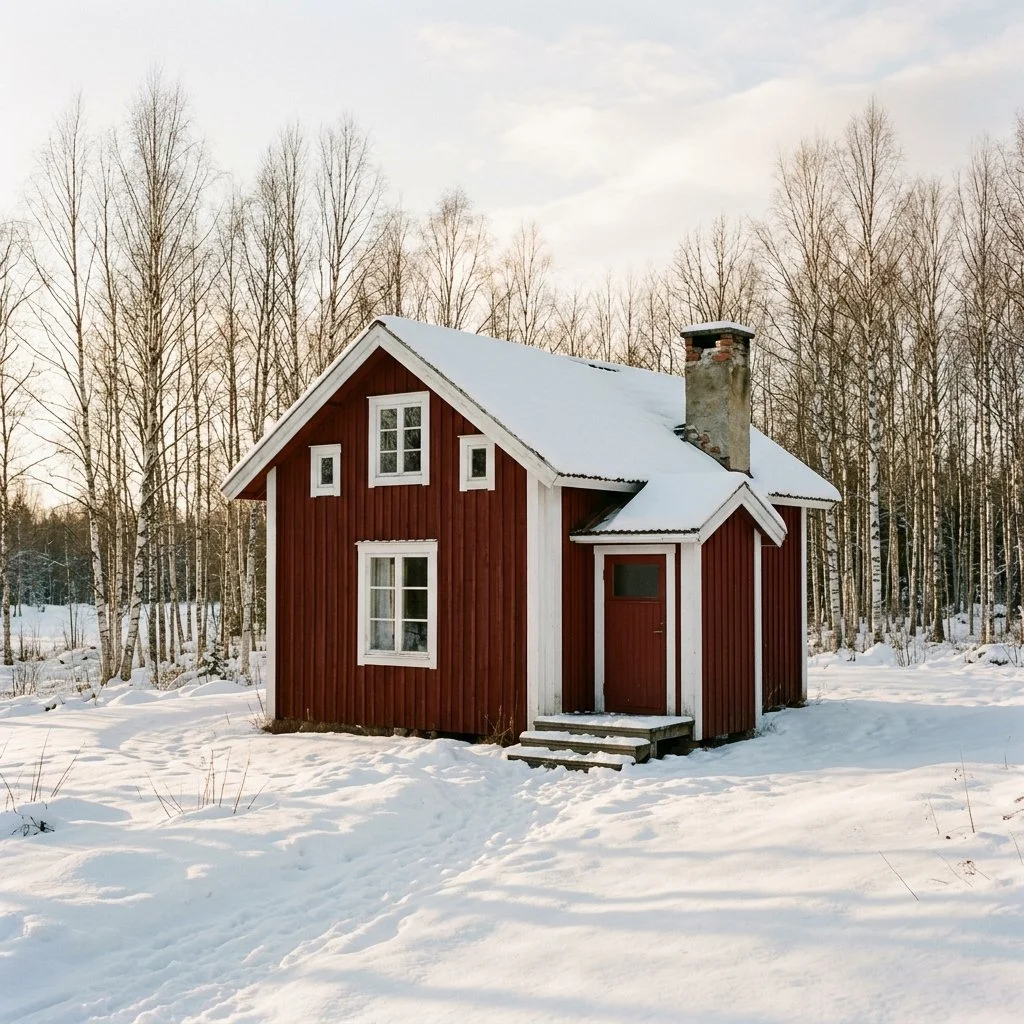
The same mine gave Sweden its red. By the sixteenth century the waste heaps had weathered into a red sludge, and heated and mixed with linseed oil and rye flour it made an excellent paint for wood. The paint company says King Johan III had the roofs of his Stockholm palace painted with it in 1573, and by 1764 the mine was making it on an industrial scale.
Timber house with white trim stands in a snow covered landscape framed by bare birch trees.
Glass Made Where the Wood Was
Kosta, the oldest glassworks still running in Sweden, was founded in 1742 by two officers who had served in Charles XII's army, on the site of an old ironworks. Some of the first workers came from Thuringia. Småland had the forest to feed the furnaces and sand in the ground, and at its peak the region had 45 glassworks. For its first 150 years Kosta made mostly plain utility glass, window panes among it. The region is called the Kingdom of Crystal now, and the regional tourist board counts thirteen glassworks and studio hot shops there. The big factory at Kosta is one. Some of the smallest have one or two glassmakers who also design their own work.
Made From What Sweden Had
The forest ran short and the mine lasted a thousand years, and each of these objects has a maker you can find. If I were sourcing any of it, I would start with the stove. A kakelugnsmakare is a maker of tiled stoves, and a few ceramists restore old stoves and build new ones on the eighteenth century principle. Glass comes from Småland, where the glassworks and studio hot shops of the Kingdom of Crystal let you stand next to the furnace. Skultuna is the address for brass. If a specification calls for Falu red, check the tin. Falu Rödfärg is a protected name for paint made with pigment from the Falun mine, and plain rödfärg can be any red iron oxide paint made with flour.
What Greek Food Is Stored and Cooked In
Greek kitchens reflect a slower rhythm of living, where meals are shared and materials are natural. This journal entry explores how Mediterranean traditions shape rustic ceramics, olive wood tools, and linen textures within timeless coastal interiors.
A Cretan household kept its oil and wine in a jar from Thrapsano. A Sifnian household baked its Sunday chickpeas overnight in a pot from Sifnos. Both objects came from village potters who worked by hand and went to their customers. This piece covers how those two villages made their pots and where their potters work today.
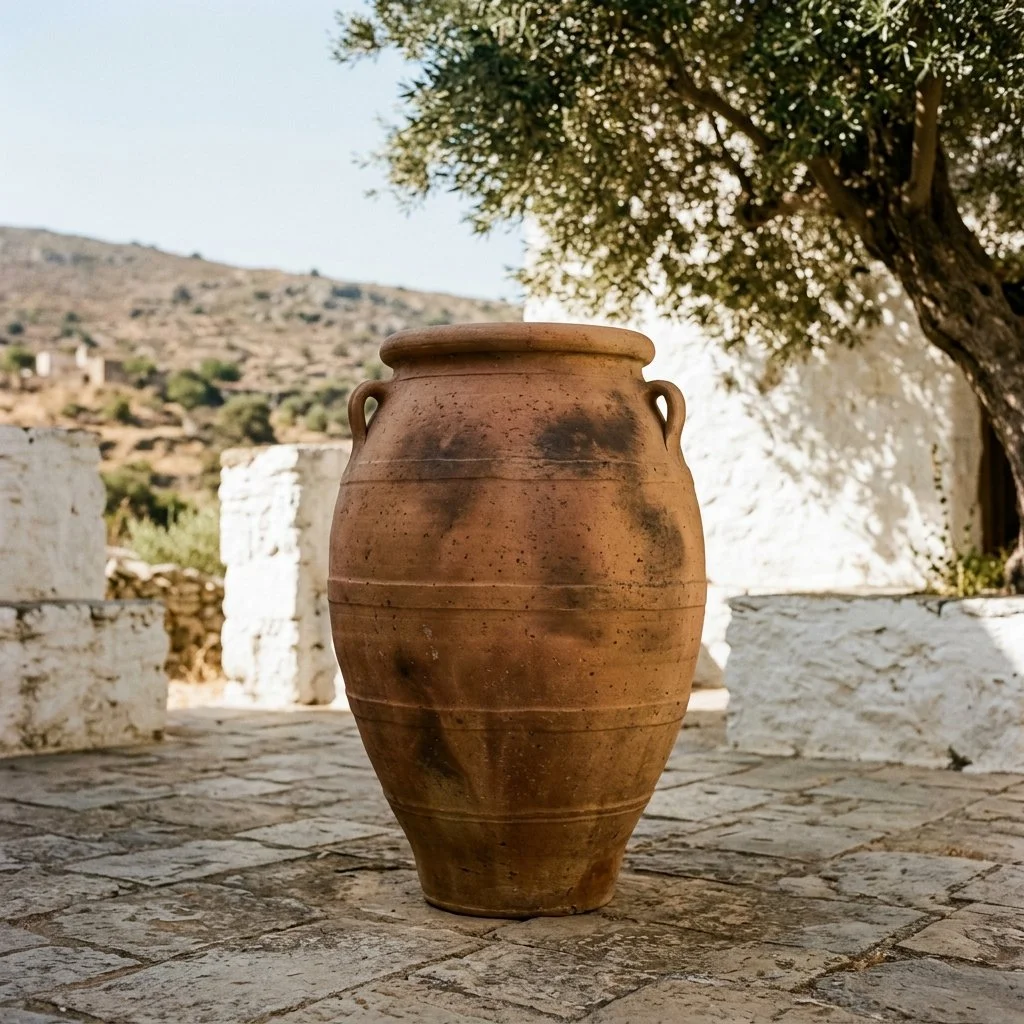
A large, unglazed Cretan terracotta storage jar with subtle coil marks and dark fire charring.
Building a Thrapsano Jar
The West Magazines at Knossos are nineteen long storerooms that once held an estimated four hundred giant jars, about a hundred and fifty of which survive. The Cretan Ethnology Museum says wine has been kept in jars like them since Minoan times, and it shows one made by Thrapsano potters in the sixteenth century. Thrapsano is a village about thirty kilometers from Heraklion, and for generations its men built storage jars by hand and sold them across much of the island.
A large jar went up in six sections: the base, the first brim, the round brim, the straight brim, the big brim and the lip. Each section had to dry before the next was added. One jar took about sixty kilograms of clay. The jars sat on a low turntable that one member of the guild turned by hand while the master built, and the turntable could not spin evenly. Maria Voyatzoglou recorded the method in the Penn Museum's Expedition magazine in 1974 and noted that a jar made this way is necessarily asymmetrical. After the kiln, the jar was filled with water and left for at least a month, until the walls became watertight.
A wine jar had a small hole low on the side for tapping and a clay lid over the mouth. Jars like it were in use until the middle of the twentieth century. Thrapsano's tourism pages call its potters the successors of the Minoans. The museum's sixteenth century jar is the oldest attributed to the village that I found. One oil jar in the Cretan Ethnology Museum carries its potter's name and village, pressed into the clay with a cylinder seal.
The Village That Was Supposed to Stop
In the old system the workshop moved to the clay. The season ran May 21 through September 14. Guilds of six left Thrapsano in different directions and set up wherever a rented field had clay and water. One member of each guild cut the firewood. They built a kiln and sold the jars they made to the district around them. About 180 of those seasonal kilns have been found across the island.
By 1974 only about ten master potters were left in the village, and three of them still made jars. Voyatzoglou expected no one in Thrapsano to carry the craft on. It carried on anyway. Family potteries on the edge of the village now build large unglazed jars from red clay and fire them in kilns fed with compressed olive pits. A potter who visited in 2018 found mostly family businesses and sons learning the trade. The clay now arrives crushed in sacks, where the guilds once dug their own.
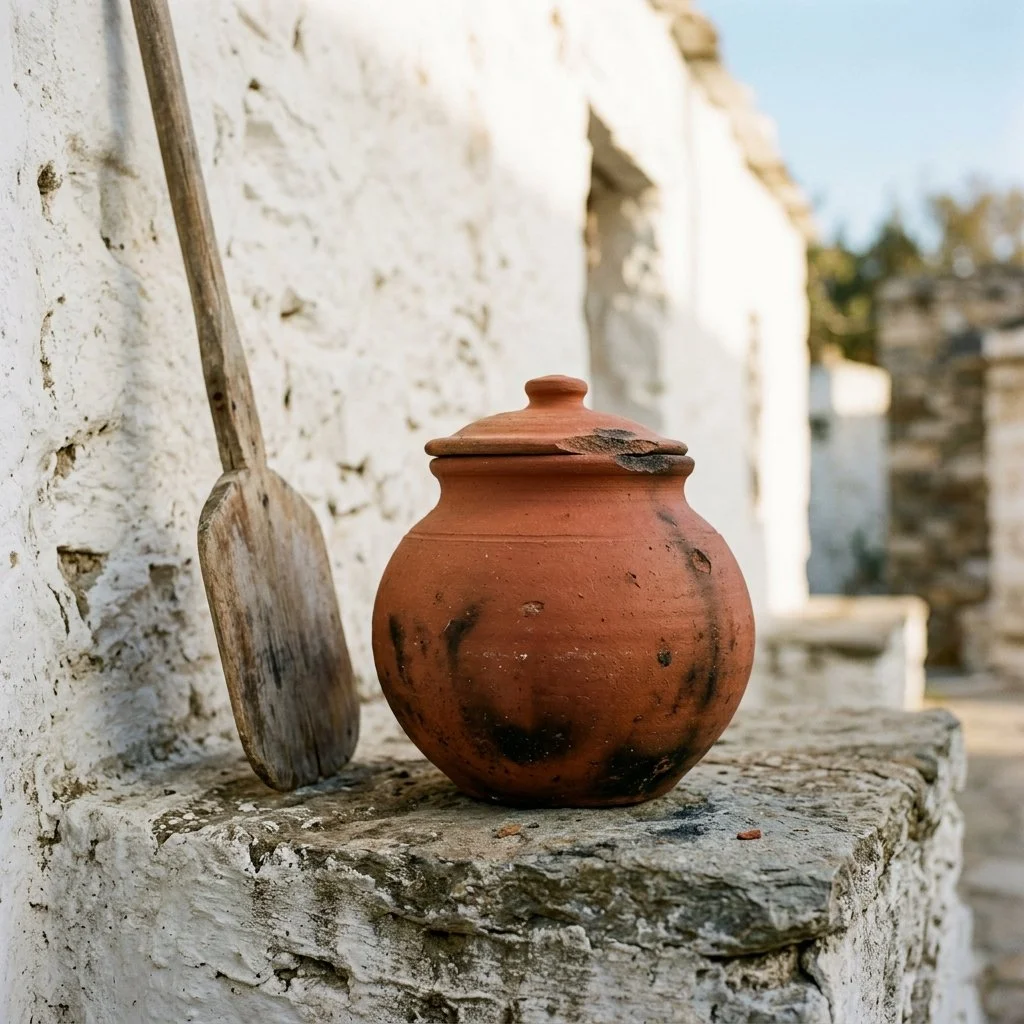
Round bellied red clay cooking pot with a small lid on a stone ledge.
The Pot Sifnos Exported
Sifnos is a small island in the western Cyclades. Pottery finds from the Middle Cycladic period, about 2000 to 1500 BC, are the earliest the Sifnos Pottery Museum records there, and the potters still prepare their own red clay, which stands up to fire. Their cooking pot, the tsoukali, was the main pot in Sifnian kitchens and the island's main export. The workshops became known as tsikalaria, and the island's name became tied to the pot. The museum records Tournefort, a French botanist, as the first to write about the pots, in the early eighteenth century.
Potters carried the trade with them. From the nineteenth century they sold across the nearby islands and farther, and the museum says a potter was called a Sifnios on many islands even when he came from somewhere else. The museum also records the first permanent Sifnian potter in Attica, Angelos Paleos, at Maroussi in 1833.
Sifnians still cook in the pot. Revithada, a chickpea stew, is baked overnight in a clay pot, and the mastelo is a large baking dish for the Easter lamb, made for wood ovens. The traditional potters throw on a wheel with simple tools, so a Sifnos pot is thrown where a Thrapsano jar is coiled.
Potters at Thrapsano and Sifnos
Households across Crete and much of the Aegean were stocked from villages like these. Both places still have working potters. The family potteries at the edge of Thrapsano make large unglazed jars in the traditional shapes, and the village holds a pottery festival every July with jar building demonstrations. Sifnos has potteries in Vathi and Kamares. A potters' association was founded there in 2001, and Artemonas has a pottery museum and hosts a gastronomy festival every September that includes pottery demonstrations.
If I were specifying one object from either place for a house, I would start with the Thrapsano jar. I did not confirm which potters take commissions or ship abroad, and the Sifnos Pottery Museum, which lists a contact address, is where I would begin asking.

The Water That Runs the Day
We obsess over furniture and light but ignore the water that sustains us. Learn how to treat hydrology as a vital nutrient for the home.
Choosing the exact stone for a kitchen island or the right cut of oak for a floor can take weeks, and almost never with the same care for the material that actually keeps them alive. Water touches a person more directly than either one, and it usually gets less thought than the tile around it. The Intuitive System treats water as a designed layer of the house, the same way it treats light and air, not something that only gets attention when it runs low or looks strange.

Integrated bathroom wet room, filtered water and a high flow multi jet shower.
What's Actually in the Water
Most whole house filtration is built around KDF-55, a copper zinc media that clears chlorine and dissolved heavy metals out of the water through a straightforward electron exchange. But a lot of municipalities have shifted from chlorine gas to chloramine as a disinfectant, because it holds up longer moving through pipes, and chloramine barely reacts to KDF media at all. I didn't realize how many houses have the whole house stage and skip the stage at the shower until someone explained what that gap actually means for chloramine specifically. A second filtration stage at the showerhead, using ascorbic acid, the same vitamin C people take for a cold, breaks chloramine down through an entirely different reaction. Skip that second stage and chloramine is still reaching skin every morning, whole house filter or not.
Drinking and cooking water usually go a step further, through reverse osmosis, which strips out nearly everything dissolved in it, including the calcium and magnesium that give water any flavor. A remineralization stage downstream of the membrane adds a small, controlled amount of those minerals back before the water reaches the tap, which is the real reason remineralization belongs in a filtration system rather than being a word attached to one.
Recovery Without a Dial
Wellness features that used to live at a spa are showing up in the primary suite now, and the market backs that up. The Global Wellness Institute puts the wellness real estate sector at roughly $584 billion in 2024, on a path toward $1.1 trillion by 2029, and separate luxury market research has found homes with real wellness infrastructure selling at a genuine premium over comparable homes without it. A cold plunge basin or a mechanically managed thermal soak isn't a novelty anymore. It's a specified system that holds an exact temperature and flow rate without anyone standing there to adjust a valve, which is exactly why it has to be planned into construction or a full remodel rather than added afterward.
What the House Manages on Its Own
Older leak protection relies on point sensors, small moisture pucks that have to actually get wet before they do anything. I used to think that was sufficient, until I saw how easily a slow leak inside a wall passes every one of those pucks by without touching one. A whole house, flow based valve works differently. It sits on the main line and learns what normal water use in that house looks like, so it can tell the difference between someone running a shower and water moving continuously through a pipe with nothing turned on. When it reads the second pattern, it shuts the water off on its own, which is what actually protects a floor or a ceiling from the kind of leak nobody notices until the finish is already ruined.
Water that's already been through real filtration doesn't need to just run down a drain once it's served its purpose. Routed underground through drip emitters buried six to ten inches below the surface, it reaches a plant's root zone directly, and the soil itself works as the final filter before anything moves deeper into the ground. There's no runoff and nothing lost to evaporation off a hot walkway.
Pumps and filtration hardware sit on mounts that isolate vibration, inside their own insulated utility room, so the mechanical side of all this stays out of the rooms people actually live in.
Mechanical utility room featuring a whole-house water filtration system and remineralization tank.
The Water That Doesn't Wait for the City
A private well used to be the default water source for most homes. It's showing up again now, deliberately, even on properties already connected to municipal water, because where local codes allow it, a well can serve as a genuine backup rather than the only source. The part that gets missed is the power behind it. A contractor pointed out that a working well and a dead well pump look identical from the yard, since the water's still down there either way. Most well pumps run on 220-volt service, and most portable backup generators only put out 110. Real water security during an outage needs either a generator sized to actually carry that pump or a small circuit built around solar panels and a battery, dedicated only to keeping the pump alive when the grid doesn't. That circuit gets planned in during construction and then forgotten about, right up until the day it matters.
Ask What It's Actually Rated to Remove
A house that filters for chlorine and never asks about chloramine hasn't solved the problem, it's addressed half of it. The concrete question worth asking a water treatment specialist isn't whether a system filters the water. It's which disinfectant the system is actually built to handle, since most municipal water carries one or the other now, not both the same way. That's the specification that decides whether a shower is doing what it was designed to do, or only doing half of it.

The Luminous Boundary
A home does not begin at the front door. It begins at the property line. Learn how to use lighting to create a seamless transition and a sense of arrival at your home.
There's a real, sixty year old field of study behind the instinct to light a driveway, and almost nobody who owns one has heard of it. A criminologist named C. Ray Jeffery coined the term Crime Prevention Through Environmental Design, or CPTED, in a 1971 book, and an architect named Oscar Newman published a parallel study the following year showing that the physical design of a space, not just its occupants, measurably changed crime rates on the ground. Lighting was one of the design elements they studied most closely, and one of their central findings runs against the instinct most people act on: more light is not automatically safer light.
A home at twilight featuring a driveway illuminated by warm, recessed linear floor lights and bollards.
I hear about this from a landscape lighting designer while they were working through the exterior plan for a property with a long approach drive. A single unshielded floodlight, aimed at the house from the yard, does something specific and unhelpful. It overwhelms the eye, and everything just outside its beam goes darker by comparison. It also depends entirely on itself, since one bulb burning out or one angle changed leaves the deepest shadow exactly where a person would want to see. And none of this stops at the driveway. The same edge that needs to feel like arrival at the front of a house needs to feel like a safe place to walk, sit, and swim at the back of it, and the two sides ask for genuinely different things.
How Much Light a Path Actually Needs
The number is smaller than most people guess. The Illuminating Engineering Society's own recommended practice for walkways, IESNA DG-5-94, sets residential path lighting at an average of about half a foot candle, a small fraction of the ten to twenty foot candles a living room runs at. That number holds whether the path in question is the drive out front or a garden walkway leading to a fire pit. Neither one is meant to be bright. Both are meant to be legible, evenly lit enough that a foot finds solid ground without hesitation.
Stairs are the one place that number changes, and the reason is worth knowing. A person doesn't read a step by how much light falls on the tread. They read it by the light hitting the vertical face of the riser, which is what actually tells the eye where one level ends and the next begins. That's why exterior stair lighting is specified with a higher vertical illuminance than horizontal, closer to a full foot candle on that riser face, even though the tread itself needs far less. Skip that distinction and a perfectly bright staircase can still be the one place in the whole property where someone misses a step, whether that staircase leads to the front door or down to a sunken patio.
Light That Helps Instead of Blinds
Getting that low, even number without creating glare is a fixture problem, not just a placement problem. A full cutoff fixture is built so that no light escapes above the horizontal plane running through its base, which keeps the beam pointed at the ground instead of into anyone's eyes. Lighting designers actually grade this with a real rating system, developed jointly by the Illuminating Engineering Society and the International Dark Sky Association, called BUG: backlight, uplight, and glare, each scored on its own scale. Asking for a fixture's BUG rating is a genuinely different conversation than asking for its wattage, and it's the one that determines whether a bollard reads as a soft marker along the drive or as a headlight aimed at the front door.
This is also where the CPTED research and simple good manners overlap. Light that spills past the property line doesn't just annoy a neighbor, it can wash out the very sightlines that keep a shared street safe for everyone on it, which is part of why natural surveillance, keeping a clear sightline from the house to the street, is one of the field's core principles. The same instinct shows up in landscaping. A hedge kept under about three feet and a tree canopy held above about eight keeps the view from a window to the street open, instead of building a row of hiding places disguised as curb appeal.
The Backyard Isn't the Front Yard's Understudy
Everything above still applies once you walk around the house, but the backyard adds two problems the front never has to solve.
The first is a real tension, not an oversight. CPTED's whole natural surveillance principle depends on a space being visible from the street, which is exactly what a backyard is designed not to be. The fence and the hedge that make a patio feel private are the same features that remove the sightline that would otherwise make anyone working back there conspicuous. It hadn't occurred to me that a hedge chosen purely for privacy could quietly work against a home's own surveillance, until the same designer pointed it out. There's no way around that trade, but it does mean a rear entry, a side gate, or a door off a pool deck deserves the same shielded, motion triggered lighting as the front approach, not an afterthought version of it, precisely because it isn't getting watched from the street the way the driveway is.
The second is water. Any fixture within reach of a pool falls under Article 680 of the National Electrical Code, which requires ground fault circuit interrupter protection on the circuit and, for an underwater luminaire, sets its lens between four and eighteen inches below the normal water line. Above the waterline, the same low glare principle from the front of the house matters even more, because a wet, reflective deck surface bounces glare back up at exactly the angle a person's eye is trying to judge the pool's edge from. A pool deck lit for both a swim at dusk and a fall free walk to the gate at midnight is a full cutoff fixture problem before it's ever a decorative one.

Residential courtyard with recessed linear lighting. Olive trees and desert flora are softly uplit against architectural walls.
The House That Watches Itself When You Don't
The exterior lighting still has to work when the property is empty, and this is where the oldest trick in home security quietly fails. A plug in timer that switches lights on and off at the same minute every night is precisely the pattern anyone casing a house learns to spot within a few evenings. I hadn't thought about a timer being a liability rather than a safeguard until it was explained to me. It's an easy mistake to make when the whole point of a timer is supposed to be peace of mind. The fix isn't more light. It's less predictable light: staggered on and off times that shift slightly night to night, paired with motion triggered fixtures along the path itself that only fire when something is actually moving through the space.
None of that has to compete with an evening spent outside. A landscape lighting system worth having is wired in zones, meaning the perimeter lighting, the path lighting, and the patio or pool lighting each run on their own circuit rather than one switch for the whole yard. Those zones get saved as scenes, so a single button can call up a warm, dimmable "Entertaining" setting for a dinner on the patio while the perimeter zone keeps running its own staggered security pattern in the background, unaffected. The same system that keeps a house looking occupied while you're in another country is the one that lights a summer gathering an hour later, and it's the zoning, not a second system, that lets it do both.
It Already Has a Name
None of this is a personal design philosophy. It's a documented field with a name, a research history, and its own rating systems, and a landscape lighting designer can be asked to design toward it directly instead of guessing at what "feels safe." Ask for CPTED principles and a BUG rating by name instead of a wattage number. Then ask one more question, one most people never think to: how the away schedule actually varies from one night to the next, not just whether it exists. The boundary of a property was always doing more work than marking where the driveway starts. It was deciding, every night, whether anyone walking it, front or back, could see where they were putting their feet.
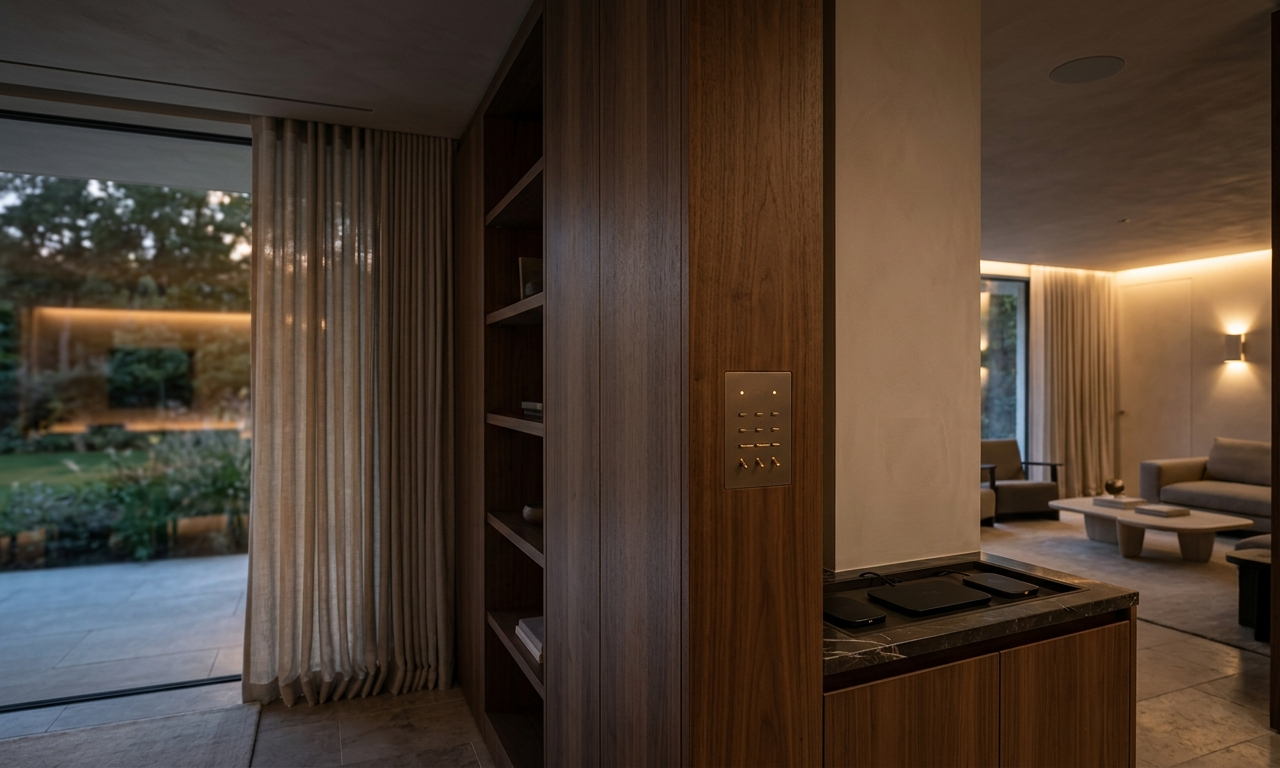
The House That Hides Its Own Intelligence
The highest form of technology is the kind you never see. Discover how to integrate "The Digital Shadow" and remove digital friction from your home.
In 1990, a handful of European electrical manufacturers sat down to fix a problem nobody was calling "smart home" yet. Every company had its own proprietary way of wiring lighting, shading, and climate systems, which meant a house was locked to whichever brand installed it first. Their solution, a shared wiring standard called KNX, still runs some of the most technologically dense residential projects being built today. It has no app that can crash. It doesn't need the internet to work. A switch on one wall can talk directly to a shade motor across the room, the same way it did on the day it was installed.
That is what real intelligence in a house looks like. Not a screen. A wire.
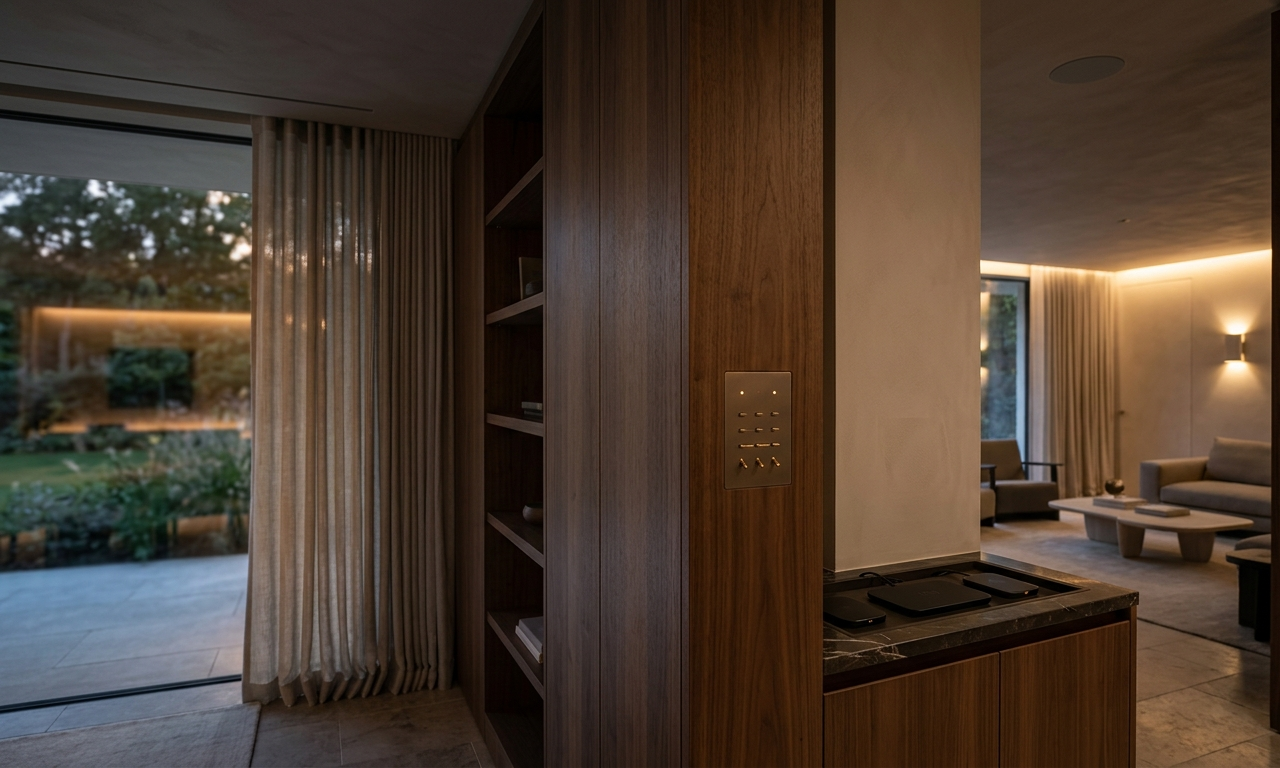
Interior showcasing "The Digital Shadow". Custom integrated brass tactile keypad. Beside it, a recessed charging station is neatly tucked into a stone countertop.
Wired to Think for Itself
KNX runs on a two core cable that carries both the data and the power at once, and a single one of those cables can serve more than sixty sensors and switches without a router or a cloud account anywhere in the chain. Each device holds its own instructions. A wall switch doesn't ask a hub whether the light should turn on; it sends a signal straight to the fixture and the fixture responds. Pull the internet connection and the shades still move, the lights still dim. That resilience is the actual argument for hardwired systems over the Wi-Fi mesh gadgets most people picture when they hear "smart home." A firmware update on the other side of the world has no way to reach into your living room and turn off your lights.
It's the first thing worth checking on any automation plan, because the wiring decision happens months before anyone picks a keypad, and it's the one decision that's genuinely hard to undo later.
The Shade That Learns to Disappear
Motorized shading has its own version of this same instinct: engineer the mechanism so thoroughly that you stop registering it as a mechanism at all. The better shading lines finish their brackets by hand, in satin nickel, brass, or a dark graphite, so the hardware reads as a fitting rather than a gadget bolted to the window frame. The bottom rail is extruded aluminum, but it's wrapped in the same fabric as the shade, so when the shade retracts, the hem disappears into the negative space of its own fold instead of leaving a visible metal bar sitting there. And the drive itself is built so you register the change in light before you register the motor moving at all.
None of that is decoration. It's the same design decision as the wiring: make the mechanism true, then make it disappear.

A floor to ceiling window with a woven greige motorized roller shade partially raised.
A Switch You Feel Before You See
The keypad is where most houses give the game away, because most keypads are glass and light and clearly a piece of consumer electronics dropped into a plaster wall. The better ones are built the opposite way. Buttons and faceplate come from the same material, whether that's matte polymer or brushed metal, so the whole thing feels like one solid object, not a screen bolted into a frame. Some lines even finish the keypad and the shading brackets in the same brass or graphite, so the same finish carries across both fixtures instead of looking like two separate purchases. You touch a piece of architecture. You don't tap a screen. Given the choice, I'd take the switch every time.
The networking hardware gets the same treatment, just further out of sight. Instead of a router sitting on a console table with a blinking light, the cabling runs to a structured media panel tucked into a closet, and the access points that actually carry the signal are recessed into the ceiling where nobody looks up expecting to find one. I've had systems integrators tell me this is the single most requested change on a renovation: not more technology, just none of it visible.
Ask What Happens When the Wi-Fi Goes Down
If you want to know whether a home's systems are actually integrated or just wired to a hub with good marketing, ask one question: what still works when the internet doesn't? A wired bus like KNX keeps running because the logic lives in the devices themselves, not in a server somewhere. A cloud dependent system goes dark with the router. That's the real distinction, and it's the one worth asking a systems integrator about before a single keypad gets specified, because by the time the walls are closed, the wiring decision is the one you're stuck with.

The Air Is a Material Too
Air quality is the most overlooked material in a home. You can have the finest furniture, but if you are breathing stagnant air, your recovery will always be capped.
When a bedroom starts to feel stale, the instinct is to reach for a candle or run the diffuser bought specifically to fix that feeling. It rarely does. The pollutant actually climbing fastest in a closed room overnight is one no scent can touch, and it keeps climbing whether the diffuser is running or not. Air behaves the way any other material in the house does. It has a real chemistry, and once I started asking how it should actually be specified, "just add a purifier" stopped sounding like an answer.
Bedroom that features a plush bed with neutral toned linens and an air purification vent integrated into the wall.
The Part You Can't Smell
Outdoor air runs around 400 to 420 parts per million of carbon dioxide. Close a bedroom door for the night and that number climbs steadily, since two sleeping adults are the only source in the room and there's nowhere for their exhaled air to go. Confined, poorly ventilated spaces regularly push past 2,000 ppm by morning. At Lawrence Berkeley National Lab, researchers tested this directly using a business simulation designed to measure strategic thinking rather than simple recall, and found that performance on that higher order thinking dropped most sharply once concentrations reached 2,500 ppm. That's not the vague fog people blame on a bad night's sleep. It's a measurable dip in exactly the kind of thinking a morning design review needs.
What HEPA Actually Guarantees
HEPA is a legal threshold, set by the U.S. Department of Energy, not a marketing word. To earn the name, a filter has to capture at least 99.97 percent of particles at 0.3 microns, the size research has found hardest for any filter to catch. Anything smaller or larger gets trapped even more effectively. "HEPA-type" and "HEPA-like" are unregulated phrases that typically land in the 85 to 99 percent range, well below the real number. On the HVAC side, filters are rated by MERV, a separate scale running 1 to 16. A true HEPA filter performs above the top of that scale entirely, which is exactly why most residential ductwork can't run one without significant changes. It's also why the actual fix for a primary suite is usually a standalone HEPA unit sized to that room, not a filter swap on the whole house system.
The Ventilation Number Nobody Asks For
The U.S. residential ventilation code, ASHRAE 62.2, sets a minimum of 0.35 air changes per hour for the house as a whole, and no less than 15 cubic feet per minute of fresh air per occupant. That's a floor, not a target. Modern construction, built tight for energy efficiency, often struggles to hit even that floor on its own, since the drafty old envelope that used to let air leak in and out by accident is precisely what better insulation and sealing are designed to eliminate. The tighter and more efficient a house gets, the more it needs mechanical help to breathe. The real answer, and the one mechanical engineers actually spec for airtight homes, is an energy or heat recovery ventilator. An ERV or HRV brings in fresh outdoor air and exhausts stale indoor air continuously, while transferring the heat or coolness between the two airstreams so the house isn't losing the energy it worked to keep.
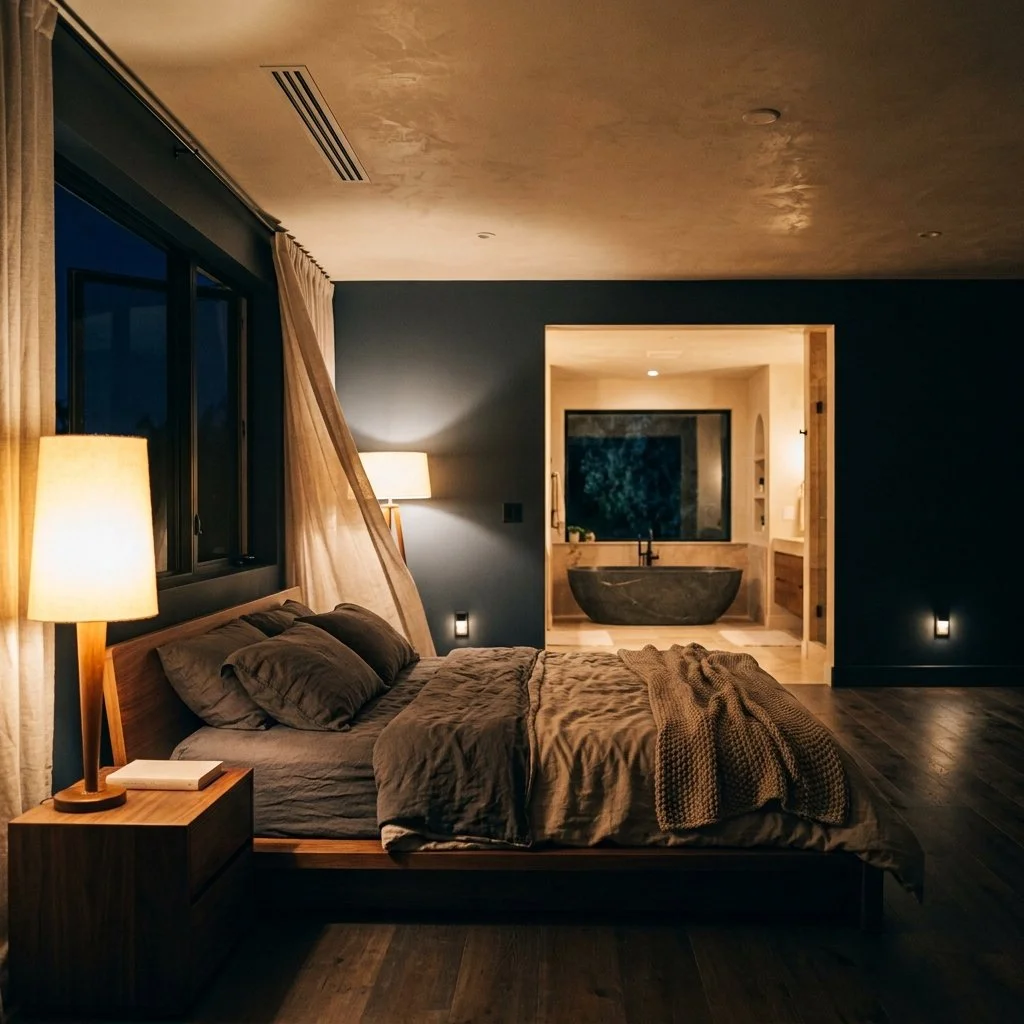
Primary bedroom featuring a flush mounted linear ventilation grille, a walnut platform bed, and warm amber lighting.
Diffusing the Wrong Thing
The idea that scent signals clean air runs backward. Chamber studies on ultrasonic diffusers have measured real, specific chemical output: over just fifteen minutes, lemon, lavender, eucalyptus, and grapeseed oils released measurable milligram quantities of compounds like d-limonene and eucalyptol into the room. When I asked why a product marketed for clean air would turn up in a pollution study at all, the answer was almost embarrassingly simple: anything that evaporates into a room is adding something to the air, not removing anything from it. A separate study measured similar output, in the 790 to 855 microgram per cubic meter range, for tea tree oil and two other common diffuser scents, and found that heating the oil, rather than diffusing it at room temperature, pushed that number even higher. None of this makes a diffuser dangerous in normal use. It does mean the smell of a "purified" room and the actual chemistry of that room are two different things, and treating one as proof of the other is the mistake. If fragrance still matters, a cool, unheated method run briefly is the more honest choice than one left running through the night in a closed room.
The Air Was Never Neutral
Stone shows a crack. Wood shows a warp. Air fails invisibly, and only a number catches it: a CO2 reading and a real filtration rating, tested rather than assumed. It's the one material in the house that can't be evaluated by walking through the room and looking. The only way to know it's right is to ask for the test.

The Home’s Circadian Pulse
A home should be more than a shelter, it should be a system that supports how you actually function. Learn how to master the "Daily Descent" and turn your lighting into a tool for recovery.
Flip on an overhead light at nine at night and the room fills with the same wavelength the sun throws at noon. The room can't tell the difference. Something in your eye can, a cell whose only job is telling your brain what time it is, not what anything looks like.
A modern, luxury living room featuring a 'Daily Descent' circadian lighting design.
Why Morning Needs More Than Bright
Brightness alone doesn't move that clock much. Color temperature does most of the work. The same lux reading from a warm 2700K bulb carries less than half the circadian signal of that same lux at 6000K, because the ratio between visible brightness and what that one eye cell actually registers shifts with the color of the light, not just its intensity. I went looking for a real number architects actually design toward here, not just a stylistic guideline, and there is one. The WELL Building Standard, the certification used for occupant health, sets its circadian lighting requirement in a unit built for exactly this: at least 150 to 275 melanopic lux at eye level, for four hours a day, starting no later than noon. A room that only measures "bright enough" on a light meter can still be doing almost nothing for that clock if the color is wrong.
The Sky Already Does This
Midday sun sits around 5,500K. By sunset it's dropped to somewhere near 2,000 to 2,800K, closer to a candle flame than to daylight. A home that pulls its own light warmer and lower through the afternoon isn't following a design trend. It's tracking something that happens every single day, whether or not anyone built a system around it. Practically, that means less reliance on a single ceiling fixture as the afternoon goes on, and more from lamps and sconces sitting at eye level or below.
A warm, living room featuring a dark velvet armchair, a small side table, and low, amber glowing light.
The Trick Behind a Good Evening Dim
Firelight and candlelight sit around 1,850 to 2,000K. An old incandescent bulb warms naturally as it dims, because a heated filament simply glows redder the cooler it gets. An LED doesn't do that on its own. If a dimmed fixture in your house shifts toward amber as it goes low, that's not a coincidence, and it's not free. It's a tunable white circuit, engineered specifically to fake the behavior an incandescent filament used to give away for nothing. Worth knowing before paying a premium for it, and worth insisting on if a fixture claims "warm dimming" but only gets dimmer, never warmer.
The One Cell That's Actually Watching
None of this is really about how a room looks after dark. It's about giving one very specific, very old cell in the eye the signal it was built to look for, at the hour it expects to find it. The category to ask a lighting designer for is tunable white, sometimes called Human Centric Lighting. It's a real specification, and the reason it entered the residential market at all is that it can be programmed to the actual sunrise and sunset schedule of wherever the house sits, not a generic dimmer curve. Get the color right through the day and the house does entrainment work the sky used to do for free.
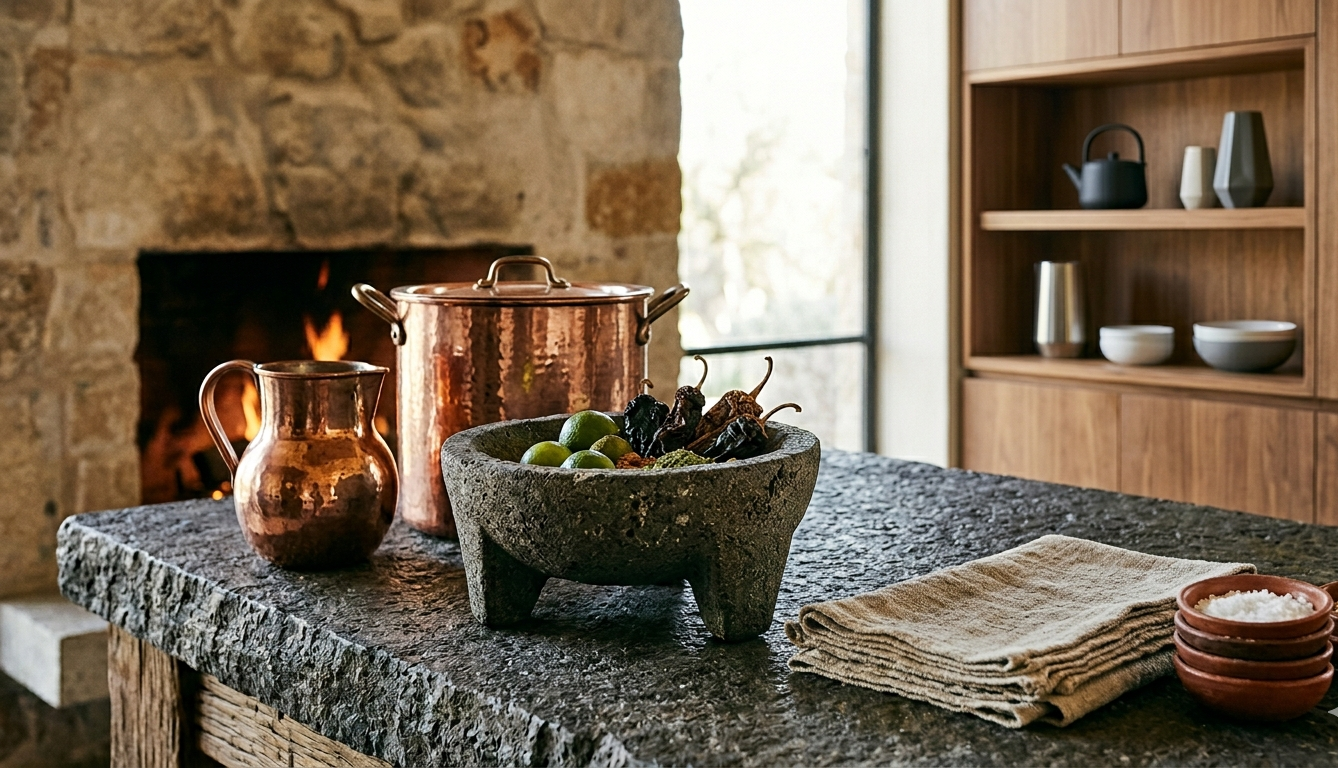
The Elemental Kitchen
The most enduring kitchens are defined by objects that possess a weight of their own. Discover the "Heavy Tools" of the hearth, from the volcanic anchor of the molcajete to the thermal conduct of hand hammered copper.
Before a new molcajete ever touches a chile or a clove of garlic, it gets a rougher job first. Grind a handful of raw white rice and a spoonful of salt against the stone, over and over, until the grit stops running gray. That first grinding scrapes off the loose grains left behind by the carving, the ones that would otherwise turn up in your salsa. It's not a step you skip if you want the stone to actually work. That's the real difference between a permanent kitchen and a convenient one. Permanence asks something of you first.
Basalt molcajete and copper cookware on a dark stone counter in a modern kitchen with a warm hearth.
The Stone That Grinds, Not Blends
A molcajete is carved from a single block of vesicular basalt, the kind full of tiny air pockets left behind when volcanic rock cools fast. Mine came out of workshops in Puebla and Jalisco, where the craft goes back to the Aztec and Maya, who ground the same way in the same material long before a Spanish kitchen ever asked for one. The porous surface does something a blender can't. Grinding ruptures the cell walls of a chile or a clove of garlic instead of slicing through them, and that releases oils and aromatics a blade cuts past without touching. The stone doesn't dull the way a blade does either. As the tiny bubbles at the surface wear down with use, they expose fresh texture underneath, so a molcajete worked for twenty years grinds better than one still in its box.
The Copper That Answers to Heat
Copper conducts heat at roughly 392 watts per meter kelvin, which is why a copper pot heats faster and more evenly than almost anything else you can put on a burner, and why a sauce reduces without the scorched ring that shows up in a heavier stainless pan. I don't spec copper for a kitchen unless it's actually going on the stove, not just sitting out to be looked at, because the metal only earns its place in real heat. Coppersmiths in Santa Clara del Cobre, Michoacán, have hammered the metal by hand since before the Spanish arrived. The Purépecha worked copper there long before the town had its current name, and in 1538 the bishop organizing the region's crafts assigned coppersmithing to Santa Clara specifically, so neighboring villages wouldn't compete for the same trade. The copper mines nearby ran dry decades ago. What the workshops hammer today is mostly recycled scrap, old wire and cable pulled apart and melted down again. Every copper pot needs a lining, usually tin, because copper reacts with anything acidic, and a tomato sauce or a squeeze of lime will turn both the food and the metal the wrong direction. Tin starts to soften above roughly 425 degrees, so a copper pot that's had years of real use eventually goes back to be relined, maybe once a decade with real care. The one place copper works fine bare is sugar and egg work, since neither reacts with it, which is why confectioners kept unlined kettles long after everyone else moved on.
The Press That Works on Leverage
A cast iron tortilla press is two flat plates hinged at the back, with a lever that turns a small amount of hand pressure into the even, downward force it takes to flatten a ball of masa into a perfect round. Before the press existed, that same flattening happened by hand, clapped rapidly between the palms or rolled thin the way you'd roll pastry, both slower and less even. The mechanics are simple but easy to miss. A wider plate spreads the same force over more surface, which is why a larger press leaves a tortilla the same thickness at the center as at the edge instead of thick in the middle and ragged at the rim. The same leverage handles anything else that calls for uniform, heavy pressure, seed crackers or heritage flatbreads, whatever the kitchen needs that day.
The Wood That Takes the Oil, Not the Sealant
I keep coming back to Tzalam for anything that touches the hand directly, a rolling pin or a spoon with a long handle, since its density and rot resistance are already established in what I've written about doors and floors. What changes here is the finish. Furniture gets sealed. A tool that touches food gets oiled instead, food grade mineral oil worked into the grain by hand and reapplied as the wood absorbs it, never a topcoat that would seal the surface shut. The wood keeps breathing. That's the whole reason to choose it here instead of somewhere it would only sit and be looked at.
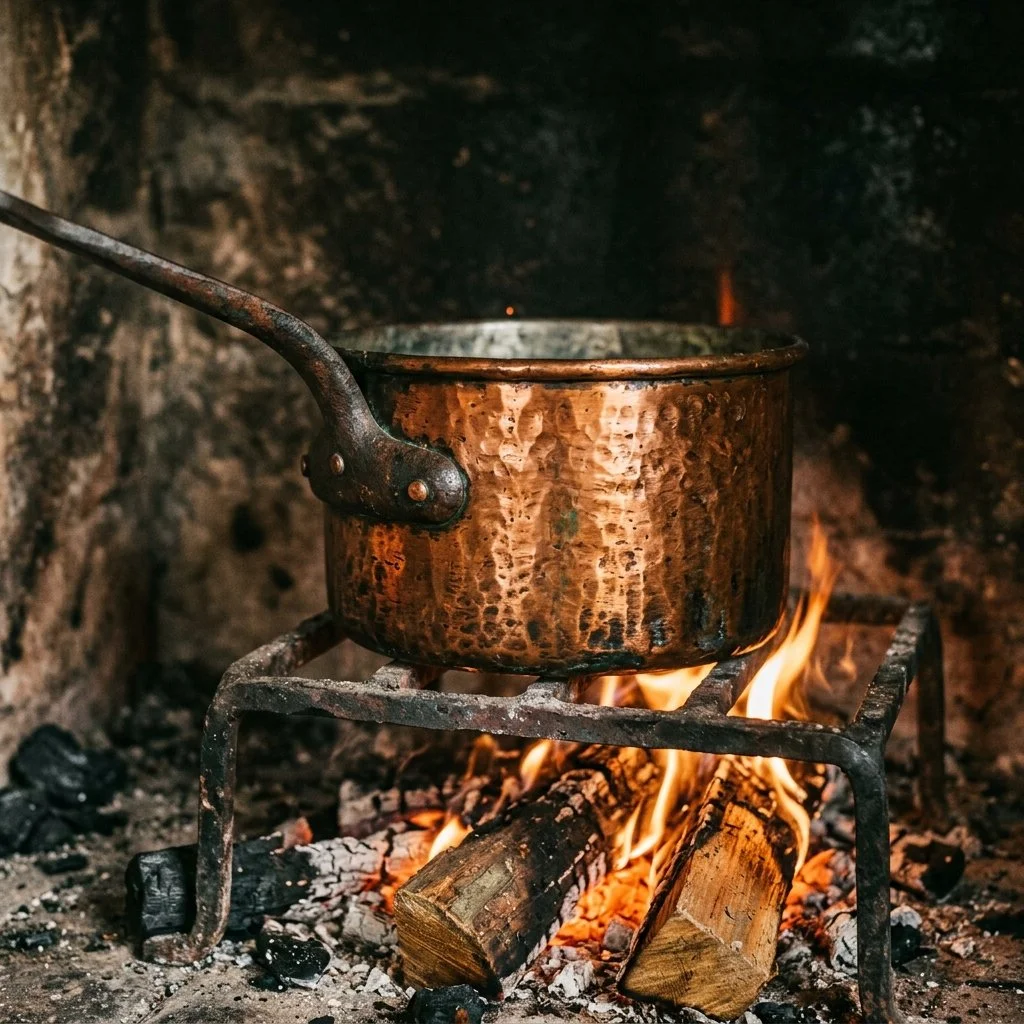
A hand hammered copper pot with visible mallet marks and a rustic patina.
The Clay That Pulls Moisture the Wrong Way
Terracotta means baked earth in Italian, and the name describes exactly what it is: clay fired at a relatively low temperature so it stays porous instead of vitrifying shut. Salt kept in wood or plastic pulls moisture from the air and clumps. Salt kept in unglazed terracotta doesn't, because the clay's own pores draw that moisture out of the salt and hold it in the vessel wall, where it evaporates off the outside instead.
The Kitchen That Gets Better With Use
Every one of these pieces improves with exactly the use that would ruin something cheaper. The molcajete grinds better once its surface has been worked in. The copper needs its lining renewed every decade because it's actually being used for what it's for. The press wears smooth at the hinge. The wood darkens and takes the oil more evenly the longer it's handled. The terracotta keeps doing its job precisely because it stays unglazed. None of that is an argument for buying less. It's an argument for buying the kind of thing that was built to be used constantly rather than protected. For the stone, I still go back to the same carvers in Puebla and Jalisco. They quarry and shape basalt the same way they always have. For the copper, it's worth seeking a piece that actually came out of a workshop in Michoacán, hammered by hand, rather than one that only looks like it was.