Blown Glass Lighting Comes Three Ways
A sculptural hand blown glass fixture starts one of three ways, and the spec sheet rarely tells you which. Free blown glass is shaped on the pipe by breath and hand tools, with nothing around it but air. Mold blown glass is blown by mouth into a mold. Pressed glass is forced into a mold and never blown at all, which is why one piece looks exactly like the next. "Mouth blown" can honestly describe the first two, and which one you're buying decides how much a set will vary and whether a reorder can ever match it.

Cluster of free blown clear and smoke glass pendants hung at staggered heights in a double height stair hall.
Mouth Blown Can Still Mean Mold Made
Samuel Wilkinson's Blown pendant for &Tradition is mold blown. Its quilted texture was modeled in CAD, and each shade is blown into a mold by hand. One retailer describes that mold as 3D printed metal. A person still inflates every piece. The mold fixes the outline, so a row of them reads much closer to a matched set than free blown shades can.
How Much Should a Set of Blown Pendants Vary?
Free blown shades vary in size and wall thickness, and a good maker will tell you that's the point. Variation reads as intent in a cluster hung at staggered drops. In a straight row it reads as a mistake, because the eye compares each shade to the one beside it. Decide which the room needs before choosing the process. For a row, ask the maker for the real size range across the whole run, not one nominal dimension on a drawing, and lay out the hang so the two most different pieces never sit side by side.
A Wooden Mold Burns a Little Every Time
Czech glassworks such as Moser and Harrachov carve many of their molds from wood, most often beech. Moser's mold maker says pear gives the better surface but is scarce, so beech does most of the work. A tree takes up to thirty years to grow big enough. The wood is kept wet, and when hot glass meets it, a film of steam forms between them that mostly keeps the glass off the wood. Mostly. Each piece chars the inside a little more, so a wooden mold has a working life. Blenko in West Virginia carves its molds from cherry and gets up to about 1,000 pieces from one before it has to be replaced.
Metal lasts longer, but with no steam cushion the glass touches the mold directly. Blenko credits the thick steel of one mold with the orange peel texture on its most popular water bottle. It also notes that a mold where the glass isn't turned while it's blown loses fine detail and tight curves faster than one where it spins.
A crisp pattern cut into a wooden mold can soften over a long run. A reorder depends on the mold surviving. Moser describes soaking an old mold in hot water overnight when an order comes back years later, and it's usable the next day "if all goes well." So ask whether the mold is wood or metal, and whether the studio keeps it once your order ships.
How to Tell Real Murano Glass Lighting
Murano glass has a legal mark of origin. Vetro Artistico Murano was set up under Veneto Regional Law 70 of 1994 and is managed by Promovetro, the consortium of the island's glassmakers. Only licensed producers can apply it. It goes on as an adhesive label that carries the producer's number code, with the name printed in gold leaf. A label can come off, so ask for the producer number on the paperwork too. A listing that says "Murano style" is telling you where the glass wasn't made.
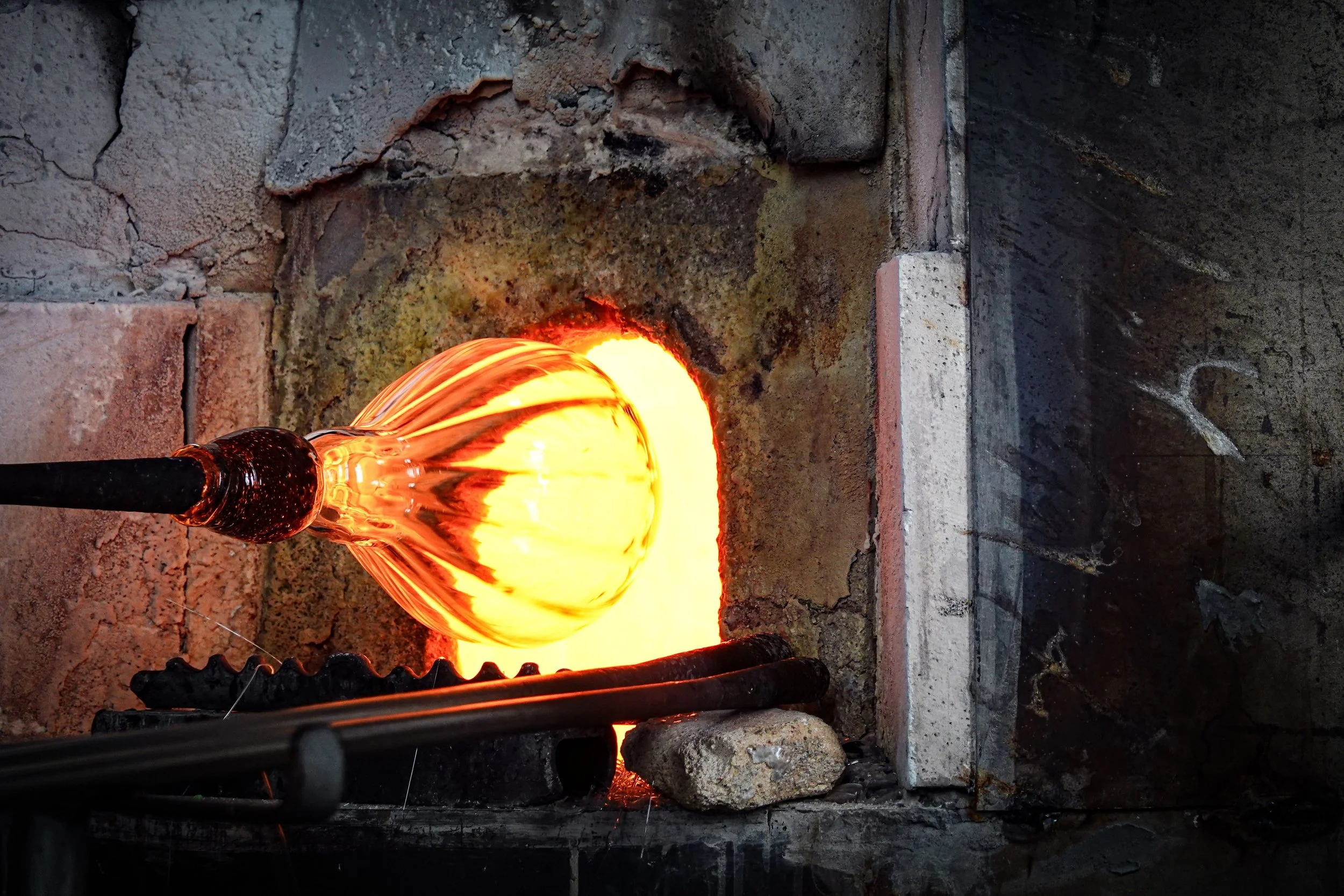
Glassblowing studio.
What the Ceiling Has to Hold
Blown glass is heavy, and sculptural pieces are heavier. One Lasvit pendant of Czech glass blown into a beech mold is listed at 6 kilograms, about 13 pounds, and a cluster multiplies that on a single canopy. A ceiling box carries only so much weight, and a box built for more is marked inside with its limit. Anything beyond that has to hang from its own support tied into the framing. Free blown walls vary in thickness, so the weights vary too. Get the weight of the heaviest piece from the maker and hand the cluster's total to whoever frames the ceiling while blocking can still go in.
The Mold Is Part of the Order
In a free blown set no two pieces match, so a broken shade comes back as a sibling, never a twin. A mold blown set can be extended for exactly as long as its mold survives. I'd want to know where the mold is before I fell for the glass. If you're looking past Venice, look outside Guadalajara. Archaeologist Karime Castillo names Tonalá and Tlaquepaque as the main centers of traditional glassblowing in Mexico, a trade that took root there in the early nineteenth century. The glass is what the client sees. The mold decides whether anyone can make one more.