The Luminous Boundary
There's a real, sixty year old field of study behind the instinct to light a driveway, and almost nobody who owns one has heard of it. A criminologist named C. Ray Jeffery coined the term Crime Prevention Through Environmental Design, or CPTED, in a 1971 book, and an architect named Oscar Newman published a parallel study the following year showing that the physical design of a space, not just its occupants, measurably changed crime rates on the ground. Lighting was one of the design elements they studied most closely, and one of their central findings runs against the instinct most people act on: more light is not automatically safer light.
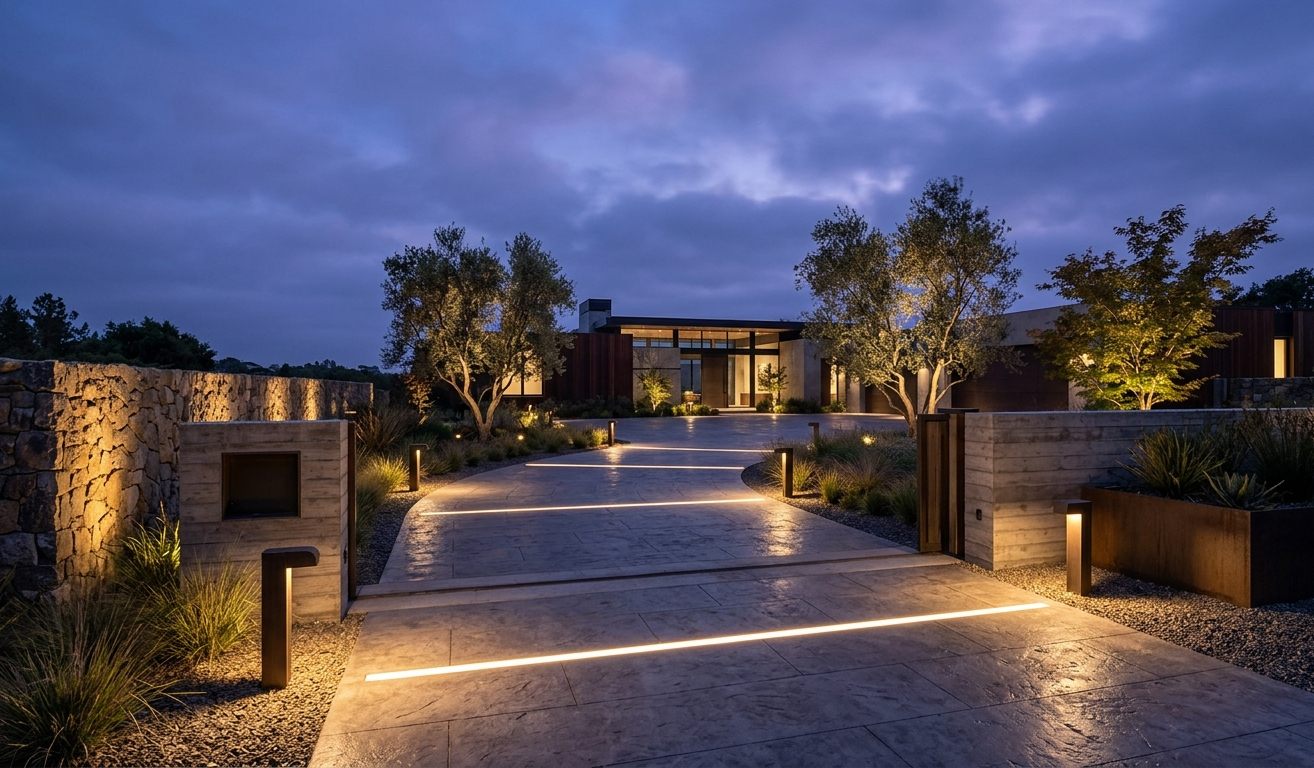
A home at twilight featuring a driveway illuminated by warm, recessed linear floor lights and bollards.
I hear about this from a landscape lighting designer while they were working through the exterior plan for a property with a long approach drive. A single unshielded floodlight, aimed at the house from the yard, does something specific and unhelpful. It overwhelms the eye, and everything just outside its beam goes darker by comparison. It also depends entirely on itself, since one bulb burning out or one angle changed leaves the deepest shadow exactly where a person would want to see. And none of this stops at the driveway. The same edge that needs to feel like arrival at the front of a house needs to feel like a safe place to walk, sit, and swim at the back of it, and the two sides ask for genuinely different things.
How Much Light a Path Actually Needs
The number is smaller than most people guess. The Illuminating Engineering Society's own recommended practice for walkways, IESNA DG-5-94, sets residential path lighting at an average of about half a foot candle, a small fraction of the ten to twenty foot candles a living room runs at. That number holds whether the path in question is the drive out front or a garden walkway leading to a fire pit. Neither one is meant to be bright. Both are meant to be legible, evenly lit enough that a foot finds solid ground without hesitation.
Stairs are the one place that number changes, and the reason is worth knowing. A person doesn't read a step by how much light falls on the tread. They read it by the light hitting the vertical face of the riser, which is what actually tells the eye where one level ends and the next begins. That's why exterior stair lighting is specified with a higher vertical illuminance than horizontal, closer to a full foot candle on that riser face, even though the tread itself needs far less. Skip that distinction and a perfectly bright staircase can still be the one place in the whole property where someone misses a step, whether that staircase leads to the front door or down to a sunken patio.
Light That Helps Instead of Blinds
Getting that low, even number without creating glare is a fixture problem, not just a placement problem. A full cutoff fixture is built so that no light escapes above the horizontal plane running through its base, which keeps the beam pointed at the ground instead of into anyone's eyes. Lighting designers actually grade this with a real rating system, developed jointly by the Illuminating Engineering Society and the International Dark Sky Association, called BUG: backlight, uplight, and glare, each scored on its own scale. Asking for a fixture's BUG rating is a genuinely different conversation than asking for its wattage, and it's the one that determines whether a bollard reads as a soft marker along the drive or as a headlight aimed at the front door.
This is also where the CPTED research and simple good manners overlap. Light that spills past the property line doesn't just annoy a neighbor, it can wash out the very sightlines that keep a shared street safe for everyone on it, which is part of why natural surveillance, keeping a clear sightline from the house to the street, is one of the field's core principles. The same instinct shows up in landscaping. A hedge kept under about three feet and a tree canopy held above about eight keeps the view from a window to the street open, instead of building a row of hiding places disguised as curb appeal.
The Backyard Isn't the Front Yard's Understudy
Everything above still applies once you walk around the house, but the backyard adds two problems the front never has to solve.
The first is a real tension, not an oversight. CPTED's whole natural surveillance principle depends on a space being visible from the street, which is exactly what a backyard is designed not to be. The fence and the hedge that make a patio feel private are the same features that remove the sightline that would otherwise make anyone working back there conspicuous. It hadn't occurred to me that a hedge chosen purely for privacy could quietly work against a home's own surveillance, until the same designer pointed it out. There's no way around that trade, but it does mean a rear entry, a side gate, or a door off a pool deck deserves the same shielded, motion triggered lighting as the front approach, not an afterthought version of it, precisely because it isn't getting watched from the street the way the driveway is.
The second is water. Any fixture within reach of a pool falls under Article 680 of the National Electrical Code, which requires ground fault circuit interrupter protection on the circuit and, for an underwater luminaire, sets its lens between four and eighteen inches below the normal water line. Above the waterline, the same low glare principle from the front of the house matters even more, because a wet, reflective deck surface bounces glare back up at exactly the angle a person's eye is trying to judge the pool's edge from. A pool deck lit for both a swim at dusk and a fall free walk to the gate at midnight is a full cutoff fixture problem before it's ever a decorative one.
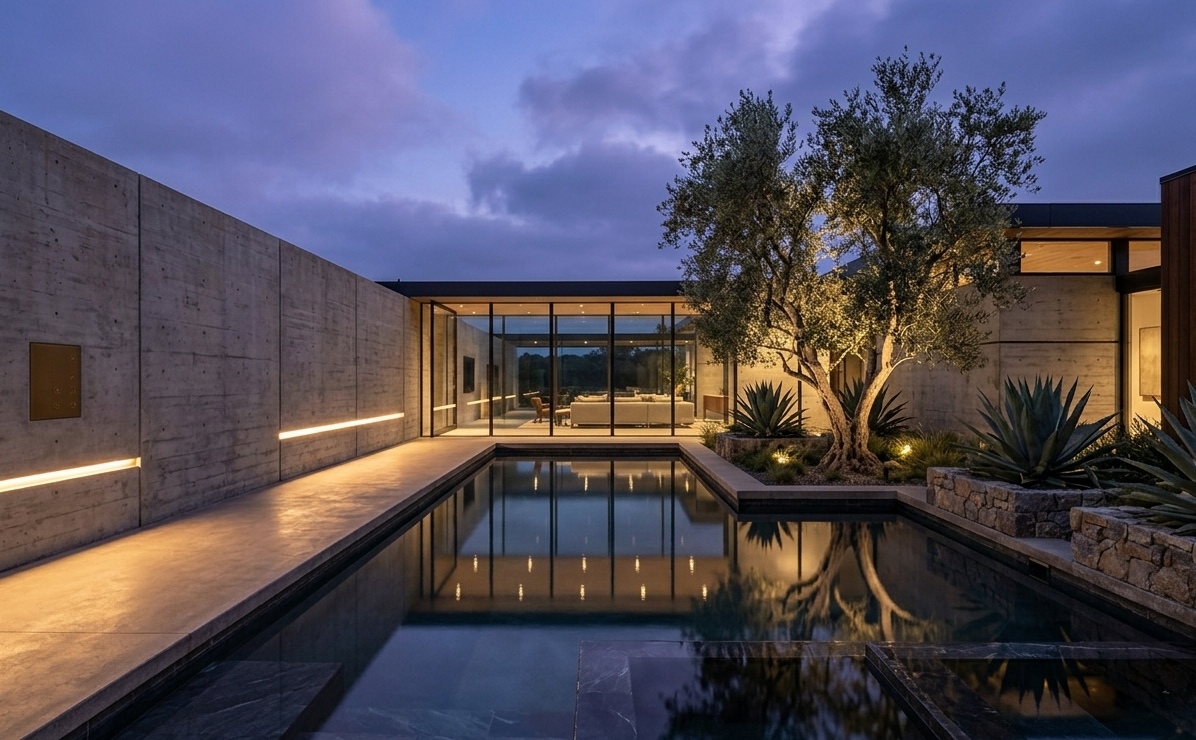
Residential courtyard with recessed linear lighting. Olive trees and desert flora are softly uplit against architectural walls.
The House That Watches Itself When You Don't
The exterior lighting still has to work when the property is empty, and this is where the oldest trick in home security quietly fails. A plug in timer that switches lights on and off at the same minute every night is precisely the pattern anyone casing a house learns to spot within a few evenings. I hadn't thought about a timer being a liability rather than a safeguard until it was explained to me. It's an easy mistake to make when the whole point of a timer is supposed to be peace of mind. The fix isn't more light. It's less predictable light: staggered on and off times that shift slightly night to night, paired with motion triggered fixtures along the path itself that only fire when something is actually moving through the space.
None of that has to compete with an evening spent outside. A landscape lighting system worth having is wired in zones, meaning the perimeter lighting, the path lighting, and the patio or pool lighting each run on their own circuit rather than one switch for the whole yard. Those zones get saved as scenes, so a single button can call up a warm, dimmable "Entertaining" setting for a dinner on the patio while the perimeter zone keeps running its own staggered security pattern in the background, unaffected. The same system that keeps a house looking occupied while you're in another country is the one that lights a summer gathering an hour later, and it's the zoning, not a second system, that lets it do both.
It Already Has a Name
None of this is a personal design philosophy. It's a documented field with a name, a research history, and its own rating systems, and a landscape lighting designer can be asked to design toward it directly instead of guessing at what "feels safe." Ask for CPTED principles and a BUG rating by name instead of a wattage number. Then ask one more question, one most people never think to: how the away schedule actually varies from one night to the next, not just whether it exists. The boundary of a property was always doing more work than marking where the driveway starts. It was deciding, every night, whether anyone walking it, front or back, could see where they were putting their feet.