The House That Hides Its Own Intelligence
In 1990, a handful of European electrical manufacturers sat down to fix a problem nobody was calling "smart home" yet. Every company had its own proprietary way of wiring lighting, shading, and climate systems, which meant a house was locked to whichever brand installed it first. Their solution, a shared wiring standard called KNX, still runs some of the most technologically dense residential projects being built today. It has no app that can crash. It doesn't need the internet to work. A switch on one wall can talk directly to a shade motor across the room, the same way it did on the day it was installed.
That is what real intelligence in a house looks like. Not a screen. A wire.
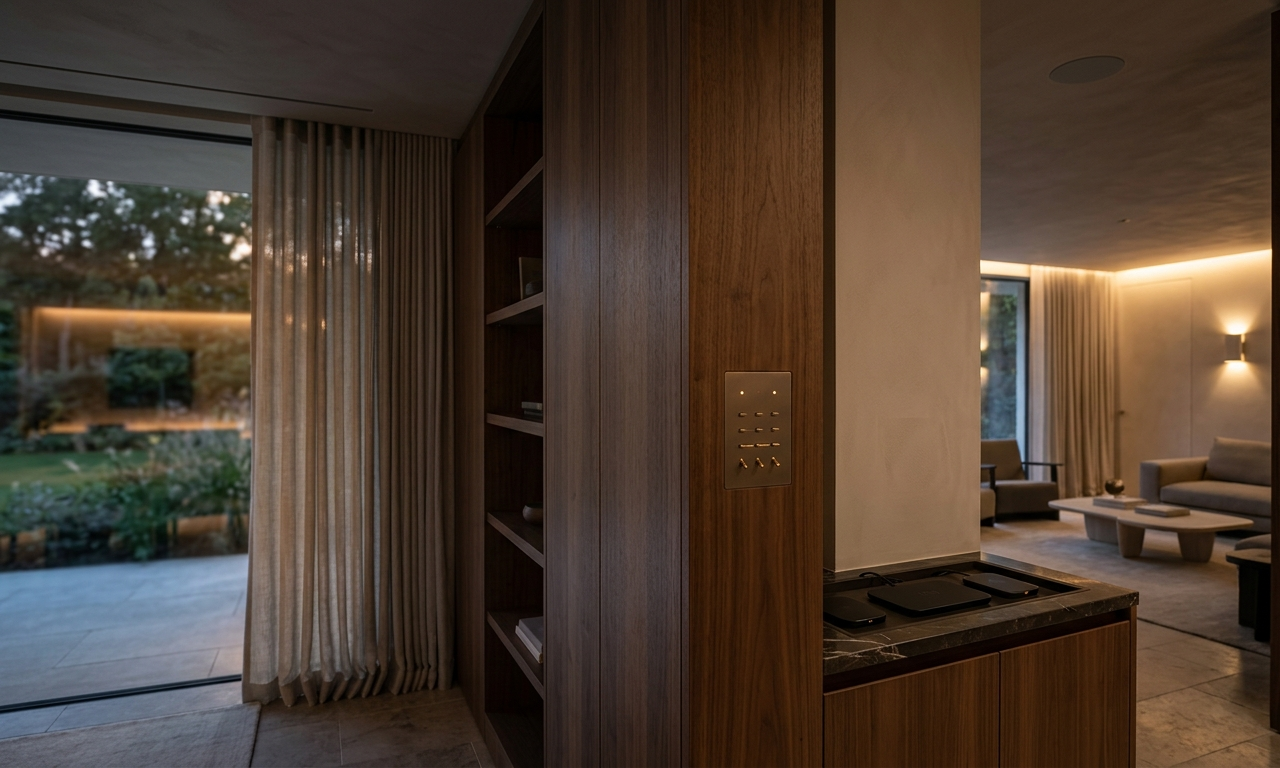
Interior showcasing "The Digital Shadow". Custom integrated brass tactile keypad. Beside it, a recessed charging station is neatly tucked into a stone countertop.
Wired to Think for Itself
KNX runs on a two core cable that carries both the data and the power at once, and a single one of those cables can serve more than sixty sensors and switches without a router or a cloud account anywhere in the chain. Each device holds its own instructions. A wall switch doesn't ask a hub whether the light should turn on; it sends a signal straight to the fixture and the fixture responds. Pull the internet connection and the shades still move, the lights still dim. That resilience is the actual argument for hardwired systems over the Wi-Fi mesh gadgets most people picture when they hear "smart home." A firmware update on the other side of the world has no way to reach into your living room and turn off your lights.
It's the first thing worth checking on any automation plan, because the wiring decision happens months before anyone picks a keypad, and it's the one decision that's genuinely hard to undo later.
The Shade That Learns to Disappear
Motorized shading has its own version of this same instinct: engineer the mechanism so thoroughly that you stop registering it as a mechanism at all. The better shading lines finish their brackets by hand, in satin nickel, brass, or a dark graphite, so the hardware reads as a fitting rather than a gadget bolted to the window frame. The bottom rail is extruded aluminum, but it's wrapped in the same fabric as the shade, so when the shade retracts, the hem disappears into the negative space of its own fold instead of leaving a visible metal bar sitting there. And the drive itself is built so you register the change in light before you register the motor moving at all.
None of that is decoration. It's the same design decision as the wiring: make the mechanism true, then make it disappear.
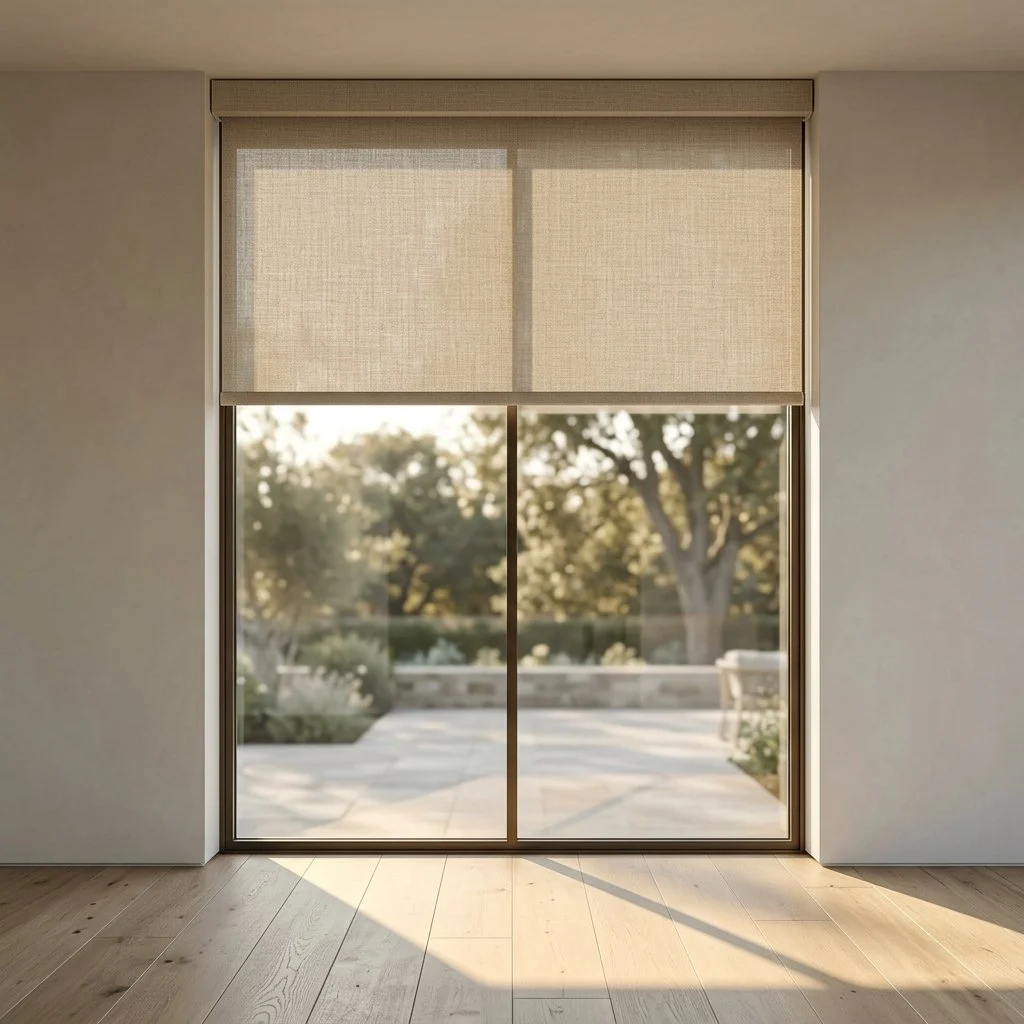
A floor to ceiling window with a woven greige motorized roller shade partially raised.
A Switch You Feel Before You See
The keypad is where most houses give the game away, because most keypads are glass and light and clearly a piece of consumer electronics dropped into a plaster wall. The better ones are built the opposite way. Buttons and faceplate come from the same material, whether that's matte polymer or brushed metal, so the whole thing feels like one solid object, not a screen bolted into a frame. Some lines even finish the keypad and the shading brackets in the same brass or graphite, so the same finish carries across both fixtures instead of looking like two separate purchases. You touch a piece of architecture. You don't tap a screen. Given the choice, I'd take the switch every time.
The networking hardware gets the same treatment, just further out of sight. Instead of a router sitting on a console table with a blinking light, the cabling runs to a structured media panel tucked into a closet, and the access points that actually carry the signal are recessed into the ceiling where nobody looks up expecting to find one. I've had systems integrators tell me this is the single most requested change on a renovation: not more technology, just none of it visible.
Ask What Happens When the Wi-Fi Goes Down
If you want to know whether a home's systems are actually integrated or just wired to a hub with good marketing, ask one question: what still works when the internet doesn't? A wired bus like KNX keeps running because the logic lives in the devices themselves, not in a server somewhere. A cloud dependent system goes dark with the router. That's the real distinction, and it's the one worth asking a systems integrator about before a single keypad gets specified, because by the time the walls are closed, the wiring decision is the one you're stuck with.