The Shape of a Shadow
I've started paying more attention to what the light in a room doesn't reach than what it does. Vision scientists call this shape from shading. Depth and form get read almost entirely from variation in light, not from brightness itself. A room lit evenly in every corner gives your eye nothing to work with. It reads as flat because, to your brain, it actually is.
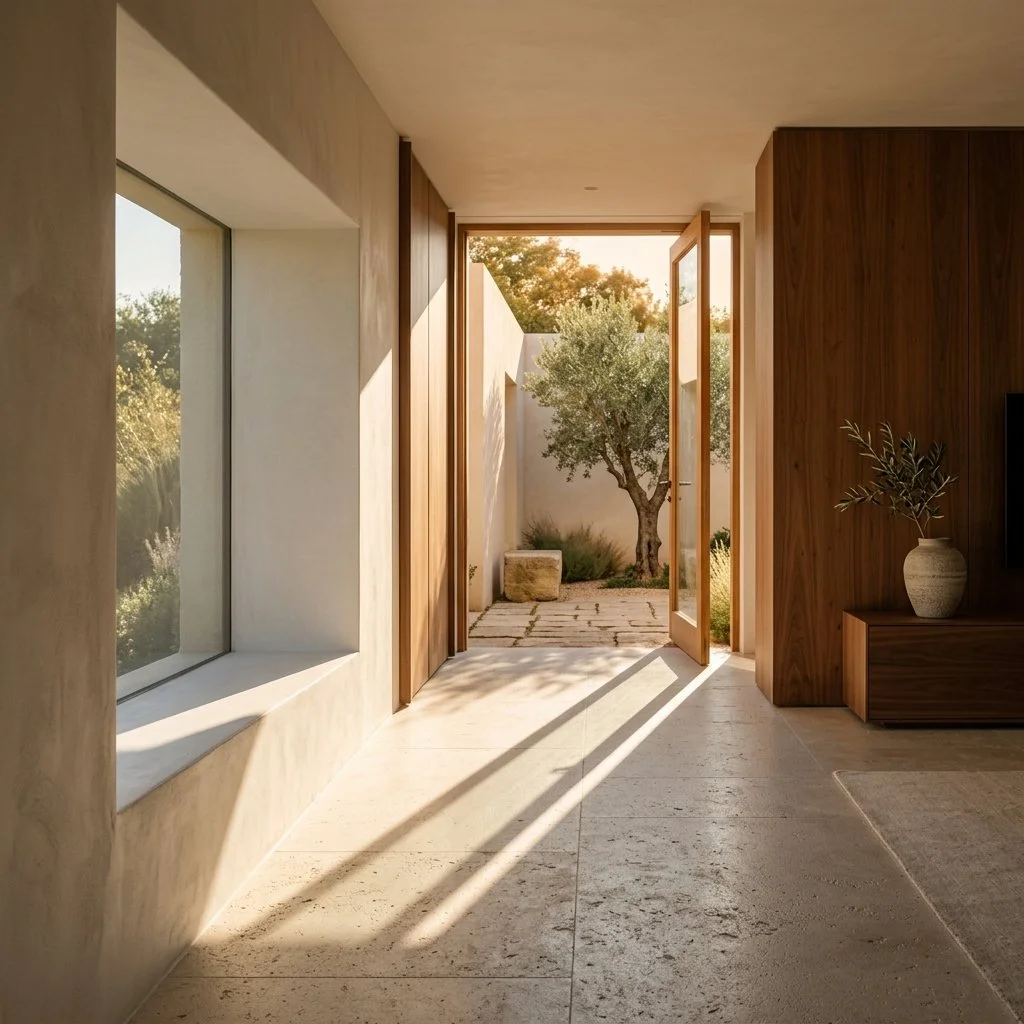
Interior featuring white plaster walls, warm walnut accents, and honed limestone floors illuminated by late afternoon sunlight.
The Wall as a Canvas
A clean architectural wall doesn't need art hung on it. It needs the sun. When I position openings to catch the day's movement rather than just to let light in, the wall itself becomes the changing element in the room. At ten in the morning, a shadow might fall in a thin diagonal line near the floor. By late afternoon, that same wall shows something else. The shadow has stretched and softened, and it crosses a different plane of the stone now. Stone especially rewards this. Raking light at a low angle catches the micro texture that direct overhead light flattens out, so the same slab of limestone or travertine can read as smooth at noon and geological at five o'clock.
Contrast as Comfort
There's a real psychological function to shadow that gets lost when a room is designed purely for brightness. A space that's lit uniformly in every corner feels exposed, almost clinical, the way an operating room or a big box store does. Shadow gives a room scale. It tells your eye where a hallway ends and something more private begins. Neither a wall nor a door has to do that work. I think of certain corners of a house as deliberately unlit, not because I ran out of fixtures, but because a room that never lets the eye rest anywhere never actually settles.
Controlling Where the Light Enters
I'm not looking for big windows. I'm looking for a specific, controlled point of entry. A narrow vertical slit does something completely different to a room than a niche set deep into the wall, even at the same square footage of glass. Architects call the depth of that opening the reveal. A deep reveal does real work. It blocks the sun through most of the day and lets it in only at one specific hour and angle, so the shadow it casts crosses the floor at nearly the same time every day, like a sundial. In hotter climates, a brise soleil does something similar on a larger scale. It's a fixed screen or a set of fins mounted outside the glass that filters direct sun into a pattern of shade, so the room still breathes. Control the entry point instead of just maximizing it. You're not letting the sun in. You're drawing with it.
The Weave That Filters It
Not every house gets to make these decisions at the architectural stage. Most of the time I'm working with existing openings, and that's where the textile does the job the wall can't. I keep coming back to handwoven Oaxacan cotton for this. Weavers there still work the backstrap loom, telar de cintura, a technique that predates the Spanish conquest by more than a thousand years. One end ties to a post, the other to the weaver's own waist, so her body supplies the tension. In Santo Tomás Jalieza, the town outside Oaxaca City where most of this weaving happens, Friday is still market day, when the number of women selling in the plaza roughly triples. That process produces a slightly irregular thread, nothing like the uniform thickness of a machine loom, and that irregularity is exactly what scatters harsh light into something softer instead of letting it pass through as a hard, flat shaft. Cloth woven on the treadle loom, worked by foot pedal and introduced later, gives a tighter, more even filter, useful in rooms that want the softening effect without much visible texture.
For the rooms where I want that atmosphere on demand rather than fixed in the fabric, motorized blinds do the technical version of the same job. One is a sheer weave that still moves with the air. The other is a full blackout panel for a room that needs to go completely dark. Both run off a single switch. It's the same instinct, applied with a switch instead of a loom.
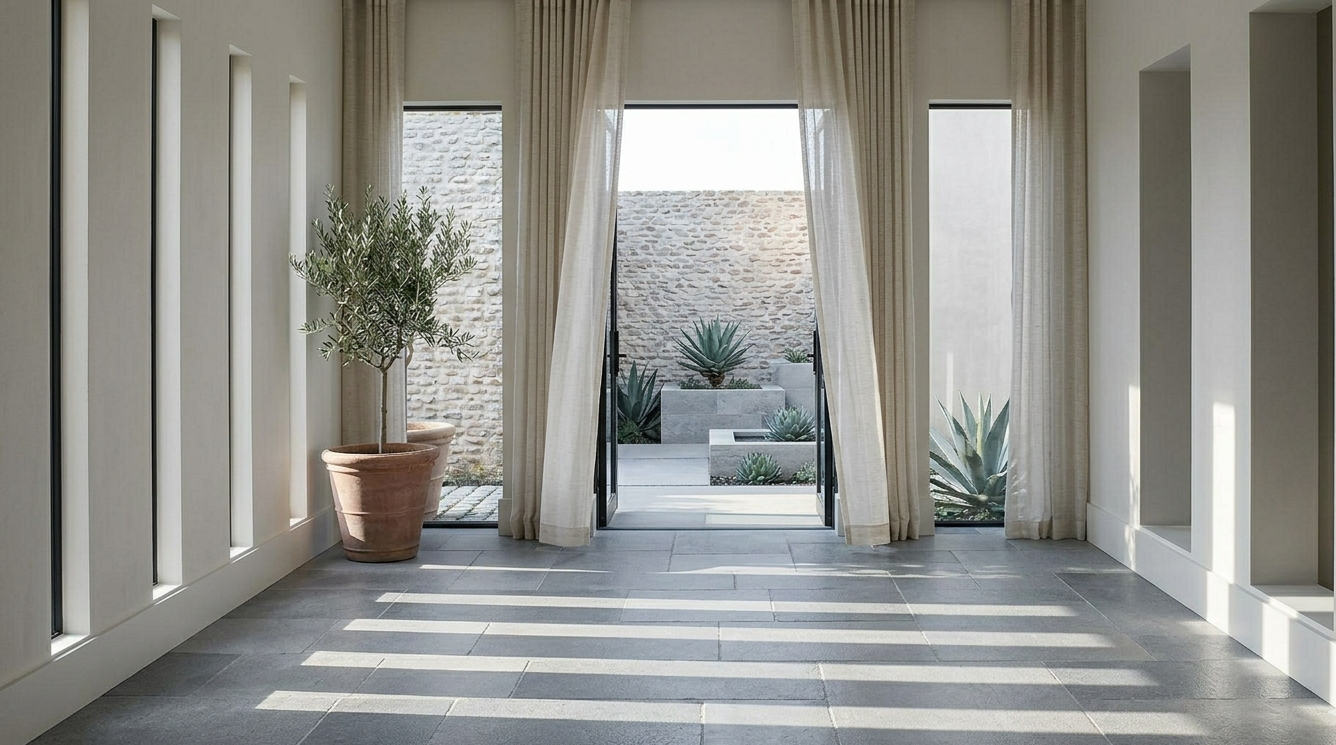
Windows cast shadows on a stone floor with natural fiber window treatments on an open door heading to a private courtyard.
The Sun Was Always the Material
Light itself costs nothing. What it does in a room, once you decide where to let it in and what to filter it through, is the actual design. I'd rather build a house around where the shadow falls at five o'clock than around how many lumens a fixture puts out. The sun was always the material. Everything else, the reveal and the weave in the curtain, is just how I've learned to shape it.
