Antique Mirror Walls Are Made New
An antique mirror wall, as the trade sells it, is new glass that has been silvered and then aged so it reads as old plate. Antique mirror is still the name on spec sheets, and it’s what people type when they search for panels and tiles. Two products share that name. In one, a full sheet is aged before anyone cuts it. In the other, each panel is cut first and aged afterward, and the difference shows once the panels meet on a wall.

Library shelves built into the wall, backed with aged mirror panels, lit by evening lamplight.
What the Aging Copies
For centuries, most European mirrors were backed with an amalgam of tin and mercury. An InCollect article on how mirror glass ages describes workers flooding tin on a marble table with mercury, then lowering the glass onto it. That backing never fully settles. Its crystals keep growing and mercury slowly escapes, so old plate darkens and the damage can’t be reversed.
In 1835 the German chemist Justus von Liebig worked out a way to deposit silver on glass, and by the end of that century silver had replaced mercury in industrial mirror making. The search term “mercury glass mirror” borrows its name from somewhere else. The Corning Museum of Glass calls “mercury glass” a mistaken name for nineteenth century silvered glassware, made by sealing a silver solution between the double walls of a vessel.
How Is Antique Mirror Different From Regular Mirror?
It’s the same glass. Dominic Schuster’s guide for designers notes that the antiquing happens on the back, so the glass keeps the qualities of plain mirror. AGC described its antique mirror as getting its look through controlled oxidation of the silver coating, with each pattern unique because every sheet was made by hand. Donghia’s spec sheet for its Ether mirror noted that further oxidation may happen over time, which is worth raising with any supplier before a client signs off.
The base glass matters as much as the finish. Schuster recommends low iron mirror under antiquing because it reflects color accurately. A tinted base changes the reflection, and Dreamwalls by Gardner Glass, in North Carolina, listed its Clear Charcoal antique mirror as its most popular antique pattern on bronze tinted glass.
A Sheet Aged Before It’s Cut
General Glass described its antique mirror as made in Italy and finished by hand through a proprietary oxidation process, stocked as quarter inch sheets roughly four by eight feet. A fabricator cuts it to size like ordinary mirror. The company’s data sheet said to wash cutting lubricant off the back right away, since it can dissolve the protective coating, and to seam the edges after cutting for the warranty to apply.
This is the route Schuster cautions designers about. His guide warns that antique sheets finished first and cut to size afterward look uniform, and that a discerning eye can tell. His own mercury finishes put the aging around each panel’s edges, the way old mercury and silvered plate degraded, and a cut through a sheet aged as a whole can’t do that.
A Panel Aged After It’s Cut
Schuster’s studio in Hampshire, founded in 2011, finishes each panel individually after cutting it to size. His Mercury Sparkle finish is lightly distressed and catches the light in flecks, while Heavy Mercury imitates plate so degraded it reflects very little. Yachts International reported that he sourced glass from England, Belgium, Germany and Mexico, then silvered it by hand.
Safety glass changes the order. Only plain glass can be tempered, so a tempered panel has to be silvered after tempering and antiqued after that, which suits a panel near a fireplace or set into furniture. Edges change the whole wall. Clean cut edges, softened and darkened, butt together square in the traditional way, while polished edges leave a small V between panels and read more contemporary.
Old Plate Is a Separate Purchase
Genuine antique mirror is a different decision. The InCollect article notes that mercury and silver backings were made side by side for decades, so the coating alone can’t date a piece of glass. Old mercury plate also raises a handling question that conservators answer differently. Williamstown Art Conservation Center said amalgam mirrors aren’t a serious source of mercury vapor, while the American Institute for Conservation’s wiki warns that deteriorating amalgam releases liquid and vapor mercury and calls for care in handling. I’d leave any recutting or reframing of old plate to a conservator.
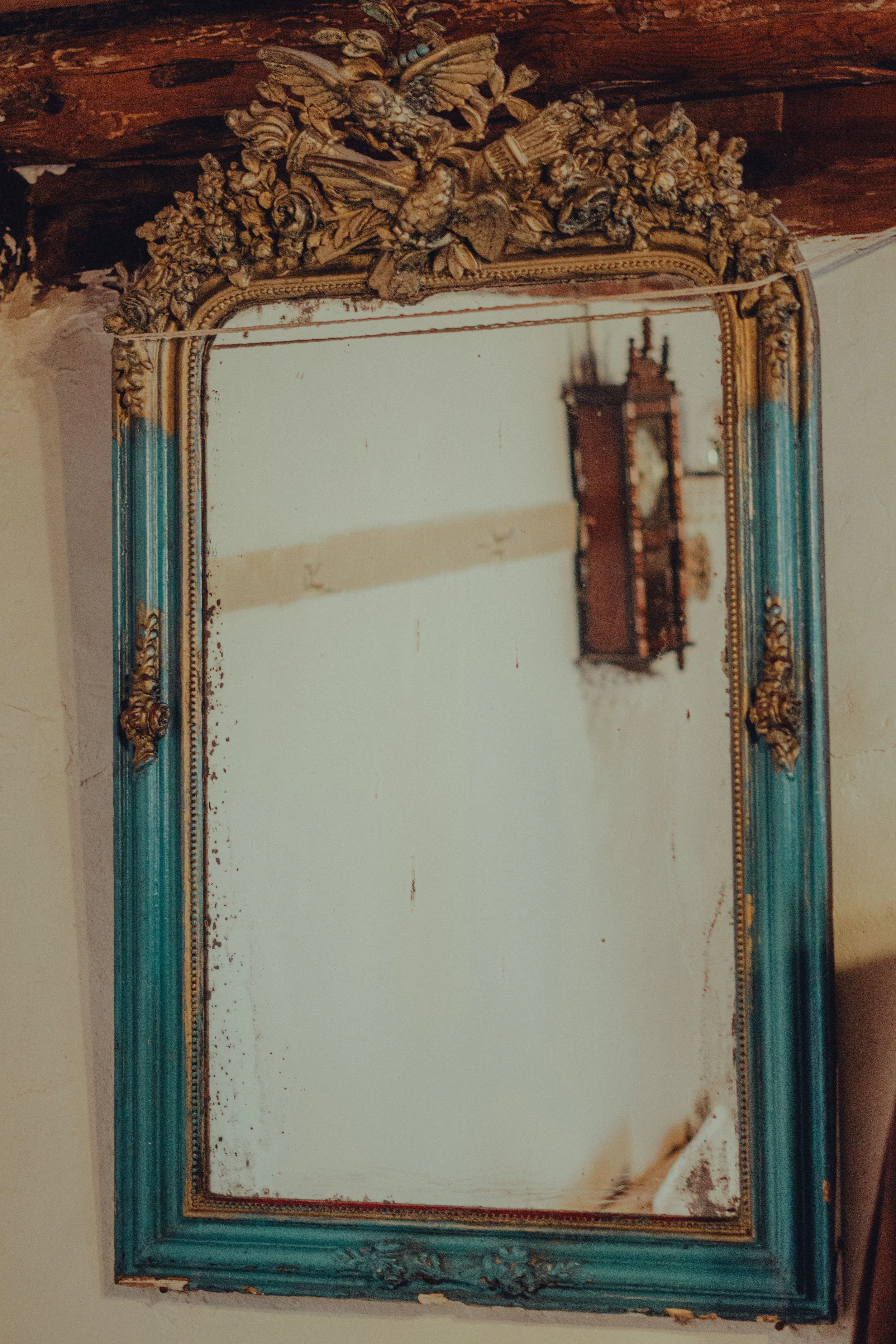
Close view of old mirror glass with dark spotting along its edge.
Wet Rooms Need the Warranty Read First
Moisture is what blackens the silver on ordinary mirror, and antiqued mirror arrives with its silver already partly oxidized. General Glass’s standard mirror warranty asked that mirrors in bathrooms and kitchens be set up off the base, and warned that spray cleaners can puddle at the edges. Tile retailers rate some antique mirror tile for shower walls and others not at all. Check the manufacturer’s guide for the exact product before it goes near a shower.
Choose the Route by the Seams
I’d decide by counting joints. A wall of a few large panels has only a few cut edges, so a sheet aged before cutting gives little away. A wall of small panels or tiles is mostly edges, and that’s where aging after the cut earns its place.
Both products arrive under the same name, so ask which one the quote assumes, aged before cutting, or after.
