Most Boiserie Is Really Molding
Boiserie is French for woodwork. In an eighteenth century Paris room it meant a wall built as joinery, with solid oak frames holding panels that were set loose inside them. Most of what gets sold as boiserie now is something else. It is strips of molding nailed over drywall or MDF and painted so the wall reads as framed. Both have a place on a project. The difference shows up in the price, and in whether the wall can ever come down and go up again in another house.
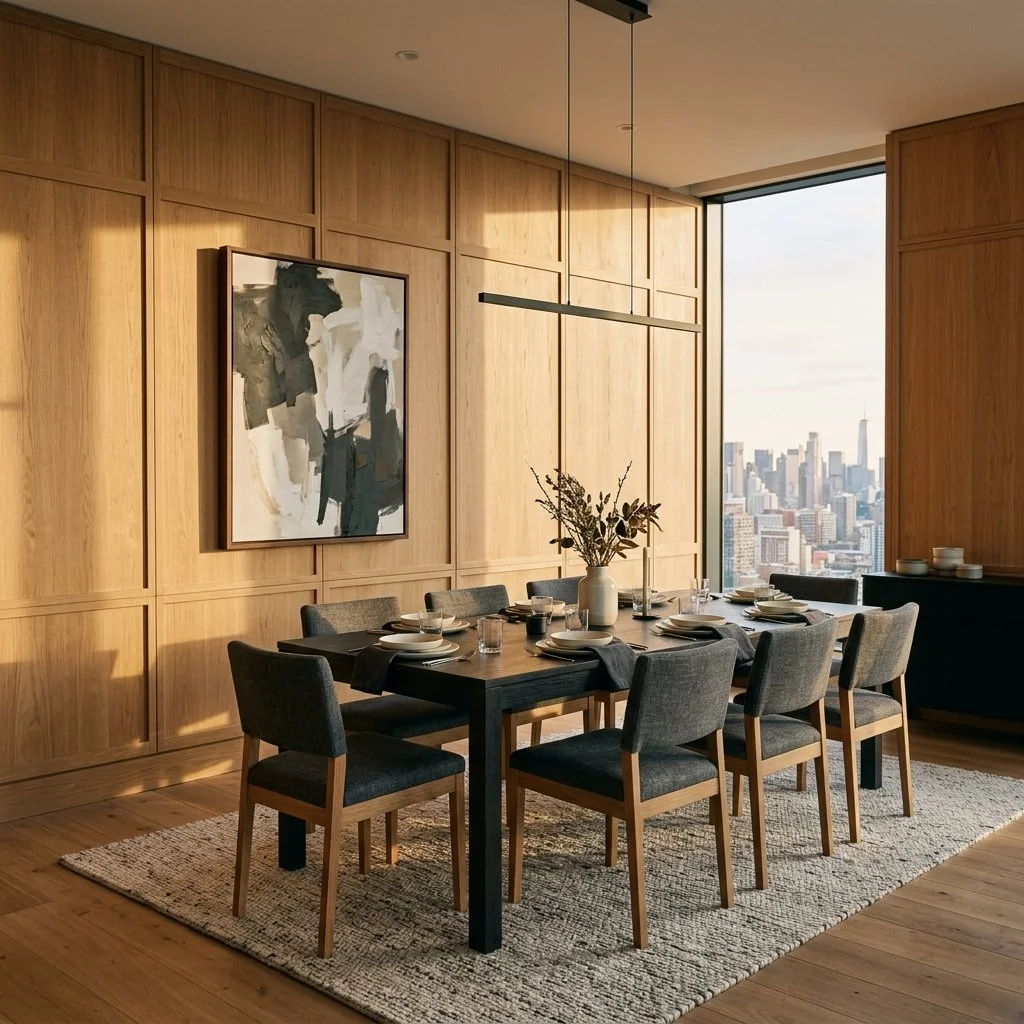
Penthouse dining room with floor to ceiling oiled oak frame and panel walls.
What Boiserie Is Made Of
A real paneled wall is frame and panel construction at room scale. Vertical stiles and horizontal rails are joined into a rigid frame, and each panel sits in a groove cut into that frame without glue. The panel is left to float, so it can swell and shrink in its groove while the frame holds its shape, as long as the house keeps its humidity steady. Paneling built that way in the 1700s still lines rooms in museums.
Most of the Paris rooms at the Met are oak. Its room from the Hôtel de Varengeville, made around 1736 to 1752, is catalogued as painted and gilded oak. Some of the finest relief was cut in a softer wood and fixed to the oak. The Salon Doré at San Francisco’s Legion of Honor pairs white oak paneling with high relief carving in linden. Painted walls follow their own rule today, the Woodwork Institute’s guide specification calls for a closed grain hardwood when paneling will be painted.
Molding on Drywall Is a Different Product
The applied version starts with a flat sheet, often MDF, fixed to the wall, with molding strips nailed over it to draw the frames. There is no panel, only painted wall surface between strips. The ornament can be high density polyurethane, a rigid plastic poured into a mold, sometimes taken from a master carved by hand. It doesn’t move with humidity the way wood does, and in a damp room that is a real argument for it.
Makers have built a middle tier. Lualdi’s Avenue paneling, designed by Robert A. M. Stern, was made to order as shaped panels in matte lacquer. David/Nicolas launched La Boiserie at Milan Design Week 2026 as part bespoke craft and part reproducible system. Systems like these can be beautiful. The specification still needs to say what sits under the lacquer.
Carved Wood and Cast Ornament
Cast work turns up even in museum rooms. The Salon Doré’s four cornices carry cast plaster ornament alongside its carved linden. Féau Boiseries is the Paris house founded in 1875 that sold antique paneling to Gilded Age American families. Under Guillaume Féau, who took over in the early 1990s, it added a line of reproductions that use resin for precise details.
I don’t think cast work cheapens a room when it sits up at the cornice, out of reach. What I want is a shop drawing that labels which elements are carved wood and which are cast, so nobody finds out with a sander.
Antique Rooms Arrive With Later Additions
French dealers have been sending antique boiserie across the Atlantic since the Gilded Age, when Richard Morris Hunt installed an antique gold paneled ballroom supplied by Allard at Marble House. Museum labels show how often those rooms changed along the way. The Met’s label for the Varengeville room ends with “with later additions.” Its Neoclassical room from the Hôtel Lauzun, made around 1770, carries one modern panel and has no known eighteenth century provenance; by 1874 it lined a collector’s library on the Île Saint-Louis, stripped to bare oak and stained a dark brown.
Dealers still sell rooms in panels, shipped to be adapted to the buyer’s space. Where a room has been is part of what the client is paying for, so the dealer should put in writing how much of it is original and what was added later. Féau dates pieces in a lab by their paint colors, so paint analysis is a fair thing to request.
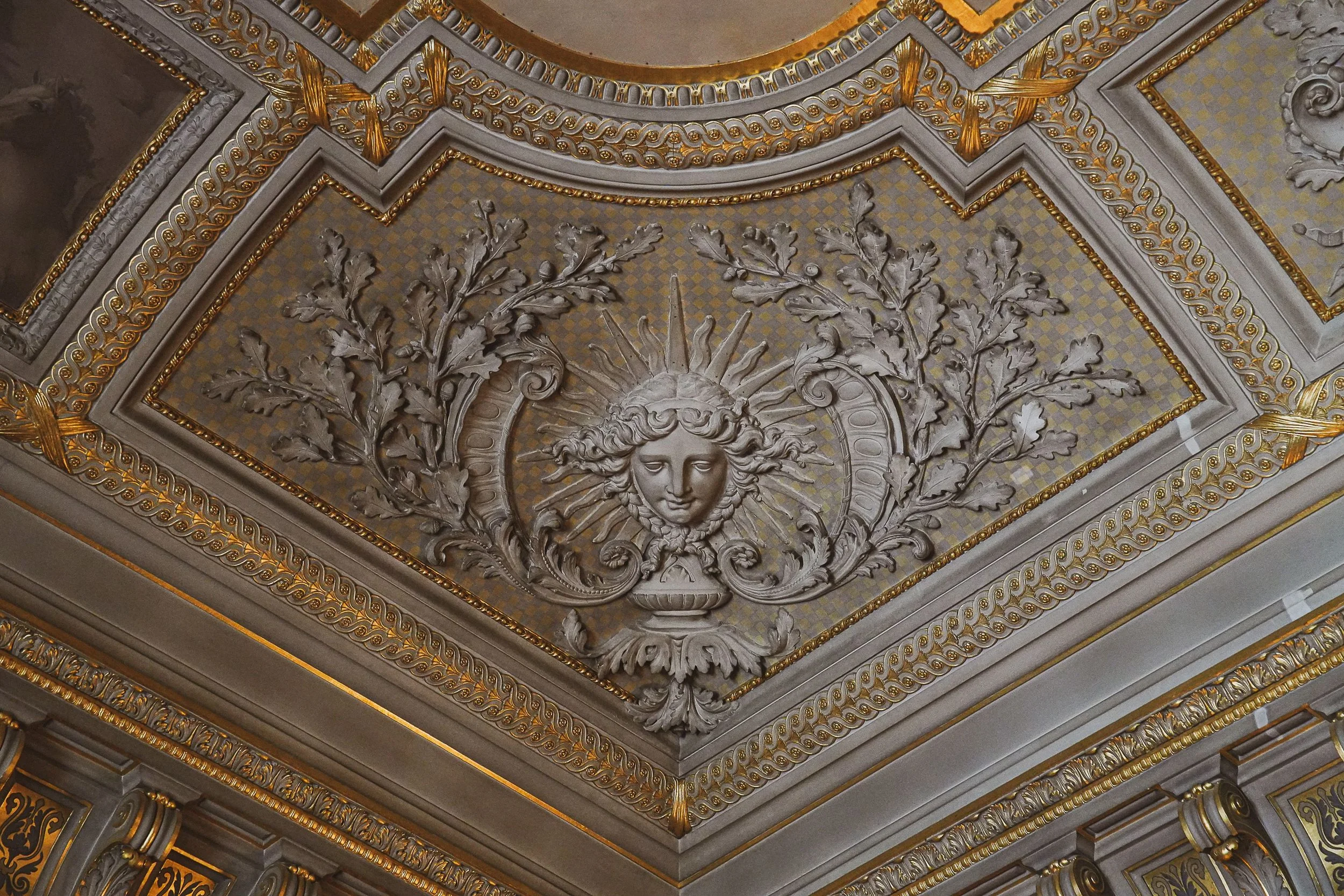
Close view of carved antique wall paneling
Water Gilding or Oil Gilding
Both methods turn up on gilded paneling. Water gilding lays gold leaf over gesso and a clay layer called bole, and the bole lets the gold be burnished with an agate stone to a mirror finish beside matte areas. The Salon Doré is water gilded. Oil gilding can’t be burnished, and the Royal Collection Trust notes that most architectural gilding has been oil gilded.
When missing carvings in the Salon Doré were recut, they were water gilded to match the old work. The project summary published by the American Institute for Conservation noted that oil would have been faster. On a new wall, that tradeoff is the first thing to settle with the gilder, and it lands in the client’s budget.
Start With One Corner
Real paneling has its own place in the specification. In MasterSpec it is Section 06 42 14, Stile and Rail Wood Paneling, built to a grade in the Architectural Woodwork Standards, where Premium is the highest of three. The Woodwork Institute’s guide specification asks for a mockup of one section with an inside and an outside corner. Whoever builds it, an architectural woodworking firm for new work or an antique dealer adapting a room, should name the carver and the gilder on the job. Then study that corner. It shows whether a panel sits inside a frame or a strip of molding sits on a wall, and that difference is what the word boiserie now hides.
