How to Tell When Furniture Is Really Well Made
Material density and engineering are the true markers of a high end home. Analyze the technical requirements of quality furniture. Learn to identify the engineering that defines a high quality investment and build your living room studio on a foundation.
Dovetails are reported in furniture from Egyptian tombs of the First Dynasty, close to 5,000 years ago. The tails are cut as trapezoids that lock against the direction a drawer front gets pulled, and glue makes the joint close to impossible to separate. The English name comes from the shape of a dove's tail. It is still the first joint I would check on any case piece.
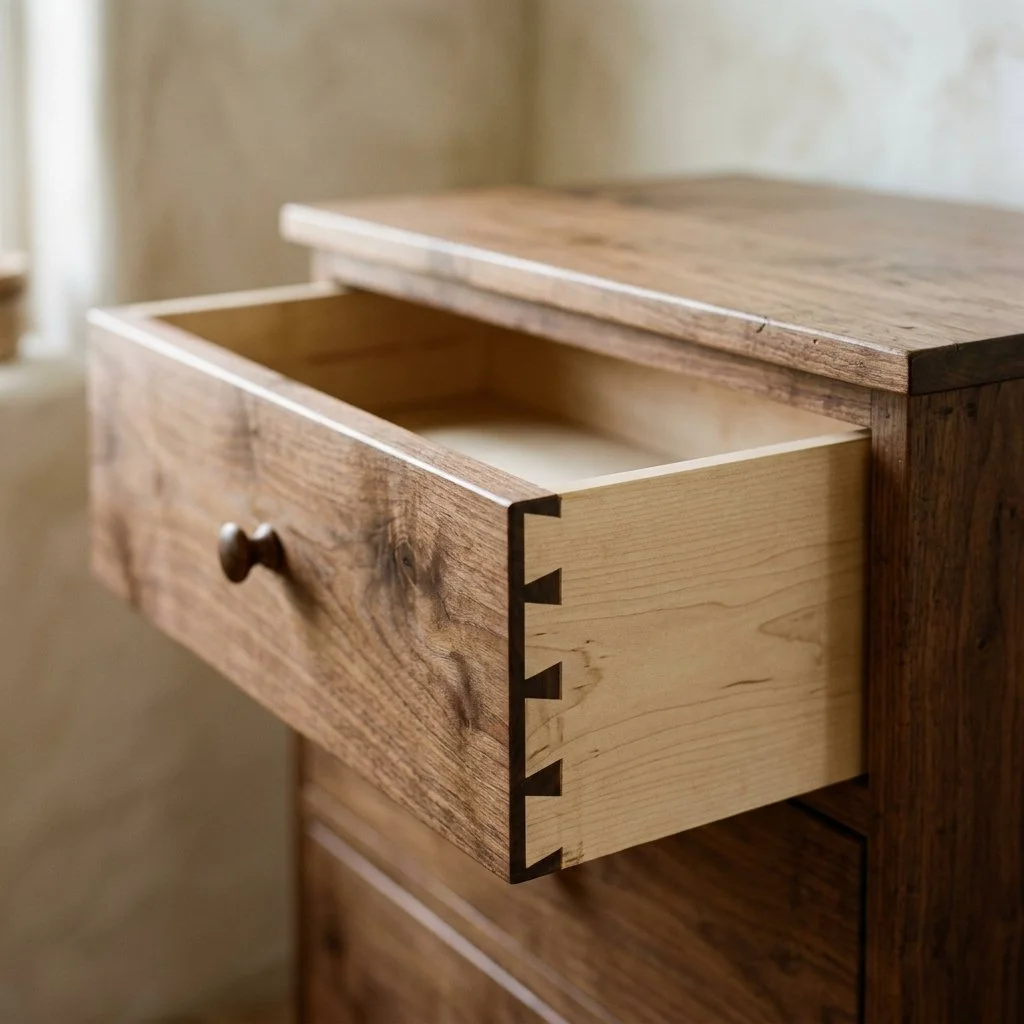
Walnut drawer pulled out, showing tightly fitted dovetail joints at the corner where the front meets the pale maple side.
The Drawer Corner
Pull a drawer all the way out and look at where the front meets the side. Interlocking pins and tails hold that corner together in the wood itself, which lets a drawer front take a hand on its pull every day for years. Each pin sits tight in its tail with no gap showing.
What Holds a Leg to a Rail
A chair leg takes sideways force every time someone leans back, and the joint built for that is the mortise and tenon. Bed frames from First Dynasty tombs at Tarkhan already had them. A tongue on the rail fits a slot in the leg, so glue meets wood along the grain on every face of the tenon. Glue grips long grain far better than end grain, which is why a pair of dowels in the same space holds less. Woodworkers who repair chairs describe the same failure on doweled joints. The glue survives and the wood around the dowel tears out.
Solid Wood Moves
Wood takes on and gives up moisture with the seasons. It changes far more across its width than along its length, and kiln dried boards keep moving after they reach a house. A well made piece is built to allow that. In frame and panel construction the center panel floats in its groove, unglued, so it can widen in humid months without splitting the frame. A solid tabletop with breadboard ends is pinned at the center, while the outer pins pass through oval holes so the top can expand and shrink. In one season the ends sit slightly proud of the tabletop, and in another slightly short. That is what a correctly built solid top does. A slab fastened rigidly to its base can split, and no glue is strong enough to hold wood that wants to move.
Hardware That Can Be Adjusted
Concealed hinges adjust in all three directions after installation, so a door that shifts a millimeter can be brought back without being taken off. That matters on a piece that will spend decades in changing humidity. Undermount slides with soft close come with a published load rating that varies by model, and it is worth asking for.
Makers argue about whether slides belong in fine furniture at all. Waxed wooden runners are the traditional answer, but they can bind when humidity swells them and they wear with use. Metal slides give full extension and can be adjusted. Some makers refuse to put metal in anything traditional, and others use it everywhere. The drawer should run straight and sit with an even gap all the way around.
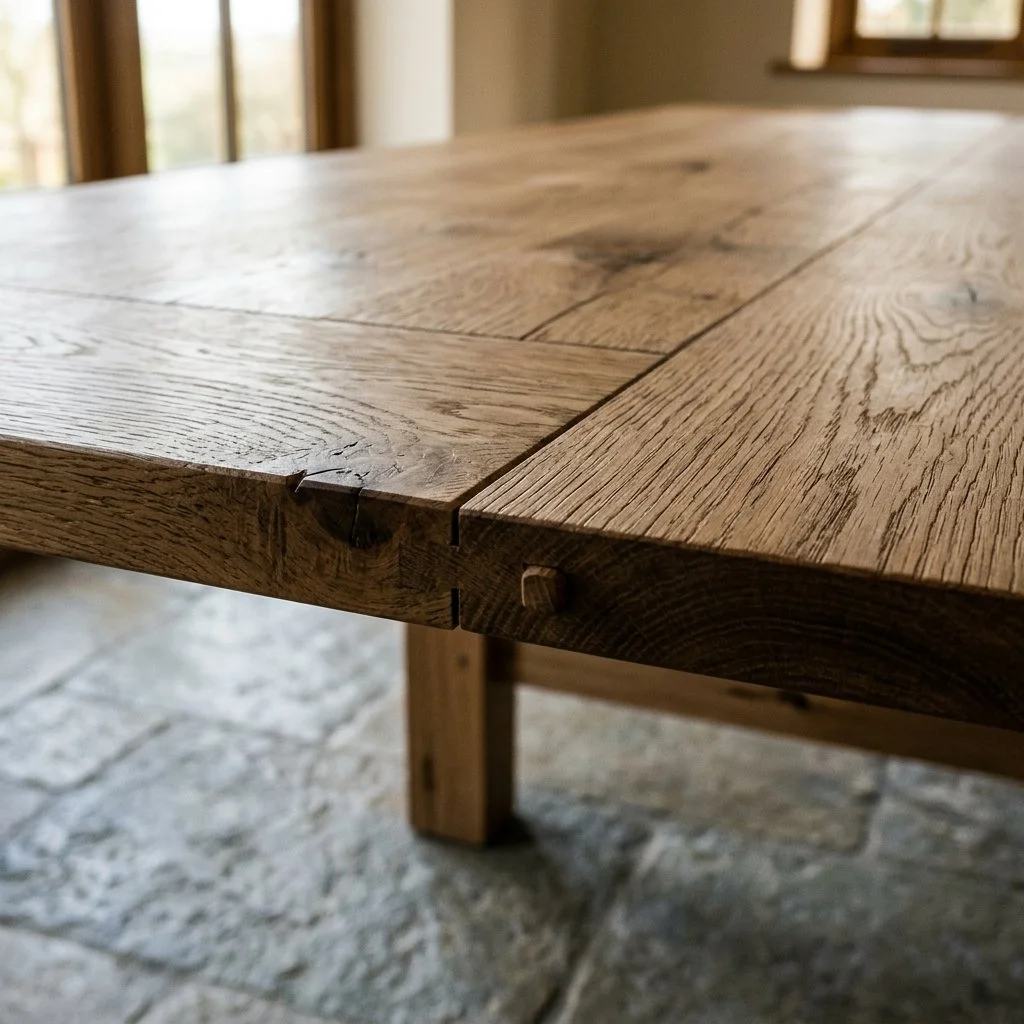
Solid oak tabletop with a breadboard end, side grain shows through the thin finish, with a wooden peg visible at the joint.
A Finish You Can See Into
A good finish lets the grain show through it. French polish is the far end of that idea. It is shellac, which comes from a scale insect native to Asia, worked on with a cloth pad in many thin coats, a method in use since the 1600s. It is softer than modern varnish and marks white when water or alcohol sits on it, so it suits a bedroom chest better than a bar. Open grain woods like walnut and mahogany need their pores filled first, one more step that takes time. Shellac can also be repaired easily.
Turn the piece so light rakes across the surface. The grain should appear to move under the finish.
The Hours Nobody Sees
Someone cut and fitted each joint and left the panels room to move. Someone built the finish coat by coat and waited for each one to dry. A piece that skipped all of it can look identical from across a room, and identical in a listing photo. A specification that names the joinery and the finish gives a workshop something to be held to.
Tzalam and the Living Grain
In a home, furniture isn't an accessory, it’s a legacy. Discover the dense, oily grain of Tzalam and why it is the anchor for a room designed to last a century."
I found Tzalam on a trip through Mexico, propped in the back of a small furniture shop outside Guadalajara. I mistook it for walnut right away. The color was close enough that I didn't think twice. The shop owner set me straight before I'd even finished asking the price, and the real story turned out to be better than the one I'd assumed. Tzalam isn't walnut. It never has been. The name rode in with the furniture trade, not the tree, and it's stuck around because it's a good shorthand for a color everyone already recognizes.
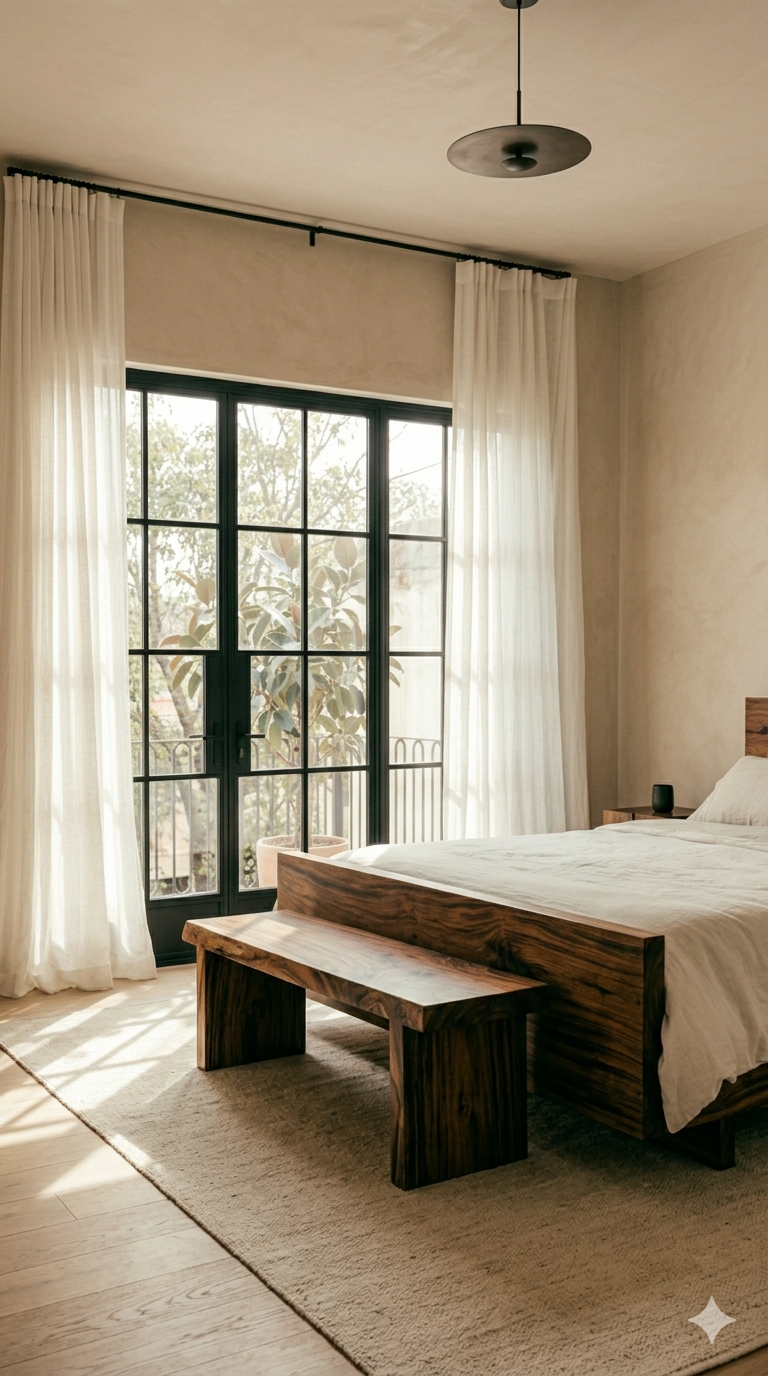
Tzalam wood bedframe and matching bed bench, in a bedroom of natural sunlight.
A Legume, Not a Walnut
Tzalam comes from Lysiloma, a genus in the legume family. Its nearest relatives in the wood world are trees like mesquite, not anything in the true walnut family. Legume woods tend to grow dense and tight grained, and Tzalam holds to that pattern. A board foot runs about 4 pounds, close to 14 percent heavier than red oak, with a specific gravity around 0.63. Pick up a Tzalam side table and a walnut one of the same size, and the difference registers in your arms before you notice anything about the grain.
The Color Does the Convincing
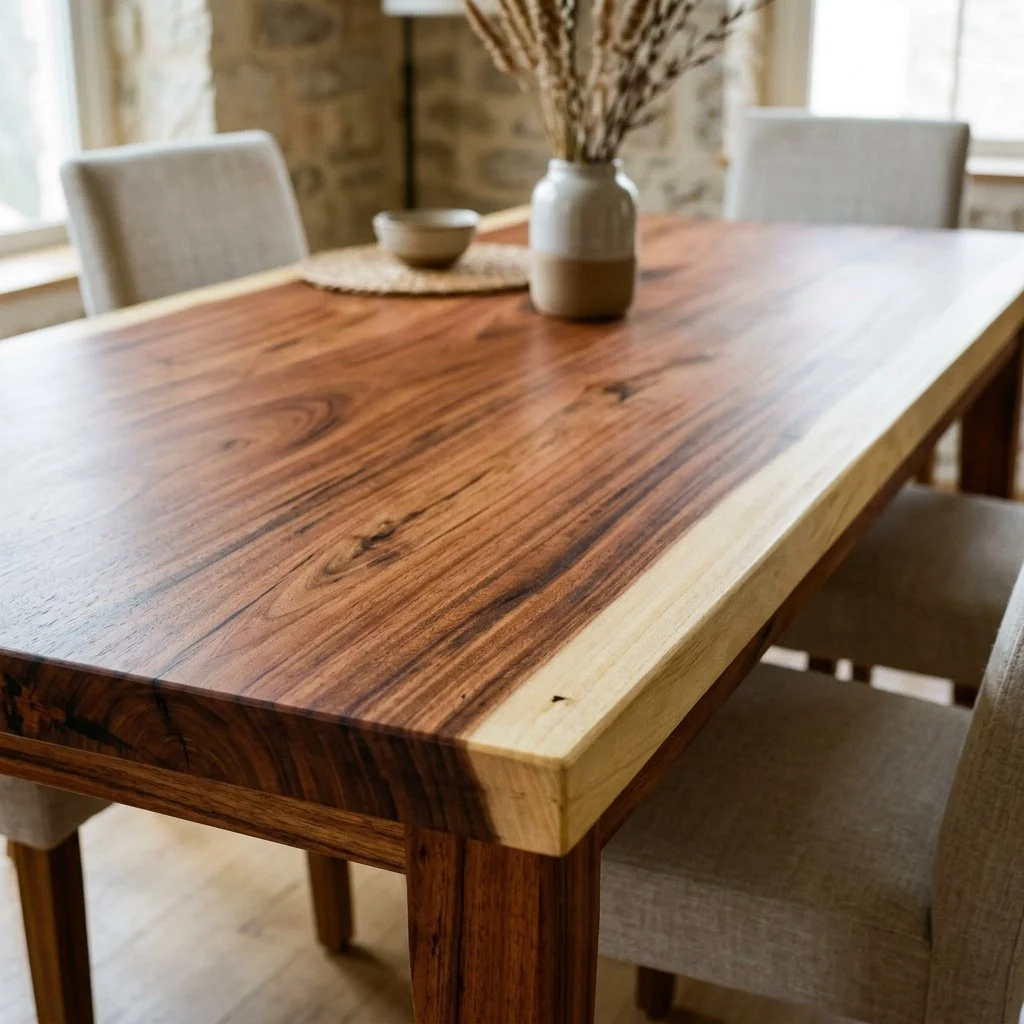
The confusion makes sense once you see the wood. Heartwood ranges from light to medium brown, often carrying a reddish or purplish cast, with darker brown streaks running through it. Set next to true walnut's cooler chocolate tone, it's close enough to fool a showroom floor. What walnut doesn't have is Tzalam's sapwood: a pale, almost gray white band that stops dead against the heartwood with no gradual transition at all. On a slab that keeps its natural edge, that line reads like it was drawn with a ruler.
Built to Outlast a Trend
Tzalam grows in the humid forest belt running through the Yucatan and into Guatemala, usually as a short, spreading tree, its trunk rarely more than two or three feet across, clear of branches for about 25 feet before the canopy opens. What it lacks in size it makes up in resistance. Tzalam carries very high natural rot resistance, which is why it shows up as often in exterior furniture as it does indoors. A table isn't going to face weather the way an outdoor piece does, but the same density that resists rot also resists the dents that mark up softer woods first. A mark on Tzalam tends to sit on the surface rather than crush into it.
Letting the Wood Finish Itself
I don't reach for a heavy varnish on Tzalam, and it isn't because the wood is unusually oily, the way teak is. It's that Tzalam's grain is tight enough, and its natural sheen strong enough after a fine final sanding, that a thick topcoat just buries something that was already working. A wax finish, applied thin and buffed by hand, lets the actual surface of the wood show instead of a film sitting on top of it. The wood does blunt tools a little faster than a softer species would. That's the tradeoff for density, and it's a fair one.
A solid Tzalam wood dining table displaying rich, reddish brown streaked heartwood accented by a distinct, pale live edge sapwood border.
The Room It's Built For
I've used Tzalam on a heavy pivot door in this house before, where the priority was structural weight and rot resistance holding against the elements. In a table or a bench, the same wood does different work. Its warm, reddish brown reads as the anchor in a room built mostly from lighter stone and pale walls, and that stark sapwood line gives a piece with its natural edge left on a kind of honesty a uniform veneer can't fake. It isn't decoration standing in for the tree. It's the tree, cut and finished. It still shows exactly where the bark used to be.
What the Name Doesn't Tell You
Next time a showroom points you toward "the walnut" and it's actually Tzalam, let it go the way I did. The name isn't going anywhere. What matters is knowing what's actually in front of you, starting with where it grew and how dense it is. The sapwood line makes the rest obvious. For a finished piece, look to a trade showroom that carries case goods sourced from Mexico and Central America. It's usually labeled correctly there. For something built to order, that conversation belongs with an importer who specializes in Central American hardwoods, not a domestic mill. That's the difference between furniture you bought and furniture you understand.
The Heavy Door
A great house starts with how it feels to walk through the front door. It’s a change in the air, a sudden drop in noise that tells your brain you’ve left the street behind. Discover the Three Point Check for engineering a silent, high gravity threshold.
Most front doors announce themselves twice. Once when they close, and again a few months later, when they start to drag or bang against the frame. A door heavy enough to matter does neither. It closes low and even, with nothing hollow in the sound, and it swings the same way five years in that it did the day it was hung.
That's not a finish problem. It's a hardware problem, and it starts below the door, not on its face.
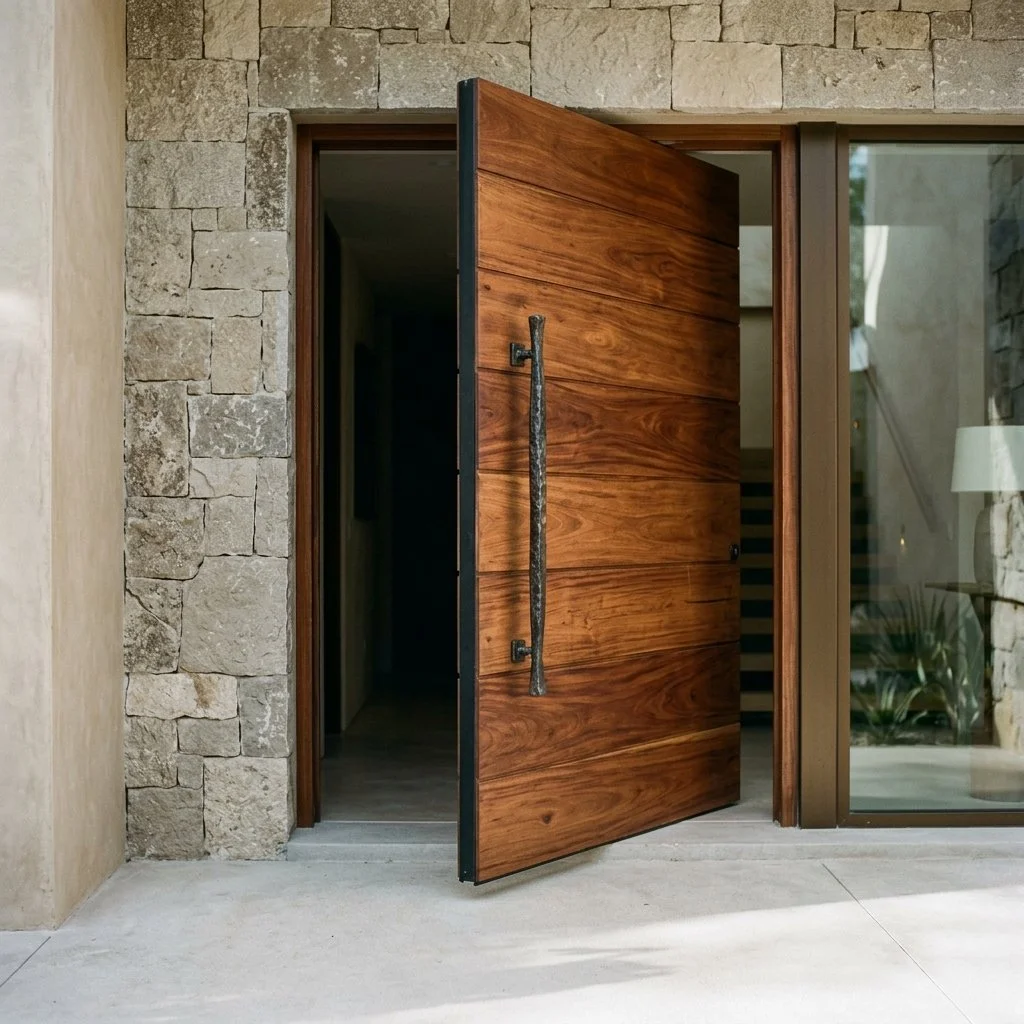
Wide plank Tzalam wood pivot entrance door open against a limestone facade, anchored by a forged blackened bronze handle.
What a Hinge Can't Carry
A standard butt hinge is mounted to the side of the frame, which means every pound of the door hangs off a few screws driven into wood. Past a certain width, usually around four feet, that frame starts losing the argument. The door sags at the top corner first, then drags at the bottom, then needs planing every year to keep closing at all.
A pivot solves the actual problem instead of masking it. It mounts at the top and bottom of the door rather than the side, and it sends the door's full weight straight down through a bearing set into the floor. Floor mounted pivot systems are rated for doors well past a thousand pounds, with no meaningful limit on width, because the floor is doing the work a frame was never built to do. That's how a slab of solid wood or stone that weighs close to five hundred pounds still opens with one finger and closes on its own with a soft, even thrum. Nothing about that is luck. It's the pivot, and it's the first hardware decision I make on any door wider than four feet, before wood or finish enters the conversation.
A Core Built Like a Wall
The other half of that sound is the door itself. A door with a hollow core reads as hollow no matter what veneer sits on the outside, because there's nothing behind the skin to absorb an impact. I check this with a knuckle before I ask what species the veneer is, because no finish fixes what's missing underneath. A real entrance door runs a solid core close to four inches thick, often built around an aluminum honeycomb structure for rigidity, then clad in heavy timber. The honeycomb keeps the door from twisting under its own weight. The timber gives it the mass that actually blocks sound.
An automatic drop seal finishes the job. It sits hidden inside the bottom of the door and stays retracted until the door closes, then lowers to meet the threshold and seals out draft and street noise. Light doesn't slip under it either. It's invisible when the door is open, which is exactly the point. A house doesn't decompress at the door if you can still hear the driveway through the gap underneath it.
Security That Doesn't Look Like Security
A visible keypad or a camera mounted on the trim tells a visitor two things at once: that the house is worth securing, and that the owner cared less about how it looked than about the fact that it was there. The better version hides the same technology inside parts of the door someone would touch anyway. A fingerprint reader built into the underside of a handle. Sensors set into the wood grain instead of bolted to the surface. The door still recognizes you. It just doesn't look like it's doing a job. Between the two, I'll always take the version a guest never notices over the one that makes a show of protecting them.
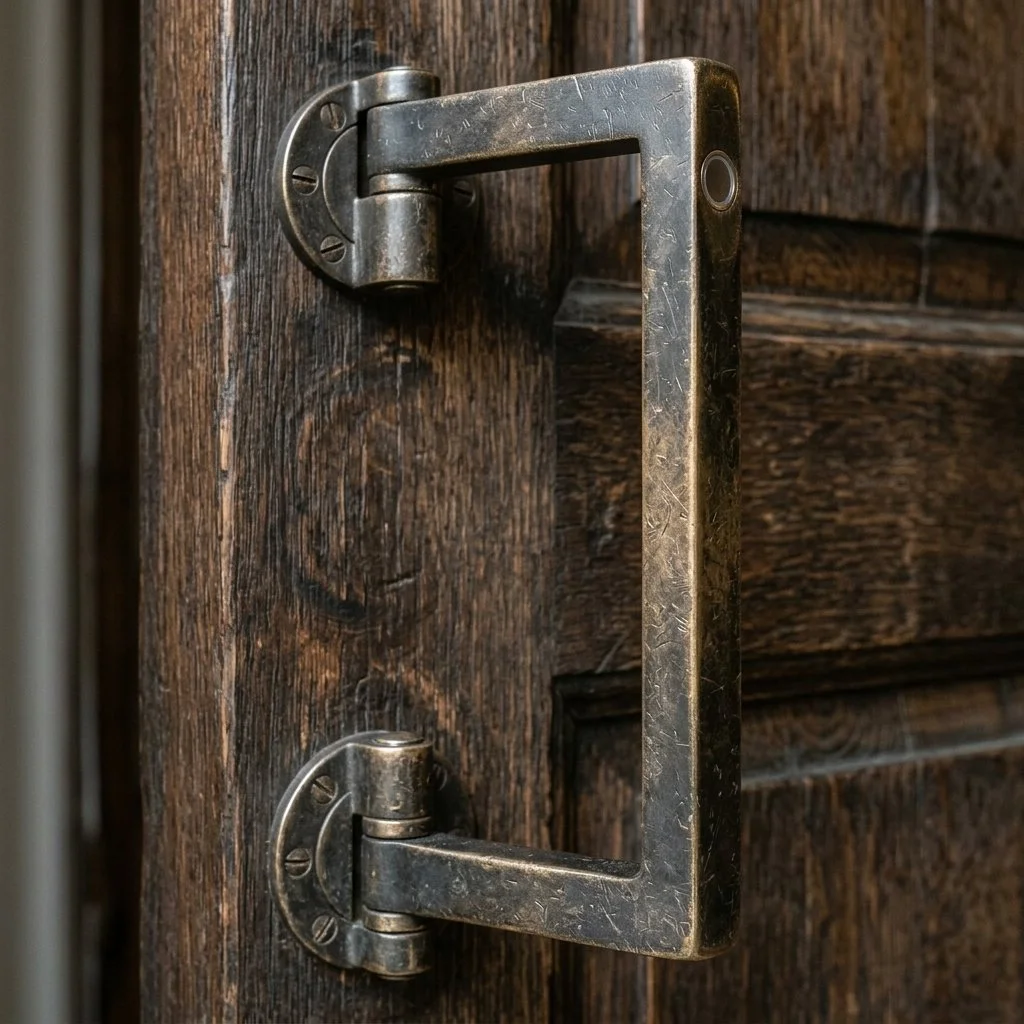
Vertical bronze pull handle on a massive dark wood pivot door, featuring a flush, integrated fingerprint reader set discreetly into the metal.
The Materials That Age Instead of Wearing Out
Tzalam, sometimes called Mayan walnut, runs harder than white oak on the Janka scale and carries a very high natural resistance to rot, which is why it holds up on an entrance that takes real sun and rain without warping or graying the way softer species do. Charred oak gets there a different way, through surface treatment rather than density, and reads darker and more matte against a stone or plaster facade. I reach for Tzalam whenever the design can carry real color instead of a uniform dark surface, and charred oak when the house wants something more restrained.
The handle is the one piece of hardware a person actually touches, which is exactly why I spec forged blackened bronze there even when I'd let something less expensive go elsewhere on the door. It stays cold against the hand the way plated hardware never does. It also changes over years of use. The oils in your skin build a patina on it that a static factory finish never develops.
The First Room in the House
I don't spec any of this to make a door look heavier than it is. The pivot, the core, the hidden lock, the bronze that changes with your hand: every one of them is real mechanical weight doing real mechanical work. A door that passes all four tests sets the standard the rest of the house has to meet. Walk through one that doesn't, and you already know, before you've seen a single room past it, exactly how much of the rest is real.
The Weight of Wood
In a world of veneers and cardboard, the weight of solid wood is the ultimate signal of intent. True luxury isn't a look you buy, it’s a density you feel. Explore the intellectual soul of walnut and the architectural strength of white oak in the modern home.
The easiest way to spot a fake table has nothing to do with how it looks. Tap a ring against solid walnut and you get a low, dull knock, the sound of mass absorbing the hit. Tap the same ring against three layers of walnut veneer glued to particleboard and you get a rattle. That's the sound of a table that's mostly air and glue underneath a photograph of wood.
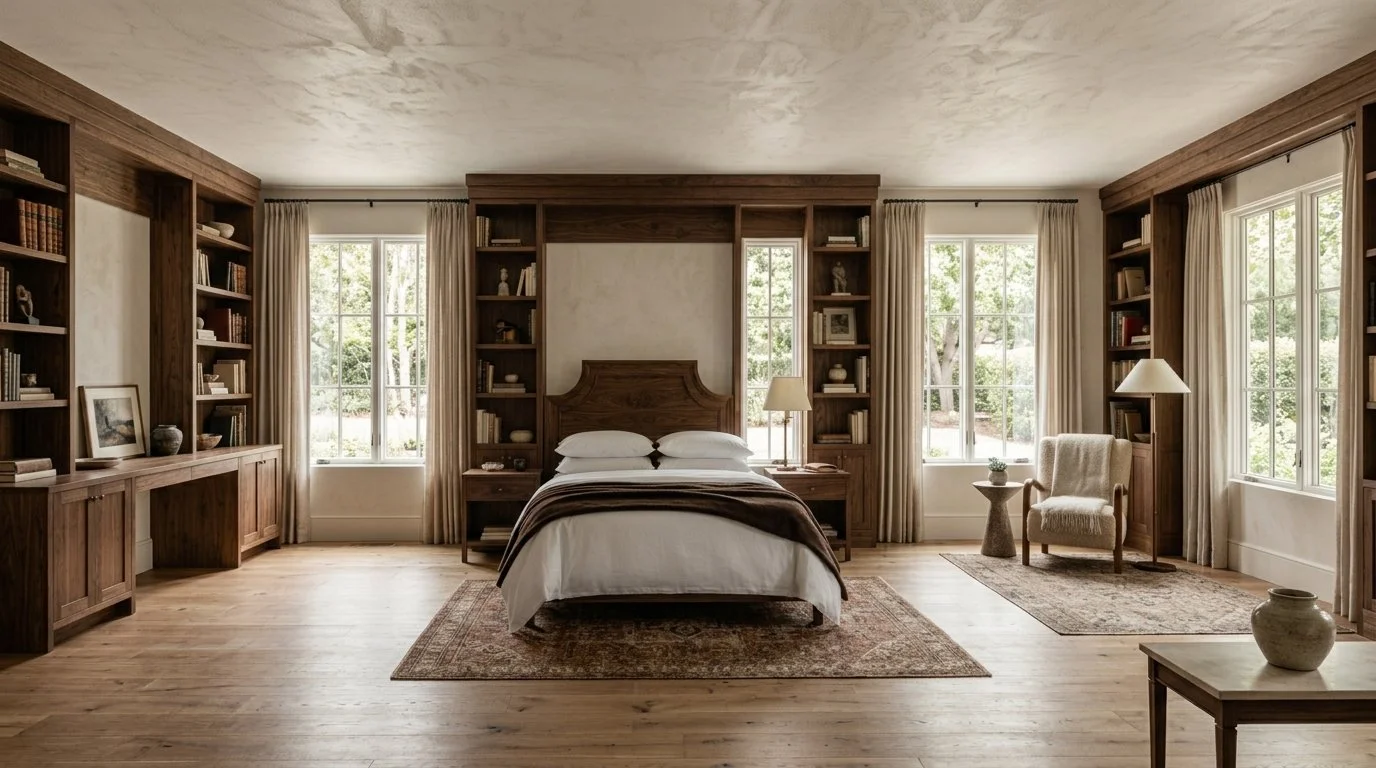
A spacious bedroom anchored by a custom walnut bed frame and surrounding millwork, and crisp white linens and a chocolate brown cashmere throw.
Walnut Doesn't Age Like the Others
American black walnut runs about 1,010 on the Janka hardness scale, which puts it on the softer end of hardwoods used in furniture. That's not a flaw. It's why walnut carves and steam bends so cleanly, and why it's been the wood of choice for gunstocks and violin backs for two centuries.
The real reason people fall for walnut is color, and the color does something almost no other wood does. Most furniture grade species, oak, cherry, maple, darken as they age. Walnut goes the other way. Fresh heartwood reads as deep chocolate brown, occasionally shading into a near purplish black, and years of light exposure pull it lighter, toward a warmer honeyed brown. A walnut desk built forty years ago isn't darker than the day it was made. It's mellowed.
Nearly three quarters of the black walnut cut in this country comes out of the central states, Missouri, Kansas, Iowa, where it's common enough to be Iowa's state tree. I look for boards from that region specifically, straight grained, with the occasional curl or burl left in rather than sanded into uniformity. Walnut is a library wood. It belongs where a room is meant for thinking, not performing.
Why White Oak Reads as Structure
White oak sits at roughly 1,350 to 1,360 on the Janka scale, about 350 points harder than walnut, and that density is the whole point. This is the wood you build a table for a family that actually uses it.
Cut it quarter sawn and white oak does something walnut can't. Every species has ray cells running radially through the trunk, but white oak's are the largest of any domestic hardwood, and sawing it on the quarter exposes them as a rippling fleck pattern across the board face, sometimes called tiger stripe. It's not a finish effect. It's the tree's own structure showing through.
There's a second reason white oak has outlasted trends for so long, and it has nothing to do with looks. Its pores are filled with a substance called tyloses, which blocks water and air from moving through the wood. It's the same property that made white oak the standard for whiskey barrels and wooden ship hulls for three hundred years. A dining table doesn't need to hold bourbon, but the same density that keeps a barrel from leaking is why an oak trestle table shrugs off a spilled glass of wine without swelling or staining.
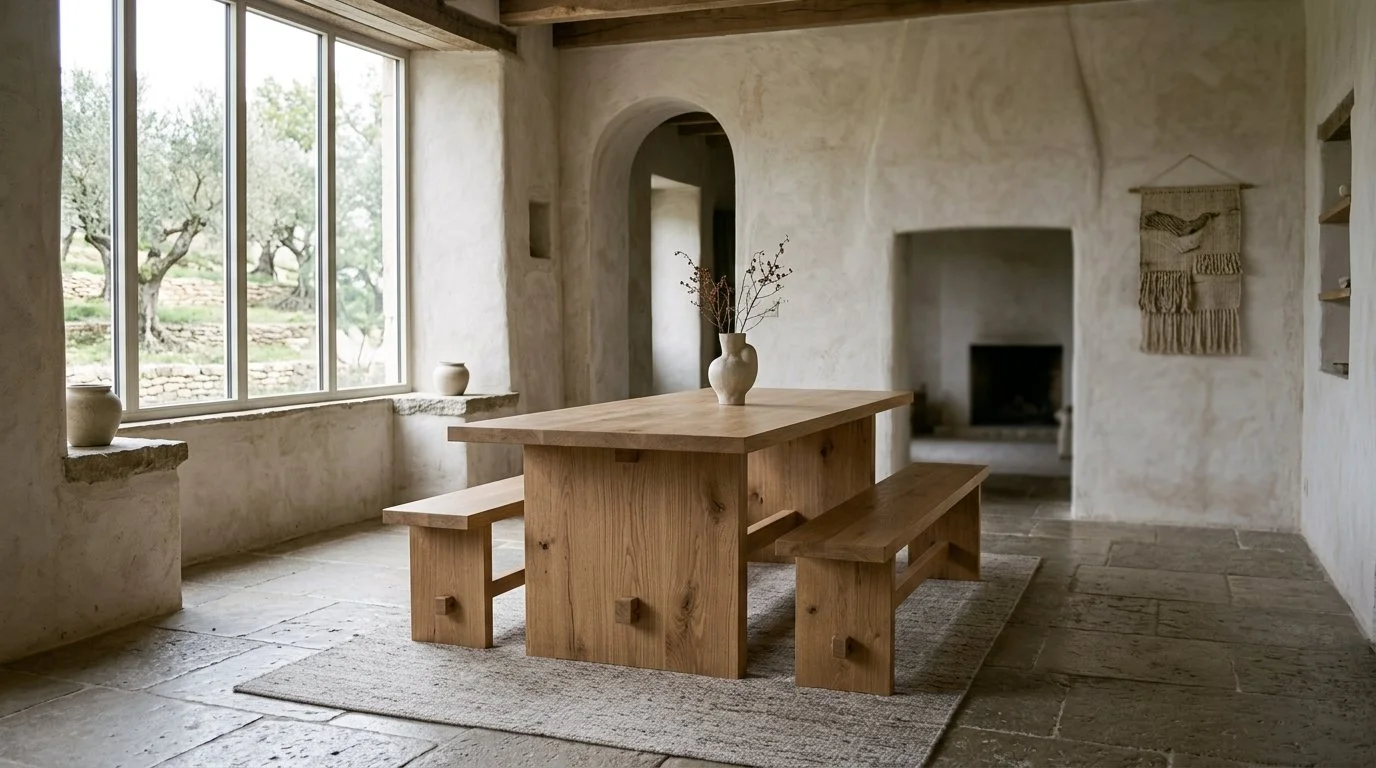
Light oak dining table with matching wooden benches on a rough stone floor, set against limewashed walls with a large window.
What a Veneer Can't Do
A veneer is a slice of real wood, sometimes as thin as a fortieth of an inch, glued to a substrate of MDF or particleboard. Manufacturers call this "stable," and dimensionally it often is. But stability isn't the same thing as durability.
Solid wood works differently. If a walnut tabletop takes a scratch during a dinner party, that mark sands and oils out, and the table gets refinished, not replaced. That's the actual argument for solid construction. It isn't that veneer looks worse on day one. It's that solid wood is the only version of the two that can be repaired at all.
The Only Question Worth Asking Before You Spec It
Before I spec anything in walnut or white oak, whether that means a trade showroom or a call to the mill, I ask one question: does the grain go all the way through, or does it stop an eighth of an inch down? The price matters less than that answer. So does the finish, and so does whatever you're told about either one.
Choosing solid wood isn't about nostalgia for how furniture used to be made. It's a practical bet that a table built to be repaired will outlast one built to be replaced, and that the house you're building deserves furniture that can actually keep up with it.