How Much Humidity a House Can Hold
A whole house humidity system adds moisture to the air while the heat runs and pulls it out while the cooling runs, and in a house full of wood and paintings it has to hold a number someone actually chose. The flooring warranty and the piano maker each publish their own figure, and in a cold climate the windows set a ceiling below some of them. The right target is the highest humidity the glass can carry without condensation, checked against the most sensitive object in the house, and both get settled before anyone picks the equipment.
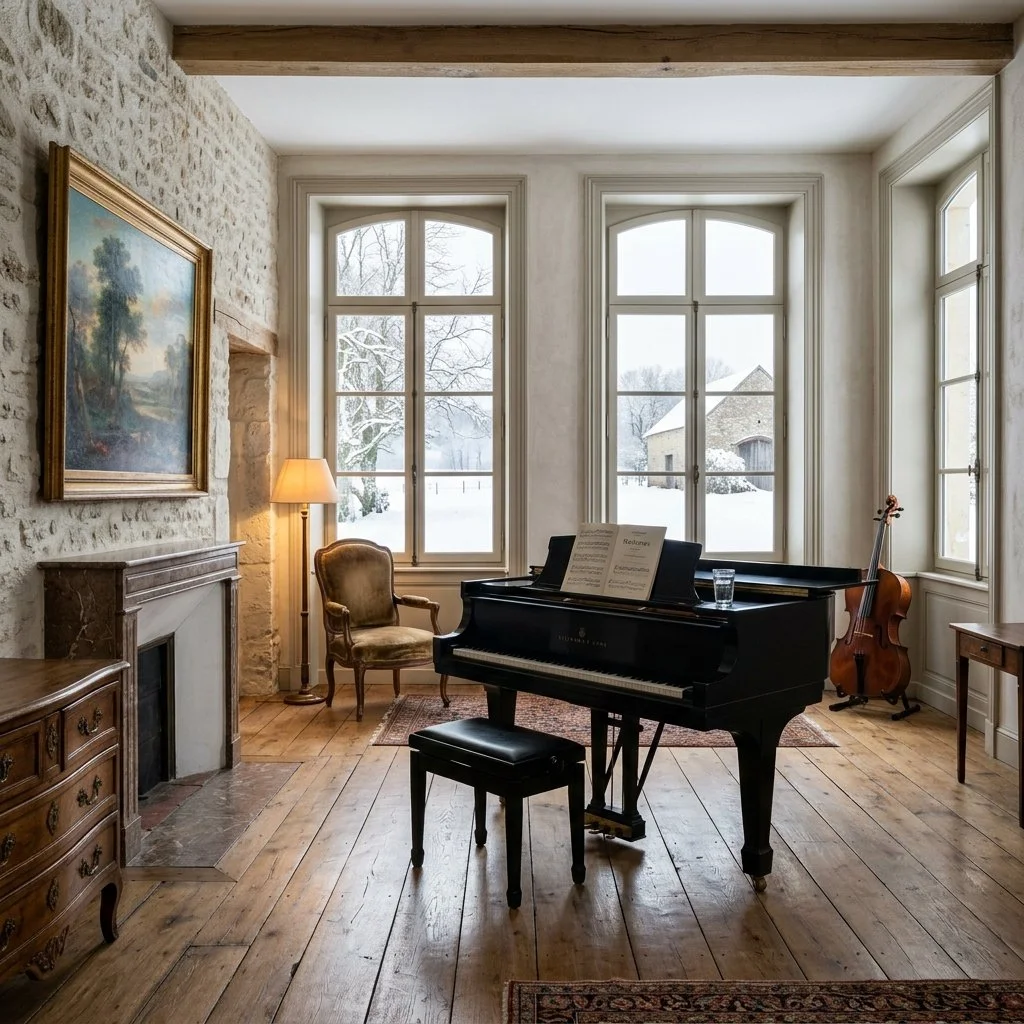
A music room in a stone farmhouse with a grand piano and clear windows looking onto snow.
The Numbers Don’t Agree
Wood flooring warranties are the most specific documents in the house on this. One engineered flooring warranty I found required the room to stay between 35 and 55 percent relative humidity year round, and a solid wood maker’s ran 35 to 60. Both excluded damage from humidity outside their range, so a floor that gaps after a dry winter may not be covered. The range for a specific floor sits in its own warranty, and the installer should confirm it in writing before installation.
Art asks for more. Chubb, which insures fine art collections, has advised display conditions around 45 percent at roughly 21°C. Steinway’s UK care guide gives a wider band, 45 to 70 percent at about 20°C. Solid wood furniture has its own tolerance, and a long heating season is when a finish starts to split where the joints meet.
Side by side, the floor’s upper limit of 55 sits just above the 45 that art and a piano both want at minimum. There is room to work.
What Indoor Humidity Is Best for Breathing?
Climate decides which way the system works hardest. A desert house in Scottsdale or a ski house in the Rockies spends much of the year adding moisture, and a house in Miami or Singapore spends it taking moisture out. Both directions matter to the people living there. The Mayo Clinic links dry indoor air to dry sinuses and nosebleeds and puts the ideal home range at 30 to 50 percent. On the humid side, the CDC’s asthma guidance recommends keeping indoor humidity around 30 to 50 percent to limit dust mites and mold.
Set beside the floors and the art, the health numbers mostly agree. A house held near 45 to 50 percent sits inside the health guidance and the collection guidance at once, which makes the number easier to defend to a client. The trouble starts outside.
How Humid Can a House Be in Winter?
Indoor moisture condenses first on the coldest surface in a room, and in winter that is the glass. Cardinal Glass, which makes insulating glass for window manufacturers, puts a comfortable average at 35 to 40 percent when it is 20°F or warmer outside, and points to ENERGY STAR’s advice of 30 to 40 percent in colder climates. A window company’s guide drops the ceiling to 30 percent once it falls to 0 to 10°F. Minnesota’s Center for Energy and Environment warns that in extreme cold, even 40 percent can condense on windows and wall surfaces.
That puts the art’s 45 percent out of reach on a January night in a snowy climate with ordinary windows. The same window guide notes that window type and air sealing both change how much humidity a house can hold before the glass fogs, since a warmer inner pane lets the room carry more moisture. The humidity a collector wants is partly a window specification. I’d put the question to the window supplier in writing, what indoor humidity will this glass hold without condensing on the coldest nights this house will see? A controller with an outdoor sensor can also lower the target as the weather turns colder and bring it back up on milder days.
The Water Decides Which Steam
Steam is the type built for tight control, and it has a second argument in its favor. The Mayo Clinic’s main warning about humidifiers is mist from a dirty unit carrying bacteria or mold into the room, and steam starts as boiling water, which is why makers such as Condair describe it as sterile.
It comes in two kinds. An electrode unit boils water by running current through it, so it depends on the minerals in the water to conduct. Humidifier maker steamOvap states that an electrode unit can’t run on reverse osmosis or deionized water for exactly that reason. A resistive unit heats the water with submerged elements, so mineral content doesn’t change its output. Condair says a resistive unit on reverse osmosis water can hold humidity within 1 point either way. It also lays out the tradeoff plainly, electrode units cost the least to buy, and resistive units cost the least over their working life once replacement cylinders and service are counted.
So the humidifier follows the water. Each manufacturer’s installation guide lists the water types a model accepts, and that list is worth checking against the house’s water treatment before anything is ordered. A house that already runs its water through reverse osmosis points toward resistive, and the steadier control is the reason a collector would pay for it regardless.
Where the Steam Comes Out
In a house with forced air, steam enters the supply duct through a dispersion tube and travels with the air. A house heated through radiant floors may have no ducts to carry it, so the steam has to enter the room directly. AprilAire sells a ductless version that pairs a steam unit mounted out of sight with a fan pack recessed into the wall. The room sees a grille rather than a cabinet. That grille is the one part of the system anyone will see. It deserves the attention of a switch plate, and it’s worth asking the manufacturer whether a custom grille in the room’s own metal finish will still let the fan pack do its job.

A penthouse hallway with a framed work and a slim grille set flush in the plaster wall.
Summer Is the Opposite Problem
An air conditioner dries the air as a side effect of cooling it, and only while it runs. Lennox notes that an oversized system can cool a room quickly and still leave the humidity behind. It reaches the thermostat setting and shuts off before it has pulled enough moisture out. Tight houses make this harder. Field Controls, which makes whole house dehumidifiers, points out that a tighter house holds on to its moisture, and that the air conditioning alone often can’t bring it down to target.
A whole house dehumidifier works independently of the cooling, and Lennox describes pairing one with a variable capacity air conditioner as one of the most efficient setups available. Before either goes on the drawings, the document to request is a written Manual J load calculation from the mechanical contractor, the sizing method published by ACCA, because the size of the air conditioner decides how much drying it does on its own.
The Most Fragile Thing Sets the Number
When the glass can’t carry the art’s number, the answer is usually smaller than the house. Steinway’s UK guide makes the same call for a single instrument, humidify the room around the piano rather than fit a unit inside it. Scaled up, that means a music room or gallery on its own zone, held at its number through January while the rest of the house drops to what the windows allow.
This is general information, not a mechanical design or medical advice. Equipment requirements and local codes vary, so confirm every figure with the manufacturer’s documentation and the project’s engineer, and take health questions to a physician.
