The Air Is a Material Too
When a bedroom starts to feel stale, the instinct is to reach for a candle or run the diffuser bought specifically to fix that feeling. It rarely does. The pollutant actually climbing fastest in a closed room overnight is one no scent can touch, and it keeps climbing whether the diffuser is running or not. Air behaves the way any other material in the house does. It has a real chemistry, and once I started asking how it should actually be specified, "just add a purifier" stopped sounding like an answer.
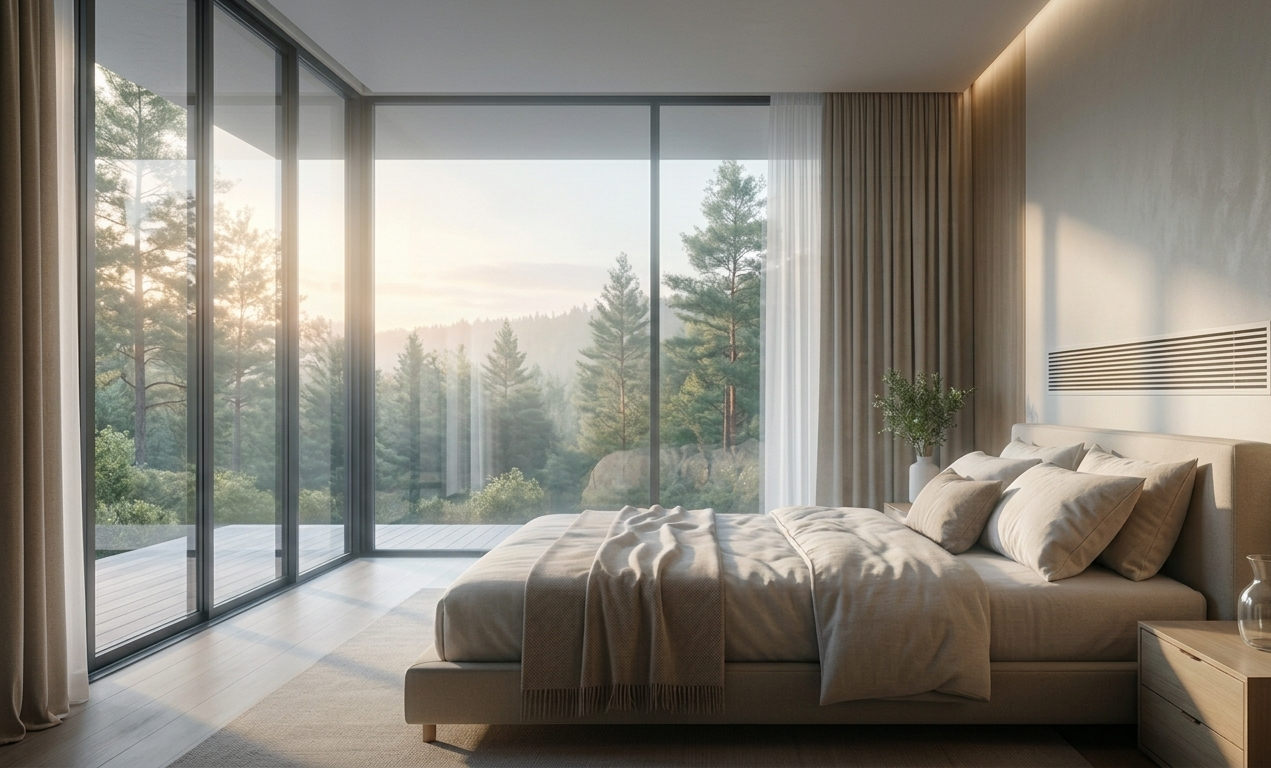
Bedroom that features a plush bed with neutral toned linens and an air purification vent integrated into the wall.
The Part You Can't Smell
Outdoor air runs around 400 to 420 parts per million of carbon dioxide. Close a bedroom door for the night and that number climbs steadily, since two sleeping adults are the only source in the room and there's nowhere for their exhaled air to go. Confined, poorly ventilated spaces regularly push past 2,000 ppm by morning. At Lawrence Berkeley National Lab, researchers tested this directly using a business simulation designed to measure strategic thinking rather than simple recall, and found that performance on that higher order thinking dropped most sharply once concentrations reached 2,500 ppm. That's not the vague fog people blame on a bad night's sleep. It's a measurable dip in exactly the kind of thinking a morning design review needs.
What HEPA Actually Guarantees
HEPA is a legal threshold, set by the U.S. Department of Energy, not a marketing word. To earn the name, a filter has to capture at least 99.97 percent of particles at 0.3 microns, the size research has found hardest for any filter to catch. Anything smaller or larger gets trapped even more effectively. "HEPA-type" and "HEPA-like" are unregulated phrases that typically land in the 85 to 99 percent range, well below the real number. On the HVAC side, filters are rated by MERV, a separate scale running 1 to 16. A true HEPA filter performs above the top of that scale entirely, which is exactly why most residential ductwork can't run one without significant changes. It's also why the actual fix for a primary suite is usually a standalone HEPA unit sized to that room, not a filter swap on the whole house system.
The Ventilation Number Nobody Asks For
The U.S. residential ventilation code, ASHRAE 62.2, sets a minimum of 0.35 air changes per hour for the house as a whole, and no less than 15 cubic feet per minute of fresh air per occupant. That's a floor, not a target. Modern construction, built tight for energy efficiency, often struggles to hit even that floor on its own, since the drafty old envelope that used to let air leak in and out by accident is precisely what better insulation and sealing are designed to eliminate. The tighter and more efficient a house gets, the more it needs mechanical help to breathe. The real answer, and the one mechanical engineers actually spec for airtight homes, is an energy or heat recovery ventilator. An ERV or HRV brings in fresh outdoor air and exhausts stale indoor air continuously, while transferring the heat or coolness between the two airstreams so the house isn't losing the energy it worked to keep.
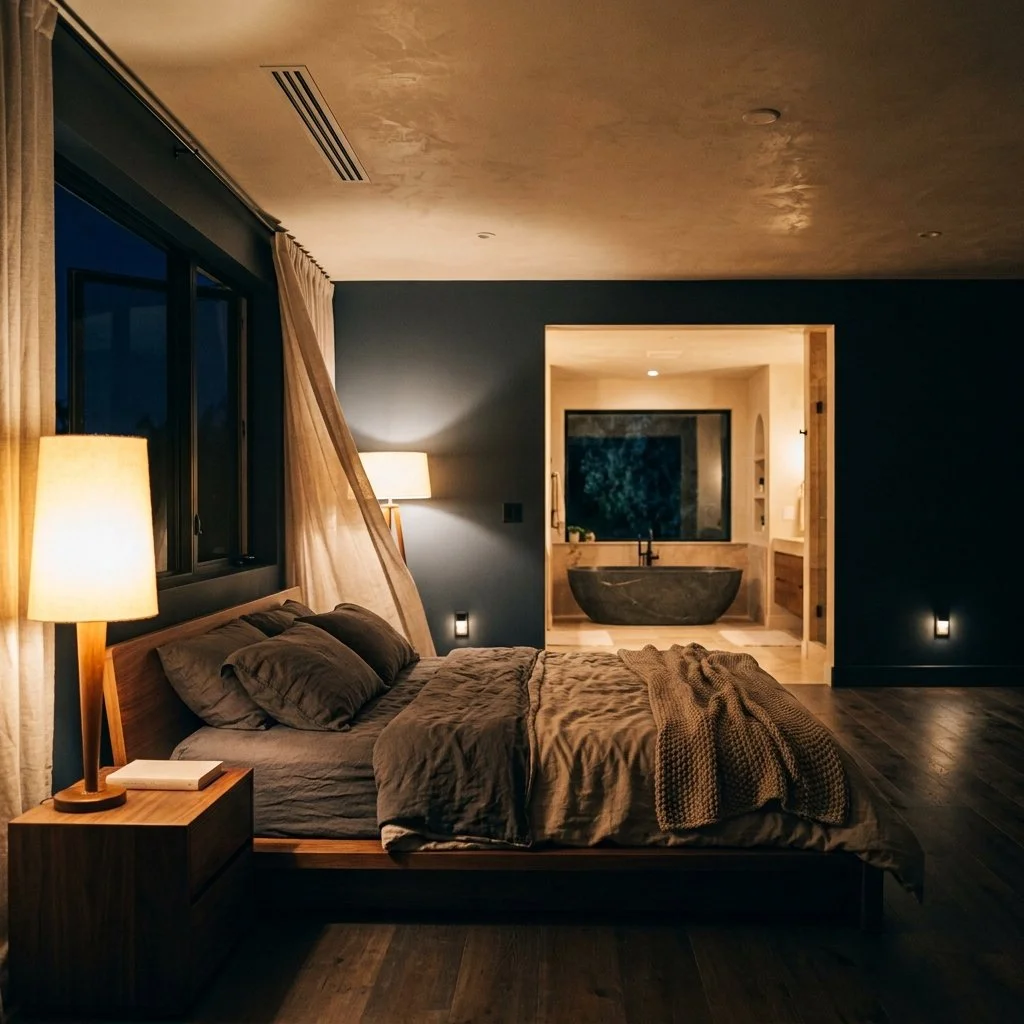
Primary bedroom featuring a flush mounted linear ventilation grille, a walnut platform bed, and warm amber lighting.
Diffusing the Wrong Thing
The idea that scent signals clean air runs backward. Chamber studies on ultrasonic diffusers have measured real, specific chemical output: over just fifteen minutes, lemon, lavender, eucalyptus, and grapeseed oils released measurable milligram quantities of compounds like d-limonene and eucalyptol into the room. When I asked why a product marketed for clean air would turn up in a pollution study at all, the answer was almost embarrassingly simple: anything that evaporates into a room is adding something to the air, not removing anything from it. A separate study measured similar output, in the 790 to 855 microgram per cubic meter range, for tea tree oil and two other common diffuser scents, and found that heating the oil, rather than diffusing it at room temperature, pushed that number even higher. None of this makes a diffuser dangerous in normal use. It does mean the smell of a "purified" room and the actual chemistry of that room are two different things, and treating one as proof of the other is the mistake. If fragrance still matters, a cool, unheated method run briefly is the more honest choice than one left running through the night in a closed room.
The Air Was Never Neutral
Stone shows a crack. Wood shows a warp. Air fails invisibly, and only a number catches it: a CO2 reading and a real filtration rating, tested rather than assumed. It's the one material in the house that can't be evaluated by walking through the room and looking. The only way to know it's right is to ask for the test.