The Home’s Circadian Pulse
Flip on an overhead light at nine at night and the room fills with the same wavelength the sun throws at noon. The room can't tell the difference. Something in your eye can, a cell whose only job is telling your brain what time it is, not what anything looks like.
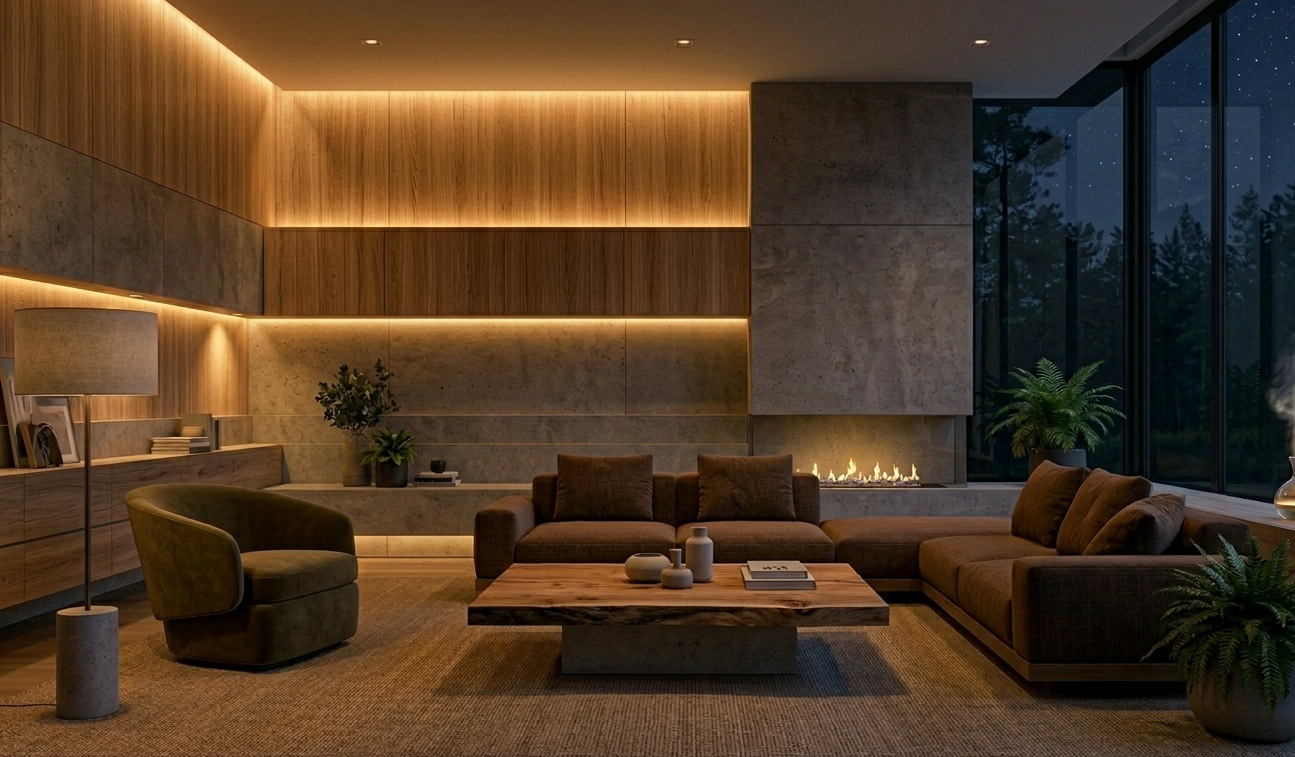
A modern, luxury living room featuring a 'Daily Descent' circadian lighting design.
Why Morning Needs More Than Bright
Brightness alone doesn't move that clock much. Color temperature does most of the work. The same lux reading from a warm 2700K bulb carries less than half the circadian signal of that same lux at 6000K, because the ratio between visible brightness and what that one eye cell actually registers shifts with the color of the light, not just its intensity. I went looking for a real number architects actually design toward here, not just a stylistic guideline, and there is one. The WELL Building Standard, the certification used for occupant health, sets its circadian lighting requirement in a unit built for exactly this: at least 150 to 275 melanopic lux at eye level, for four hours a day, starting no later than noon. A room that only measures "bright enough" on a light meter can still be doing almost nothing for that clock if the color is wrong.
The Sky Already Does This
Midday sun sits around 5,500K. By sunset it's dropped to somewhere near 2,000 to 2,800K, closer to a candle flame than to daylight. A home that pulls its own light warmer and lower through the afternoon isn't following a design trend. It's tracking something that happens every single day, whether or not anyone built a system around it. Practically, that means less reliance on a single ceiling fixture as the afternoon goes on, and more from lamps and sconces sitting at eye level or below.
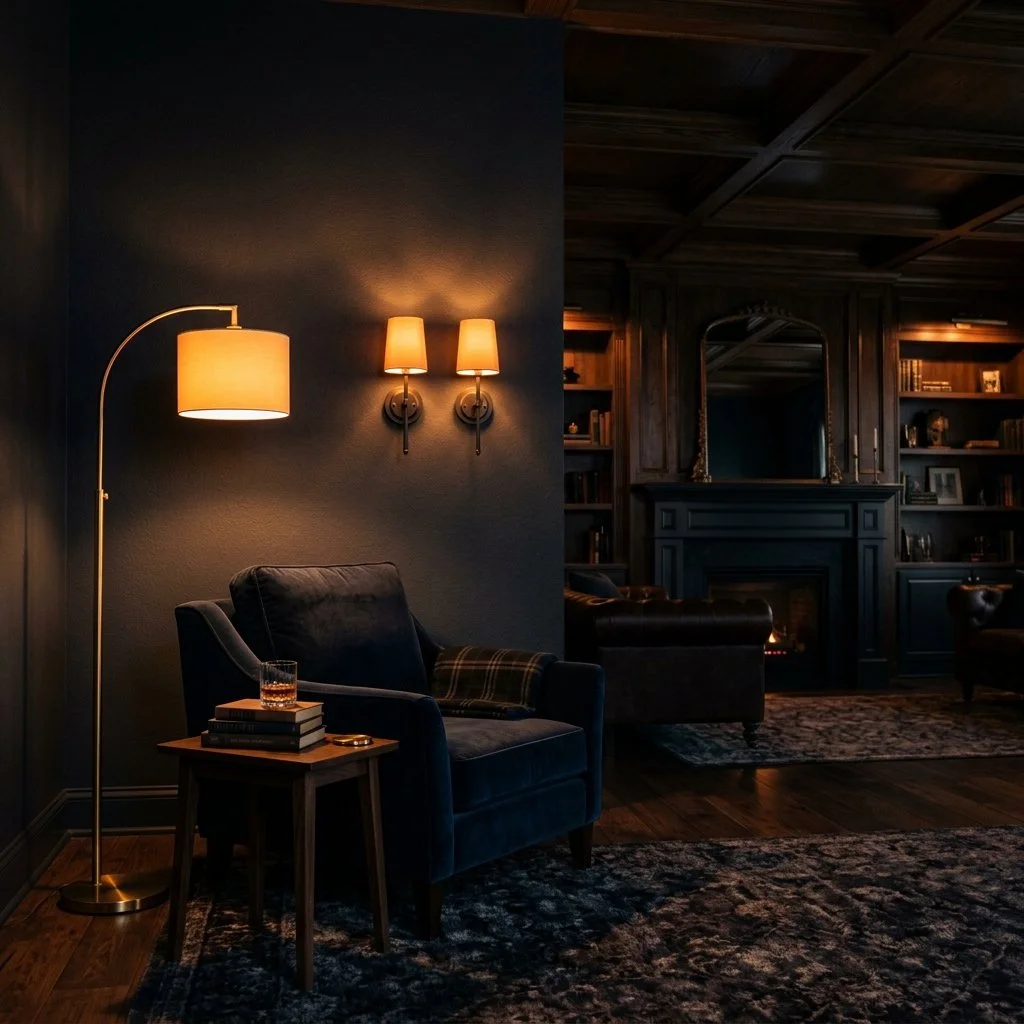
A warm, living room featuring a dark velvet armchair, a small side table, and low, amber glowing light.
The Trick Behind a Good Evening Dim
Firelight and candlelight sit around 1,850 to 2,000K. An old incandescent bulb warms naturally as it dims, because a heated filament simply glows redder the cooler it gets. An LED doesn't do that on its own. If a dimmed fixture in your house shifts toward amber as it goes low, that's not a coincidence, and it's not free. It's a tunable white circuit, engineered specifically to fake the behavior an incandescent filament used to give away for nothing. Worth knowing before paying a premium for it, and worth insisting on if a fixture claims "warm dimming" but only gets dimmer, never warmer.
The One Cell That's Actually Watching
None of this is really about how a room looks after dark. It's about giving one very specific, very old cell in the eye the signal it was built to look for, at the hour it expects to find it. The category to ask a lighting designer for is tunable white, sometimes called Human Centric Lighting. It's a real specification, and the reason it entered the residential market at all is that it can be programmed to the actual sunrise and sunset schedule of wherever the house sits, not a generic dimmer curve. Get the color right through the day and the house does entrainment work the sky used to do for free.
