The Composition of Light
I think about a room's lighting as three separate jobs, not three versions of the same fixture. Confuse the jobs and you get a space that's either flat and shadowless or, worse, unevenly lit in a way nobody can quite name. Get them right and the room reads as put together, not stitched together, layer by layer.
A kitchen island needs about 50 footcandles of light to chop something safely. The armchair eight feet away needs a fifth of that. Most rooms treat every corner the same, and the eye can always tell.
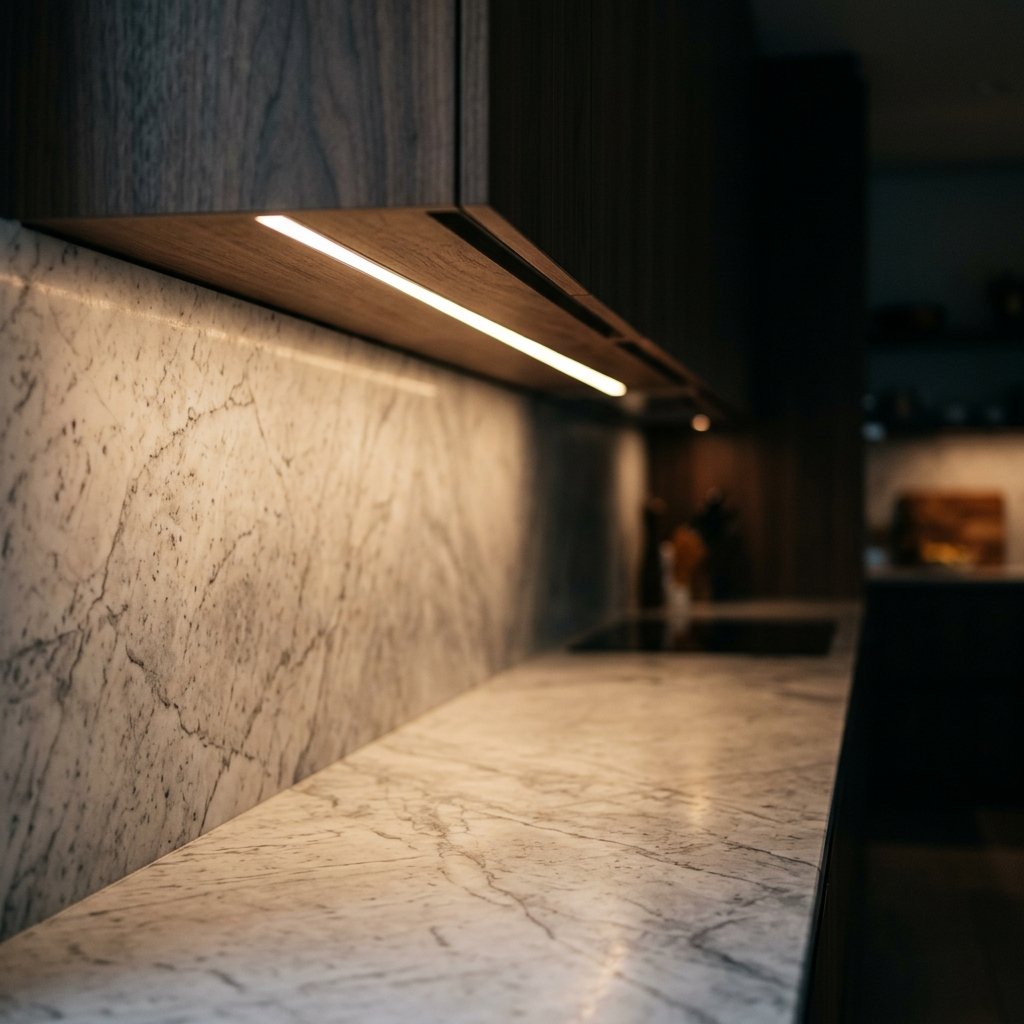
Recessed LED strip under a dark wooden cabinet, illuminating the rich veining of a honed marble countertop with warm, even light.
The Baseline: Ambient Light
Ambient is the light that establishes what the room looks like before anyone does anything in it. It should sit low and even, somewhere in the 10 to 20 footcandle range for a living room or bedroom, which is genuinely dim compared to a kitchen, where the IES recommends 30 to 40 footcandles just for general coverage. That's dim enough to see the room by, not read fine print in it.
Color temperature matters more here than anywhere else, because ambient is the light every other layer gets judged against. Most residential interiors land between 2700K and 3000K, warm enough to flatter skin and wood without tipping into the amber cast of pure candlelight. Recessed architectural downlights do this job well, and so does cove lighting run above crown detail. Either one needs to sit on a dimmable circuit, or the fixed level becomes a mistake in a room that's used for both dinner parties and Tuesday mornings.
The Layer That Gets Requested: Task Light
Task is the layer clients actually notice missing, usually the first time they try to read in a chair or chop something on an island lit only from above. The IES puts kitchen prep surfaces at 50 to 100 footcandles and reading areas at 20 to 50, both well above ambient levels, which is the whole point.
This is also where decorative choices fail on function. A pendant scaled for looks over an island frequently doesn't put out enough lumens to actually do task work, which is a real and common design error, not a matter of taste. Linear LED strips run under cabinets solve counter work without adding visual clutter, and a gooseneck or articulating lamp does more for a reading chair than a second ambient fixture ever will. The test for any task fixture is simple: does it hit the number at the surface where the work happens, not just brighten the general area.
Accent, Used With Restraint
Accent is the layer with the least amount of light and the most amount of judgment involved in placing it. Its job is to direct attention toward something specific, a run of millwork or a single piece of art, and it fails the moment it starts competing with task or ambient instead of pointing toward something.
Color rendering index matters more here than brightness. A high CRI source, generally 90 or above, is what lets a picture light show a canvas's actual pigment instead of a washed-out approximation, and what lets an uplight run at low voltage reveal real texture in a stone wall instead of flattening it. Picture lights belong in this layer. So do hidden uplights run along vertical texture, and an occasional structural wall sconce. What doesn't belong is treating accent as a second ambient source; if it's making the room brighter, it's doing the wrong job.
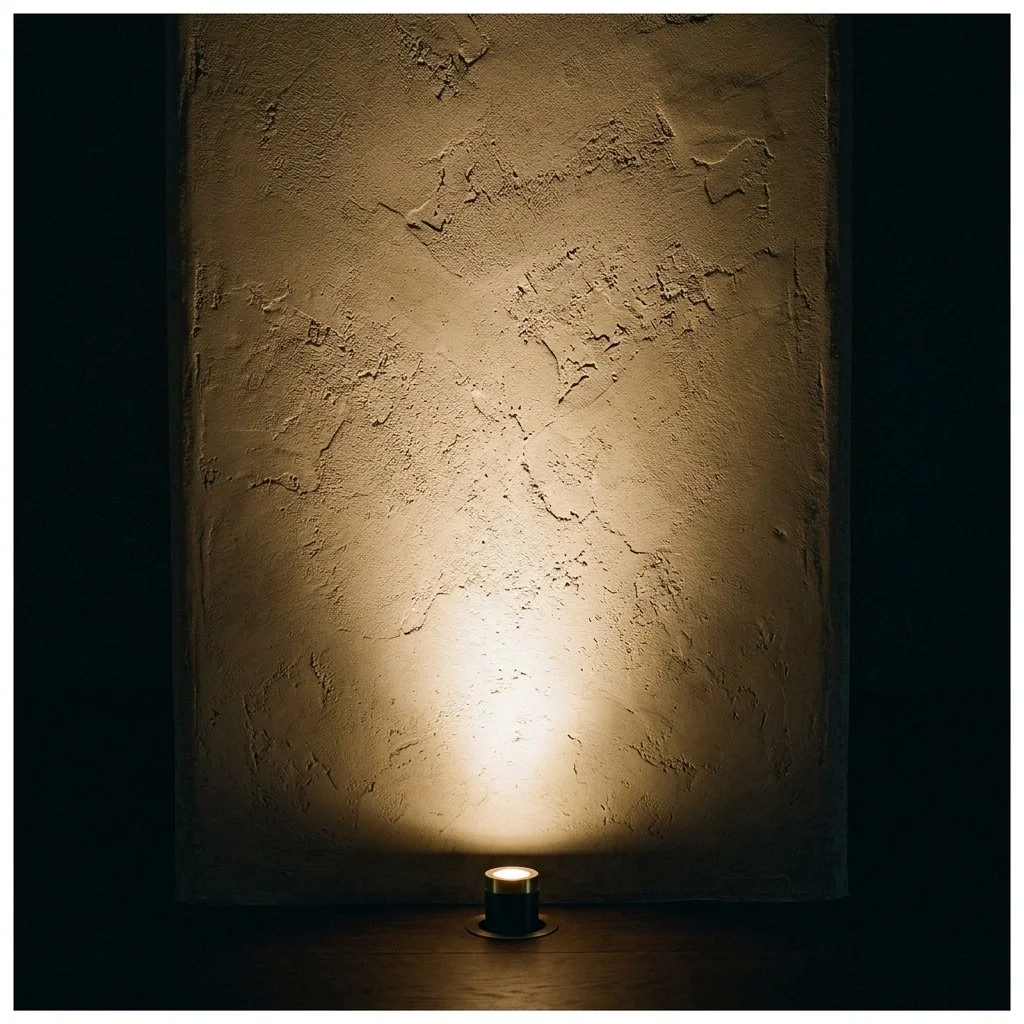
Small in ground uplight casting warm, grazing illumination up a heavily textured plaster wall surrounded by deep shadow.
Keeping the Numbers Honest Across the Room
Mismatched temperature between otherwise fine layers is the most common failure I see, more often than an actual missing layer. A 2700K recessed can next to a 4000K strip under the cabinet reads as wrong even to someone who couldn't tell you why. Manufacturers who build for professional specification, USAI is one real example, sell entire product platforms locked to a single static Kelvin option across every fixture type, precisely so a designer can hold 2700K or 3000K constant on the recessed can, the task strip, and the accent sconce alike, without hunting for matching bulbs later. That consistency is a spec decision, made once, at the start of a lighting plan, not something fixed after the fact with warmer bulbs in one lamp.
Ask for the Number
None of this requires more fixtures or a bigger budget. It requires knowing what number a surface is supposed to hit and checking that the Kelvin rating is the same across every layer in the room. That onion still needs its 50 footcandles. The chair next to it still only needs ten.
