Chukum Plaster Starts With a Tree
Chukum plaster is lime mixed with the bark water of a Yucatán tree, and what goes into a bag today depends on who mixed it. The lab evidence for why it works, and what to ask for before it goes on a wall.
I started with one plain question: what is in a bag of chukum? The sources I read agree on part of the answer and split on the rest.
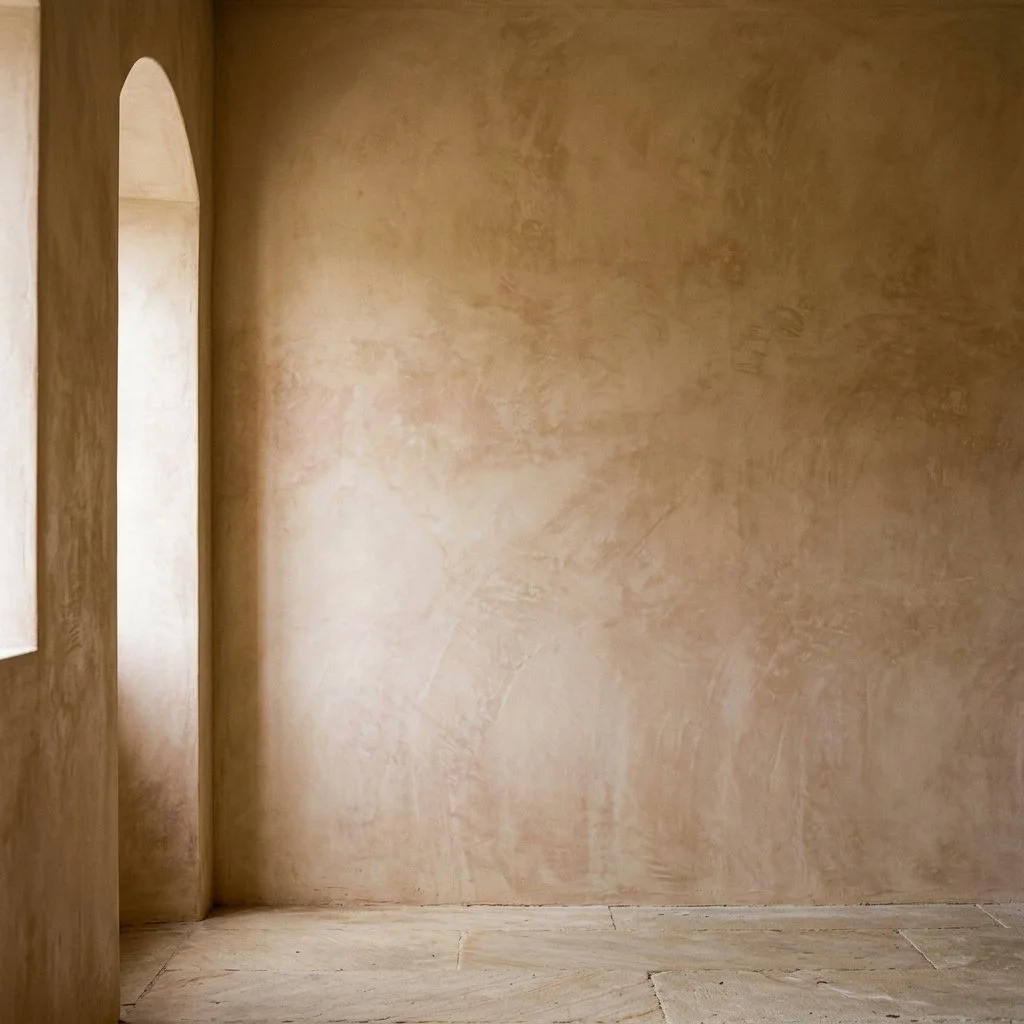
Burnished plaster wall in warm earth tones lit from the side.
The Bark Water Does the Work
Chukum takes its name from a tree, Havardia albicans, native to the Yucatán Peninsula. The plaster is lime mixed with water drawn from that tree's bark instead of plain water. Diego de Landa, a Spanish bishop of Yucatán, wrote in the sixteenth century that the upper part of Maya buildings was a strong limewashed mortar roof, made as it still was in his day with water from a tree's bark.
The best explanation I found for why it works came from a mineralogy lab at the University of Granada in 2023. The researchers analyzed lime plasters from the Maya city of Copán, in Honduras, and found organic molecules locked inside the calcite crystals, an arrangement that resembles seashell. To test the cause, they followed the advice of local masons who descend from the Maya builders and mixed new lime mortar with bark extracts from chukum and from a second native tree, jiote. The replicas showed the same features as the old plaster. The extracts are mostly polysaccharides, and in the set plaster they let the mortar give a little before it breaks and slow its chemical breakdown.
The accounts differ on preparation. The Granada team steeped bark in water for 48 hours. An architecture journal says the bark is boiled twice. The same journal credits an architect, Salvador Reyes Ríos, with reviving the plaster in 1996, after which his firm spent about fifteen years experimenting with mixtures.
Lime or Cement Depends on the Bag
The Granada study used lime. It says nothing about cement. One supplier describes its modern method as a paste of cement and fine limestone powder mixed with bark water. A builder in Tulum writes that chukum contains no cement at all. Both use the same name. The journal's account describes two routes to a chukum wall: the firm that revived it mixes chukum from scratch for each project, it says, while limestone cement and bark water are now available to buy.
Lime hardens by taking carbon dioxide from the air and turning back into calcite, the mineral the Granada team examined. Cement hardens by reacting with water. Those make different walls, and a specification that says only "chukum" lets two bidders price and build different ones. I would want the binder named in writing before I compared any two quotes.
How It Goes on the Wall
Chukum goes onto porous surfaces such as concrete or brick. A scratch coat goes on first for grip. One or more body coats follow, and the final surface is finished by hand, burnished or sponged depending on the texture wanted. One supplier sells a coarser mix for exteriors and wet areas and a finer one for smooth interior walls.
The Tulum builder says an exterior wall takes five to seven days to cure and needs protection from direct sun and rain in the early stages. Its page stresses that the finish depends heavily on who applies it, and it puts the cost at two to four times cement render and paint.
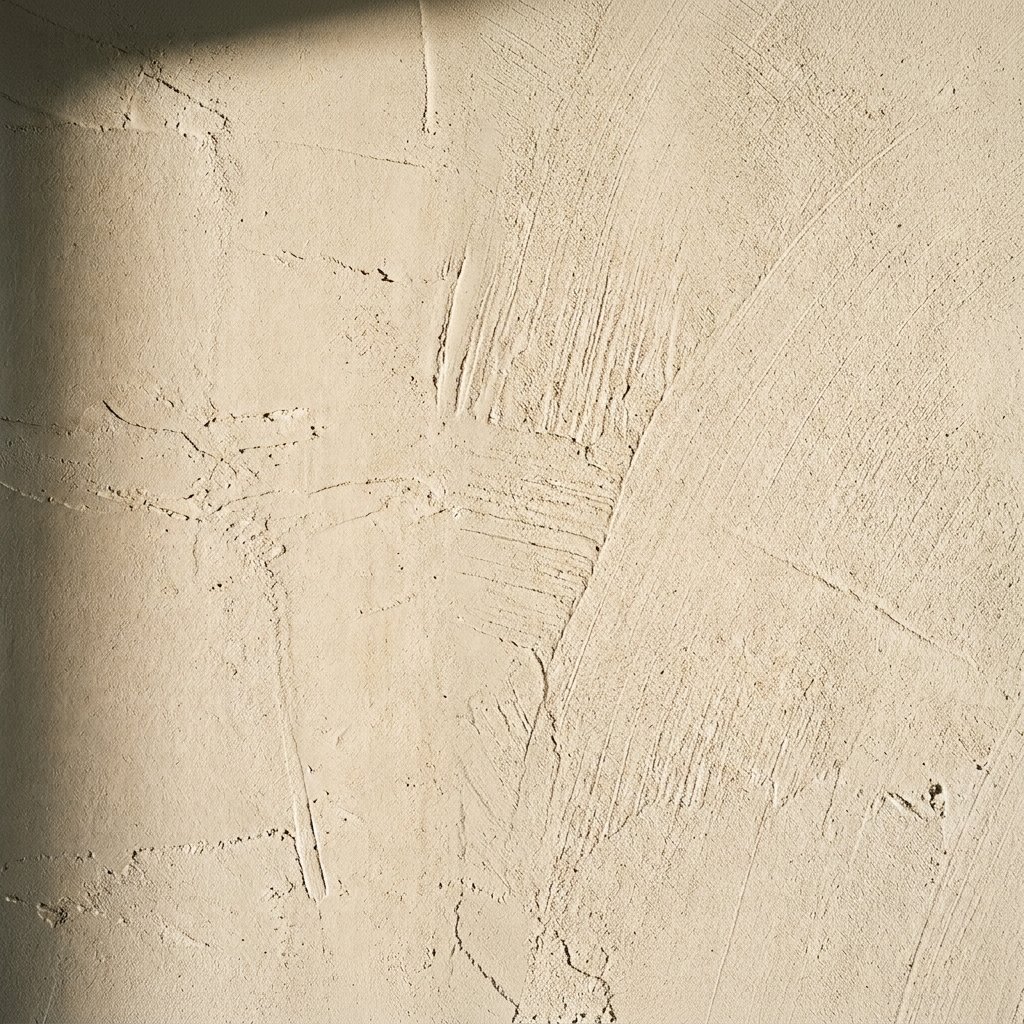
Close view of a plaster wall with a soft tonal change where two coats meet.
A Wall Meant to Change
Suppliers describe marbling and patina developing after installation, and some architects use that on purpose. At Por Ahí, a house in Mérida, the facades were applied at different times so the surface would come out mottled. At Niop Hacienda in Champotón, the architects finished the sounder walls in chukum and let the areas that had lost their old finish read as marks of age beside them.
Upkeep advice conflicts too. The builder recommends sealing exterior walls each year with wax or a breathable sealant, while a supplier says chukum needs no sealer. The builder adds that a skilled applicator can repair a damaged patch and match it without a visible line.
A Sample Board Shows Only the First Day
Marbling and patina develop over time, and a sample board cannot show them. Before I specified chukum, I would ask for two things. The first is the binder, in writing, from whichever route the crew takes. The second is a finished wall from the same crew and the same mix that has weathered for at least a year.
The name is old and the recipe has a documented history, but what goes into any one bag is still up to whoever mixed it. A weathered wall shows you the result.
The Mineral Palette
In a sanctuary, color isn't something you apply, it’s something you reveal. Discover why we move away from synthetic paint and toward a permanent foundation of Bone, Sand, and Silt.
I used to think a mineral palette meant a mood board of stone photos: bone, sand, silt, done. Then I started asking why those colors actually happen, and the answer kept coming back to the same word.
Pure limestone is white. Calcite, its main mineral, carries no color of its own. Every buff, tan, and honeyed tone you've ever called "natural stone" got there because something else rode along in the rock for a few million years: iron.
Rust on a nail and warmth in a limestone slab are the same chemical event. Iron reacts with oxygen and turns some shade of red, orange, or brown. How dark it goes depends on how much oxygen it got and how long it had. Once you know to look for it, the same reaction turns up in fired clay and troweled plaster as often as it does in stone. A mineral palette isn't dozens of unrelated materials that happen to look good together. Most of the warmth in it is one element, working the same job in different disguises.
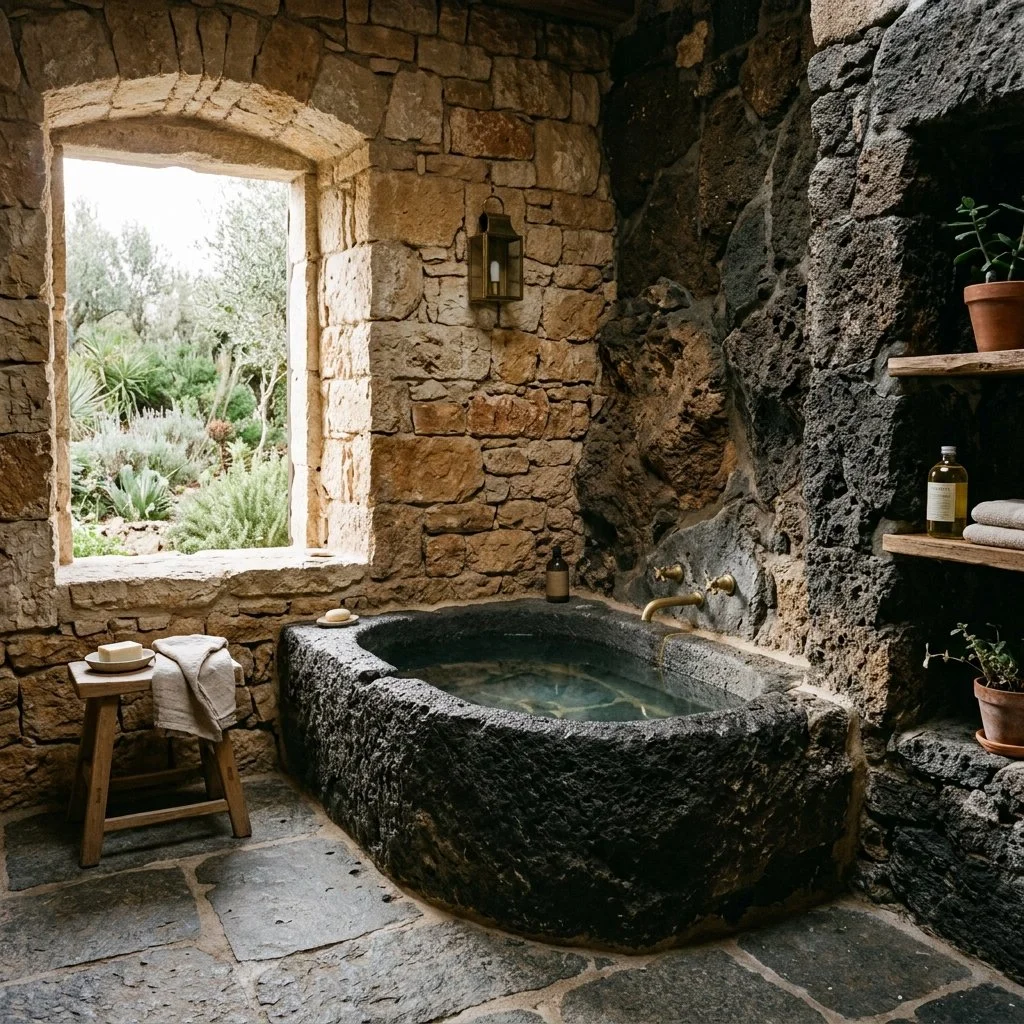
Stone bathroom, volcanic rock, carved bath, with limestone walls.
What the Same Reaction Looks Like in Three Materials
In limestone and travertine, iron oxide is an impurity, not the main event. The base rock is mostly calcium carbonate; a small amount of hematite or goethite mixed through it pushes the color toward buff, gold, or a deep reddish brown. Organic matter trapped in the same layer pulls it the other way, toward gray and black instead. Two slabs from the same quarry can read completely differently. It comes down to which one happened to trap more of each.
Basalt starts out dark, colored by the same iron and magnesium minerals that make it dense. Left outside, it weathers. The iron in it oxidizes into hematite, and the surface slowly turns brown. It's the identical chemistry as a limestone's warm streak. This time it's just running on stone that started dark instead of light.
Terracotta gets its red the same way, on purpose. Potters choose a clay body high in iron because firing it in a kiln rich with oxygen turns that iron a deep rust red. Starve the same clay of oxygen during the firing, or start with a body low in iron, and the color shifts toward gray or black instead. The kiln isn't creating a color. It's deciding how much of the iron already in the clay gets to show.
It even turns up somewhere you wouldn't expect: the aubergine veining running through Calacatta Viola marble is the same iron oxide, distributed as fine mineral streaks instead of a uniform stain.
What Happens When Iron Isn't the Story
Not every dark or cool tone traces back to an absence of iron. Obsidian is volcanic glass, cooled from lava so fast that no crystal structure ever forms. Its black has nothing to do with oxidation. It comes from the glass itself, the way a dark beer bottle is dark without any iron involved. But even obsidian isn't immune to the pattern. Mahogany obsidian gets its swirl of red and black from the exact same hematite inclusions, proof that iron finds its way into almost anything molten enough to carry it.
In limestone and marble, the cooler grays and near black tones usually trace back to carbon and organic matter trapped during formation, not to iron's absence. Two impurities, two directions. One warms the stone. One cools it. Most quarries carry some of each in the same face.
Why Lime Plaster Actually Glows
The claim that limewash "glows" usually gets left as decorating language, but there's a real mechanism behind it. Limewash cures through carbonation: calcium hydroxide reacts with carbon dioxide in the air and forms calcite crystals directly on the wall. Those crystals have a dual refractive index. Light entering one gets split and reflected back twice. Ordinary paint just bounces light off a pigment particle once. That's the actual source of the glow people notice on a limewashed wall at dusk. It isn't a metaphor. It's a different physical process than the one happening on a painted wall beside it.
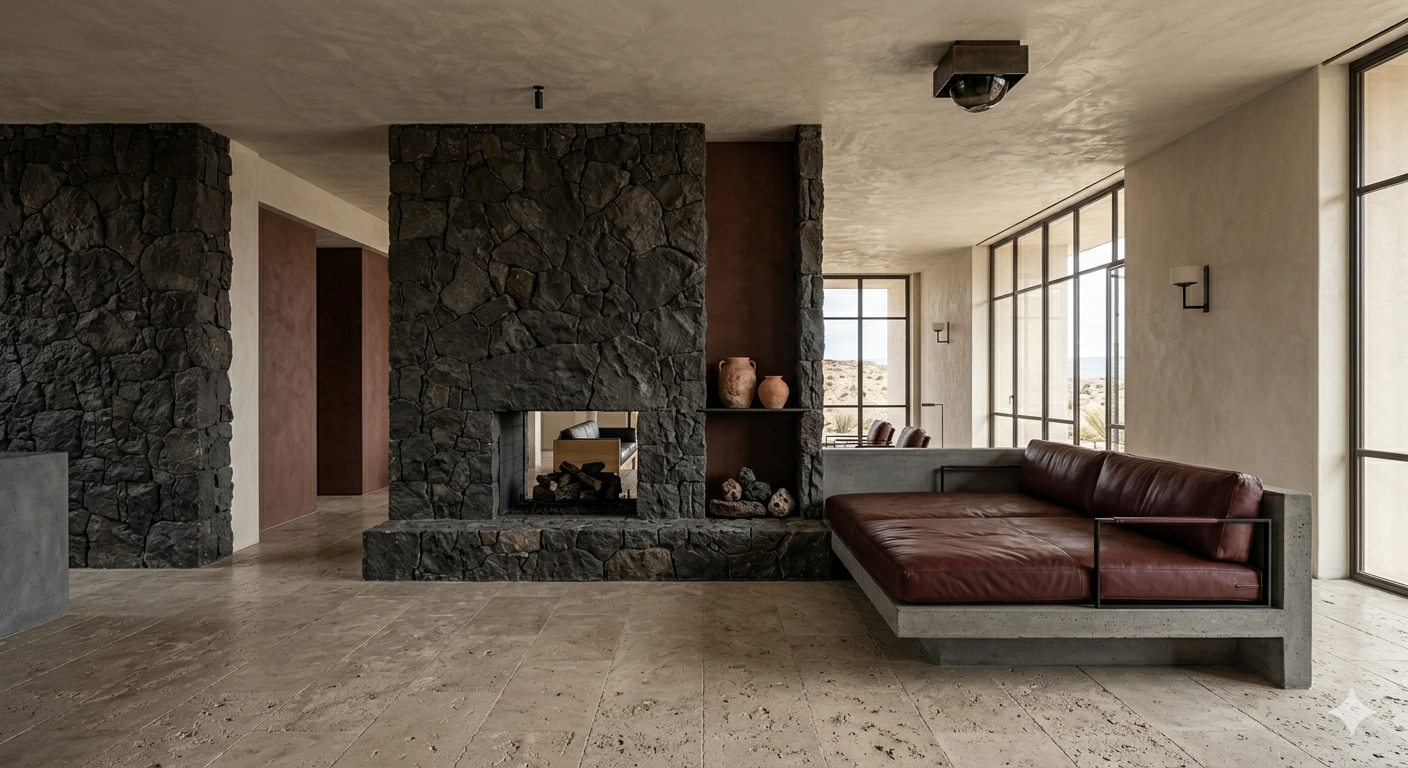
Expansive living area, stone floors, volcanic rock fireplace, limestone walls and celling.
Consistency Is a Chemistry Decision, Not a Mood Board One
Once you can see iron oxide, or its absence, as the actual variable, matching materials gets simpler. I look at a room's materials and ask one question first: what's actually coloring each one. A room built from stone, clay, and plaster all warmed by iron stays in one family no matter how many different materials are on the list, because they're all running on the same underlying chemistry. Mix in a marble darkened by carbon, or a true black basalt, and you've introduced a genuinely different mineral story, not just a darker paint chip. That's the real reason some earthy rooms feel coherent and others feel matched by eye against a fan deck. One is tracking an actual element through different materials. The other is guessing.
Match the Chemistry, Not the Chip
Strip away the marketing language and a mineral palette comes down to minerals doing what they've always done. Iron reacts with oxygen and warms whatever it touches. Carbon does the opposite; trapped in stone, it darkens instead. Calcite splits light because of its own crystal shape, which is the real reason plaster glows and paint doesn't. None of that was designed to feel expensive. It's old enough, and consistent enough, to read as inevitable in a room. Before matching two materials on a mood board, I want to know what's actually coloring each one. Materials running on the same iron reaction hold together no matter how different they look on paper. Pair iron against carbon, and no amount of squinting at swatches will make them agree.
The Grit of the Floor
High gloss stone is a signal of excess, not elegance. A home should not feel like a hotel lobby. Discover why the Madison Prime Home standard prioritizes 'grit', the tactile connection between the foot and the foundation.
A fabricator honing a slab doesn't grind until the stone looks good. They grind until they hit a number, then they stop. Most honed finishes end somewhere between 200 and 800 grit, commonly around 400. A polished finish keeps going, all the way to 1,500 or 3,000 grit, closing the stone's surface until it throws back a reflection. The difference between the two floors in your house isn't taste. It's where the machine stopped.
There is a common mistake in high end residential design: chasing the mirror finish because it photographs well and reads as expensive on a walkthrough. Polished stone at floor level is reflective and cold underfoot. Wet, it turns dangerously slick. Worse, it reads as commercial. It's a hotel lobby, an airport concourse, a space built for people passing through, not living in it.
I think a floor should be an anchor. It should have grit, both kinds. The literal kind, and the kind that means something has weight and won't be talked out of it.
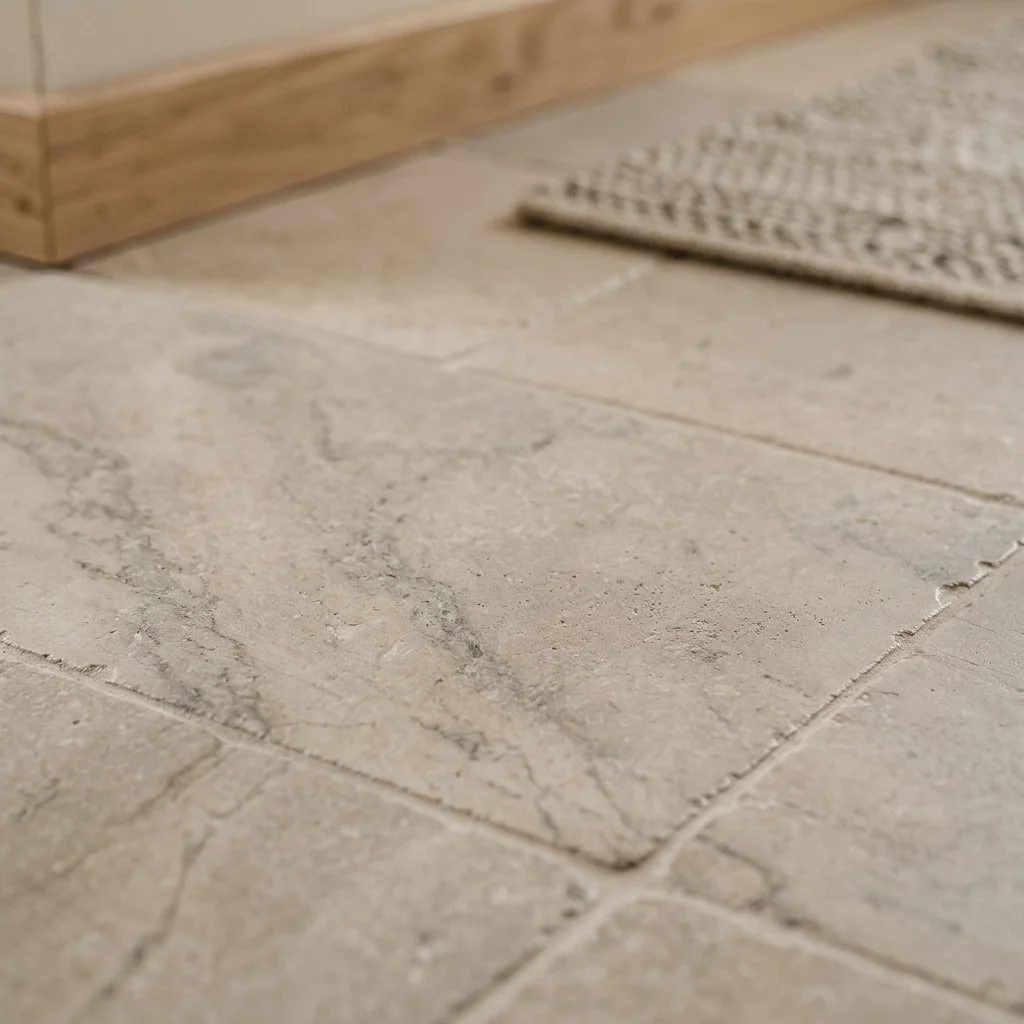
Honed limestone flooring highlighting its soft, matte surface and natural veining.
What the Foot Knows
Walk barefoot across a honed or leathered tipped floor and it feels like the earth, not a sheet of glass. That's not only sensation. Texture absorbs light instead of throwing it back, which is part of why a matte floor makes a room feel settled instead of staged. This is the same instinct that runs through the mineral palette of a house, where the raw, earthbound tones of a material are allowed to set the mood instead of getting polished out of it.
The Honed Finish
Honing is the baseline for a serious floor. A fabricator runs the slab through a sequence of progressively finer diamond abrasives and simply stops before the final burnishing stage that closes the stone's surface to a shine. The result is flat and matte, with none of the glare that would wash out a marble's veining or the fossil fragments locked into a limestone. It also feels different underfoot: soft, not slick. And it ages better. A polished surface shows every scuff against the gloss. A honed one absorbs them.
The Leathered Grain
Leathering goes a step further. Rotating diamond brushes wear into a stone's softer minerals and glide over the harder ones. What's left is a rippled, almost pebbled surface, the reason people reach for the word leather to describe it. It's the most forgiving floor there is. Fingerprints and water spots disappear into the texture, and so do the small scratches that come from actually living in a room. The grip underfoot is real, not decorative.
The Tumbled Edge
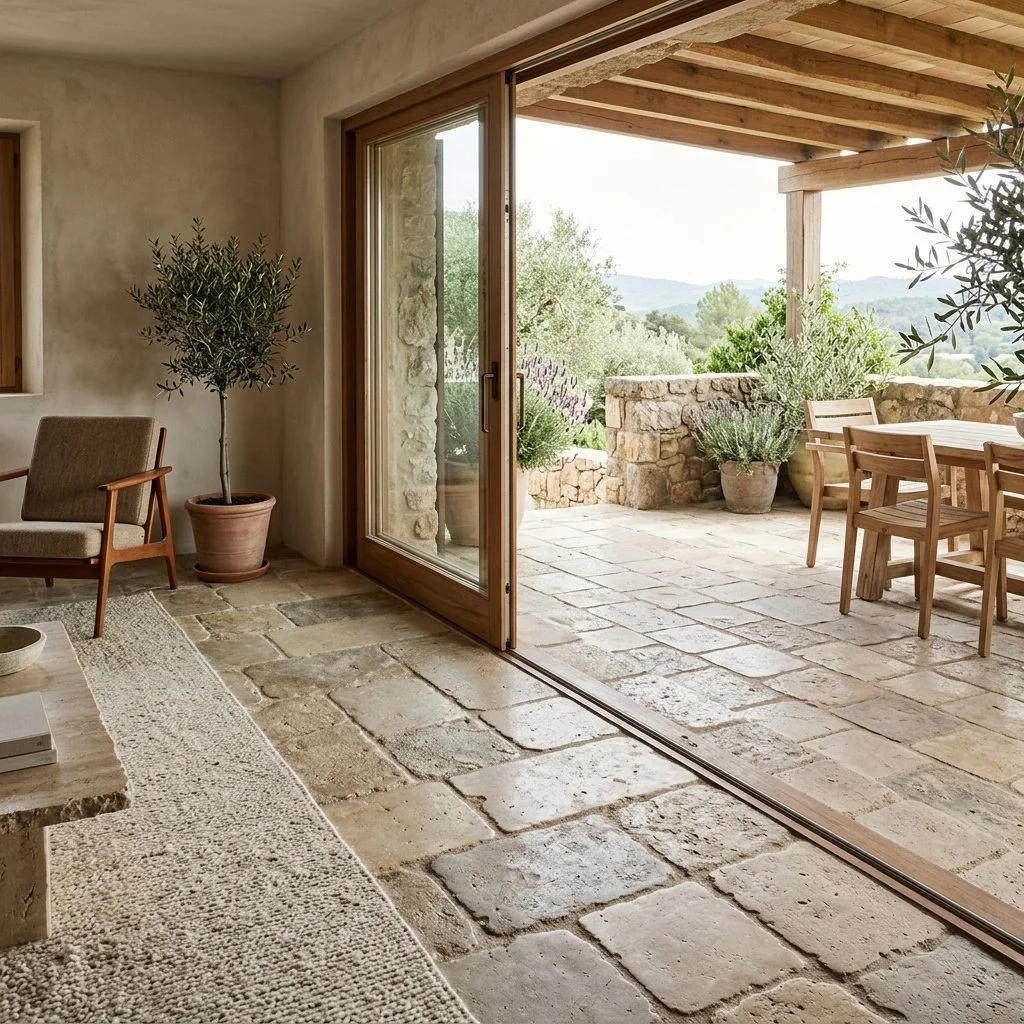
For the threshold between an interior room and a terrace, I look for a tumbled or brushed finish. Barrel tumbling with abrasive media and water rounds the edges and softens the face of the tile until it looks like it's been walked on for a century. It trades the precision of a fresh cut for something closer to the truth of a floor laid by hand.
Grip Before Gloss
Slip has a legal minimum, and a mirror polished floor often misses it. ANSI A137.1 sets the wet dynamic coefficient of friction, DCOF, at 0.42 minimum for a level interior floor that might get walked on wet. Anywhere bare feet are likely, a pool deck, a shower floor, a bath, the recommended minimum climbs to 0.60. A floor polished to a high shine routinely tests below that first number when wet. A honed or leathered surface tests well above it. This is the part of "grit" that has nothing to do with how a room photographs and everything to do with whether someone falls in it.
Tumbled stone floor tiles at the transition from an indoor living room to an outdoor terrace.
What Holds the Floor
Honed limestone is the standard I come back to. It's dense enough to perform, but the surface reads warm rather than clinical, which matters when it's the thing your feet meet first thing in the morning. Stone also carries real thermal mass, which is why it pairs so well with radiant heating systems: it absorbs warmth evenly and releases it slowly, instead of running hot in one spot and cold in the next.
Leathered basalt or granite earns its place in mudrooms and anywhere else that sees heavy daily traffic, but the two behave differently under a boot for a real reason. Basalt is an extrusive rock, formed at the surface as lava cools fast, which gives it a tight, even grain and a Mohs hardness around 5 to 6 across the whole slab. Granite is intrusive, cooled slowly underground, which lets its minerals grow large enough to see: hard quartz next to much softer mica and feldspar. That unevenness gives granite its movement, but it also means it can wear unevenly over decades. Basalt just wears the same, everywhere, for longer.
Honed, unfilled travertine is where I land for a floor that wants some age to it. The natural surface pitting comes from the same trapped gas that shaped the stone in a wet room built for the long term, but on a floor, left open and honed rather than filled and glossed, it does something different: it gives bare feet a texture to actually read, not just look at. Sealing a floor like this belongs to ongoing care, not to this conversation.
What You're Actually Standing On
A house is only as steady as the ground beneath it. Choose a floor with texture and you're choosing a material that's honest about where it came from and what it's made of. A polished floor is a display. A textured one is a foundation. I'll trade the shimmer of a trend for the grit of something that holds.
A Bathroom Is Either Built or Installed
Moving beyond utility. Explore the Madison Prime standard for the carved residential bath.
Travertine gets its texture from gas, not water. As water rich in minerals rises to a hot spring's surface and meets the air, it releases carbon dioxide, and the bubbles that escape leave pockets running through every block that forms afterward. What looks like an ornamental surface is really a record of something leaving the stone in a hurry.
Most of what separates a real bathroom from a merely expensive one, to me, comes down to how honestly it treats what the stone actually is. Not how well the room hides it.
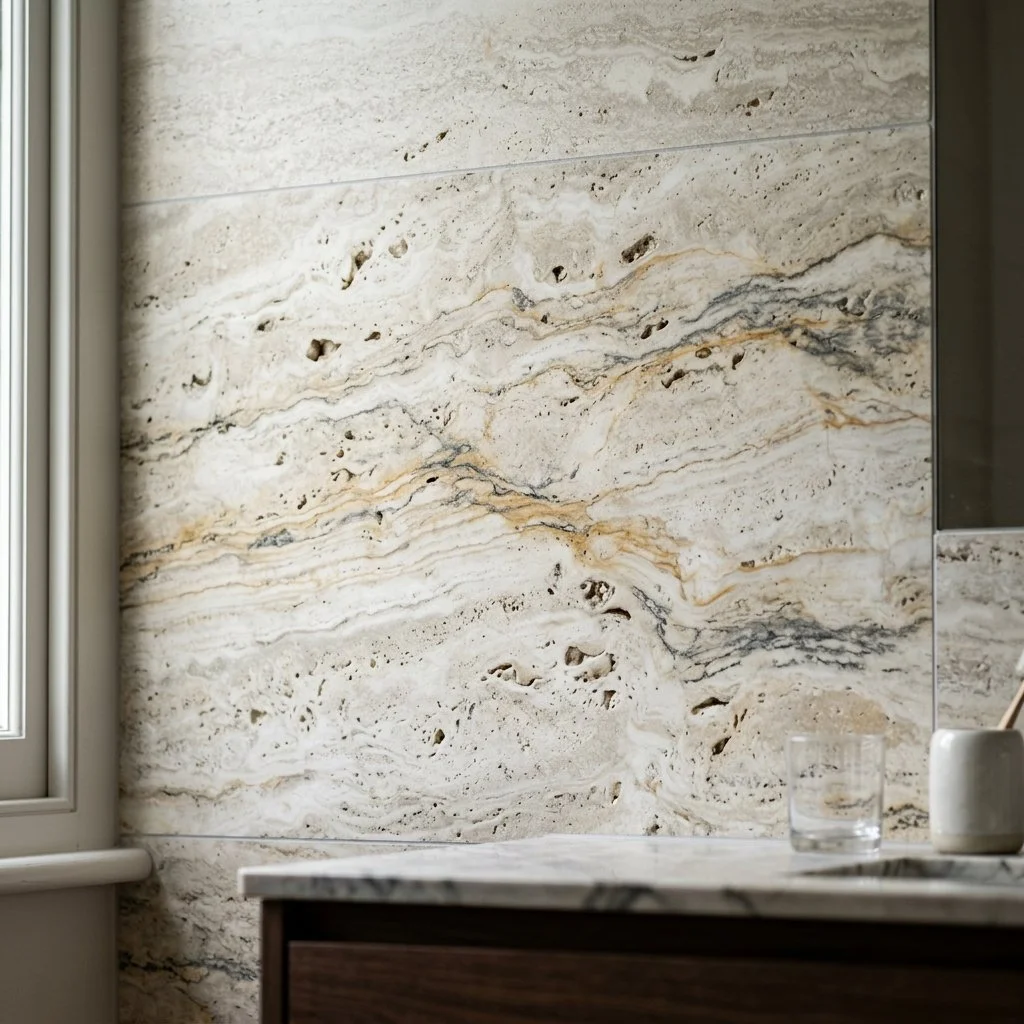
Honed silver travertine bathroom wall panel featuring natural porous texture and oyster, warm ochre, and graphite grey veining.
What the Stone Actually Is
Limestone forms in shallow seas over millions of years, as calcium carbonate from shells and coral compresses into rock. Cut a slab open and you can sometimes find the fossil itself: a shell fragment, or a pinhole where one used to sit. It's dense enough for a bathroom floor and porous enough that it needs sealing before it meets water, a plain fact that gets left out of a lot of showroom pitches.
Travertine is limestone's louder cousin, made the same way but through hot spring water instead of ocean sediment. Denizli, Turkey, the province surrounding the famous white terraces at Pamukkale, has roughly forty working quarries producing much of the world's supply. The protected terraces themselves are never touched. The trapped gas leaves real holes, not a printed pattern meant to look like holes. A fabricator can fill those with resin or grout to match the stone's color, which most professionals recommend anywhere water actually sits, a shower floor or wall, since an open pore in a wet zone collects grime and can hold mold no sealer fully solves. Left unfilled, the same stone reads rougher and shows its formation honestly, a choice that still works on a dry powder room wall or a feature wall outside the spray. It's a real tradeoff tied to where the water goes, not a style preference, and I ask which zone I'm specifying for before I ask which finish looks better.
The Vanity That Doesn't Have Seams
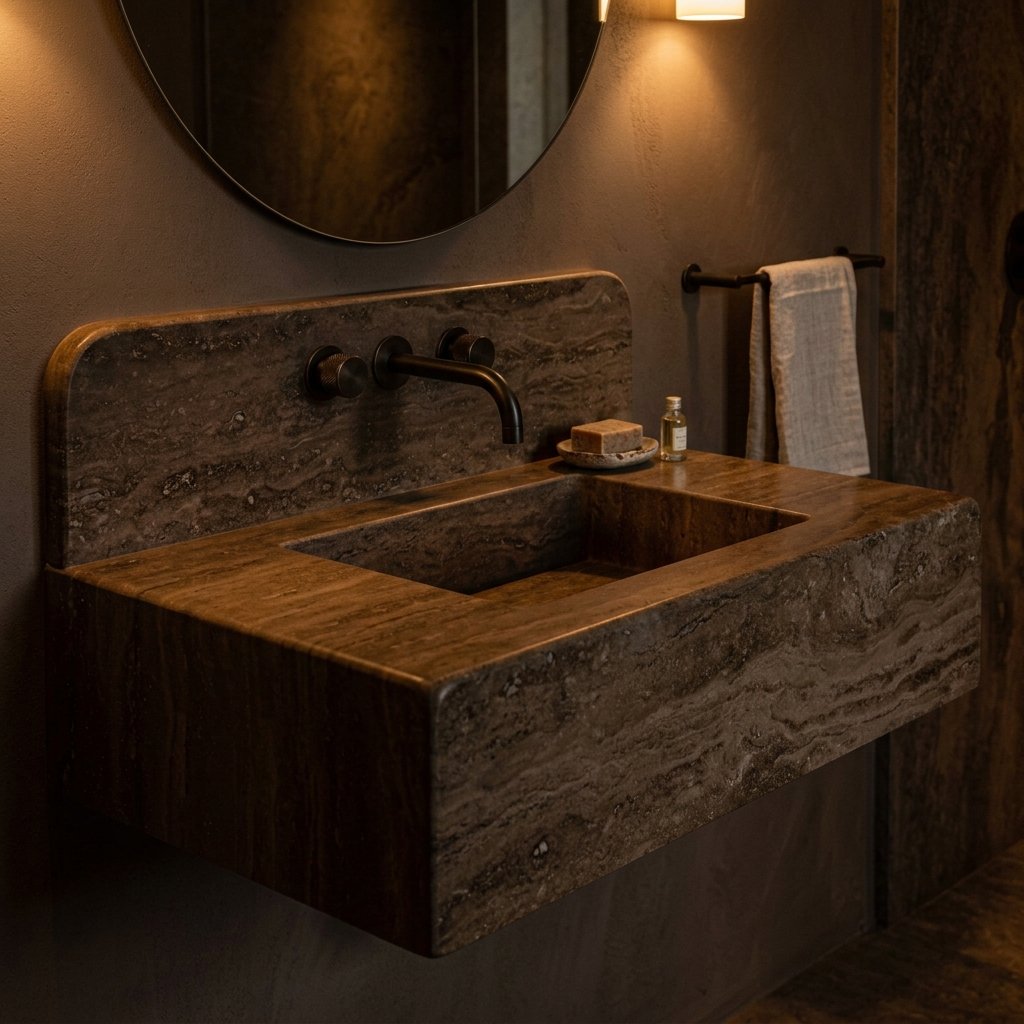
A vanity carved from a single block of stone has no caulk line where the basin meets the counter, because there was never a seam to begin with. The bowl and the deck were one piece of rock before anyone touched it with a chisel. Water runs back into itself instead of pooling at a joint, a small mechanical advantage most people never notice until the version with the seam starts to stain.
It's also heavier than photographs ever convey, and that isn't a small detail to me. A basalt slab vanity barely two and a half feet wide can run over a hundred pounds before a faucet is even mounted. That weight is real evidence of the material behind it. A stone veneer bonded over a lighter substrate can look identical in a listing photo and weigh a fraction of that, which matters the day someone has to hang it on a wall.
Floating vanity hand carved from deep brown, richly veined natural stone with a seamlessly integrated basin.
The Drain Decides the Floor
A center drain pulls the floor toward it from four directions at once, which limits how large a tile or stone slab you can lay without the corners reading choppy. A linear drain only needs the floor sloped one way, at a code minimum of a quarter inch per foot, so a single wide stone panel can run the length of the shower without a seam breaking up the surface. The strainer sits flush and tile-in, finished in the same stone as the floor, so the drain itself nearly disappears into the plane it drains.
That decision, made early with the plumber and not the tile setter, is the one I flag first on any bath, because it decides whether the floor reads as one continuous surface or a floor interrupted by a fixture.
The Room That Admits What It's Made Of
None of this is decoration. The pores are the record of how the stone actually formed, filled or left open depending on where water goes. The seam that was never cut is a mechanical decision, not a style one. Neither is meant to be noticed. Both are meant to work, and to keep working, for longer than most of the fixtures around them. A vanity's weight is one piece of that evidence, not the whole case for it. Whether the stone stays honed or gets sealed against years of steam is a separate conversation, one Care & Preservation covers in more depth. What I actually ask a fabricator, before color or finish, is what the material is doing when no one's looking at it.