The Weight of Wood
The easiest way to spot a fake table has nothing to do with how it looks. Tap a ring against solid walnut and you get a low, dull knock, the sound of mass absorbing the hit. Tap the same ring against three layers of walnut veneer glued to particleboard and you get a rattle. That's the sound of a table that's mostly air and glue underneath a photograph of wood.
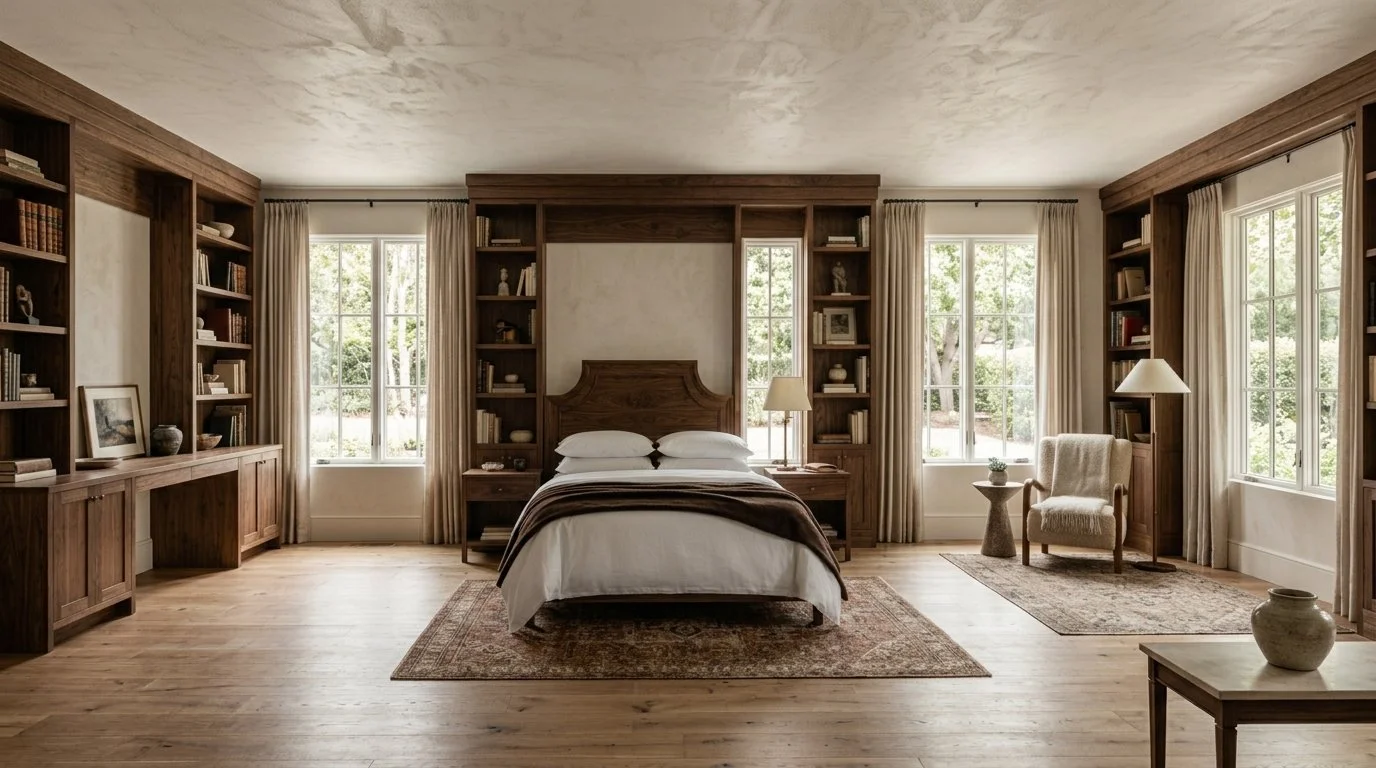
A spacious bedroom anchored by a custom walnut bed frame and surrounding millwork, and crisp white linens and a chocolate brown cashmere throw.
Walnut Doesn't Age Like the Others
American black walnut runs about 1,010 on the Janka hardness scale, which puts it on the softer end of hardwoods used in furniture. That's not a flaw. It's why walnut carves and steam bends so cleanly, and why it's been the wood of choice for gunstocks and violin backs for two centuries.
The real reason people fall for walnut is color, and the color does something almost no other wood does. Most furniture grade species, oak, cherry, maple, darken as they age. Walnut goes the other way. Fresh heartwood reads as deep chocolate brown, occasionally shading into a near purplish black, and years of light exposure pull it lighter, toward a warmer honeyed brown. A walnut desk built forty years ago isn't darker than the day it was made. It's mellowed.
Nearly three quarters of the black walnut cut in this country comes out of the central states, Missouri, Kansas, Iowa, where it's common enough to be Iowa's state tree. I look for boards from that region specifically, straight grained, with the occasional curl or burl left in rather than sanded into uniformity. Walnut is a library wood. It belongs where a room is meant for thinking, not performing.
Why White Oak Reads as Structure
White oak sits at roughly 1,350 to 1,360 on the Janka scale, about 350 points harder than walnut, and that density is the whole point. This is the wood you build a table for a family that actually uses it.
Cut it quarter sawn and white oak does something walnut can't. Every species has ray cells running radially through the trunk, but white oak's are the largest of any domestic hardwood, and sawing it on the quarter exposes them as a rippling fleck pattern across the board face, sometimes called tiger stripe. It's not a finish effect. It's the tree's own structure showing through.
There's a second reason white oak has outlasted trends for so long, and it has nothing to do with looks. Its pores are filled with a substance called tyloses, which blocks water and air from moving through the wood. It's the same property that made white oak the standard for whiskey barrels and wooden ship hulls for three hundred years. A dining table doesn't need to hold bourbon, but the same density that keeps a barrel from leaking is why an oak trestle table shrugs off a spilled glass of wine without swelling or staining.
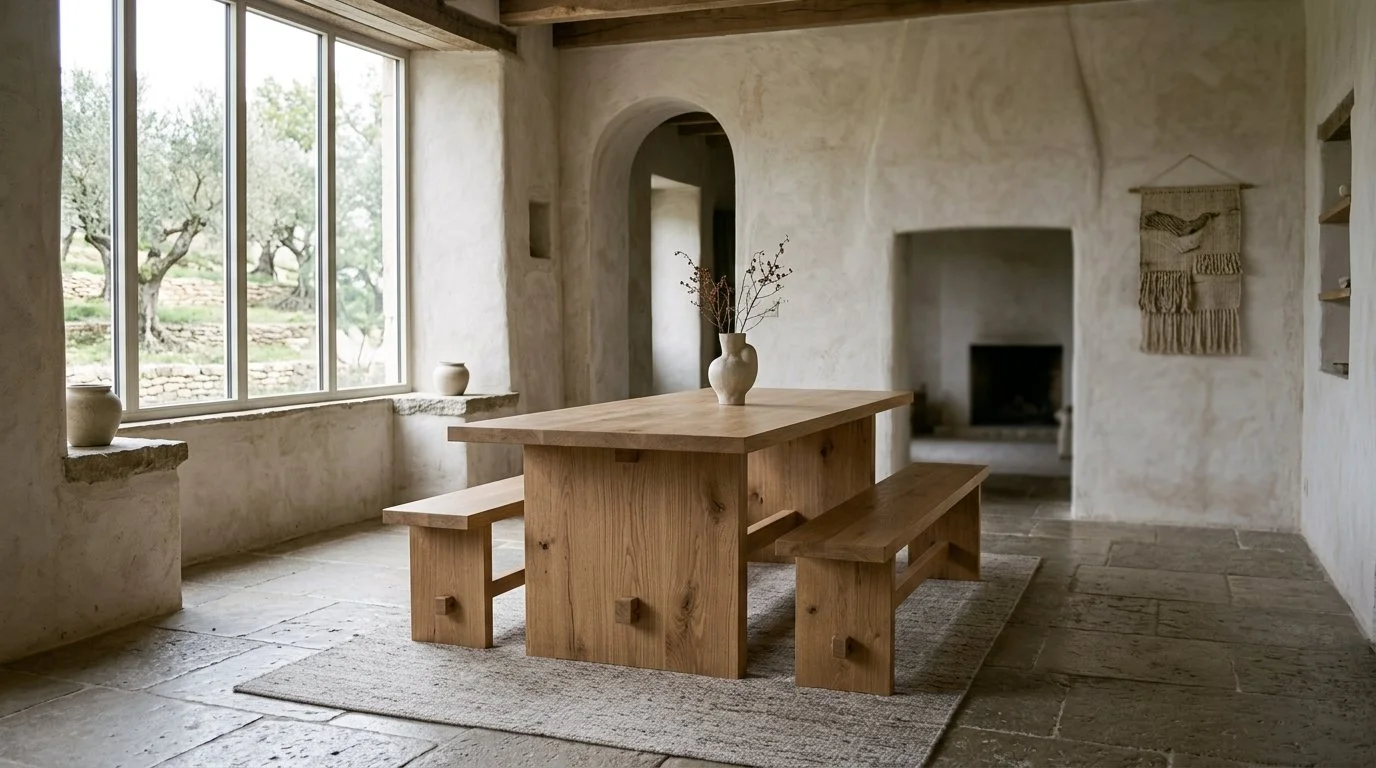
Light oak dining table with matching wooden benches on a rough stone floor, set against limewashed walls with a large window.
What a Veneer Can't Do
A veneer is a slice of real wood, sometimes as thin as a fortieth of an inch, glued to a substrate of MDF or particleboard. Manufacturers call this "stable," and dimensionally it often is. But stability isn't the same thing as durability.
Solid wood works differently. If a walnut tabletop takes a scratch during a dinner party, that mark sands and oils out, and the table gets refinished, not replaced. That's the actual argument for solid construction. It isn't that veneer looks worse on day one. It's that solid wood is the only version of the two that can be repaired at all.
The Only Question Worth Asking Before You Spec It
Before I spec anything in walnut or white oak, whether that means a trade showroom or a call to the mill, I ask one question: does the grain go all the way through, or does it stop an eighth of an inch down? The price matters less than that answer. So does the finish, and so does whatever you're told about either one.
Choosing solid wood isn't about nostalgia for how furniture used to be made. It's a practical bet that a table built to be repaired will outlast one built to be replaced, and that the house you're building deserves furniture that can actually keep up with it.