The Kitchen Anchor
A mitered edge is a small trick of geometry that fools almost everyone. Two pieces of stone, each about three quarters of an inch thick, get cut at a matching angle of forty five degrees and glued together at the corner. What you see afterward reads as four solid inches, sometimes more, with no seam in sight. Fabricators call the result an apron, and I've watched one built in under a minute. It's the same instinct behind every kitchen I'd actually call an Anchor.
An Anchor is what happens when a kitchen stops being a workspace with appliances plugged into it and starts reading as one fixed piece of the house. Not a set of cabinets and countertops assembled to fit a floor plan. Something built into the architecture that isn't going anywhere.
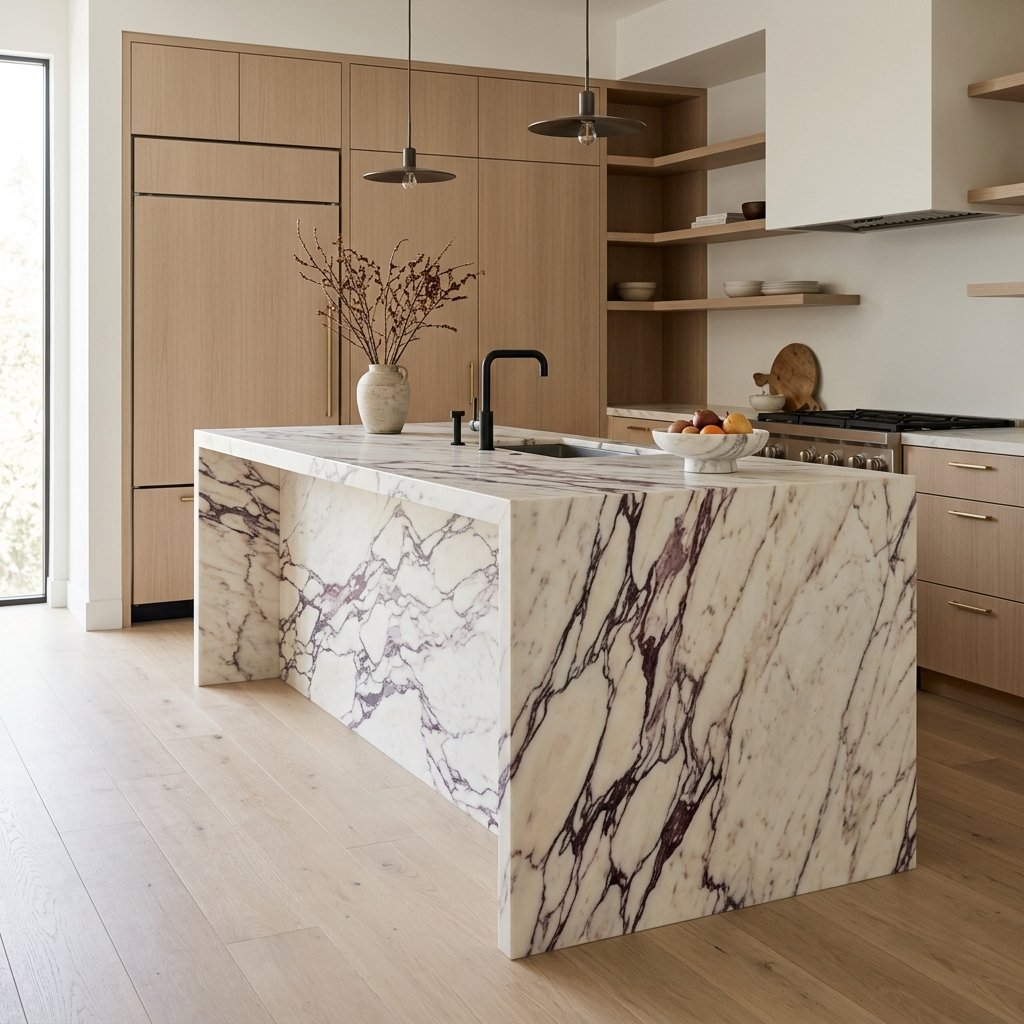
Kitchen featuring a monolithic, honed Calacatta Viola marble island with dramatic violet veining and a seamless waterfall edge, set against custom white oak cabinetry.
Where the Weight Actually Comes From
A twelve foot island that looks carved from one uninterrupted mass, in stone, concrete, or heavy timber, does something specific to a room. It reads as structural the way a fireplace does, whether or not it's technically load bearing.
Real continuity is the whole test, not the appearance of it from a single angle. A slab that wraps the island without a visible break at the corner is doing real work. A slab that's continuous on the front and stops cold at a butt joint on the side isn't, and anyone who's spent time on a job site can spot the difference walking past.
Site cast concrete earns this for less money than most stone, because it's poured in place and can run straight from the floor into the island base as one tonal surface. Stone gets there through the miter above, or through a waterfall edge, where the top of the slab is bookmatched to the vertical side so the veining appears to pour over the corner instead of stopping at it. It's the hardest cut a fabricator makes, and it's worth finding a shop that's done it before you fall for a slab.
What I Keep Out of Sight
The mechanical half of a kitchen works against the Anchor if you let it. My rule is simple. If it isn't the counter or the cabinetry, it doesn't get to show. The architecture is the one exception, because the architecture is the point.
Refrigeration and dishwashing units go panel ready. They arrive with a bare front, built to accept a custom cover from the cabinetmaker instead of the appliance company. Done well, a panel ready refrigerator disappears into the run of cabinetry completely enough that guests open what they assume is a pantry door.
Small appliances get the same treatment. A pocket door or a compartment faced in stone holds the coffee maker and the stand mixer, everything a working kitchen actually needs but has no business being visible in one that's trying to look permanent.
Choosing a Material That Can Carry It
Not every material earns the word Anchor. I look for real physical mass first. Then a finish that reads as a choice rather than a default. The fabricator matters just as much as either one, because the best slab in the world means nothing in unpracticed hands.
Honed stone is the finish I specify most, not polished. A honed surface has been ground flat and stopped there, without the final buffing that brings up a mirror shine, so the eye settles into the stone's actual pattern instead of the light bouncing off it. It also asks more of the person who owns it. Honed marble shows a lemon juice etch faster than polished marble does, which is either a real commitment or a real deal breaker depending on the client.
Calacatta Viola is the marble I reach for when a kitchen needs actual drama instead of a safe neutral. It comes out of the Apuan Alps around Carrara, the same quarries that supplied the Medici family five centuries ago, and its violet and burgundy veining runs through the stone rather than sitting on top of it, which is why it survives being cut into a bookmatched pair without losing the pattern that made it worth buying. When a room needs less noise, a paler, more restrained travertine, Silver among them, does the same structural job without the same visual weight.
Wood belongs in this conversation on the same terms as stone. Charred or fumed oak, matched board to board across an entire run of cabinetry, works on the same logic that makes a solid walnut tabletop worth its price over a veneer imitation. Break the match anywhere along the face and the illusion collapses the moment someone stands in front of it.
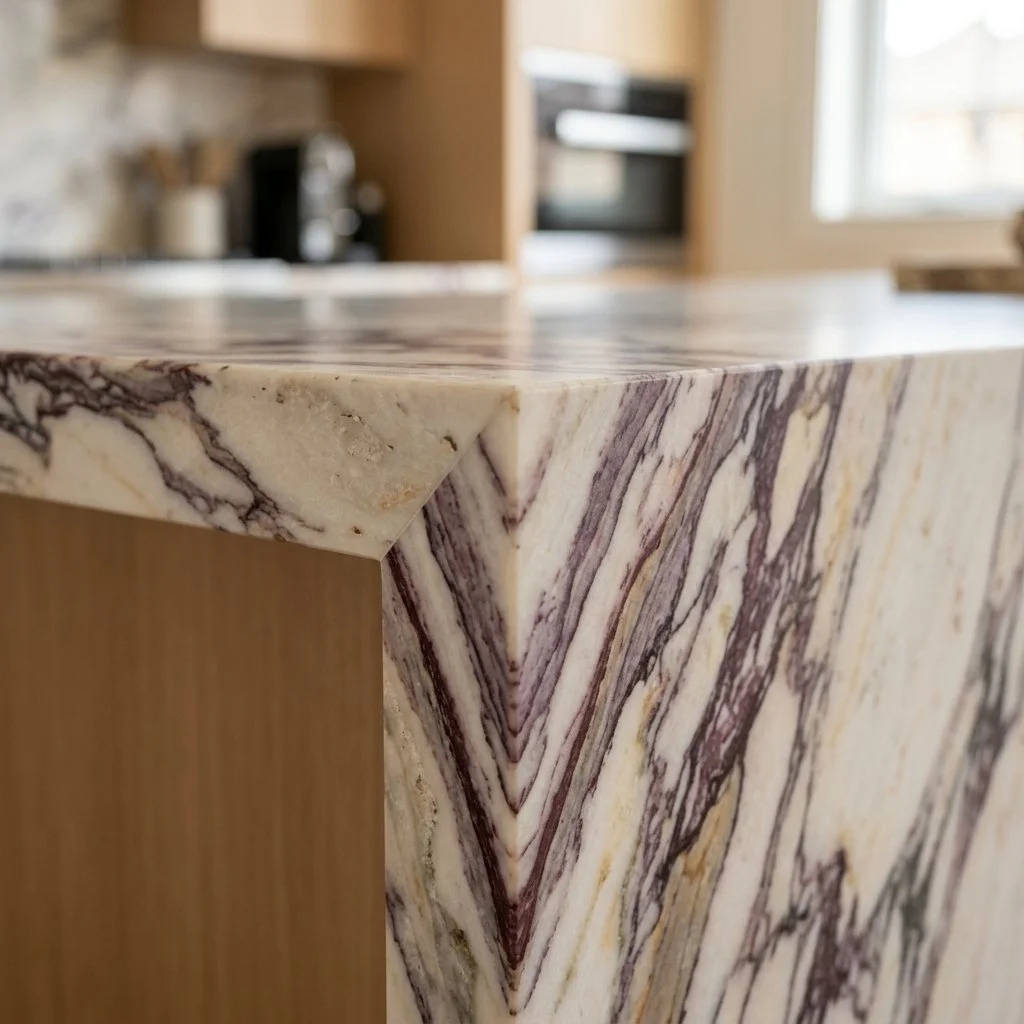
Honed Calacatta Viola marble kitchen island corner featuring a seamless 45-degree miter joint.
Where the Seam Falls
Every fabricator places a seam somewhere, on purpose or by accident. A shop that's cut its share of miters and waterfall edges can point to it without pausing, because they planned it there before the stone was ever cut. A shop that hedges when you ask is telling you something real: the Anchor you pictured and the one they can actually build aren't quite the same object.
I look at that seam longer than most clients think is reasonable. It's the one place on the whole island where the illusion could fail, which makes it the one place worth caring about most.
This isn't a piece with one place to send you. A mitered slab and a bookmatched cabinetry face come out of entirely different corners of the trade, a stone yard on one side, a mill or cabinet shop on the other. What matters more than the channel is whether whoever you're standing in front of has actually cut the joint before, not just quoted it.