Venetian plaster, limewash and Roman Clay can look alike on a sample board, but a different binder holds each one together, and the binder decides the primer, the drywall level and where the finish can go. Traditional limewash and Venetian plaster are lime, and Portola sells its Roman Clay as clay based. A good specification names the binder, not just the finish.

Dining room with slate blue plaster walls and ceiling, trim painted to match.
Limewash vs Venetian Plaster
Limewash is slaked lime thinned with water, about 15 to 20 percent lime in the Heritage Council of New South Wales guide. It hardens as the lime carbonates back into calcium carbonate, goes straight onto masonry, and has to stay thin, because a heavy coat crazes and cracks. The same guide warns that many commercial limewashes contain acrylic, which stops moisture and salts from passing through the wall, so write the product name and its data sheet into the submittal, never the word limewash alone. Even a lime product can sit on acrylic, on drywall, Portola’s Lime Wash goes over its Limeproof Undercoat, a primer made with 100 percent acrylic resin. That does no harm indoors, but on old masonry put the lime on the bare wall, which Portola allows.
Venetian plaster is a heavier build. The name comes from sixteenth century Venice, where crushed marble and lime were laid 2 to 5 millimeters thick, and by Pierre Finkelstein’s account in Walls & Ceilings it looked like marble at a hundredth of the weight, in a city built on stilts. Today the name covers almost any troweled plaster. Marmorino is the grittier relative, with larger aggregate, and it often needs a second coat laid onto the first while it sets to reach its higher sheen. That sheen comes from the crew’s hand, not the bucket, so hire on finished walls the crew has done.
Roman Clay vs Venetian Plaster
Portola’s data sheet calls Roman Clay a clay based coating without naming the binder, so treat it as its own finish, not a stand in for Venetian plaster. It goes on with a knife or trowel over smooth interior drywall, and Portola’s optional topcoat gives it an eggshell sheen. Lime Venetian plaster burnishes because, like marble, it is calcium carbonate. Judge Roman Clay against its own topcoated sample, never against a polished plaster board.
Portola sets its limits plainly. The topcoat makes Roman Clay washable but not waterproof or stain proof, and Portola keeps Roman Clay out of showers, exteriors, walls in constant contact with water, and kitchen backsplashes. Portola’s site also says the topcoat darkens the color 10 to 20 percent depending on the shade, so approve color only on a topcoated sample. For a plastered shower, look to a lime system built for it: Vasari’s Tadelakt style shower system goes over a waterproof primer or membrane, with its heavy textured Mastercoat as the base plaster coat.
Is Venetian Plaster Lime or Acrylic?
It can be both, and the name alone won’t tell you which. Finkelstein dates the shift to the 1990s and 2000s, when makers added acrylic so lime plaster could go over sealed walls, and he finds cheaper products heavy on acrylic and light on lime. Even a lime plaster carries some, Vasari’s specification for Mastercoat lists synthetic binders alongside filtered lime and marble. The two don’t mix in the bucket, since lime stirred into an acrylic plaster can jellify, so keep each wall to one maker’s system.
Acrylic plasters are more forgiving and easier to touch up, while lime has a more natural luster, by Finkelstein’s account, and he won’t call either one better. All of them scuff and can be repaired, so on a stair or hallway wall, budget for touch ups rather than avoid the finish.
Primer and Drywall Level for Each Finish
Drywall level should follow the finish. Specify Level 5 under a polished Venetian plaster. The GA-214 language in Vasari’s specification recommends it for smooth, gloss finishes and severe light, and Portola prefers Level 5 under Roman Clay too. Vasari asks for Level 3 or higher under Mastercoat, its heavy textured plaster, on interiors. For primer, Finkelstein wants water based rather than oil based so the wall can pass a little moisture, and a mineral primer in random, multidirectional strokes where a smooth wall needs tooth.
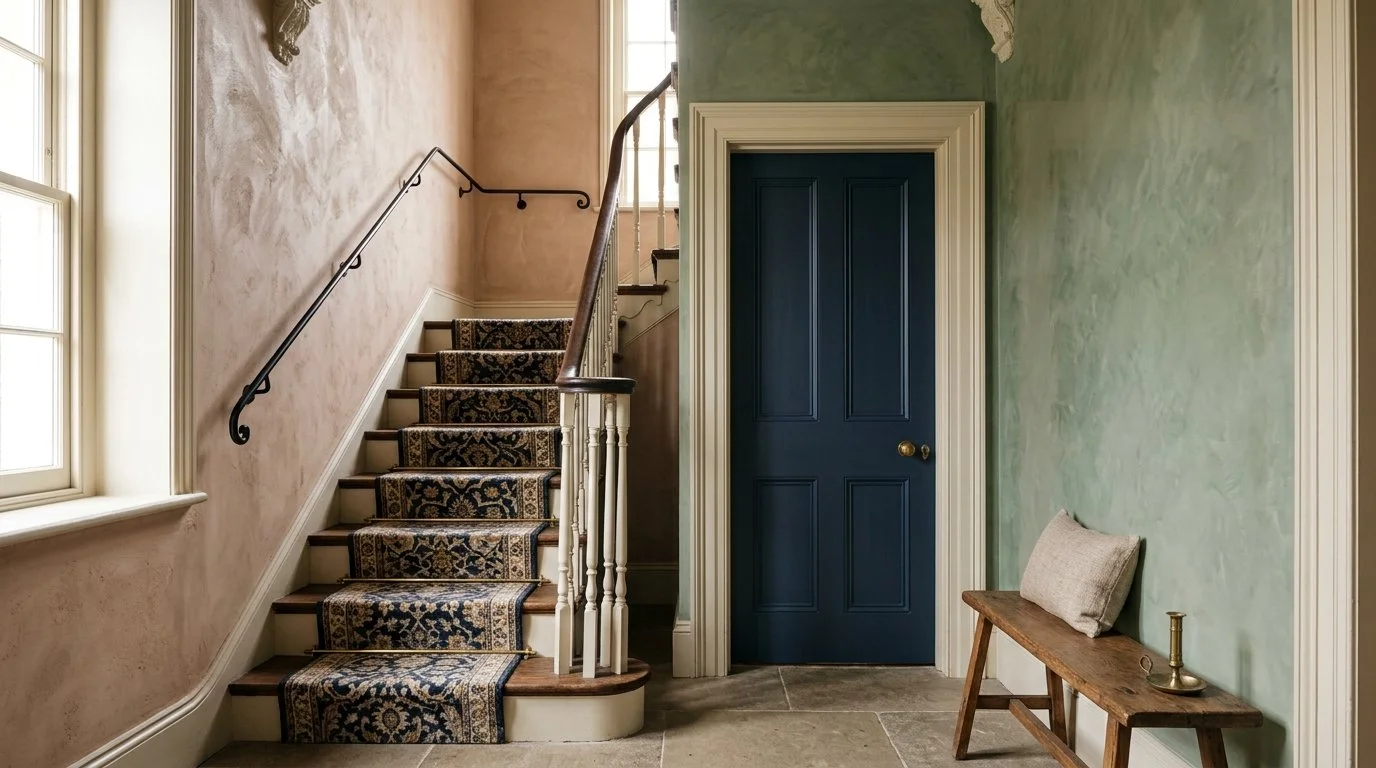
Restored townhouse where a matte plaster wall meets a polished plaster wall.
Do You Need to Seal Venetian Plaster?
Sealing is optional, and it earns its place in wet rooms, kitchens, baths and on high traffic walls. Finkelstein uses wax, a stone impregnator or black soap. Treat sealing as protection for the surface, never as a reason to put polished plaster in a shower. Outdoors, follow the maker, Vasari seals exterior Mastercoat with its Mineral Sealer to limit water stains and patina, and that advice belongs to that product.
Specify by Binder, Approve by Mockup
Within 09 25 Other Plastering, MasterFormat sorts plaster by binder: 09 25 13 is acrylic, 09 25 23 is lime based, and 09 25 26 is natural clay. Put a lime Venetian plaster in 09 25 23 by its main binder, as Vasari does with Mastercoat, and a mostly acrylic one in 09 25 13. Until Portola names its binder, I’d write Roman Clay in 09 94 as a decorative finish, and limewash, a coating, with painting in 09 91.
Vasari’s specification places the mockup where the architect directs and keeps it until the work is accepted. Have the crew doing the job lay it, topcoated or sealed exactly as the finished wall will be, because both the sheen and the color depend on that panel.