The Rules That Protect Talavera
The blue that makes Talavera instantly recognizable traces back to Chinese porcelain. It arrived by way of the Manila galleon trade, the shipping route that carried Ming Dynasty ceramics across the Pacific into New Spain, and colonial potters in Puebla took to that cobalt so completely it became the color the whole tradition is remembered for. Italian influence added the rest of the palette a century later. None of that history shows up on the label. What does, if the piece is real, is a hologram.

A pattern of hand painted tile lining a fountain in a modern courtyard.
A Name Only Six Places Can Use
Since 1997, "Talavera" has been a legal designation in Mexico, not a style anyone gets to claim. The Denominación de Origen de la Talavera, overseen by the Consejo Regulador de Talavera, ties the name to where a piece is made and to the clay and process behind it. Only a handful of places qualify: the city of Puebla and the nearby towns of Atlixco, Cholula, and Tecali, plus San Pablo del Monte across the state line in Tlaxcala. A tile in the right pattern made anywhere else, or made there with a shortcut in the process, doesn't get to use the word. Certified pieces carry a hologram to prove it.
Six Colors, Not One More
The design rule is just as specific as the geographic one. An authentic piece can only be painted in some combination of six colors: blue, black, green, orange, yellow, and mauve, and every one has to come from natural pigment, applied by hand. A printed pattern in a convincing blue and white isn't Talavera. Neither is a seventh color, however close it reads to the traditional palette.
Thrown, Painted, Fired Twice
The forming process hasn't changed much since the colonial period. Each piece is thrown by hand on a wheel, then fired, glazed, painted, and fired a second time, and the glaze itself is still a formula of tin and lead that workshops have used for centuries. It's slower than any mold or machine transfer print could be, and that's part of what the designation actually protects: not just a look, but the process itself, done by hand, not skipped.
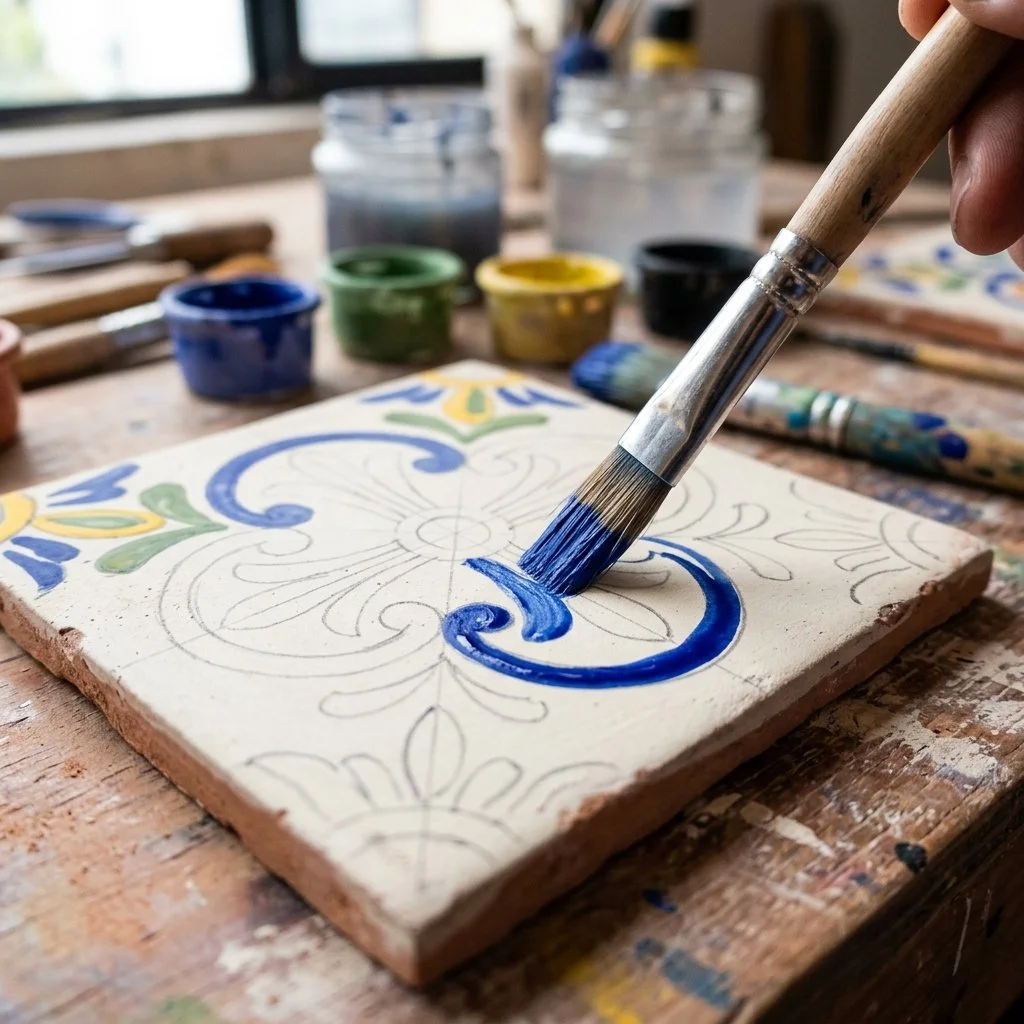
Close view of a paintbrush adding blue pigment to a hand painted tile mid pattern.
A Craft That Nearly Didn't Survive
The tradition came close to disappearing more than once. Mexican independence broke up the guild that had kept quality consistent through the craft's golden age, and Puebla's workshops dropped from dozens to fewer than eight. By the 1980s only four remained. Artists and collectors pulled it back from the edge in the early twentieth century, and the 1997 law was, in part, a second rescue: a way to keep the workshops that had held onto the real process from being undercut by cheaper imitations. The craft still runs on a shrinking base of trained artisans.
Ask to See the Hologram
For anyone specifying it, the practical version of all this is simple. A real piece comes with a certificate and a hologram from the Consejo Regulador, and a workshop that can't produce either isn't selling what it says it's selling. The pattern is the least protected part of the whole tradition. The paperwork is the most.