Reeded Glass Isn't Fluted Glass
I've had a fabricator and a supplier hand me the same pane under two different names, more than once. Reeded and fluted glass get used as if they mean the same thing, on cabinet doors and shower screens as often as on a spec sheet. They don't. One has ridges that stand up off the surface. The other has grooves cut into it. The distinction is real, even if almost nobody in the trade bothers to keep it straight.
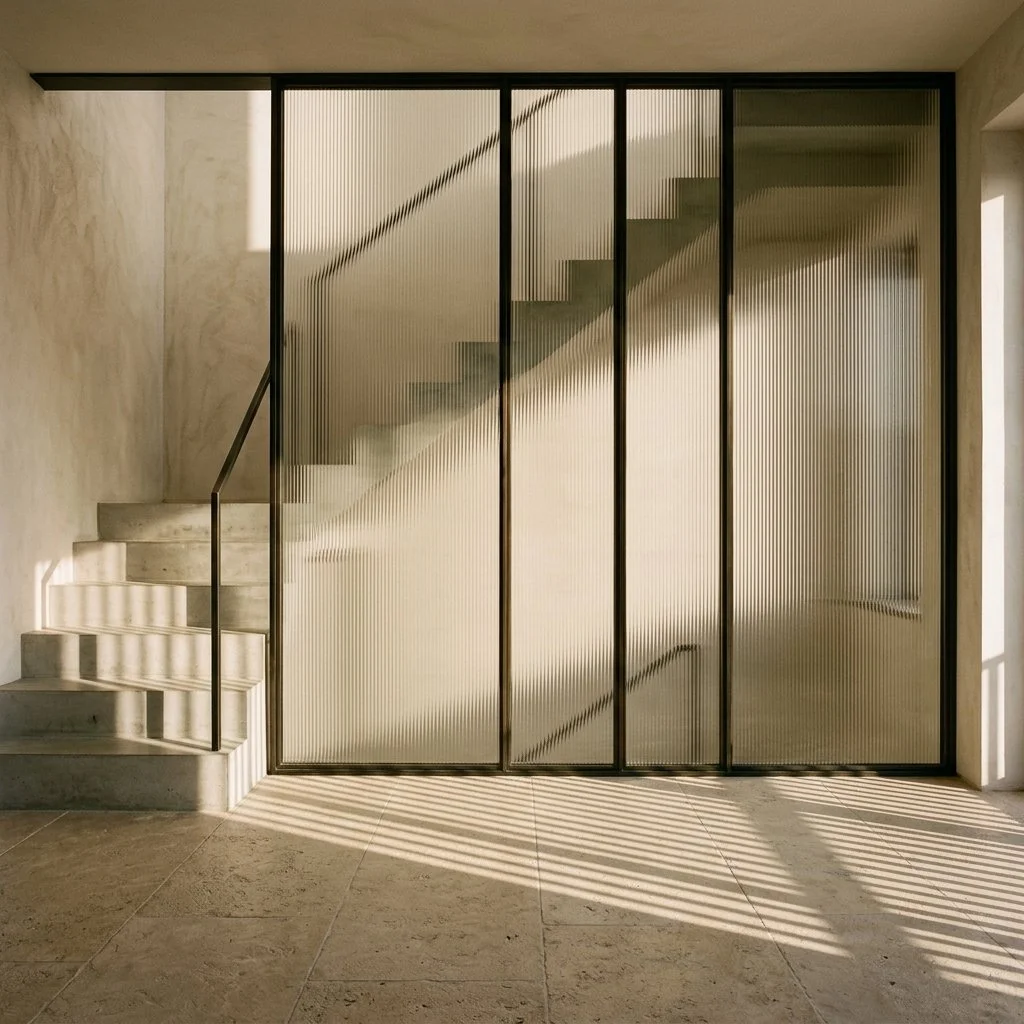
A fluted glass panel in a blackened bronze frame casting a striped shadow pattern across a stone floor.
Two Different Rollers, Two Different Shapes
Textured flat glass is made by rolling, not floating. Molten glass, close to 1050°C, passes between two rollers cooled with water. One roller is smooth. The other is engraved with the negative of whatever pattern is going onto the glass. The ribbon comes out the other side around 850°C, then cools slowly in an annealing oven so it doesn't turn brittle. Whatever shape is cut into that engraved roller becomes the shape pressed into the glass.
That's where reeded and fluted actually diverge. Reeded glass takes its name from reeds and cane: the ridges rise up, convex, off the surface. Fluted glass borrows its name from a column, the same channels you'd find carved into a classical shaft: the grooves cut in, concave. Most manufacturers and showrooms use "reeded" to cover both, which is exactly how the confusion holds on.
A Patent Solved a Privacy Problem in 1886
This isn't a new idea dressed up as one. An 1886 English patent, filed by William Edward Chance, covered new machinery for rolling rippled glass sheets. A few years later, a second pair of rollers was added to press an actual pattern into a sheet that had already been rolled flat, one side textured, one side smooth enough to cut and glaze normally. Rolling the sheet twice, first flat, then patterned, became the standard way to produce it, and it's still close to how it's done now. The finished sheets were sold under names like "fancy figured rolled" and "patent rolled," in tints that read almost like a paint chart: clear, blue, amber, green, a pink tinted like wine and sold as "cathedral" glass. The purpose hasn't changed since. Obscure the view, keep the daylight.
The Ridges Do a Different Job Than Frosting Does
It's worth separating this from frosted glass too, since all three end up doing similar work in a spec conversation. Frosted glass is made by sandblasting or acid etching a clear pane, which pits the surface at a microscopic level and scatters light in every direction at once. That's what gives it a cloudy, matte look, opaque enough to hide detail but never sharp in any direction. Reeded and fluted glass work differently. The ridges or grooves are directional, not random, so they distort an image along one axis while still passing light through clearly along the others. Stand close and you'll see color and movement stretched into vertical bands, not a uniform blur.
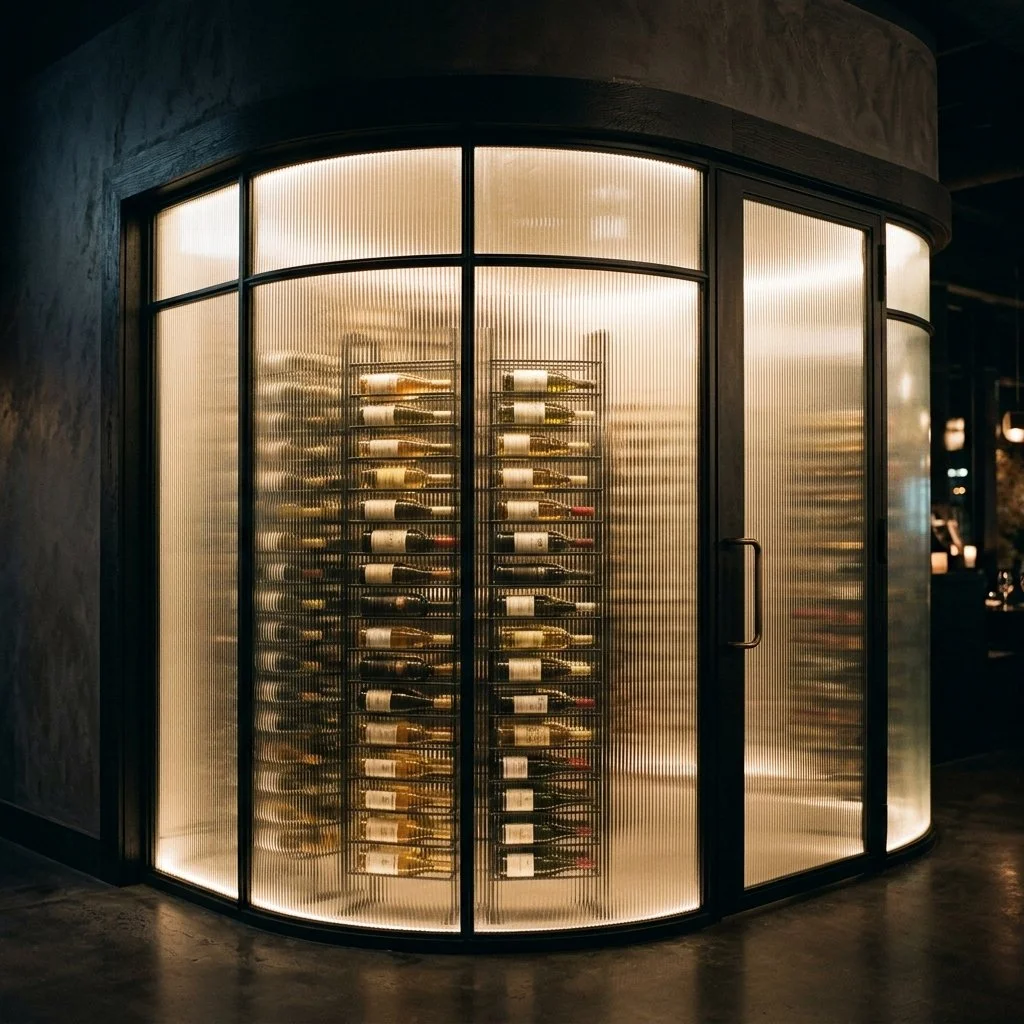
A curved, fluted glass wine room enclosure backlit with warm light, wine bottles softly blurred behind the bent glass.
Architecture Took It Up in the 1920s
Rolled patterned glass had been a Victorian utility material for decades before it became a design statement. That happened in the 1920s and '30s, when its straight vertical lines fit naturally into Art Deco storefronts and partitions, an architecture already built around streamlined, repeating geometry. Modernist architects picked it back up again decades later for office interiors and cabinetry. The glass didn't change in either revival. The buildings around it did.
Specify the Pattern, Not Just the Name
None of this makes reeded and fluted glass interchangeable, even when the paperwork treats them the same. A convex ridge and a concave groove bend light differently enough that a rendering can look nothing like what actually ships. I'd trust the sample over the spec sheet every time. Hold it up to real light before the name on the order gets treated as fact.