
Antique Mirror Walls Are Made New
An antique mirror wall is new glass aged to read as old plate, either as a full sheet before cutting or panel by panel after. How the two look once the panels meet, and what to ask before you specify.
An antique mirror wall, as the trade sells it, is new glass that has been silvered and then aged so it reads as old plate. Antique mirror is still the name on spec sheets, and it’s what people type when they search for panels and tiles. Two products share that name. In one, a full sheet is aged before anyone cuts it. In the other, each panel is cut first and aged afterward, and the difference shows once the panels meet on a wall.

Library shelves built into the wall, backed with aged mirror panels, lit by evening lamplight.
What the Aging Copies
For centuries, most European mirrors were backed with an amalgam of tin and mercury. An InCollect article on how mirror glass ages describes workers flooding tin on a marble table with mercury, then lowering the glass onto it. That backing never fully settles. Its crystals keep growing and mercury slowly escapes, so old plate darkens and the damage can’t be reversed.
In 1835 the German chemist Justus von Liebig worked out a way to deposit silver on glass, and by the end of that century silver had replaced mercury in industrial mirror making. The search term “mercury glass mirror” borrows its name from somewhere else. The Corning Museum of Glass calls “mercury glass” a mistaken name for nineteenth century silvered glassware, made by sealing a silver solution between the double walls of a vessel.
How Is Antique Mirror Different From Regular Mirror?
It’s the same glass. Dominic Schuster’s guide for designers notes that the antiquing happens on the back, so the glass keeps the qualities of plain mirror. AGC described its antique mirror as getting its look through controlled oxidation of the silver coating, with each pattern unique because every sheet was made by hand. Donghia’s spec sheet for its Ether mirror noted that further oxidation may happen over time, which is worth raising with any supplier before a client signs off.
The base glass matters as much as the finish. Schuster recommends low iron mirror under antiquing because it reflects color accurately. A tinted base changes the reflection, and Dreamwalls by Gardner Glass, in North Carolina, listed its Clear Charcoal antique mirror as its most popular antique pattern on bronze tinted glass.
A Sheet Aged Before It’s Cut
General Glass described its antique mirror as made in Italy and finished by hand through a proprietary oxidation process, stocked as quarter inch sheets roughly four by eight feet. A fabricator cuts it to size like ordinary mirror. The company’s data sheet said to wash cutting lubricant off the back right away, since it can dissolve the protective coating, and to seam the edges after cutting for the warranty to apply.
This is the route Schuster cautions designers about. His guide warns that antique sheets finished first and cut to size afterward look uniform, and that a discerning eye can tell. His own mercury finishes put the aging around each panel’s edges, the way old mercury and silvered plate degraded, and a cut through a sheet aged as a whole can’t do that.
A Panel Aged After It’s Cut
Schuster’s studio in Hampshire, founded in 2011, finishes each panel individually after cutting it to size. His Mercury Sparkle finish is lightly distressed and catches the light in flecks, while Heavy Mercury imitates plate so degraded it reflects very little. Yachts International reported that he sourced glass from England, Belgium, Germany and Mexico, then silvered it by hand.
Safety glass changes the order. Only plain glass can be tempered, so a tempered panel has to be silvered after tempering and antiqued after that, which suits a panel near a fireplace or set into furniture. Edges change the whole wall. Clean cut edges, softened and darkened, butt together square in the traditional way, while polished edges leave a small V between panels and read more contemporary.
Old Plate Is a Separate Purchase
Genuine antique mirror is a different decision. The InCollect article notes that mercury and silver backings were made side by side for decades, so the coating alone can’t date a piece of glass. Old mercury plate also raises a handling question that conservators answer differently. Williamstown Art Conservation Center said amalgam mirrors aren’t a serious source of mercury vapor, while the American Institute for Conservation’s wiki warns that deteriorating amalgam releases liquid and vapor mercury and calls for care in handling. I’d leave any recutting or reframing of old plate to a conservator.
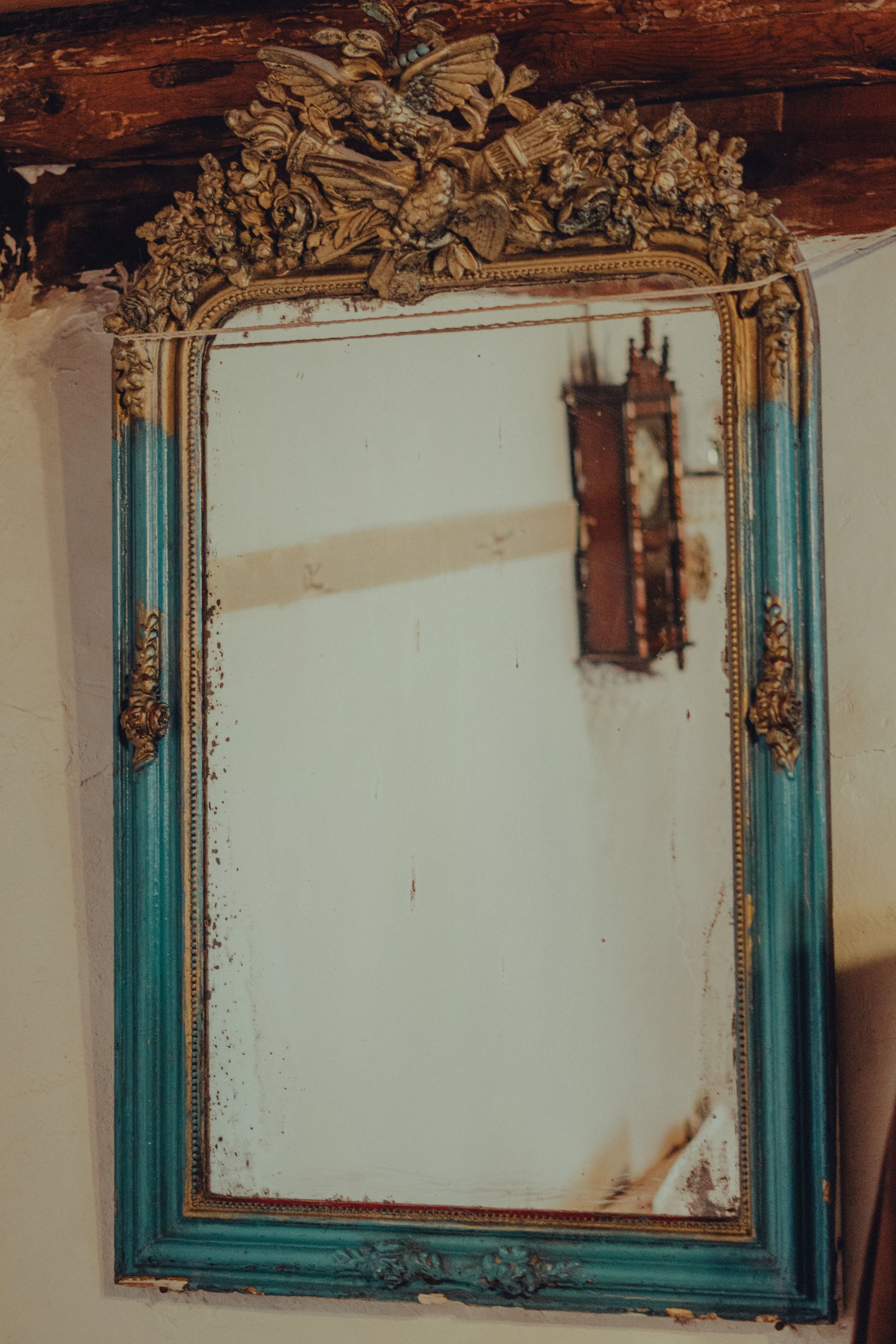
Close view of old mirror glass with dark spotting along its edge.
Wet Rooms Need the Warranty Read First
Moisture is what blackens the silver on ordinary mirror, and antiqued mirror arrives with its silver already partly oxidized. General Glass’s standard mirror warranty asked that mirrors in bathrooms and kitchens be set up off the base, and warned that spray cleaners can puddle at the edges. Tile retailers rate some antique mirror tile for shower walls and others not at all. Check the manufacturer’s guide for the exact product before it goes near a shower.
Choose the Route by the Seams
I’d decide by counting joints. A wall of a few large panels has only a few cut edges, so a sheet aged before cutting gives little away. A wall of small panels or tiles is mostly edges, and that’s where aging after the cut earns its place.
Both products arrive under the same name, so ask which one the quote assumes, aged before cutting, or after.

Porcelain Slab
Porcelain slab is fired clay printed to look like marble, not marble itself, which is the whole reason it exists. What that manufacturing process actually means for sizing standards, installation, and how to order one without a shade mismatch.
Porcelain slab is a manufactured material, pressed from clay and fired in a kiln, built to do one job, look like real marble without marble's problems. Real marble is porous. It stains from something as ordinary as red wine or lemon juice, and it etches on contact with anything acidic, permanently. Porcelain slab is fired hard enough that neither of those things happens to it. Manufacturers get the marble look by scanning an actual block of real marble at very high resolution, then printing that exact pattern onto the porcelain before it goes into the kiln. A slab that looks like Calacatta or Nero Marquina is porcelain wearing a printed image of that stone. It was never quarried.
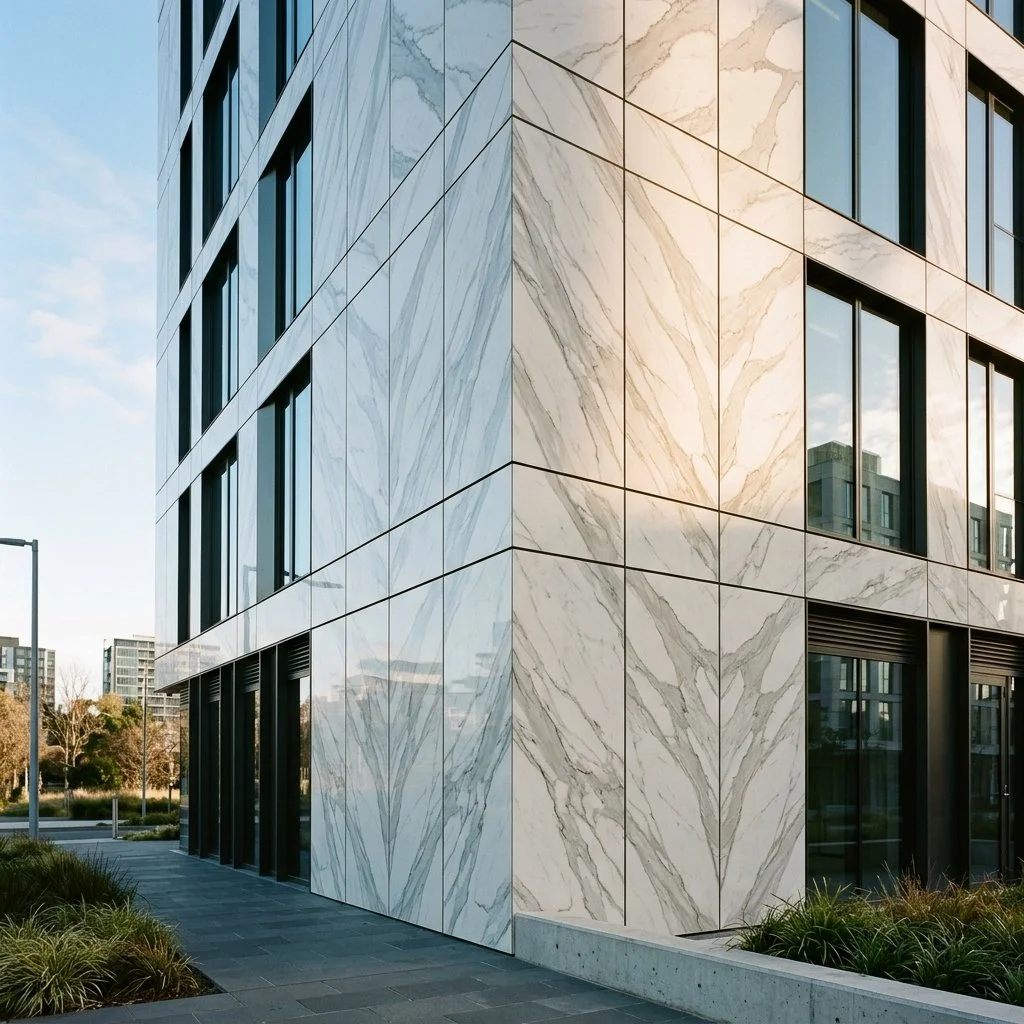
Exterior building corner clad in large stone look panels with mirrored veining and visible reveal joints.
Four Hundred Bars and a Kiln Longer Than a City Block
Here's what actually happens to make that possible. The raw material is a dry blend of kaolin clay, feldspar, and quartz, pressed under more than 400 bars of pressure to force out air and moisture before it ever sees heat. It's then fired in a kiln that can run several hundred meters long, at temperatures between 1,200 and 1,400 degrees Celsius. At that heat the minerals fuse into a single solid mass, with almost no pore space left for anything to soak into. That's the physical reason porcelain doesn't stain or etch the way marble does: a finished slab absorbs less than 0.1 percent water. It's also why porcelain reads slightly cooler to the hand than real marble. The pattern printed on top depends on this same firing step too. Some slabs are decorated, meaning the print sits on the surface only, added after pressing. Others carry the print all the way through the body. Cut a decorated slab for a mitered edge and the exposed edge shows plain material underneath. Cut one where the pattern runs through, and the edge keeps the same veining.
Gauged Has a Real Definition
"Gauged" isn't a marketing word here. In 2017, the Tile Council of North America closed out four years and more than 4,000 hours of testing with ANSI A137.3, the actual standard for gauged porcelain tiles and panels. It splits the category into two thickness classes: 3.5 to 4.9 millimeters, rated for walls only, and 5.0 to 6.5 millimeters, rated for both floors and walls. A companion standard, ANSI A108.19, governs how it actually gets set in place, using a thin mortar bed rather than a thick one. Knowing which class you're specifying isn't a technicality. It's the difference between a panel that's approved for a floor and one that isn't, whatever the sales sheet implies.
Thin Doesn't Mean Forgiving
A slab this thin handles nothing like a stone countertop. Fabricators move it with suction lifters built for the job, not by hand. Every panel gets mortar applied to both the substrate and the back of the tile itself, and any gap in that coverage becomes a weak point. Wet and exterior work calls for full coverage, no exceptions. The substrate underneath has to be flat and structurally rigid before installation starts, because a gauged panel won't bridge an uneven surface the way a thicker material sometimes can.
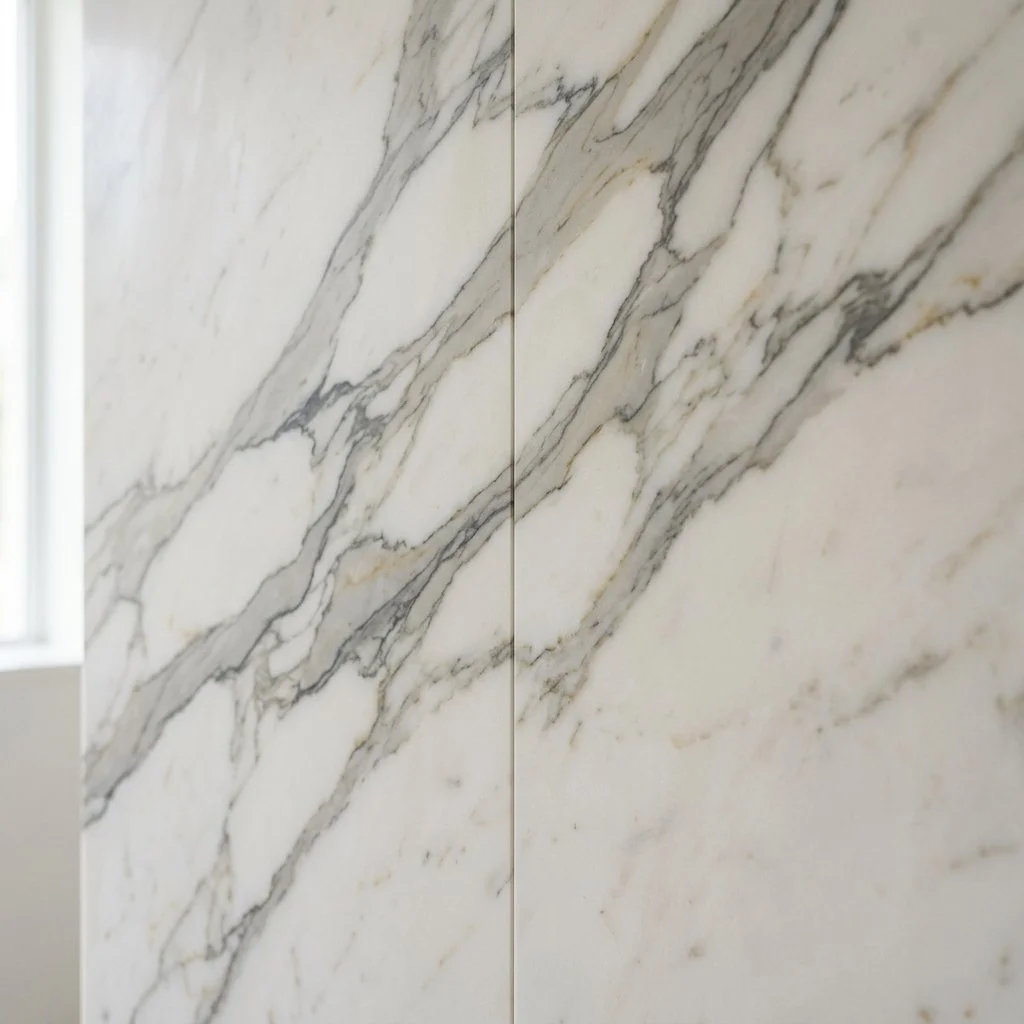
Close view of two large veined panels meeting at a seam, the pattern continuing unbroken across the join.
Specify the Run, Not Just the Pattern
Kiln temperature shifts, even slightly, from one production run to the next, and that shift shows up as shade variation between batches. The industry rates this on a V1 to V4 scale, from barely noticeable to intentionally dramatic. So there are two separate guarantees at play here, not one: the printed pattern is decided at the design stage and repeats reliably, but the exact shade of that pattern isn't, unless the whole job comes from a single production run. Every pallet is stamped with a batch number, and every box in an order should match it. Check that stamp against the delivery before a single carton gets opened, not after tile is already on the wall.

The Rules That Protect Talavera
Talavera looks like a color palette. Legally, it's a designation, tied to specific towns, six colors, and a hologram most imitations don't have.
The blue that makes Talavera instantly recognizable traces back to Chinese porcelain. It arrived by way of the Manila galleon trade, the shipping route that carried Ming Dynasty ceramics across the Pacific into New Spain, and colonial potters in Puebla took to that cobalt so completely it became the color the whole tradition is remembered for. Italian influence added the rest of the palette a century later. None of that history shows up on the label. What does, if the piece is real, is a hologram.
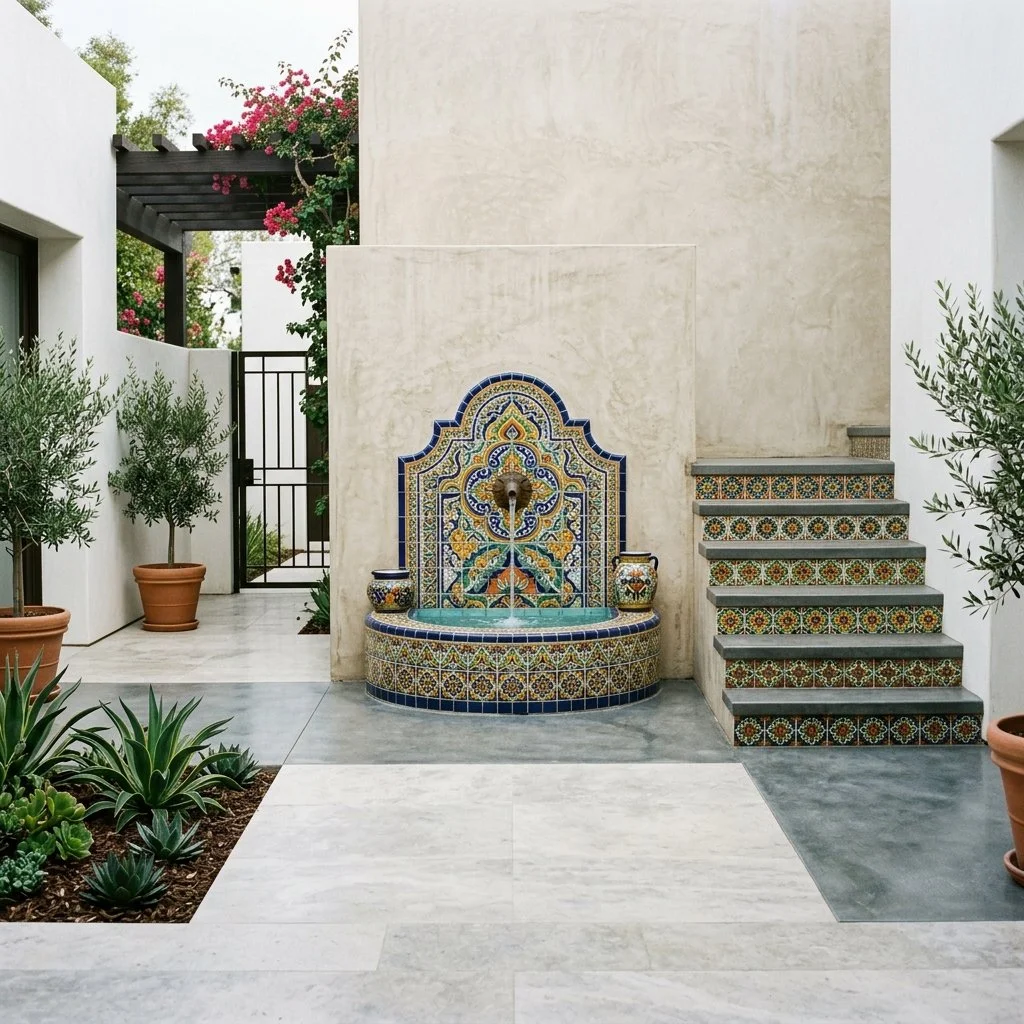
A pattern of hand painted tile lining a fountain in a modern courtyard.
A Name Only Six Places Can Use
Since 1997, "Talavera" has been a legal designation in Mexico, not a style anyone gets to claim. The Denominación de Origen de la Talavera, overseen by the Consejo Regulador de Talavera, ties the name to where a piece is made and to the clay and process behind it. Only a handful of places qualify: the city of Puebla and the nearby towns of Atlixco, Cholula, and Tecali, plus San Pablo del Monte across the state line in Tlaxcala. A tile in the right pattern made anywhere else, or made there with a shortcut in the process, doesn't get to use the word. Certified pieces carry a hologram to prove it.
Six Colors, Not One More
The design rule is just as specific as the geographic one. An authentic piece can only be painted in some combination of six colors: blue, black, green, orange, yellow, and mauve, and every one has to come from natural pigment, applied by hand. A printed pattern in a convincing blue and white isn't Talavera. Neither is a seventh color, however close it reads to the traditional palette.
Thrown, Painted, Fired Twice
The forming process hasn't changed much since the colonial period. Each piece is thrown by hand on a wheel, then fired, glazed, painted, and fired a second time, and the glaze itself is still a formula of tin and lead that workshops have used for centuries. It's slower than any mold or machine transfer print could be, and that's part of what the designation actually protects: not just a look, but the process itself, done by hand, not skipped.

Close view of a paintbrush adding blue pigment to a hand painted tile mid pattern.
A Craft That Nearly Didn't Survive
The tradition came close to disappearing more than once. Mexican independence broke up the guild that had kept quality consistent through the craft's golden age, and Puebla's workshops dropped from dozens to fewer than eight. By the 1980s only four remained. Artists and collectors pulled it back from the edge in the early twentieth century, and the 1997 law was, in part, a second rescue: a way to keep the workshops that had held onto the real process from being undercut by cheaper imitations. The craft still runs on a shrinking base of trained artisans.
Ask to See the Hologram
For anyone specifying it, the practical version of all this is simple. A real piece comes with a certificate and a hologram from the Consejo Regulador, and a workshop that can't produce either isn't selling what it says it's selling. The pattern is the least protected part of the whole tradition. The paperwork is the most.

Reeded Glass Isn't Fluted Glass
Reeded glass has raised ridges and fluted glass has grooves, but most suppliers sell both under one name. How to tell them apart, and what to put on the spec sheet instead.
Fabricators and suppliers will hand over the same pane under two different names. Reeded and fluted glass get used as if they mean the same thing, on cabinet doors and shower screens as often as on a spec sheet. They don’t. One has ridges that stand up off the surface. The other has grooves pressed into it. The distinction is real, even if almost nobody in the trade bothers to keep it straight.
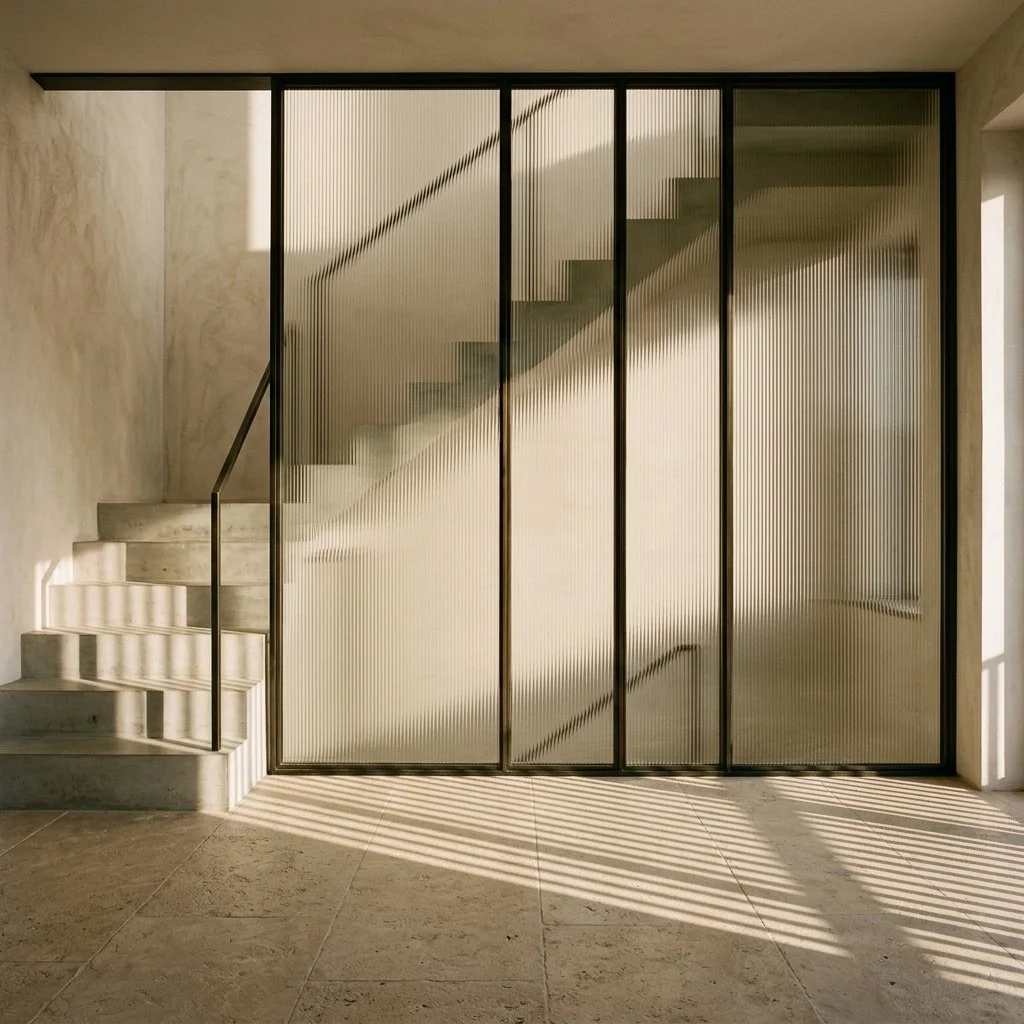
A fluted glass panel in a blackened bronze frame casting a striped shadow pattern across a stone floor.
Two Different Rollers, Two Different Shapes
Textured flat glass is made by rolling, not floating. Molten glass, close to 1050°C, passes between two rollers cooled with water. One roller is smooth. The other is engraved with the negative of whatever pattern is going onto the glass. The ribbon comes out the other side around 850°C, then cools slowly in an annealing oven so it doesn't turn brittle. Whatever shape is cut into that engraved roller becomes the shape pressed into the glass.
That's where reeded and fluted actually diverge. Reeded glass takes its name from reeds and cane: the ridges rise up, convex, off the surface. Fluted glass borrows its name from a column, the same channels you'd find carved into a classical shaft: the grooves sink in, concave. Most manufacturers and showrooms use "reeded" to cover both, which is exactly how the confusion holds on.
A Patent Solved a Privacy Problem in 1886
This isn't a new idea dressed up as one. An 1886 English patent, filed by William Edward Chance, covered new machinery for rolling rippled glass sheets. A few years later, a second pair of rollers was added to press an actual pattern into a sheet that had already been rolled flat, one side textured, one side smooth enough to cut and glaze normally. Rolling the sheet twice, first flat, then patterned, became the standard way to produce it, and it's still close to how it's done now. The finished sheets were sold under names like "fancy figured rolled" and "patent rolled," in tints that read almost like a paint chart: clear, blue, amber, green, a pink tinted like wine and sold as "cathedral" glass. The purpose hasn't changed since. Obscure the view, keep the daylight.
The Ridges Do a Different Job Than Frosting Does
It's worth separating this from frosted glass too, since all three end up doing similar work in a spec conversation. Frosted glass is made by sandblasting or acid etching a clear pane, which pits the surface at a microscopic level and scatters light in every direction at once. That's what gives it a cloudy, matte look, opaque enough to hide detail but never sharp in any direction. Reeded and fluted glass work differently. The ridges or grooves are directional, not random, so they distort an image along one axis while still passing light through clearly along the others. Stand close and you'll see color and movement stretched into vertical bands, not a uniform blur.
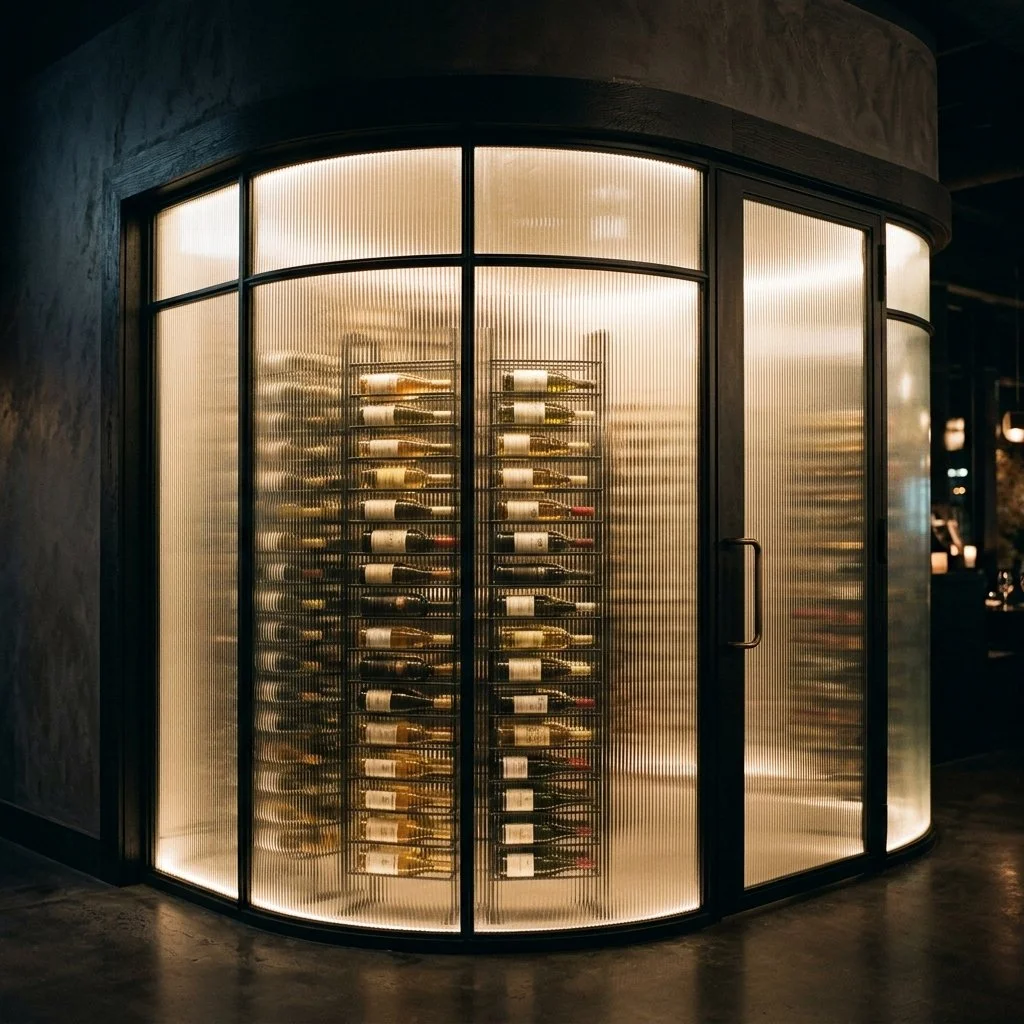
A curved, fluted glass wine room enclosure backlit with warm light, wine bottles softly blurred behind the bent glass.
Architecture Took It Up in the 1920s
Rolled patterned glass had been a Victorian utility material for decades before it became a design statement. That happened in the 1920s and '30s, when its straight vertical lines fit naturally into Art Deco storefronts and partitions, an architecture already built around streamlined, repeating geometry. Modernist architects picked it back up again decades later for office interiors and cabinetry. The glass didn't change in either revival. The buildings around it did.
Specify the Pattern, Not Just the Name
None of this makes reeded and fluted glass interchangeable, even when the paperwork treats them the same. A convex ridge and a concave groove bend light differently enough that a rendering can look nothing like what actually ships. I'd trust the sample over the spec sheet every time. Hold it up to real light before the name on the order gets treated as fact.

The Glass That Doesn't Want to Disappear
Clear glass lets through about 90 percent of visible light, and a dark neutral coating can drop that below 10. How architectural glass controls fading and glare, and the real difficulty of matching spandrel panels to the glass beside them.
Most glass walls sold as luxury do the one thing you actually don't want. They disappear completely, and a house built entirely on disappearing walls stops feeling like a house and starts feeling like a display case. I want glass that holds its ground. Dark enough to read as a material of its own. Engineered so well you forget it's filtering anything at all. I think of the good version of this as obsidian glass, heavy enough to read as stone, still unmistakably glass.
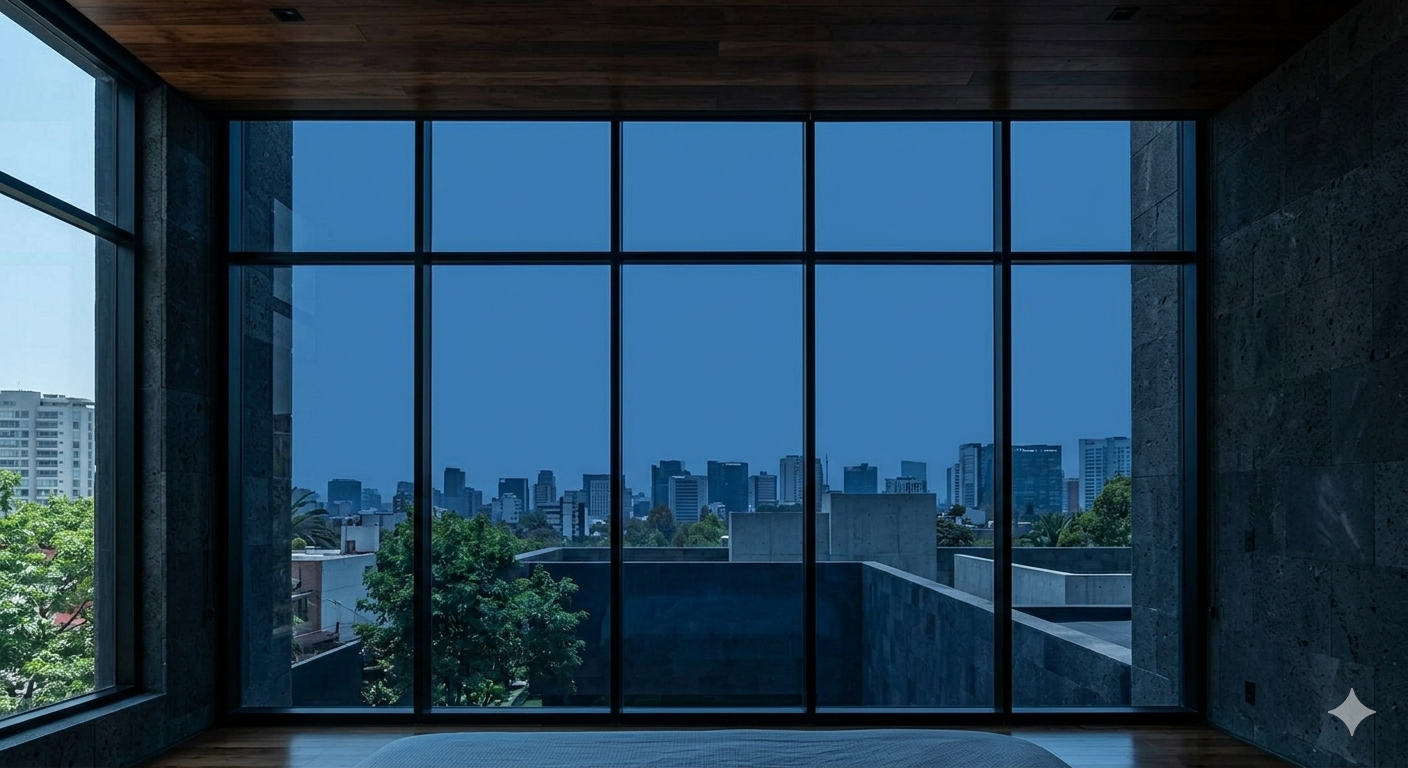
Obsidian Glass lens over the Polanco skyline.
What Clear Glass Actually Costs You
Ordinary clear glass lets through close to ninety percent of visible light and stops very little of the sun's ultraviolet. That's a fine trade in a climate with real winters and a low, forgiving sun. It's a slower problem somewhere the sun is a constant, aggressive presence for most of the year. Walnut floors bleach unevenly along the sightline of a window. Limestone gets warm enough underfoot by early afternoon that you notice it. And once the lights are on inside at night, clear glass turns into a mirror that shows you your own living room instead of the view you paid for.
Dark glass that keeps its color honest solves several of these problems with the same piece of material. It can cut visible light transmittance dramatically, in some cases below ten percent. It also blocks most of the ultraviolet radiation actually responsible for fading fabric and wood, not the visible light itself. The heat drops along with it. I've stood against a wall of this glass at noon and felt almost nothing come through.
A Lens, Not Just a Tint
The failure mode with dark glass is a cheap tint, the kind that turns everything on the other side of it blue or bronze. Oak looks cold. White walls read faintly green. It stops being a window and starts being a color filter you have to mentally correct for.
Real architectural glass solves this with coatings engineered specifically to stay neutral, gray or charcoal formulations built so a white wall still reads bone white and a plank of oak still reads warm, seen through several inches of very dark glass. The industry term for it is solar control low-E glass, and the good versions are labeled neutral reflective rather than just tinted. Color goes through intact. Only the glare and the heat get filtered out.
Built to Look Solid From the Street
From the outside, this glass shouldn't read as a hole punched in a wall. It should read as a dark, continuous plane, close in visual weight to the stone beside it. Architects get this partly by pairing the actual windows with opaque glass panels of matching color over the structural floor lines and mechanical gaps, so the whole facade reads as one uninterrupted surface instead of glass here, wall there. It's a real technique with a real name, spandrel glass, and getting the match right is harder than it sounds since transparent and opaque glass reflect light differently in different weather. Done well, the house looks carved from one piece of dark rock rather than assembled from parts.
That solidity buys you something practical too. During the day, with the light balance working in your favor, nobody on the street can see in. You get the privacy of a solid wall with the specific pleasure of a window.
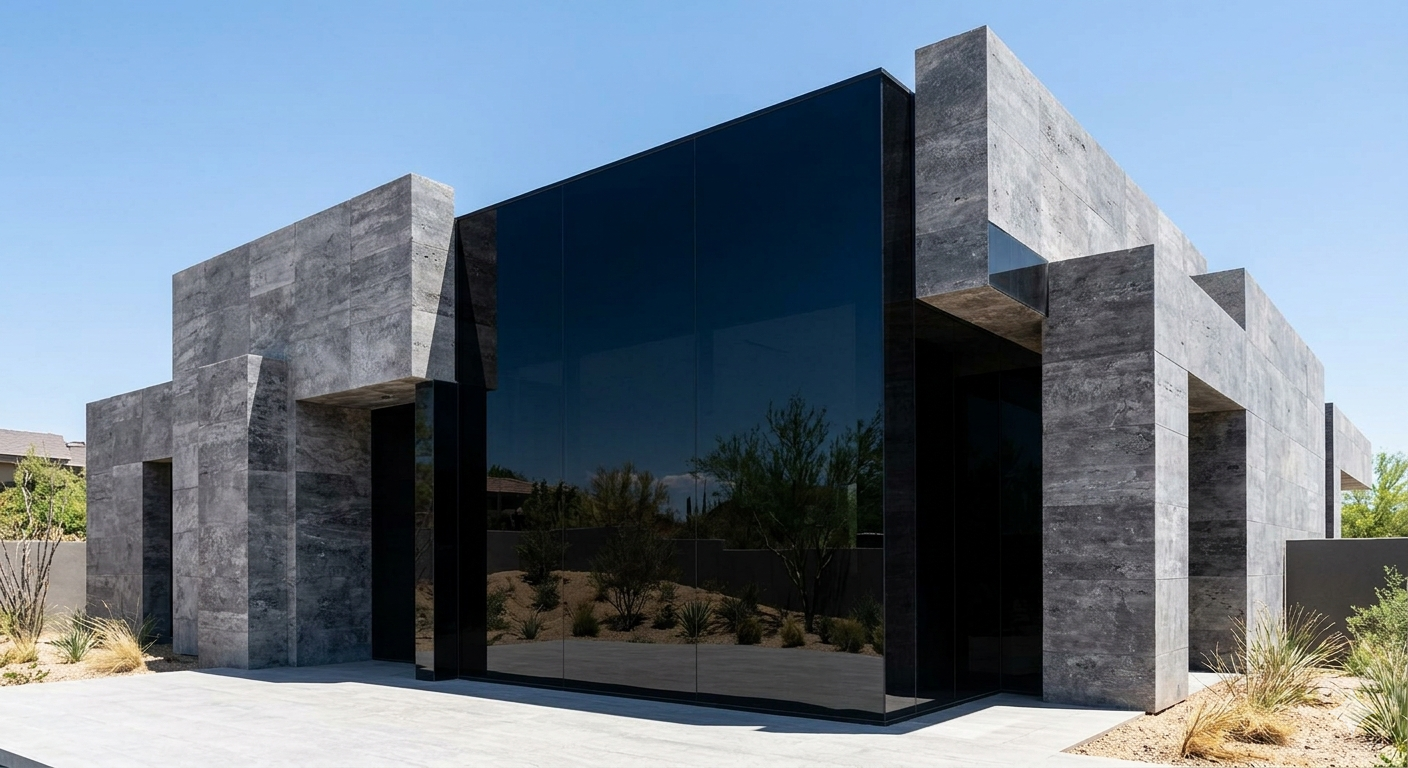
Massive, dark "slab" of obsidian glass reflecting the street side landscape.
Frames That Get Out of the Way
None of this works if the frame fights the glass for attention. A wall this dark and this heavy needs a structural system, not a hardware store window kit. The better structural glazing systems now bond the glass in rather than resting it in a groove, which lets the glass itself carry part of the load. That's how the best of them get vertical sightlines down to a couple of millimeters instead of a couple of inches.
Steel or aluminum in a matte black finish, kept as slim as the glazing system allows, disappears into the shadow line of the wall. You look at the window and see the view. I'd rather deal with a harder installation now than live for twenty years with a frame that competes with what it's supposed to be showing you.
You Choose What Gets Through
Glass doesn't have to be invisible to be good. Dark, honestly colored glass in a frame that gets out of the way is a decision about exactly how much of the outside world you want in the room at any given hour, made on your behalf so you never have to think about it again. That's a higher bar than a window that lets everything through just because it can.