Porcelain Slab
Porcelain slab is a manufactured material, pressed from clay and fired in a kiln, built to do one job, look like real marble without marble's problems. Real marble is porous. It stains from something as ordinary as red wine or lemon juice, and it etches on contact with anything acidic, permanently. Porcelain slab is fired hard enough that neither of those things happens to it. Manufacturers get the marble look by scanning an actual block of real marble at very high resolution, then printing that exact pattern onto the porcelain before it goes into the kiln. A slab that looks like Calacatta or Nero Marquina is porcelain wearing a printed image of that stone. It was never quarried.
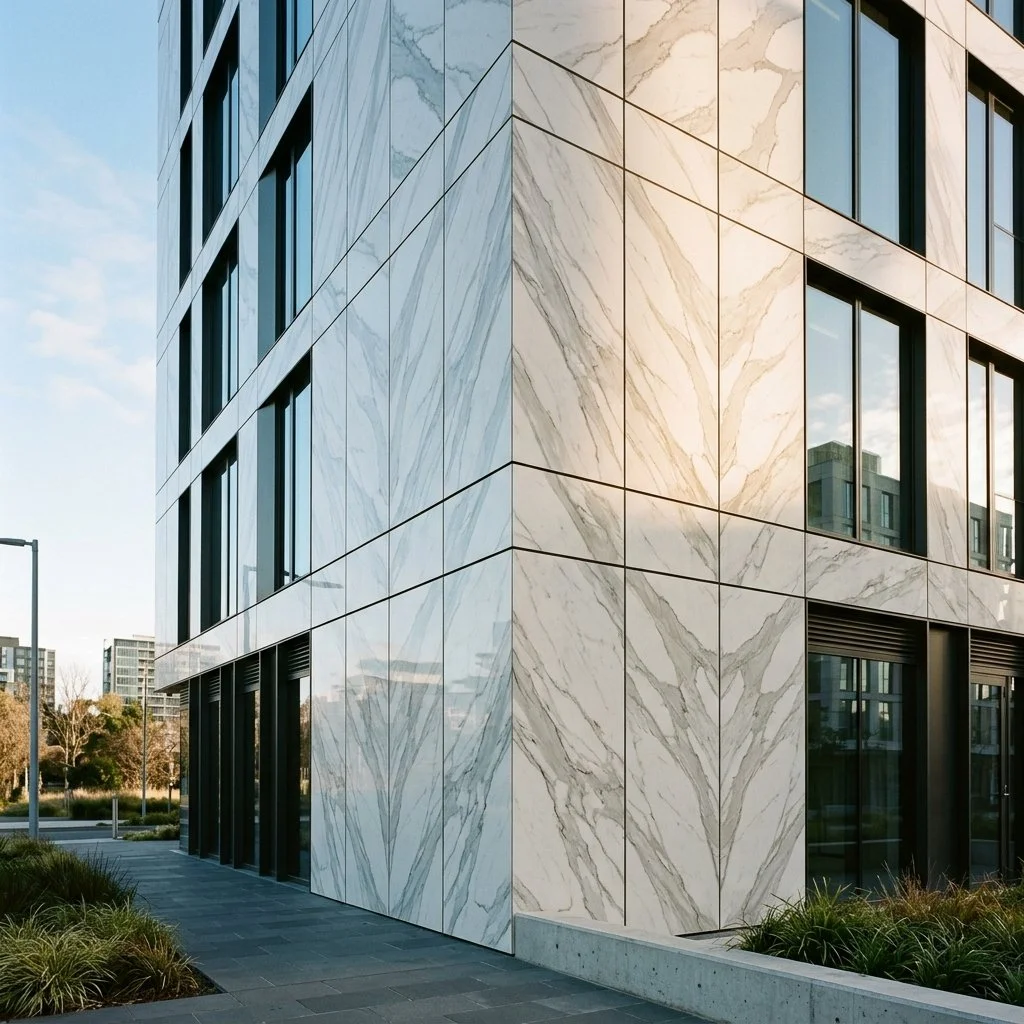
Exterior building corner clad in large stone look panels with mirrored veining and visible reveal joints.
Four Hundred Bars and a Kiln Longer Than a City Block
Here's what actually happens to make that possible. The raw material is a dry blend of kaolin clay, feldspar, and quartz, pressed under more than 400 bars of pressure to force out air and moisture before it ever sees heat. It's then fired in a kiln that can run several hundred meters long, at temperatures between 1,200 and 1,400 degrees Celsius. At that heat the minerals fuse into a single solid mass, with almost no pore space left for anything to soak into. That's the physical reason porcelain doesn't stain or etch the way marble does: a finished slab absorbs less than 0.1 percent water. It's also why porcelain reads slightly cooler to the hand than real marble. The pattern printed on top depends on this same firing step too. Some slabs are decorated, meaning the print sits on the surface only, added after pressing. Others carry the print all the way through the body. Cut a decorated slab for a mitered edge and the exposed edge shows plain material underneath. Cut one where the pattern runs through, and the edge keeps the same veining.
Gauged Has a Real Definition
"Gauged" isn't a marketing word here. In 2017, the Tile Council of North America closed out four years and more than 4,000 hours of testing with ANSI A137.3, the actual standard for gauged porcelain tiles and panels. It splits the category into two thickness classes: 3.5 to 4.9 millimeters, rated for walls only, and 5.0 to 6.5 millimeters, rated for both floors and walls. A companion standard, ANSI A108.19, governs how it actually gets set in place, using a thin mortar bed rather than a thick one. Knowing which class you're specifying isn't a technicality. It's the difference between a panel that's approved for a floor and one that isn't, whatever the sales sheet implies.
Thin Doesn't Mean Forgiving
A slab this thin handles nothing like a stone countertop. Fabricators move it with suction lifters built for the job, not by hand. Every panel gets mortar applied to both the substrate and the back of the tile itself, and any gap in that coverage becomes a weak point. Wet and exterior work calls for full coverage, no exceptions. The substrate underneath has to be flat and structurally rigid before installation starts, because a gauged panel won't bridge an uneven surface the way a thicker material sometimes can.
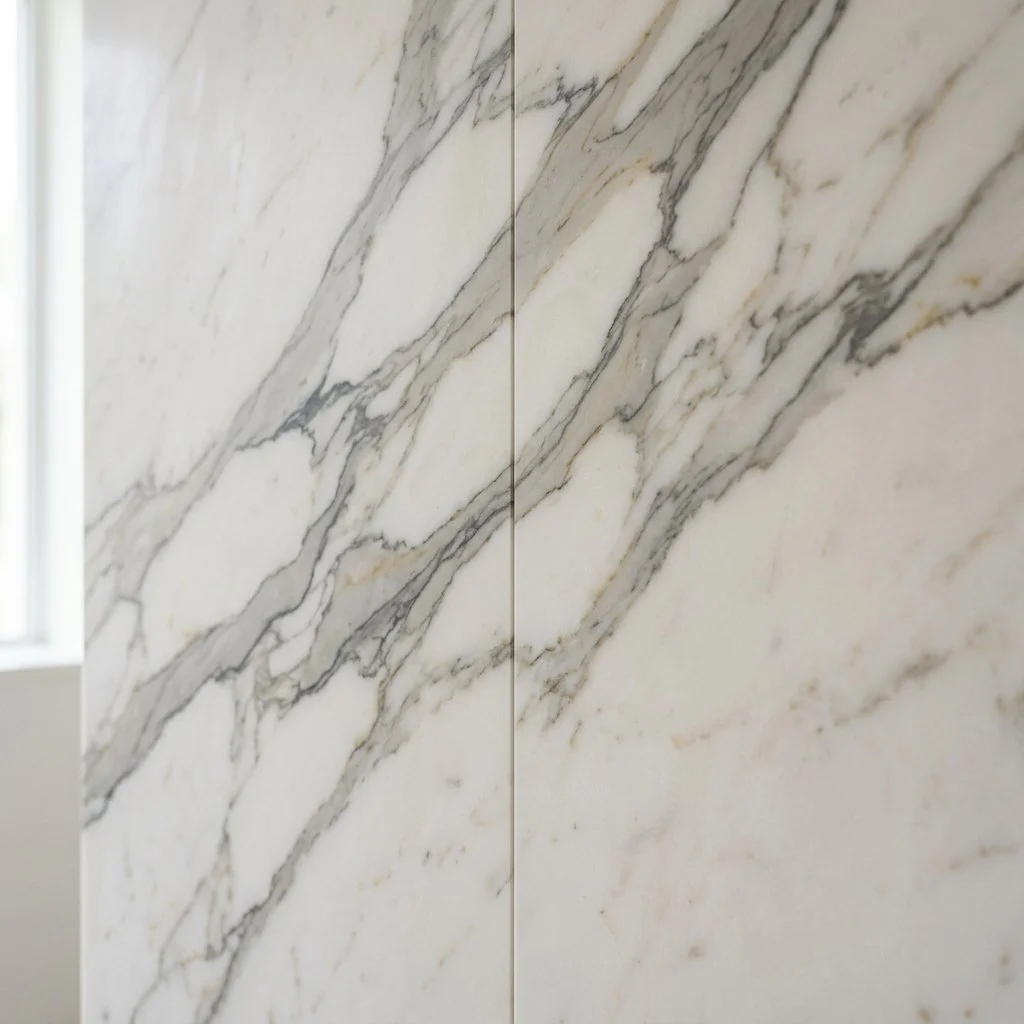
Close view of two large veined panels meeting at a seam, the pattern continuing unbroken across the join.
Specify the Run, Not Just the Pattern
Kiln temperature shifts, even slightly, from one production run to the next, and that shift shows up as shade variation between batches. The industry rates this on a V1 to V4 scale, from barely noticeable to intentionally dramatic. So there are two separate guarantees at play here, not one: the printed pattern is decided at the design stage and repeats reliably, but the exact shade of that pattern isn't, unless the whole job comes from a single production run. Every pallet is stamped with a batch number, and every box in an order should match it. Check that stamp against the delivery before a single carton gets opened, not after tile is already on the wall.