Zellige Comes From Fez and Tetouan
Zellige is fired clay tile cut by hand into small geometric pieces and fitted into mosaic, and Morocco’s own heritage nomination names two traditions of it, Fez and Tetouan. Several importers selling it in the US say it comes from Fez alone. When Morocco’s culture ministry launched the project to nominate it for UNESCO in November 2025, the project covered the zellige of Fez and Tetouan together. Tetouan is the one that gets left out.
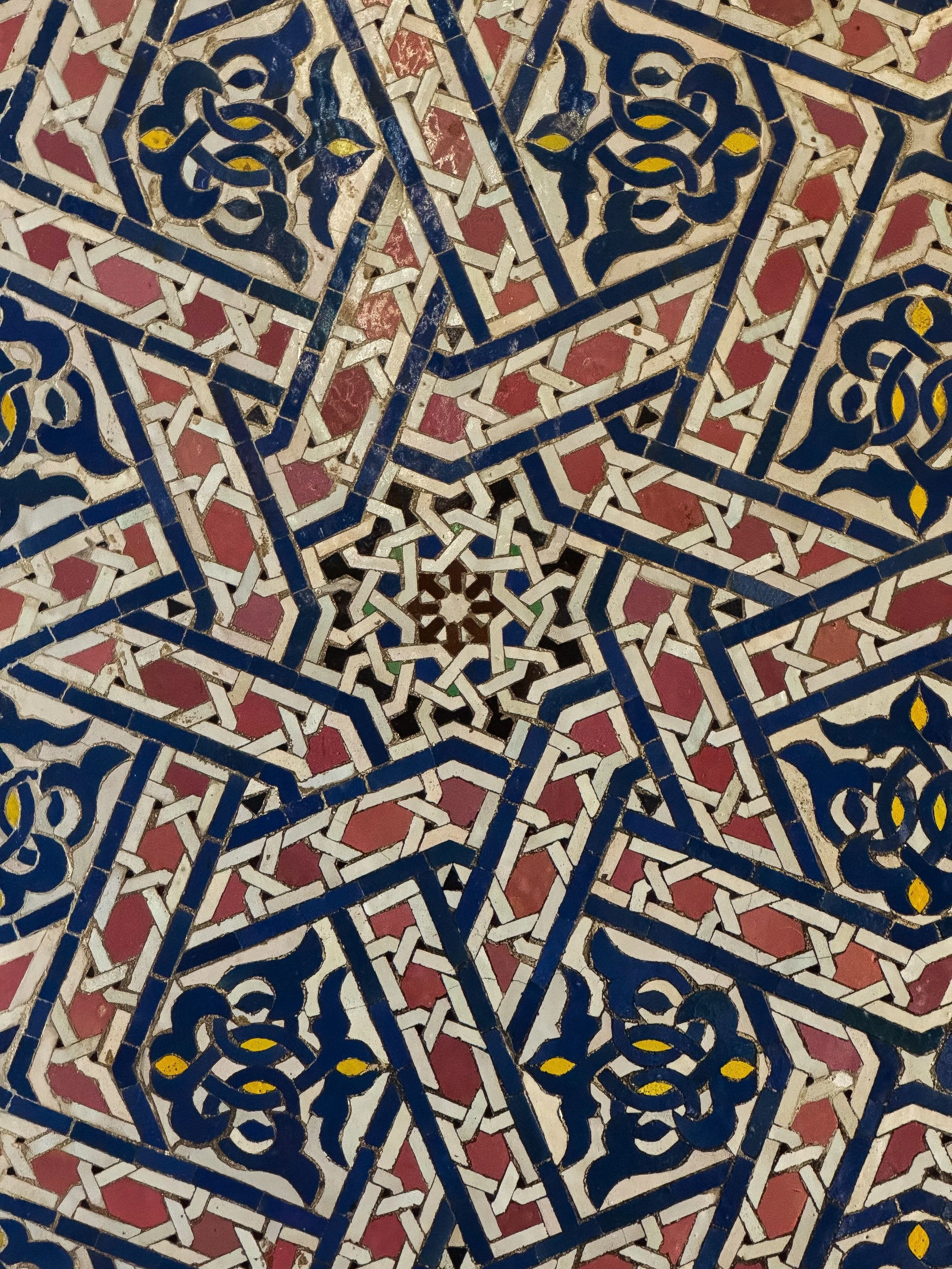
Close view of hand cut zellige mosaic, showing chiseled edges and grout lines.
What Is Authentic Zellige Tile?
The word comes from the Arabic verb zalaja, to slide, for the smooth glazed face, and the Spanish and Portuguese word azulejo grew out of it. Historically it meant the mosaic, separately chiseled pieces in different colors, fitted into star patterns and other geometry. In Spain, the same cut technique in monuments like the Alhambra is also called alicatado, from an Arabic verb meaning to cut.
The square glazed tile sold as zellige in the US is field tile, not mosaic, though importers say the squares come out of the same Fez workshops and are trimmed by hand after firing. Importers sell both under the one name, so a spec that only says “zellige” leaves open which one the client is getting. Spanish tiles of the Renaissance borrowed the mosaic patterns, and some modern square tiles are simply painted with them.
Both Traditions Crossed From Granada
M’hamed Benaboud, a professor at Abdelmalek Essaâdi University in Tetouan, traced Tetouan’s zellige to the Alhambra, where he also found tiles known as Fassi, the word for something from Fez. His conclusion, reported by Médias24 in 2022, was that both Moroccan versions came from al-Andalus. Families from Granada who settled in Tetouan after the Castilian conquest in 1492 kept developing the craft on the Moroccan side of the strait. At the 2025 nomination launch, a Casablanca university researcher dated the oldest Fez zellige to the thirteenth century. He named the minaret of the Seffarine madrasa and the Great Mosque of Fez Jdid among the earliest examples.
From the fourteenth century on, zellige was a standard finish for lower walls and floors in the western Islamic world. After the fifteenth century the cut mosaic fell out of fashion in most places, but never in Morocco.
How a Fez Workshop Makes It
Importers who buy from Fez describe the same basic sequence. Clay from the Fez region is soaked, picked clean of stones and branches by hand, pressed into molds and dried in the sun on rooftops. Each tile is glazed on one face, and the most traditional kilns burn olive pits and branches, though at least one importer’s tile is fired with gas. The heat moves unevenly through a traditional kiln, which gives each tile its own shade. One importer notes that lime in the natural clay can leave small pits in the glaze.
Another importer describes three craftsmen behind the tile and calls the last one, the cutter, the most important. He chips the fired tile into its final shape with a hammer. The cut pieces are then fitted face down and grouted into panels, the same method a Granada tour company describes for the Alhambra’s alicatado.
Tetouan Is Rarer and Costs More
Benaboud’s warning was blunt. Fez zellige has spread to Meknes, Rabat, Salé and Marrakech, while Tetouan’s has not, and Tetouan work costs more. With demand shrinking, he said the tradition could disappear without protection. A 2025 study in Anaquel de Estudios Árabes, a journal of Madrid’s Complutense University, traces the decline back to the end of the nineteenth century, as tilework brought from Spain went into Tetouan’s expansion district and its medina.
Tetouan still trains its craftsmen. Dar Sanaa, the city’s school of arts and crafts, was founded in 1919, and its apprentices learn from master artisans in trades that include faience and carved plaster.
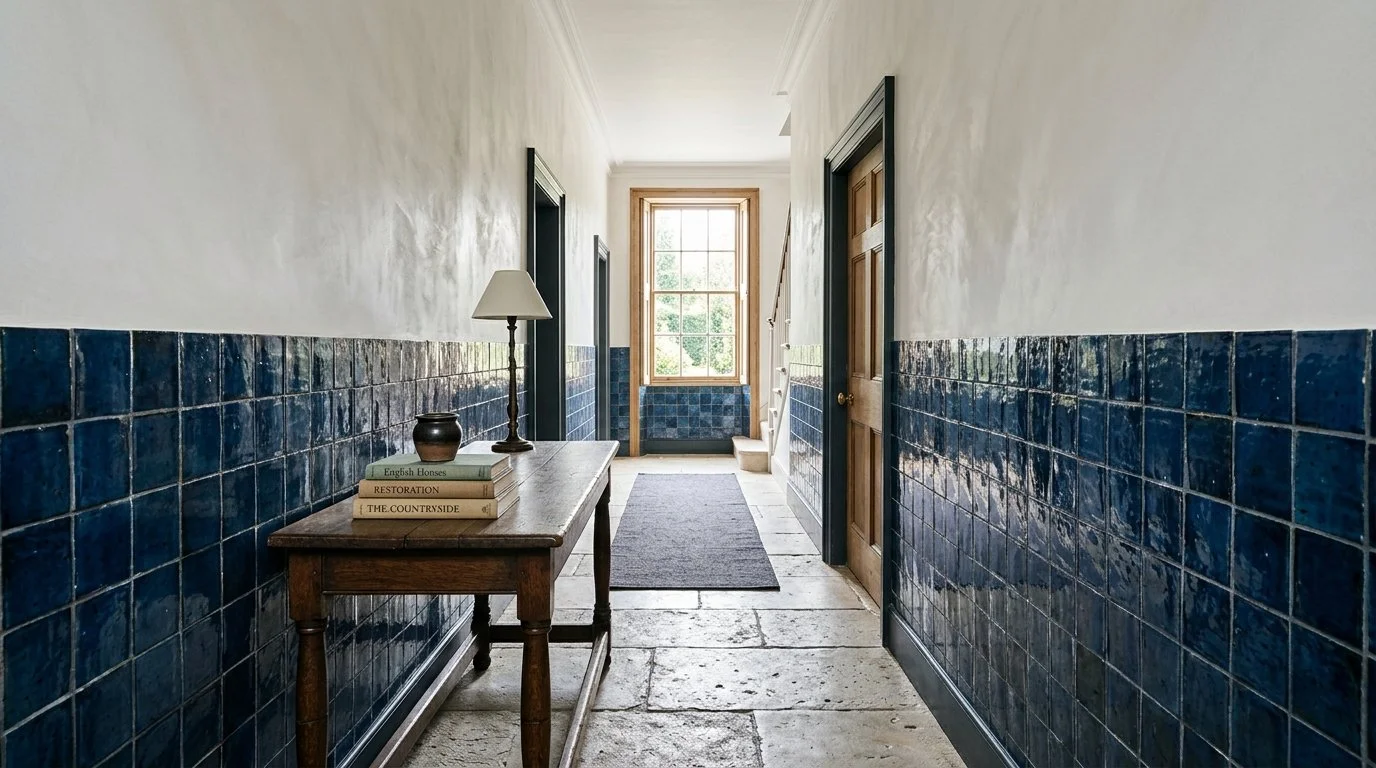
Townhouse hallway with a lower wall band of handmade glazed tile beneath lime plaster.
The Mark Covers Fez Only
Morocco’s crafts ministry filed “Zellige de Fès” as a certification mark in the US in 2016, and it was registered. It certifies that the tile comes from the Fes region and that it meets the ministry’s own quality and manufacturing standards. In Morocco, one importer says, the label is issued under Law 133-12 on traditional crafts. It works much like the origin rules that protect Talavera, and a designer can ask for it on the order.
I found no matching mark for Tetouan. For a Tetouan panel, the workshop itself is the provenance, so its name and city belong on the invoice.
The Pattern Goes to the Workshop First
Square field tile is ordered by color and size. Cut mosaic is different, because every piece is cut for one pattern. So a Fez or Tetouan workshop needs the pattern and the wall’s dimensions first, and the colors after. Fez has the larger trade and a mark to ask for, while a Tetouan panel carries the rarer tradition. If you cut zellige in either city, or import it from them, I’d like to hear from you.