Why Horsehair Fabric Runs Narrow
Horsehair fabric is cloth woven with single tail hairs as the weft, laid across a warp of cotton or silk. A tail hair is too short and springy to spin into a continuous yarn, so each one crosses the loom on its own, and its length decides how wide the finished cloth can be. That is why horsehair comes in widths of about two feet, set by the horse rather than the loom.

Study wall upholstered in dark striated fabric, with fine vertical seams.
What Horsehair Fabric Is Made Of
Conservators at The Henry Ford, repairing a footstool from a horsehair parlor set at Greenfield Village, pointed out that every hair sticks out past both edges of the cloth, since none is long enough to travel back through the warp. Product notes from Emil Rotter, a Berlin firm that sells horsehair fabric, put the count at 26 to 42 hairs held in each centimeter of warp, and warn that hairs too short will poke up through the surface. Country Life described the finished cloth as subtly striated, with a sheen like pearl.
Country Life also called it indigestible to moths and reported that it can last a century. The same Henry Ford conservators found old beetle damage on their footstool, likely drawn to the protein in the hair. So a long life is real, and an antique piece still deserves a close look underneath.
How Wide Is Horsehair Fabric?
John Boyd Textiles listed its black and mixed grey cloth at 65 centimeters, about 26 inches. Its white cloth ran 56 centimeters, about 22 inches, because white tail hair is shorter. Any seat back or wall wider than that takes a seam, and the pale colors take more of them.
That matters most on large surfaces, such as the acoustic wall panels Country Life listed among the cloth’s newer uses. Drawn in 26 inch modules, a seam reads as a line someone chose. Drawn without the width in mind, it lands wherever the cloth ran out.
Two Mills Still Weave It
Country Life reported in 2024 that only two horsehair fabric manufacturers remained, John Boyd Textiles in Castle Cary, Somerset, and Le Crin in Challes, in northwestern France. John Boyd, a Scottish merchant, began weaving horsehair in Castle Cary in 1837. Andrew Ure’s 1846 dictionary described the old method, with a child beside the loom presenting each hair to be passed through the warp. The company credits the 1870 Education Act, which sent those children to school, for its move to mechanical looms with a picker that teases out a single hair. Since 1956 it has worked in a former flax mill built in 1870, where 30 of the looms Boyd bought in 1877 were still running, according to the European Route of Industrial Heritage.
Le Crin kept the hand loom. In a 2024 Luxe partner feature on the workshop, its weavers threaded hairs into the shuttle one by one and turned out roughly eight feet of cloth per loom a day. Le Crin’s cloth is sold under Métaphores, part of Hermès’s textile division, which weaves the hair alongside other fibers such as silk and sisal.
Where the Hair Comes From
John Boyd states that its hair comes from live horses, for the best quality cloth. Design Milk, covering a Métaphores furniture collaboration, described Le Crin’s hair as a byproduct of horses bred in Mongolia for transport and farm work. Britannica notes that horsehair is sorted by length, the longest hairs go to fabric, while shorter hair becomes brush bristles or curled stuffing for mattresses. The cloth takes the top of that sort.
Read the Fiber Content Before the Name
The word “horsehair” covers a wide range of cloth. A British upholstery workshop explains that a blend of 68 percent horsehair and 32 percent cotton, like John Boyd’s, is naturally flame retardant. The same blend with polyester in place of the cotton needs a coating on the back to meet British furniture fire rules, and some cloth sold as horsehair carries as little as 10 percent hair. The name also covers haircloth, the stiff interlining tailors put inside suit fronts, which fashion fabric stores sell by the yard as horsehair.
Ask for the exact fiber content and the fire test that applies where the piece will be installed. Then ask which mill wove it. Emil Rotter had its archive patterns reissued for the firm’s centenary without naming a weaver, so the name on a sample is not always the mill’s.
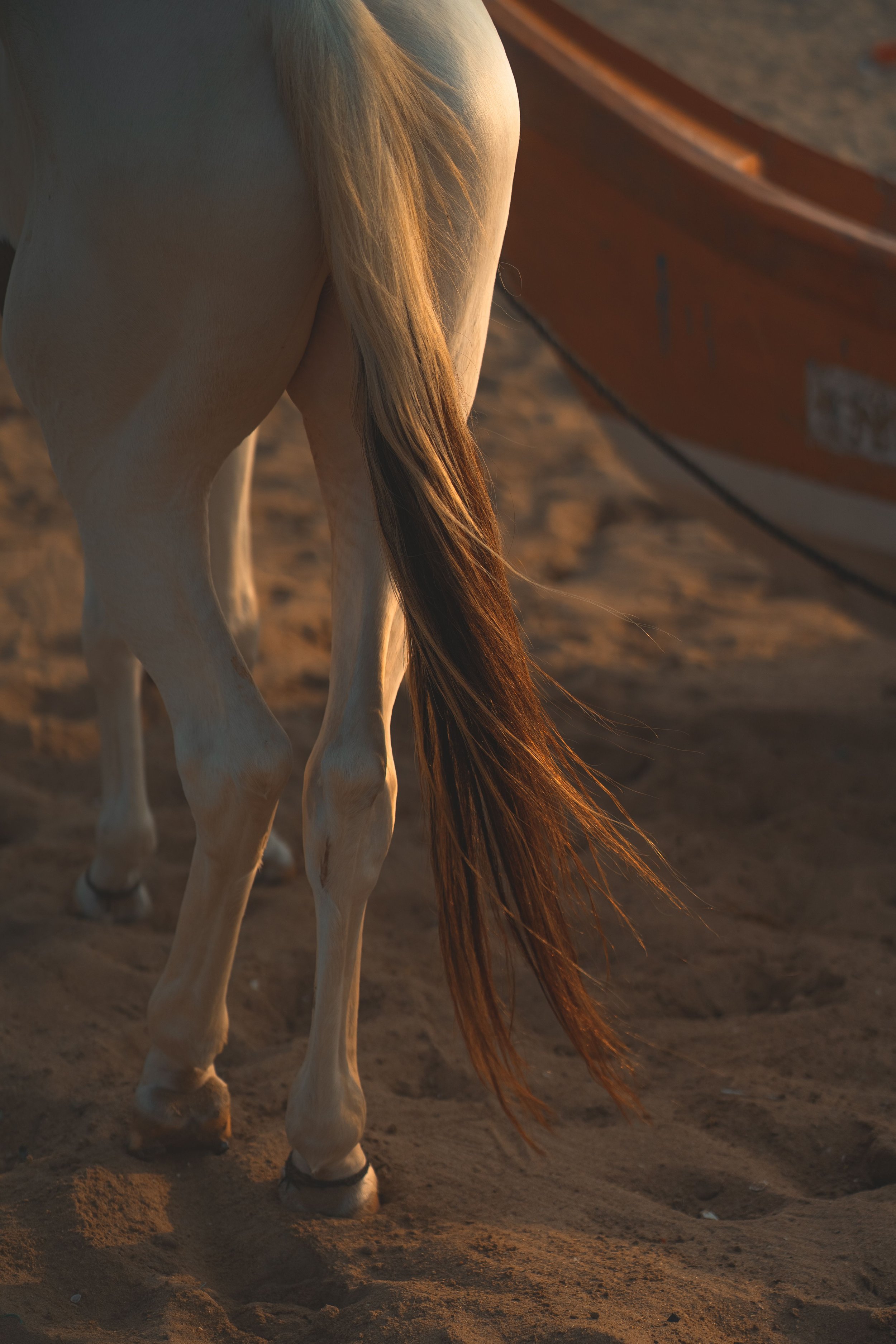
Close-up of a horse’s long tail hair in side light.
A Cloth Still Being Designed
Sir Edwin Lutyens upholstered his 1919 Napoleon chair, now at the V&A, in a black horsehair John Boyd listed as Ermine black. The mill said it was weaving the same cloth on the same loom for the reproductions the Lutyens family makes. Its range ran to nearly 200 fabrics, with custom colors woven from a 20 meter minimum. In 2026 it worked with Kate Aslangul of Oakley Moore on a striped collection, which Oakley Moore described as the mill’s first new horsehair fabric in over twenty years.
If you weave horsehair, or upholster with it, I’d like to see your work.
Let the Width Set the Grid
Horsehair rewards the designer who draws around it. Put the cloth’s width on the elevations before the frame or the wall layout is fixed, so every seam has a planned place. Before the sample is approved, get the fiber content and the mill’s name, since the hair percentage decides whether the cloth needs a fire coating at all.