Concealed security cameras on a fine home are set into the architecture while it’s being built, in a soffit or a gate pier made to hold them, so nobody bolts a camera to the facade later. The choices that make a camera disappear get made while the walls are still open. So do two decisions most projects leave to the installer, where the footage is kept, and whether the camera is allowed to listen.
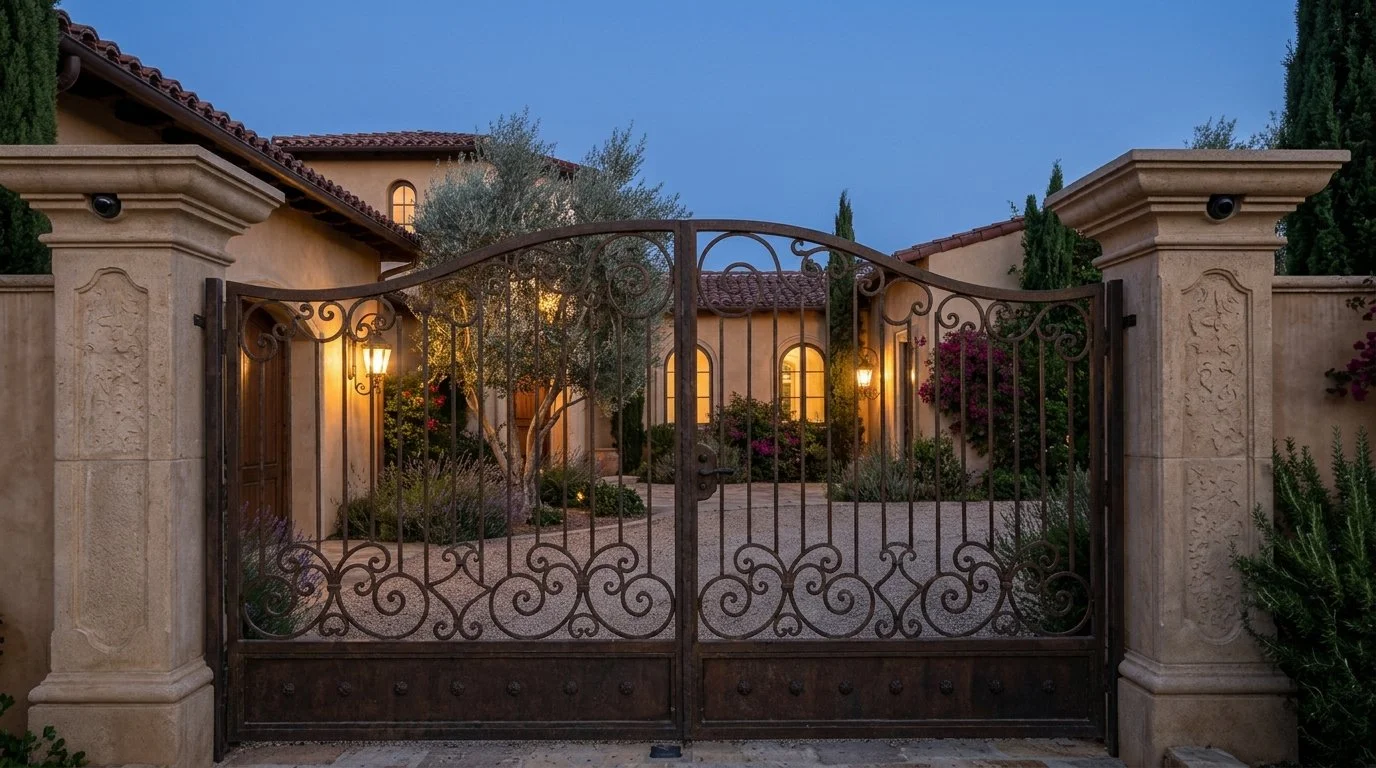
Security camera built into the carved limestone cap of a courtyard gate.
Decide What the House Should See
Beyond Audio, a Scottsdale integrator, writes that the first decision in any surveillance design is what the cameras should see and what they shouldn’t. The perimeter gets covered, meaning every entry point and the approach from the drive, while living spaces are generally left out.
David Hornung, cofounder of the design firm D&J Concepts, argues in Social Life Magazine that visible cameras and keypads communicate anxiety rather than protection. He describes biometric readers hidden in door hardware that looks entirely traditional. On a facade someone spent a year detailing, I’d let the gate and the lighting do the deterring.
Where Should Cameras Go on a New House?
The Scottsdale firm lays out coverage from the property footprint before anyone settles on a camera count. Blind spots collect at building corners and behind planting that blocks a sightline. The back of the house needs the same care, since a hedge planted for privacy also takes away the street’s view of a rear gate.
The Box Behind the Camera
Camera makers sell plates and back boxes that seat a camera over a standard junction box, and Axis, for one, lists each plate by the camera models it fits. So the mount gets chosen before the soffit closes or the stone is set. The box goes in at rough in, with extra cable coiled behind it.
LA Techs, an integrator writing about its own projects, puts it bluntly, invisible cameras can’t be retrofitted into finished architecture. Ask the integrator to mark every box on the electrical plan with the camera model it was set for.
A Housing Worth Commissioning
On one property LA Techs describes, the gate cameras were built into the pillar caps and the exterior cameras sat in custom housings matched to the trim profile. That’s work for a stone carver or a metal fabricator, and it’s the kind of commission I want this site to help designers find.
The maker needs the camera, or its drawings, before cutting anything. Have the integrator confirm in writing how much opening the lens and its night illuminator need.
Night Is When It Has to Work
Beyond Audio notes that most security incidents happen at night, so low light performance matters more than resolution. A 4K camera with a noisy night image is less useful than a 2MP camera engineered for the dark. Planned together with the landscape lighting, a motion event at the gate can also turn on the entry lights.
Footage That Stays in the House
Cloud recording fails when the internet does, which is often the moment the footage matters most. Beyond Audio designs around a local network video recorder that keeps recording either way, with a cellular link for remote access and offsite backup if the main line is cut.
Home Automation US, a smart home publisher, notes that hybrid systems also keep a copy offsite in case a thief leaves with the recorder. Give the recorder a cabinet that vents and locks, and ask the integrator how much heat it gives off before the millwork is designed.
Is It Legal for a Security Camera to Record Audio?
In California, Penal Code § 632 makes it illegal to record a confidential conversation without everyone’s consent, and that reaches cameras with microphones. Illinois and Washington are among the other states with all party consent rules. The simplest course is to commission the cameras with audio off and let the client’s attorney decide otherwise.
Video needs care too. Beyond Audio applies privacy masking, which blacks out part of the frame, to neighboring windows and the public street whenever a camera sees past the property line.
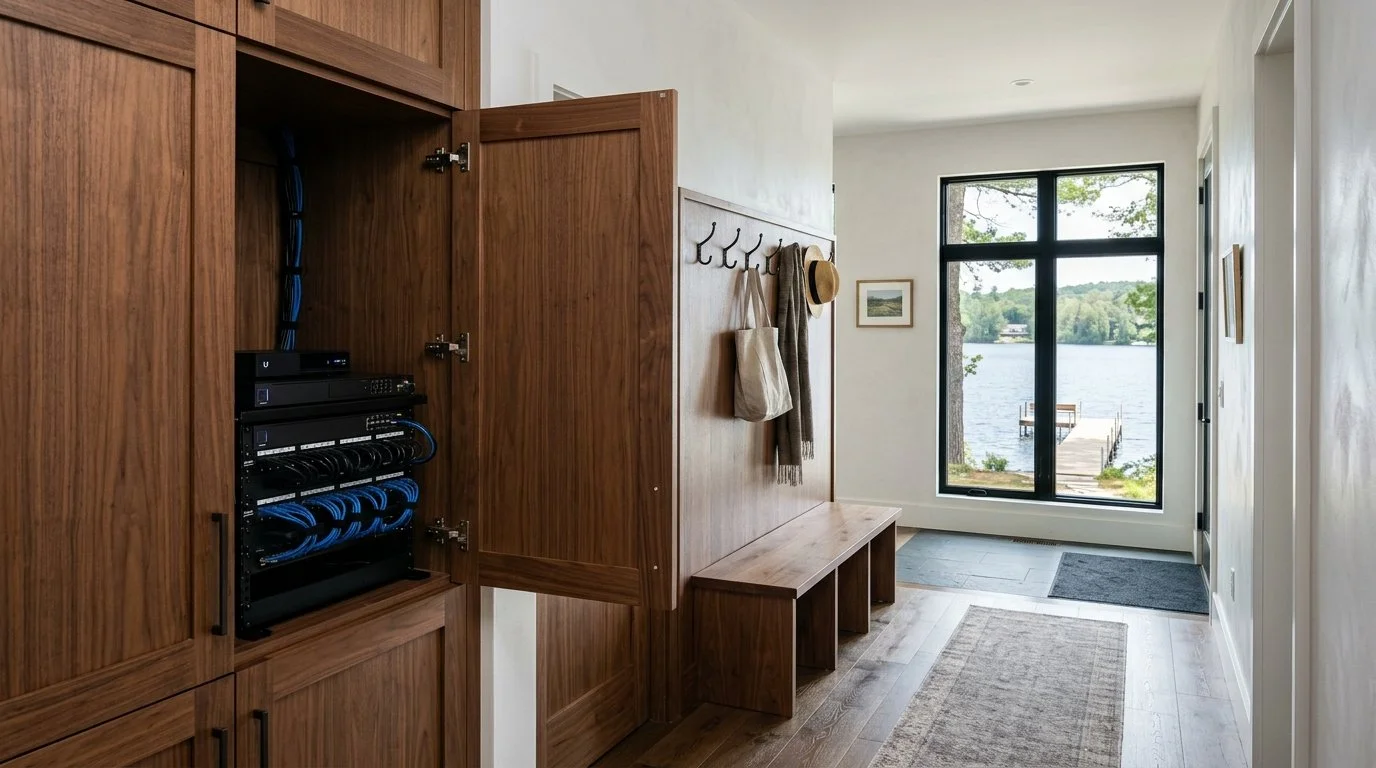
Walnut millwork cabinet in a back hall opened to show a network video recorder.
Sensors That Don’t Record a Face
For rooms where cameras don’t belong, chipmakers are building radar instead. Asahi Kasei Microdevices, a Japanese maker, began mass producing a millimeter wave radar module meant for bathrooms and bedrooms. It detects a person down to their breathing and never captures an image. Carnegie Mellon researchers found radar couldn’t pick up fine detail such as facial expressions, which is exactly why it suits a private room.
Cameras themselves are opening up as well. Matter, the open smart home standard run by the Connectivity Standards Alliance, added cameras to its specification, with local and remote access and privacy zones built in. It’s worth asking the integrator whether a camera can join other makers’ systems on an open standard, or only works inside its own app.
Build for the Camera After This One
Of everything on the plan, the camera is the piece most likely to be replaced, and the housing and the box behind it will outlast it by years. Size the housing opening with room to spare, and ask for conduit to each camera location so a new cable can be pulled without opening a finished wall. Then the next camera is a swap, and the stone pier and the trim stay exactly as the architect detailed them.
This is general information, not legal or security design advice. Recording laws vary by state; confirm with the client’s attorney and the project’s integrator.