The Elemental Kitchen
Before a new molcajete ever touches a chile or a clove of garlic, it gets a rougher job first. Grind a handful of raw white rice and a spoonful of salt against the stone, over and over, until the grit stops running gray. That first grinding scrapes off the loose grains left behind by the carving, the ones that would otherwise turn up in your salsa. It's not a step you skip if you want the stone to actually work. That's the real difference between a permanent kitchen and a convenient one. Permanence asks something of you first.
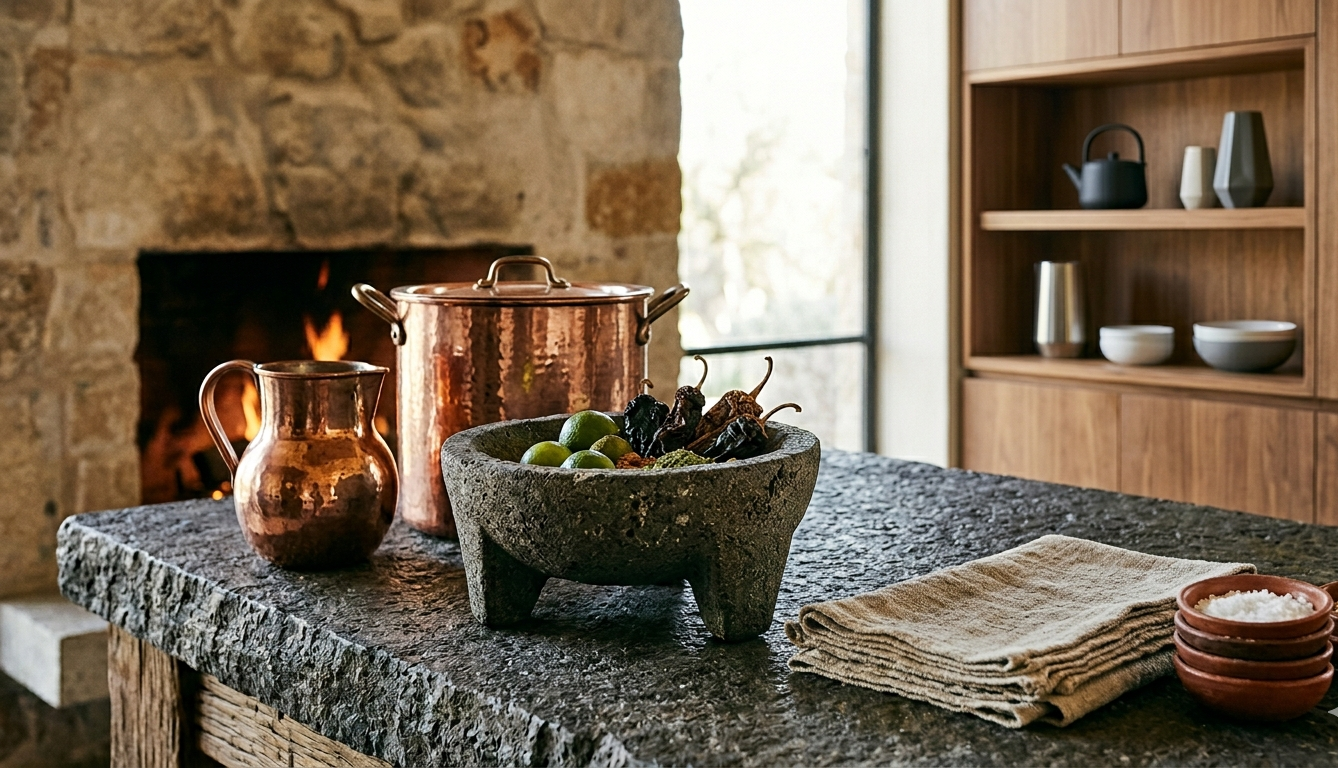
Basalt molcajete and copper cookware on a dark stone counter in a modern kitchen with a warm hearth.
The Stone That Grinds, Not Blends
A molcajete is carved from a single block of vesicular basalt, the kind full of tiny air pockets left behind when volcanic rock cools fast. Mine came out of workshops in Puebla and Jalisco, where the craft goes back to the Aztec and Maya, who ground the same way in the same material long before a Spanish kitchen ever asked for one. The porous surface does something a blender can't. Grinding ruptures the cell walls of a chile or a clove of garlic instead of slicing through them, and that releases oils and aromatics a blade cuts past without touching. The stone doesn't dull the way a blade does either. As the tiny bubbles at the surface wear down with use, they expose fresh texture underneath, so a molcajete worked for twenty years grinds better than one still in its box.
The Copper That Answers to Heat
Copper conducts heat at roughly 392 watts per meter kelvin, which is why a copper pot heats faster and more evenly than almost anything else you can put on a burner, and why a sauce reduces without the scorched ring that shows up in a heavier stainless pan. I don't spec copper for a kitchen unless it's actually going on the stove, not just sitting out to be looked at, because the metal only earns its place in real heat. Coppersmiths in Santa Clara del Cobre, Michoacán, have hammered the metal by hand since before the Spanish arrived. The Purépecha worked copper there long before the town had its current name, and in 1538 the bishop organizing the region's crafts assigned coppersmithing to Santa Clara specifically, so neighboring villages wouldn't compete for the same trade. The copper mines nearby ran dry decades ago. What the workshops hammer today is mostly recycled scrap, old wire and cable pulled apart and melted down again. Every copper pot needs a lining, usually tin, because copper reacts with anything acidic, and a tomato sauce or a squeeze of lime will turn both the food and the metal the wrong direction. Tin starts to soften above roughly 425 degrees, so a copper pot that's had years of real use eventually goes back to be relined, maybe once a decade with real care. The one place copper works fine bare is sugar and egg work, since neither reacts with it, which is why confectioners kept unlined kettles long after everyone else moved on.
The Press That Works on Leverage
A cast iron tortilla press is two flat plates hinged at the back, with a lever that turns a small amount of hand pressure into the even, downward force it takes to flatten a ball of masa into a perfect round. Before the press existed, that same flattening happened by hand, clapped rapidly between the palms or rolled thin the way you'd roll pastry, both slower and less even. The mechanics are simple but easy to miss. A wider plate spreads the same force over more surface, which is why a larger press leaves a tortilla the same thickness at the center as at the edge instead of thick in the middle and ragged at the rim. The same leverage handles anything else that calls for uniform, heavy pressure, seed crackers or heritage flatbreads, whatever the kitchen needs that day.
The Wood That Takes the Oil, Not the Sealant
I keep coming back to Tzalam for anything that touches the hand directly, a rolling pin or a spoon with a long handle, since its density and rot resistance are already established in what I've written about doors and floors. What changes here is the finish. Furniture gets sealed. A tool that touches food gets oiled instead, food grade mineral oil worked into the grain by hand and reapplied as the wood absorbs it, never a topcoat that would seal the surface shut. The wood keeps breathing. That's the whole reason to choose it here instead of somewhere it would only sit and be looked at.
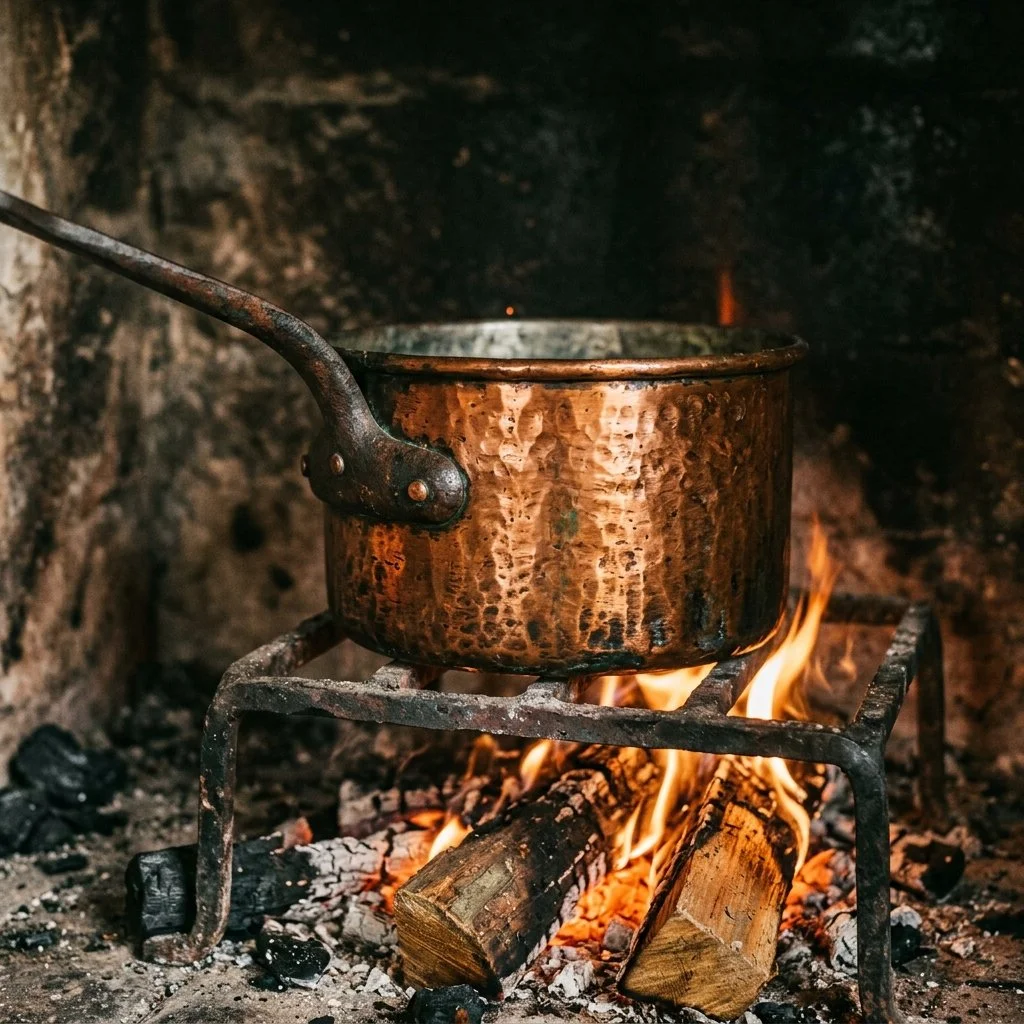
A hand hammered copper pot with visible mallet marks and a rustic patina.
The Clay That Pulls Moisture the Wrong Way
Terracotta means baked earth in Italian, and the name describes exactly what it is: clay fired at a relatively low temperature so it stays porous instead of vitrifying shut. Salt kept in wood or plastic pulls moisture from the air and clumps. Salt kept in unglazed terracotta doesn't, because the clay's own pores draw that moisture out of the salt and hold it in the vessel wall, where it evaporates off the outside instead.
The Kitchen That Gets Better With Use
Every one of these pieces improves with exactly the use that would ruin something cheaper. The molcajete grinds better once its surface has been worked in. The copper needs its lining renewed every decade because it's actually being used for what it's for. The press wears smooth at the hinge. The wood darkens and takes the oil more evenly the longer it's handled. The terracotta keeps doing its job precisely because it stays unglazed. None of that is an argument for buying less. It's an argument for buying the kind of thing that was built to be used constantly rather than protected. For the stone, I still go back to the same carvers in Puebla and Jalisco. They quarry and shape basalt the same way they always have. For the copper, it's worth seeking a piece that actually came out of a workshop in Michoacán, hammered by hand, rather than one that only looks like it was.
