The French Zinc Bar Is Cast Tin
The counter Parisians call le zinc is a top of cast tin, welded in sections over a body of solid wood. The Institut pour les Savoir-Faire Français, France’s national craft institute, says plainly that these counters are wrongly called zinc. It lists their making as a rare craft and counts only three companies in France still doing it. English speakers would call the metal pewter, though the French word étain covers both pure tin and its alloys. I went looking for where the name came from and found that the popular answer was wrong too.
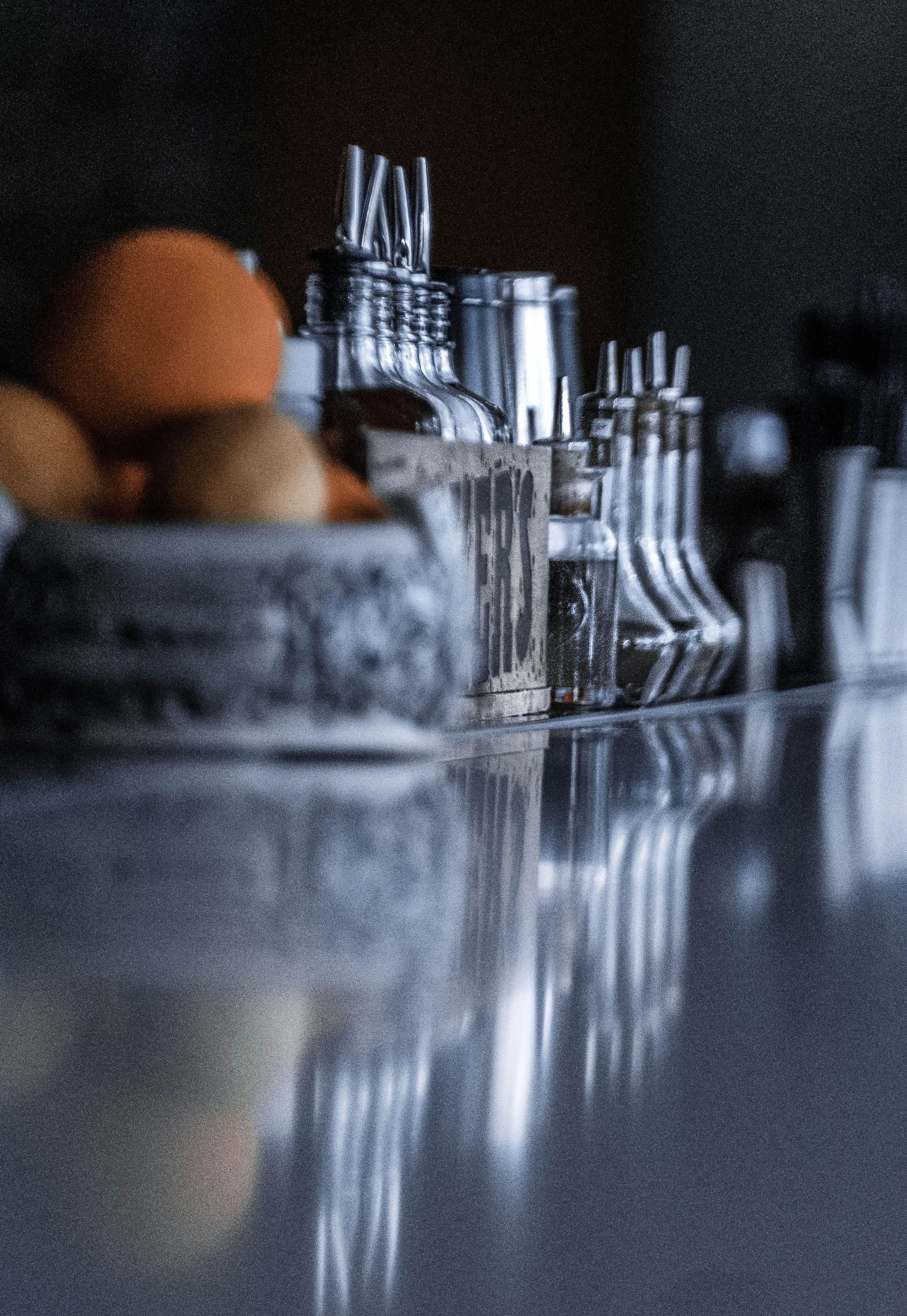
Bright metal bar top on a newer style counter.
Is a French Zinc Bar Actually Zinc?
Mostly no, and the exceptions explain the name. Many old wine merchants’ counters were covered with a sheet of zinc, the same metal on Paris rooftops. Some tops were zinc plated with tin, and one Belle Époque counter by J. Lescure of Paris sold with exactly that construction. Cast tin counters appeared in the nineteenth century, and the word stuck to them.
The word is older than most people assume. The Trésor de la langue française dates zinc as a name for the counter to 1873, in Zola’s novel Le Ventre de Paris. In 1894 the slang dictionary of Charles Virmaître credited the word to the lead covering the counter, a third metal in a story that already had two.
Where the Melted Counter Story Breaks
A French wire report and the City of Paris website have both repeated the story that zinc is a mangled form of Zinn, the German word for tin. In that version, the name came from the occupation, when counters were melted down for shell parts during the Second World War. Half of it happened. The craft institute confirms that the German army requisitioned many counters for their tin during that war.
The name came first, by close to seventy years. Zola was writing zinc for a counter in 1873, decades before the occupation. I’d rather hand a designer the dated fact than the better story.
How a Tin Counter Is Built
The base is solid wood joinery, often oak, made to fit the exact spot where the counter will stand. Each workshop works to its own tin alloy, and French makers have been barred from adding lead to it since 2000. The metal is melted and poured into steel molds for the decorative front edge, called the bordure. Its profile follows a period such as Art Nouveau or Art Deco, and some workshops still pour into old molds to match a specific era.
The cast pieces are welded together to wrap the body. The top is then planed with progressively finer blades and sanded until the weld lines disappear. A 2021 wire report carried by Médias24 described each counter at Ateliers Nectoux as about a hundred hours of work, poured from pure tin ingots imported from Indonesia.
Three Workshops Left in France
There is no diploma for this work. Cabinetmaking school covers the wooden body, but the tin itself is learned beside people who already know it. After the war, production held on mainly around Paris and the north, with pockets in Lyon and Marseille.
Ateliers Nectoux is the one I could trace by name. Marcel Nectoux opened it in 1930 on rue de Charonne in Paris, and it moved to Puteaux in 1995 and to Dax in 2011. The institute notes that these makers sell to interior architects as well as bars, with orders going abroad, especially to the United States. If I were specifying one, Nectoux is the workshop I’d call first.
Pewter or Zinc for a Kitchen or Bar
The two read differently from across a room. Zinc darkens with use toward a blue gray. Pewter reads brighter. Bastille Metal Works casts both for homes and bars in North America, and ARCHITECT magazine reported its pewter at 99 percent tin and 1 percent copper.
Both are living finishes. The craft institute describes tin as rustproof, but it still takes on a patina over time that warms the look of new metal, much the way unlacquered bronze changes where hands touch it. A client who wants the counter to stay exactly as it looked on install day should choose a different surface. Ask the fabricator to put care guidance in writing before the top ships.
The Lead Question on an Antique Bar
Antique French bars with original tin tops turn up regularly on dealer sites, and that is where the real risk sits. The 2000 ban on lead applies only to counters made since then. In 1860 the Encyclopaedia Britannica recorded that French law allowed pewter of 82 parts tin to 18 parts lead for vessels holding wine and vinegar. No one can tell you what an old counter’s tin holds without testing it.
Idaho’s public health guidance on antiques advises treating old pewter as if it contains lead. Before an old top goes into a kitchen or a working bar, have it tested. For a new top, ask the maker to state the alloy and its lead content in writing.
A Name That Outlived Its Metal
Zinc is the word France kept, and cast tin is the metal its few remaining workshops still pour. The useful habit for a designer is to write the real metal on the drawings, so the fabricator and the client are reading the same thing. That one line on a spec sheet decides whether the counter ages like a Paris bar or like a Paris roof.