How Versailles Parquet Is Built
Versailles parquet is a floor of square oak panels, first built for Louis XIV’s palace in the 1680s. Each panel is a frame holding short pieces laid in an interlaced diagonal pattern. The traditional panel holds together with mortise and tenon joints and wooden pegs, but the name now covers engineered boards, reclaimed oak, stone and vinyl. From a few feet away most of them look alike. Underneath they are different floors, and the difference belongs on the spec before anyone orders.
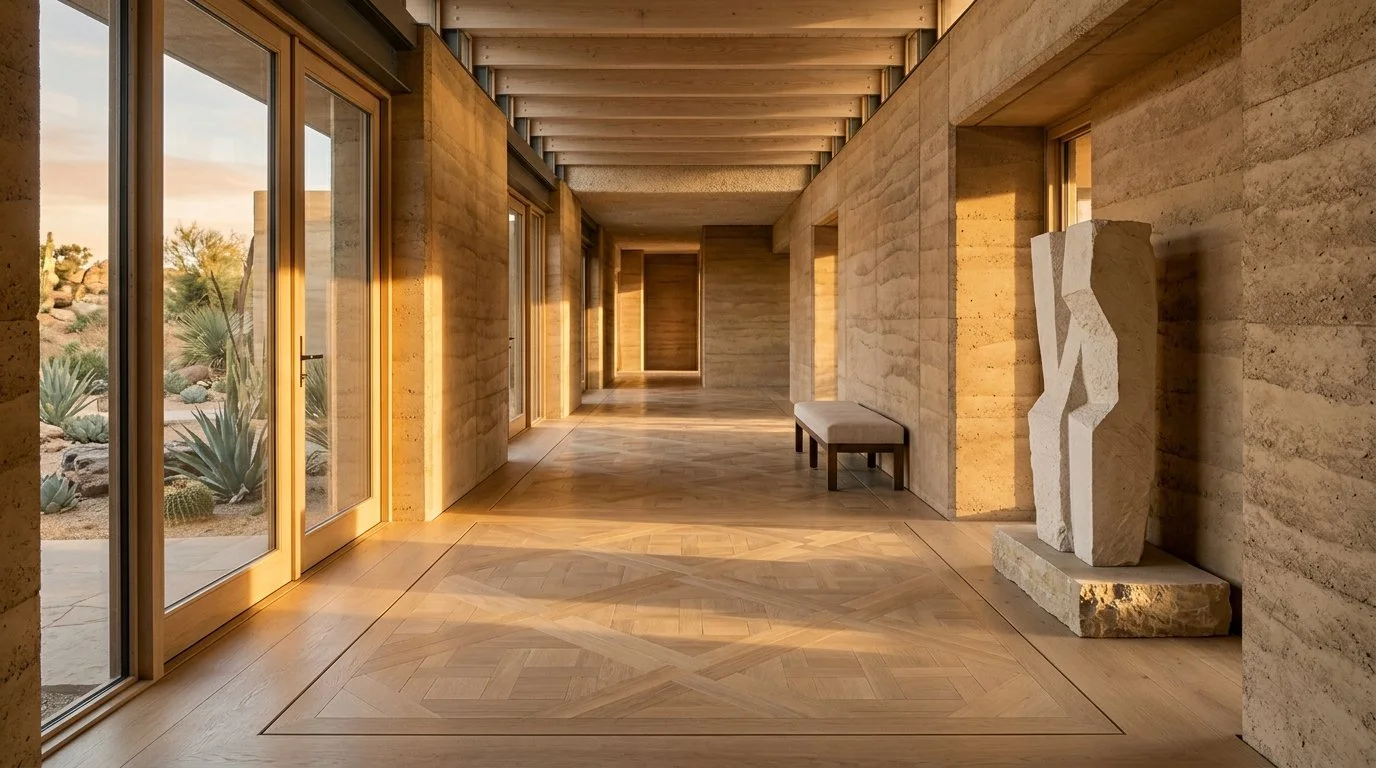
A long gallery hallway with rammed earth walls and a pale oak parquet floor of square patterned panels.
Oak Replaced Marble at Versailles
The palace had marble floors first. The British flooring company Ecora, quoted by the design site Core77, wrote that floors like these were costly to maintain and damaged the joists and timber frames beneath them. Oak panels laid on the diagonal replaced them, and the Hall of Mirrors is laid that way today, with pieces the French dealer BCA calls navettes set between the squares. Nele Lüttmann, writing for the site Craft Value, traced the copies that followed to the Prussian and Saxon courts, including Augustus the Strong’s Moritzburg Palace in the early 1700s.
The floor in that gallery today is not the 1680s floor. The French trade journal Cahiers Techniques du Bâtiment reported that a restoration program scheduled for 2004 to 2009, with the construction group Vinci as patron, relaid about 750 square meters of oak parquet there. Parqueterie Beau Soleil, a workshop in the Nièvre, says it built those panels in 2007. The paneled walls of rooms like these used the same idea at a larger scale, a frame holding the wood inside it.
How a Traditional Panel Is Joined
A traditional panel uses no glue. Beau Soleil describes its squares and frame pieces as cut for mortise and tenon joints that need none, in panels 23 millimeters thick with a 9 millimeter wear layer. Parqueterie Gagnieu, another French maker, joins the interlaced pieces with tongue and groove and pegs the mortise and tenon joints at the four corners of the frame. It also offers to build panels the way the originals were made, with mortise and tenon throughout.
So two serious French workshops describe the traditional panel differently, and each is describing its own real work. That alone undoes the fixed joint count some dealer sites state as a rule. The useful question for a maker is which joints are pegged and which are tongue and groove. If you build panels this way by hand, I’d like to see how you cut them.
Do Wooden Pegs Prove Traditional Joinery?
No. Beau Soleil, the workshop credited with the Hall of Mirrors panels, sells its own panels with or without decorative pegs. A peg can hold a joint or be there for the look of one, and only the maker can say which.
The pieces inside the frame are worth asking about too. The maker Bohemian Works says it cuts each cross in the pattern from one piece of wood. It says most industrial producers glue separate short pieces together instead, and those can shrink or come loose as humidity changes. That is a maker describing its competitors, so I read it as a question to ask, not a fact about every factory.
What an Engineered Versailles Panel Is
An engineered panel is a layer of oak pieces glued to a plywood base. Parador, a German flooring company, listed one 15 millimeters thick with a 3.5 millimeter oak top layer, and required it to be glued down across the whole floor by a professional. The top layer is the only part that can be sanded, so its thickness decides how many times the floor can be refinished. Sellers listed top layers of roughly 3 to 6 millimeters, against the 9 millimeters Beau Soleil gives for its solid panel.
Sellers of engineered panels list them for underfloor heating. One British retailer’s installation guide still warned that oak pieces set in different directions over plywood react to temperature swings. It asked for the heating to be tested first and brought up gradually. Check the manufacturer’s installation guide for the humidity range the floor needs, and whether the house can hold it through winter.
Old Oak in New Panels
BCA Matériaux Anciens, which sells both antique and new panels, says true antique Versailles parquet is now very rare. What’s offered, it says, is very often new panels made from old oak. That is a real product and often a beautiful one. The Reclaimed Flooring Company described cutting blocks from reclaimed French floorboards and fitting each one by hand to its neighbor, because old oak surfaces are uneven.
Some new oak is made to look old without stain. Pave HDM described a process of seven to ten steps that reacts with the oak’s own tannins and changes the color through the wood rather than on top of it. For a restoration that needs a documented floor, ask the dealer what building the panels came out of. Ask too whether they are original panels or new ones made from old boards.
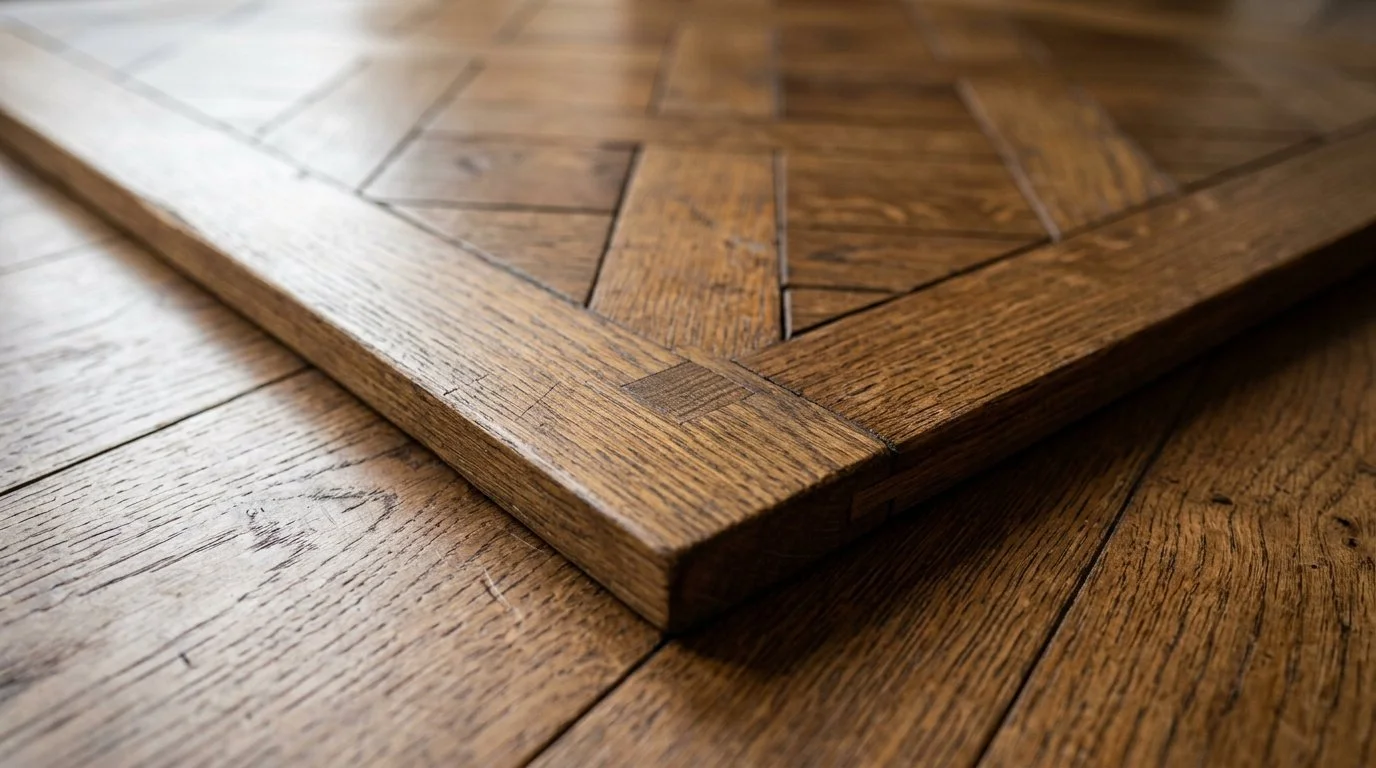
Close view of an oak parquet panel corner joined with a square wooden peg.
The Pattern Without the Wood
The drawing has also moved into stone. De Ferranti in London sells the Versailles layout in white marble and in near black limestone, and Google’s suggestions for the phrase included vinyl versions. None of these is parquet, and none has a joint inside it.
There’s a second trap in the name. Havwoods, an oak flooring company, separates Versailles parquet from the Versailles tile pattern, which it describes as usually travertine and traditionally used outdoors. Country Floors describes that tile pattern as four stone sizes repeating as a module. A spec that says only “Versailles” can come back as either one.
A Floor Built to Be Lifted Again
A panel held by its own joints is joinery, and old sets still turn up at dealers now and then, lifted out of houses to be laid again somewhere else. An engineered panel glued to a slab is a finish, often a good one, meant to stay where it was laid. Both are honest floors when the spec says which one it is.
That’s the choice to put to the client before any samples come out, a floor of joinery, or a finish carrying the same drawing. The photograph they brought in shows only the drawing.