Soft Quartzite Is Marble
Soft quartzite is a name stone yards give to marble, most often dolomitic marble, when it’s sold as the harder stone. The Natural Stone Institute’s quartzite bulletin rejects the term outright, there is only one kind of quartzite, hard and resistant to etching. A slab yard can carry three different rocks under the word quartzite, and only one of them is quartzite. That matters because a client rarely picks quartzite for its looks alone. They pick it to get marble’s veining without marble’s reaction to a squeeze of lime. If the slab turns out to be marble, the client paid for a promise the stone never made.
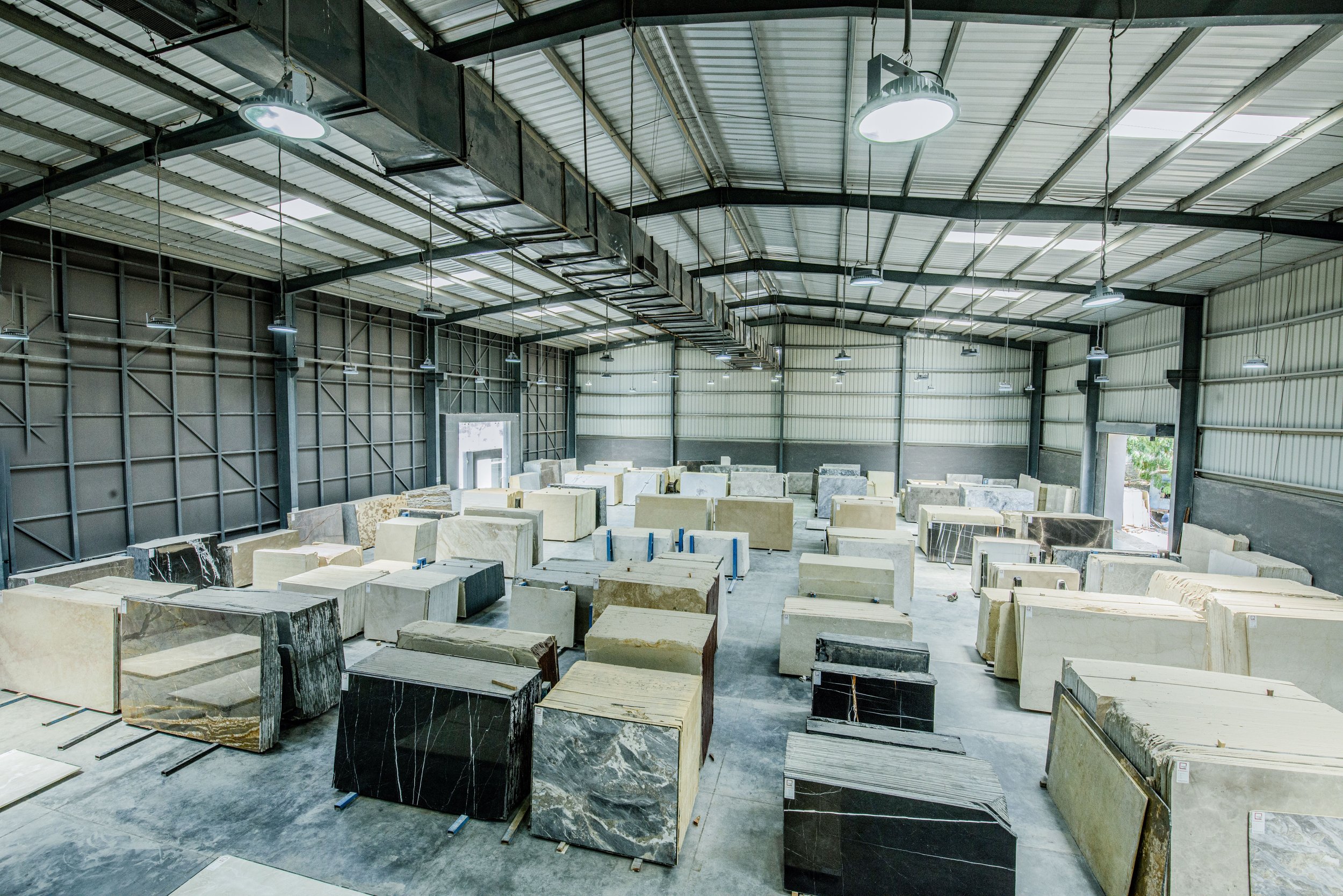
Stone yard warehouse.
Why the Name Slipped
Geologist Karin Kirk, who wrote that bulletin, named Super White and Fantasy Brown in a 2018 Building Stone Magazine article as marbles that had been widely sold as quartzite. Many dealers had started relabeling them. The trade’s habit of giving stones its own house names still made any single stone hard to track.
The confusion runs in both directions. At a 2022 stone industry session, Buddy Ontra, then president of the Natural Stone Institute, recalled being told the first Taj Mahal he cut, around 2009, was granite. Taj Mahal is real quartzite. The same discussion turned up Shadow Storm and Carrara Quartzite, sold under the quartzite name in one participant’s area, as Brazilian marbles.
The two rocks come by their resemblance honestly. Quartzite begins as sandstone, buried and heated until the sand grains recrystallize into one solid mass of quartz. Marble forms the same way from limestone or dolostone, so it stays calcite or dolomite. Even a trained eye can’t sort them, in Kirk’s view.
How Do You Tell Quartzite From Marble?
Hardness answers it. Quartz sits around 7 on the Mohs scale and glass around 5.5. The Kansas Geological Survey puts calcite at 3 and dolomite at 3.5 to 4. So quartzite scratches glass and marble cannot.
The method Kirk teaches starts with a glass tile laid flat on a table, never held in your palm. Take a sharp raw edge of the stone with no epoxy on it and press with your weight behind it. Real quartzite bites, loud enough to hear, and the scratch won’t rub off. Marble glides across, or leaves a line that rubs away. Try a second spot, since some marbles hold small pockets of quartz that can fool one pass.
With no offcut available, a knife tip on the slab edge does the same job, with the yard’s permission. Marble takes an obvious scratch. Quartzite takes nothing a fingernail can catch.
Dolomite Needs a Second Drop
The acid test confirms what the glass found. The standard is a single drop of 10 percent hydrochloric acid on unsealed stone. Calcite marble fizzes, which is the stone dissolving. Quartzite does nothing at all.
Dolomitic marble can sit there looking innocent. Scrape a little powder loose with the knife tip and put the drop on the powder instead, and dolomite gives itself away with small bubbles. Quartzite barely gives up any powder to test. Lemon juice or vinegar works as a slow version. Leave it at least 15 minutes, then look for a dull patch, or one that reads lighter or darker than the stone around it.
None of this makes dolomite a bad stone. It etches more slowly than calcite marble, which gives a client a short window to catch a spill. It just isn’t quartzite, and it shouldn’t be priced or promised as one.
Sandstone Is the Smaller Mistake
Sandstone sold as quartzite is a milder error, because both are mostly quartz and behave much alike. Porosity is the real difference, and porosity decides staining. Metamorphism comes in grades, so quartzites run along a continuum. Kirk put White Macaubas close to sandstone in porosity and Taj Mahal at the dense end, and some quartzites absorb more than some sandstones. ASTM C616, the specification for quartz based dimension stone, draws its lines by free silica content, with sandstone, quartzitic sandstone, and quartzite as Classes I, II and III.
A stone that passes the glass test can still drink red wine. A few drops of water on an unsealed sample show how fast it absorbs. Sealing is its own subject, covered in A Stone Sealer Stops Stains, Not Etching.
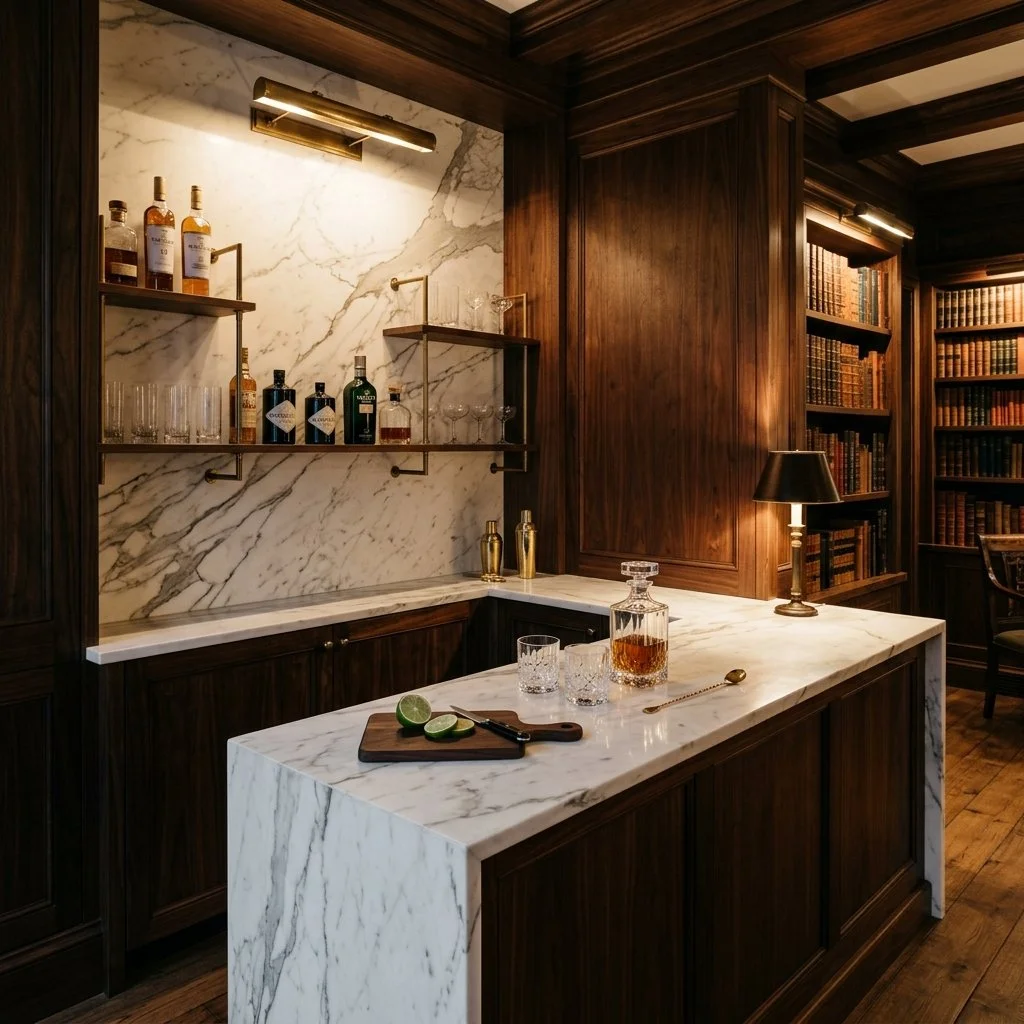
Wet bar in a paneled library with a white veined stone counter and backsplash.
The Shop Cutting It Reads the Label Too
The label matters past the client’s counter. A California workplace safety evaluation in April 2026 listed natural quartzite at more than 90 percent crystalline silica, against 10 to 45 percent for granite and under 5 percent for marble. Engineered quartz, the material behind California’s countertop silicosis cases, typically runs above 90 percent too, according to state public health researchers. A slab drifting between the words marble and quartzite tells a fabrication shop the wrong thing about the dust it is about to make.
Three Years Is the Shelf Life of a Test
A yard name and a price tag settle nothing about what a slab is. Reliable stone companies keep physical property test data on their stones, and ASTM’s guide on stone test sampling recommended that the data come from the previous three years. Kirk added that a shift in the quarry face calls for fresh testing. The two people worth working with are an importer who can hand over current lab data, and a fabricator willing to run the glass and acid tests on an offcut before anyone templates the slab. I’d ask to see the date on that data sheet before I’d ask the stone’s name.
