A Bathroom Is Either Built or Installed
Travertine gets its texture from gas, not water. As water rich in minerals rises to a hot spring's surface and meets the air, it releases carbon dioxide, and the bubbles that escape leave pockets running through every block that forms afterward. What looks like an ornamental surface is really a record of something leaving the stone in a hurry.
Most of what separates a real bathroom from a merely expensive one, to me, comes down to how honestly it treats what the stone actually is. Not how well the room hides it.
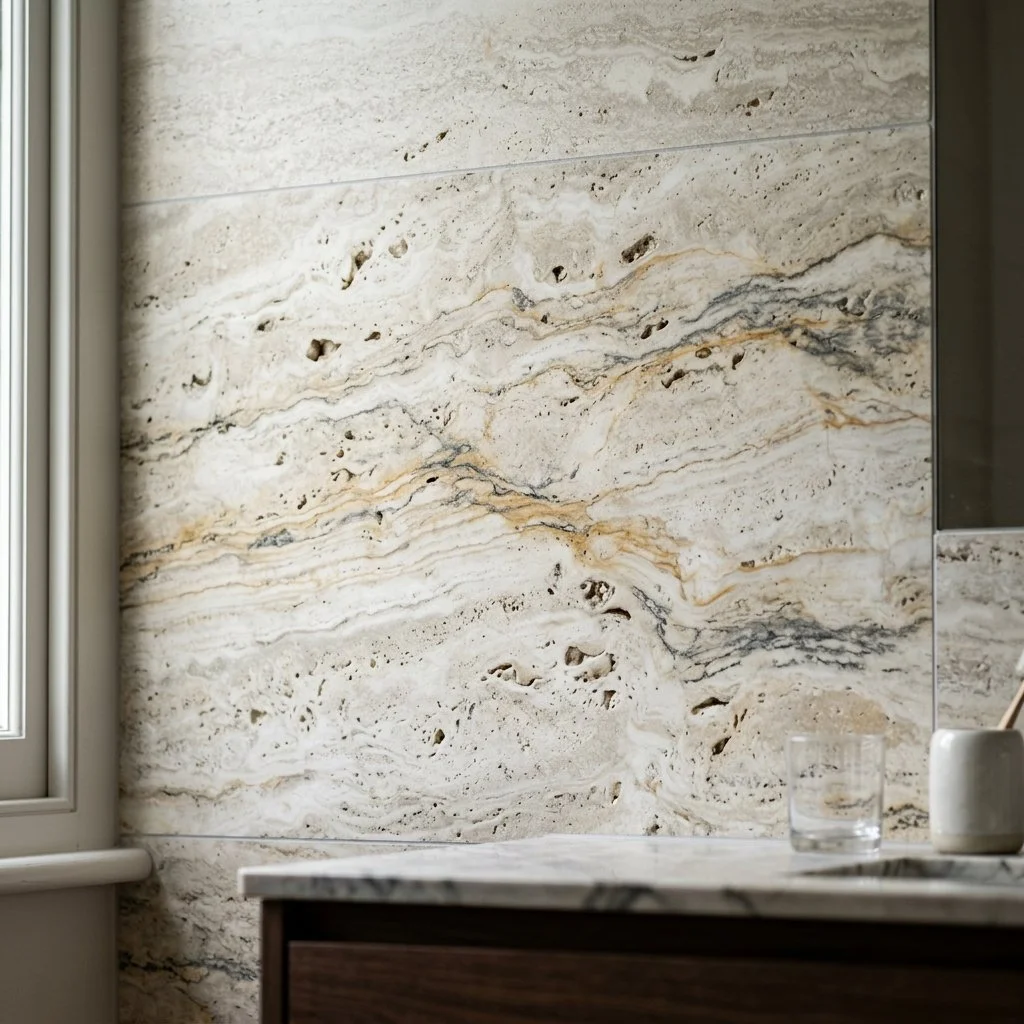
Honed silver travertine bathroom wall panel featuring natural porous texture and oyster, warm ochre, and graphite grey veining.
What the Stone Actually Is
Limestone forms in shallow seas over millions of years, as calcium carbonate from shells and coral compresses into rock. Cut a slab open and you can sometimes find the fossil itself: a shell fragment, or a pinhole where one used to sit. It's dense enough for a bathroom floor and porous enough that it needs sealing before it meets water, a plain fact that gets left out of a lot of showroom pitches.
Travertine is limestone's louder cousin, made the same way but through hot spring water instead of ocean sediment. Denizli, Turkey, the province surrounding the famous white terraces at Pamukkale, has roughly forty working quarries producing much of the world's supply. The protected terraces themselves are never touched. The trapped gas leaves real holes, not a printed pattern meant to look like holes. A fabricator can fill those with resin or grout to match the stone's color, which most professionals recommend anywhere water actually sits, a shower floor or wall, since an open pore in a wet zone collects grime and can hold mold no sealer fully solves. Left unfilled, the same stone reads rougher and shows its formation honestly, a choice that still works on a dry powder room wall or a feature wall outside the spray. It's a real tradeoff tied to where the water goes, not a style preference, and I ask which zone I'm specifying for before I ask which finish looks better.
The Vanity That Doesn't Have Seams
A vanity carved from a single block of stone has no caulk line where the basin meets the counter, because there was never a seam to begin with. The bowl and the deck were one piece of rock before anyone touched it with a chisel. Water runs back into itself instead of pooling at a joint, a small mechanical advantage most people never notice until the version with the seam starts to stain.
It's also heavier than photographs ever convey, and that isn't a small detail to me. A basalt slab vanity barely two and a half feet wide can run over a hundred pounds before a faucet is even mounted. That weight is real evidence of the material behind it. A stone veneer bonded over a lighter substrate can look identical in a listing photo and weigh a fraction of that, which matters the day someone has to hang it on a wall.
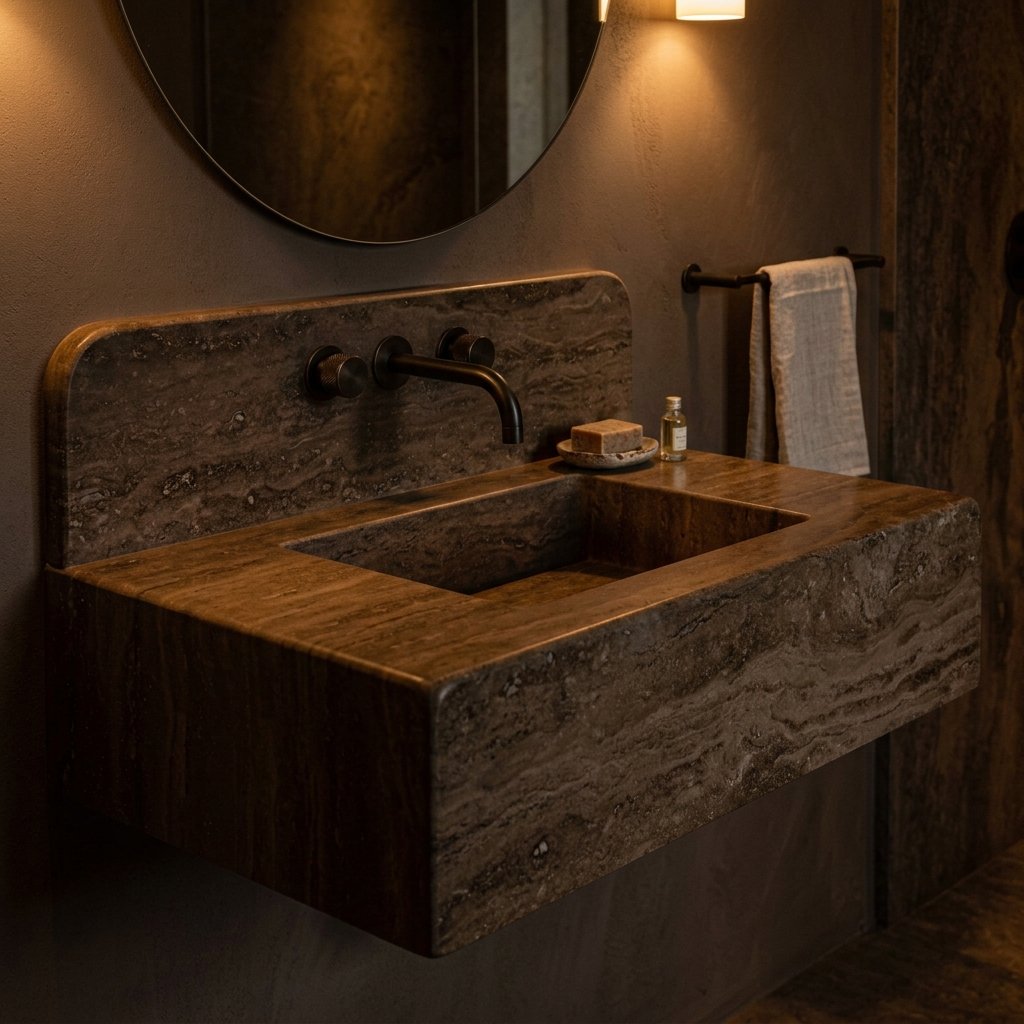
Floating vanity hand carved from deep brown, richly veined natural stone with a seamlessly integrated basin.
The Drain Decides the Floor
A center drain pulls the floor toward it from four directions at once, which limits how large a tile or stone slab you can lay without the corners reading choppy. A linear drain only needs the floor sloped one way, at a code minimum of a quarter inch per foot, so a single wide stone panel can run the length of the shower without a seam breaking up the surface. The strainer sits flush and tile-in, finished in the same stone as the floor, so the drain itself nearly disappears into the plane it drains.
That decision, made early with the plumber and not the tile setter, is the one I flag first on any bath, because it decides whether the floor reads as one continuous surface or a floor interrupted by a fixture.
The Room That Admits What It's Made Of
None of this is decoration. The pores are the record of how the stone actually formed, filled or left open depending on where water goes. The seam that was never cut is a mechanical decision, not a style one. Neither is meant to be noticed. Both are meant to work, and to keep working, for longer than most of the fixtures around them. A vanity's weight is one piece of that evidence, not the whole case for it. Whether the stone stays honed or gets sealed against years of steam is a separate conversation, one Care & Preservation covers in more depth. What I actually ask a fabricator, before color or finish, is what the material is doing when no one's looking at it.
