The Rug You Choose, and the One Underneath It
I keep seeing the same move in the best rooms: a smaller wool rug knotted by hand, set on top of a larger, flatter one woven from agave fiber, the coarse edge showing at the border like a frame. It isn't a styling trick. One material comes from a plant, the other from an animal, and each is processed in a completely different way to do a different job on the same floor. One grew in one of the driest deserts in North America, while the other came off a sheep at altitude. Getting either one right took more than choosing a color.

A master suite features a layered rug foundation, with a muted indigo hand knotted rug resting flat atop a larger, natural toned Ixtle agave base.
The Desert Layer
The stiff, pale fiber underneath is called ixtle, pulled from the leaves of Agave lechuguilla, a small agave armed with spines that dominates the Chihuahuan Desert across northern Mexico. Only the leaves are useful for this. They're pounded by hand until the long fiber strands separate out, a trade called jarciería that's been passed down for generations. A few workshops in towns like Mina, in Nuevo León, still practice it. Plastic nearly ended that trade a few decades ago. It's coming back now, mostly because people want a floor that grew somewhere real instead of one that was extruded.
Raw ixtle comes off the plant a natural creamy white, without the manufactured evenness a synthetic fiber gets from a dye vat. That paleness is structural, not decorative. It's the reason this fiber reads as a foundation rather than a finish, and why it sits underneath the wool instead of competing with it.
The High Altitude Layer
Wool does something ixtle can't. A single wool fiber is built from two types of cell that grow at slightly different rates, which twists the strand into a tight, spring like coil. That coil is why wool can stretch by close to a third of its length and still snap back to its original shape instead of tearing. A synthetic fiber that gets crushed under a chair leg stays crushed. Wool recovers, often for decades, which is the real reason a wool rug knotted by hand is described as something that improves with use instead of something that simply wears down.
The same fiber carries its own protection. Lanolin, the natural wax sheep produce, coats each strand and repels water and soil before either has a chance to set. None of that is a finish applied at a factory. It's already in the material when it arrives.
Knots, Not Glue
The easiest way to tell a rug knotted by hand from a machine made or tufted one has nothing to do with the front. It's the back. On a true hand knotted rug, a weaver ties each pile knot directly onto a vertical warp thread, then packs it tight with a comb before the next row goes in. Flip the rug over and you see the same pattern in mirror image, because there's no backing hiding it. The fringe isn't stitched on afterward. It's simply the exposed end of the warp, the same threads that ran under the pile the whole time.
A tufted rug is built the opposite way. Yarn gets punched through a canvas backing with a handheld gun, then a layer of latex is glued underneath to hold it in place. The fringe on those pieces is usually a separate strip, sewn on to imitate what the knotted version does naturally.
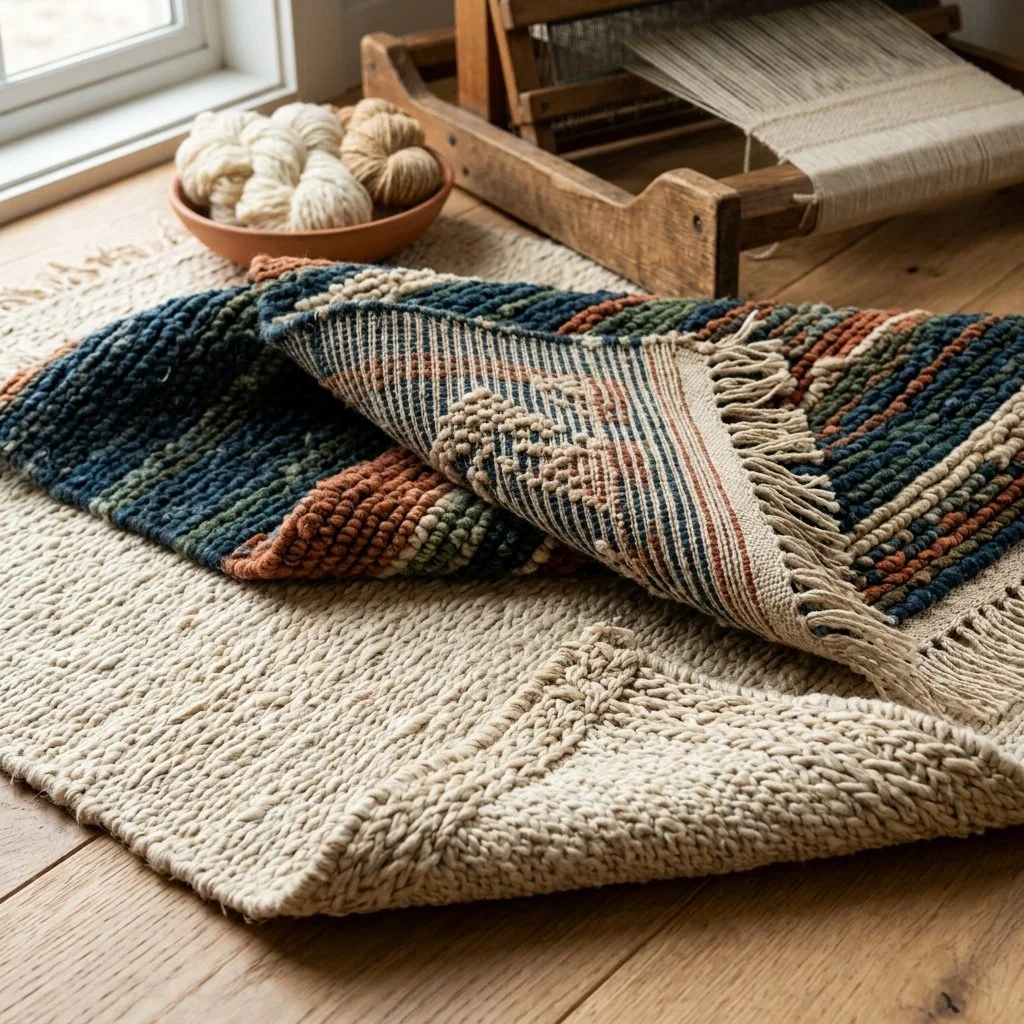
Hand knotted wool rug, resting atop a woven, natural toned Ixtle agave rug.
Check the Back First
A layered rug asks you to trust two different origins at once: a desert plant harvested by hand in northern Mexico, and a fleece grown at altitude somewhere colder. Both earn their place because of how they're made, not just how they look. Before I recommend either one, I check the back for real knots and ask where the ixtle was processed. Color comes after that, never before it.
For sourcing, I go to two different places for two different materials: a specialist rug importer who can show a knotted piece's actual origin and construction, and one of the small cooperative workshops still doing jarciería in northern Mexico for the base underneath it, rather than a mass import warehouse for either.
