Where the Kitchen Ends and the Dinner Begins
A pan dropped mid plating, four burners running while someone's still hunting for the good napkins. Open plan kitchens are built for a family's Tuesday morning, not the twenty minutes before people arrive for dinner. The room that felt generous all day suddenly has nowhere for the work to hide.
Designing kitchens with an actual boundary in mind, one that has nothing to do with square footage and everything to do with what a guest is allowed to see.
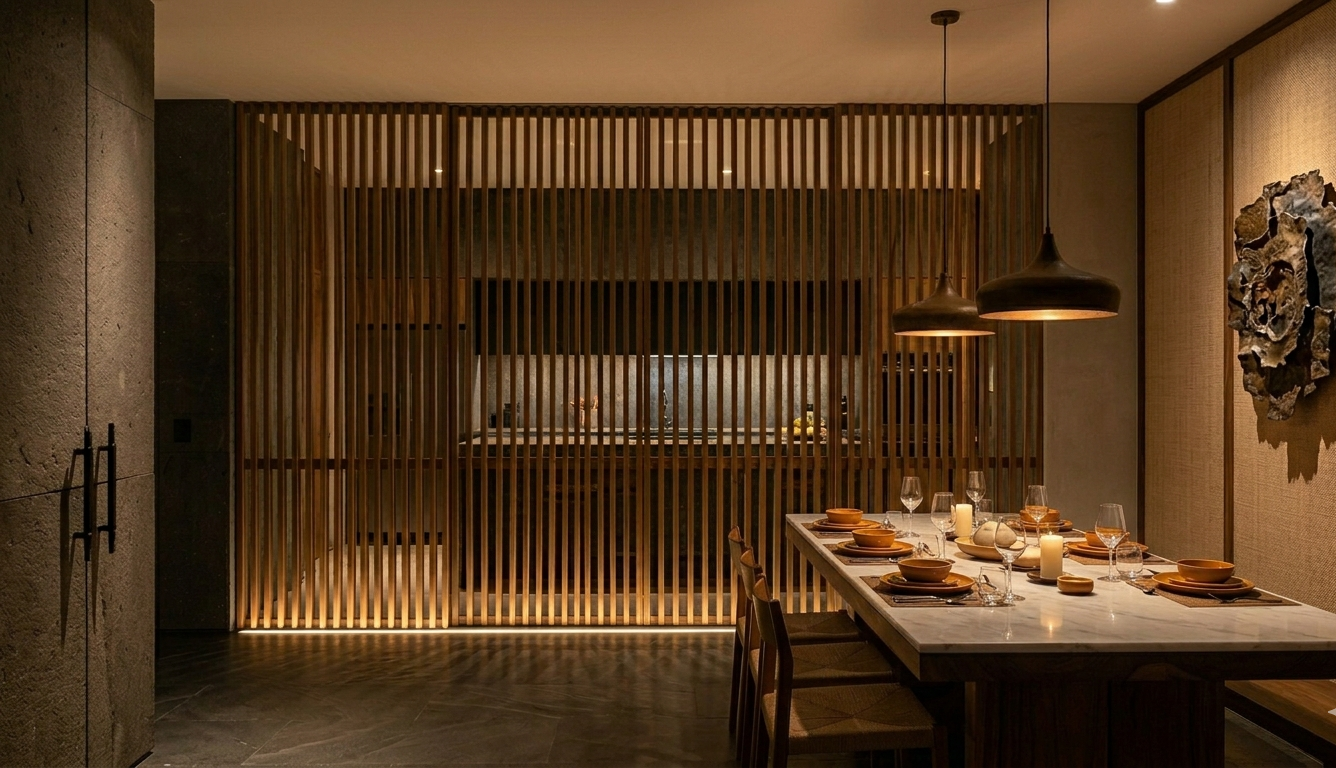
Central slatted Tzalam screen, serves as the primary visual shield, between the kitchen and dining area.
A Screen That Reads as Architecture, Not a Curtain
A floor to ceiling Tzalam screen is my usual answer. Vertical slats block the direct sightline into the work zone while still letting light and conversation pass through the gaps. Tzalam's grain is straight and clearly defined, so each slat reads as its own line rather than a repeated pattern, which matters when you're looking at forty of them at once.
For a softer version, I like heavy tanned leather panels instead. They do for sound what the screen does for sight: a soft surface between the two rooms instead of hard ones knocking noise back and forth. I've also started specifying Henequen, the plant fiber native to the Yucatan that the Maya call Ki. It's the same fiber that built enormous fortunes across the region in the nineteenth century, when the world's ships ran on henequen rope and a war overseas cutting off the competing supply sent prices soaring. Most people still picture it as coarse cordage. A few artisans in Yucatan are weaving it finely enough now that it reads as a textile, set into dark timber frames, with none of the rope like weight the material's history suggests.
The Facade That Hides the Work Behind It
The most effective partition doesn't feel like a partition at all. I like a Cantera stone pantry or prep wall, the same volcanic stone I've used elsewhere as carved objects, here doing the opposite job: a solid, upright mass instead of a shaped one. Clad in it, the working side of the kitchen reads as a permanent part of the house rather than a functional add on.
The detail that actually gets noticed up close is the hardware. Hand forged iron pulls or sandcast bronze handles turn utilitarian cabinetry into the one piece of jewelry the wall is wearing. Neither needs to explain itself. They just need to feel like they were made by someone's hands, because they were.
Light That Chooses What You See
Lighting does more of this work than people expect. I keep the kitchen itself low and amber, almost a background hum, while the dining table gets a warm, sharp pool of light from a low slung, oxidized bronze pendant. The eye follows the brightest point in the room. Put it over the table and the kitchen edges out of view on its own.
Where I want the whole room to feel handmade rather than built, I turn to Chukum, a lime plaster the Maya have used for centuries, made by boiling the bark of the Havardia albicans tree until it releases a tannin rich resin, then mixing that resin with limestone. The result is genuinely waterproof, historically used to line hacienda cisterns and ponds, and it dries to a matte, faintly uneven finish that no machine applied plaster can fake. Its color depends on which of the region's bark varieties went into the mix and how finely the limestone was ground: sometimes a pale beige, sometimes a deeper, almost ash grey. On the wall behind a partition, it gives the room a texture that looks touched rather than sprayed.
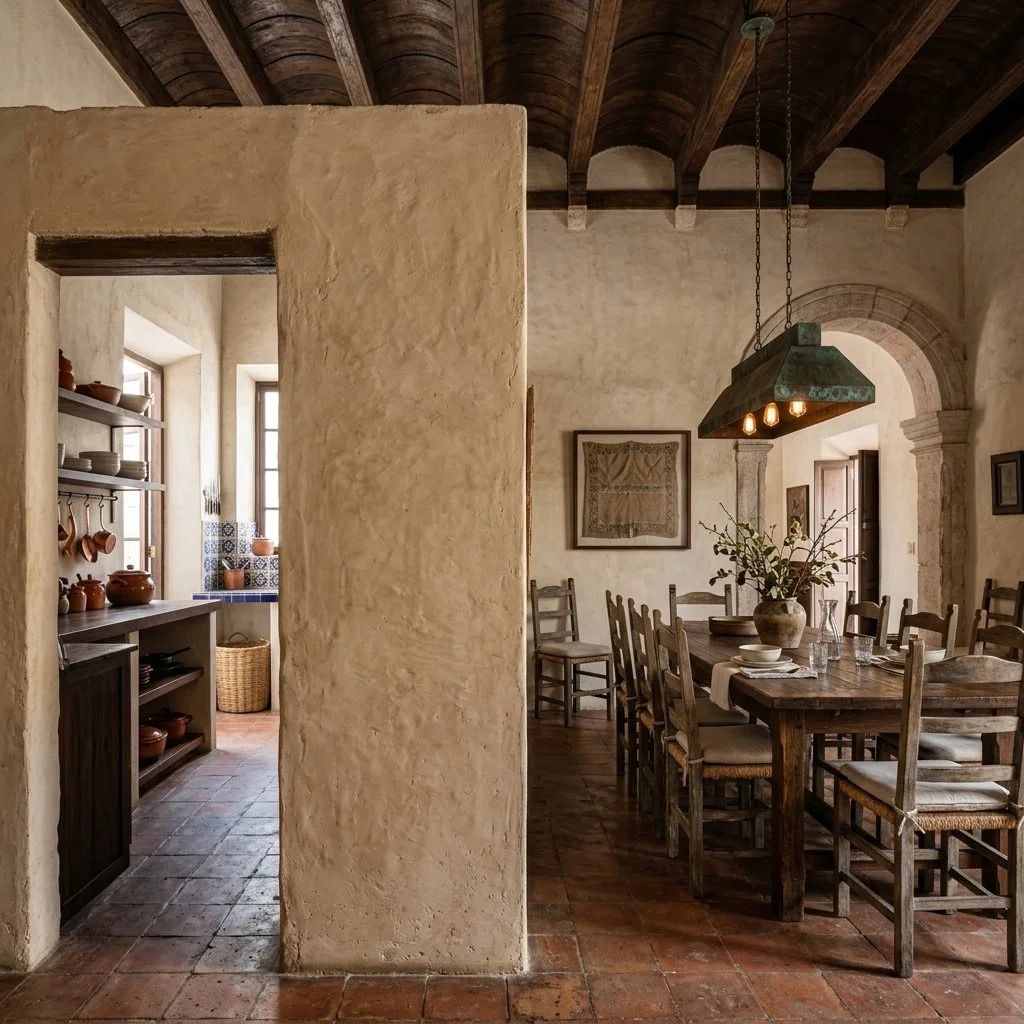
A freestanding Chukum plastered partition divides a dining area from a glimpsed kitchen.
The Work Happens Somewhere Else
The kitchen doesn't disappear behind any of this. What disappears is the fifteen minutes between courses, the plate cleared and the next one set down, happening somewhere the conversation can't see it. That reset is what the partition actually protects.
A partition like this is rarely part of the original plan. It shows up later, once a house has been lived in long enough for someone to admit the layout doesn't work for how they actually host. That makes it exactly the kind of project for whoever already knows your house, the carpenter who built your cabinets, the mason who laid your floors, not a new specialist. You already have the person. You just haven't given them this idea yet.
