The Rug You Choose, and the One Underneath It
Luxury is a tactile conversation. It’s the shift from the structural coarseness of agave to the disciplined, hand knotted softness of highland wool.
I keep seeing the same move in the best rooms: a smaller wool rug knotted by hand, set on top of a larger, flatter one woven from agave fiber, the coarse edge showing at the border like a frame. It isn't a styling trick. One material comes from a plant, the other from an animal, and each is processed in a completely different way to do a different job on the same floor. One grew in one of the driest deserts in North America, while the other came off a sheep at altitude. Getting either one right took more than choosing a color.
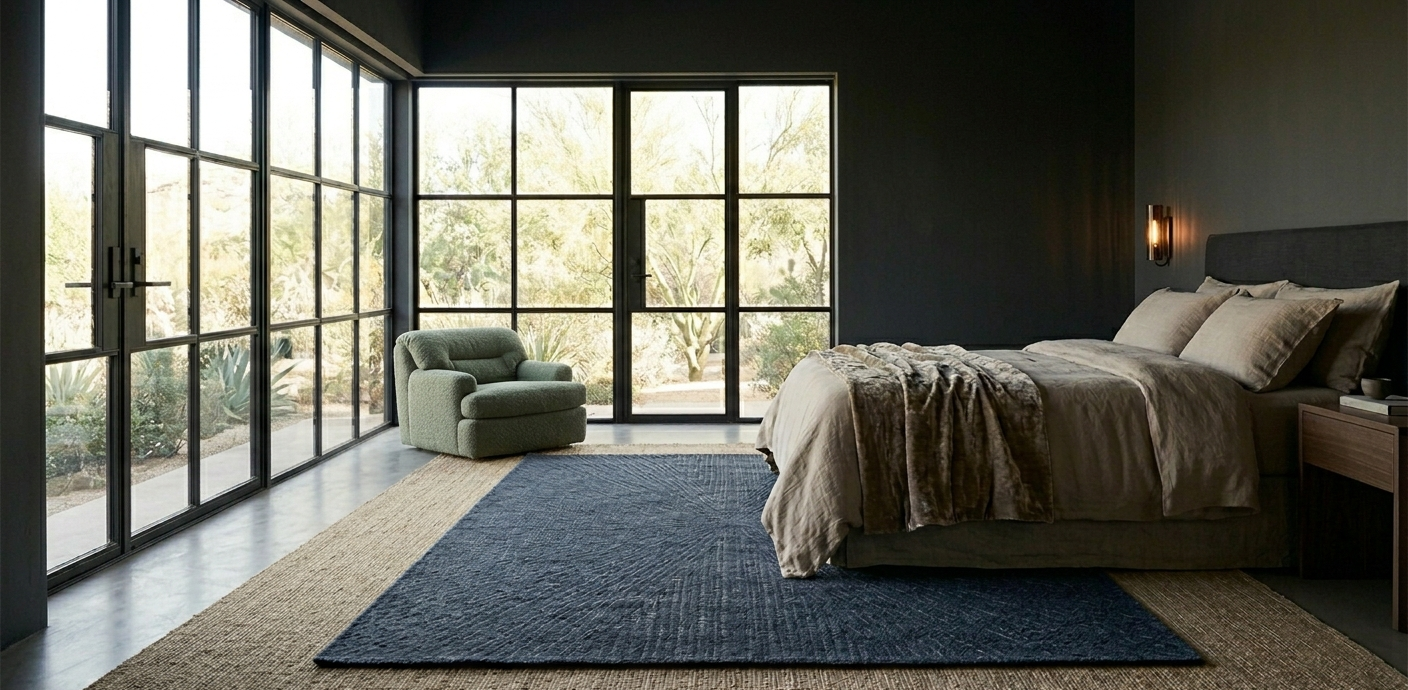
A master suite features a layered rug foundation, with a muted indigo hand knotted rug resting flat atop a larger, natural toned Ixtle agave base.
The Desert Layer
The stiff, pale fiber underneath is called ixtle, pulled from the leaves of Agave lechuguilla, a small agave armed with spines that dominates the Chihuahuan Desert across northern Mexico. Only the leaves are useful for this. They're pounded by hand until the long fiber strands separate out, a trade called jarciería that's been passed down for generations. A few workshops in towns like Mina, in Nuevo León, still practice it. Plastic nearly ended that trade a few decades ago. It's coming back now, mostly because people want a floor that grew somewhere real instead of one that was extruded.
Raw ixtle comes off the plant a natural creamy white, without the manufactured evenness a synthetic fiber gets from a dye vat. That paleness is structural, not decorative. It's the reason this fiber reads as a foundation rather than a finish, and why it sits underneath the wool instead of competing with it.
The High Altitude Layer
Wool does something ixtle can't. A single wool fiber is built from two types of cell that grow at slightly different rates, which twists the strand into a tight, spring like coil. That coil is why wool can stretch by close to a third of its length and still snap back to its original shape instead of tearing. A synthetic fiber that gets crushed under a chair leg stays crushed. Wool recovers, often for decades, which is the real reason a wool rug knotted by hand is described as something that improves with use instead of something that simply wears down.
The same fiber carries its own protection. Lanolin, the natural wax sheep produce, coats each strand and repels water and soil before either has a chance to set. None of that is a finish applied at a factory. It's already in the material when it arrives.
Knots, Not Glue
The easiest way to tell a rug knotted by hand from a machine made or tufted one has nothing to do with the front. It's the back. On a true hand knotted rug, a weaver ties each pile knot directly onto a vertical warp thread, then packs it tight with a comb before the next row goes in. Flip the rug over and you see the same pattern in mirror image, because there's no backing hiding it. The fringe isn't stitched on afterward. It's simply the exposed end of the warp, the same threads that ran under the pile the whole time.
A tufted rug is built the opposite way. Yarn gets punched through a canvas backing with a handheld gun, then a layer of latex is glued underneath to hold it in place. The fringe on those pieces is usually a separate strip, sewn on to imitate what the knotted version does naturally.
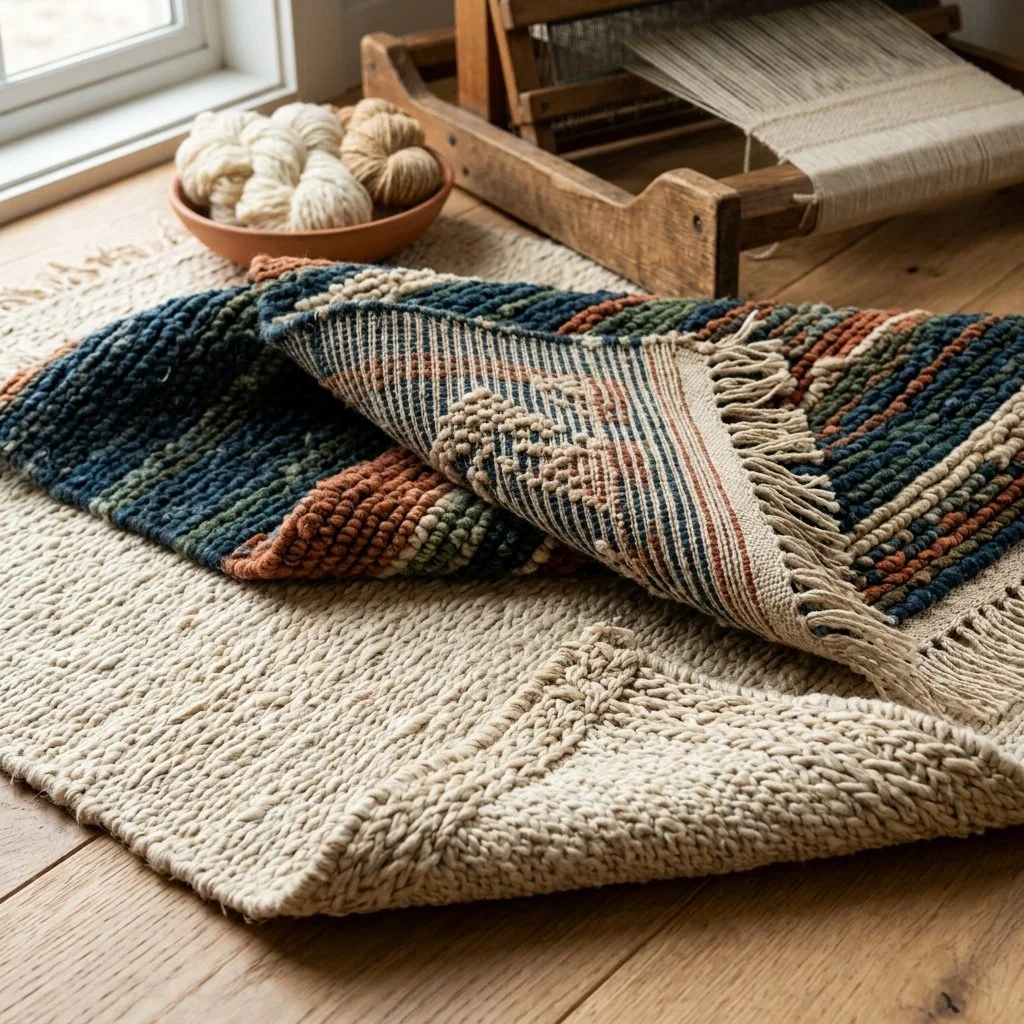
Hand knotted wool rug, resting atop a woven, natural toned Ixtle agave rug.
Check the Back First
A layered rug asks you to trust two different origins at once: a desert plant harvested by hand in northern Mexico, and a fleece grown at altitude somewhere colder. Both earn their place because of how they're made, not just how they look. Before I recommend either one, I check the back for real knots and ask where the ixtle was processed. Color comes after that, never before it.
For sourcing, I go to two different places for two different materials: a specialist rug importer who can show a knotted piece's actual origin and construction, and one of the small cooperative workshops still doing jarciería in northern Mexico for the base underneath it, rather than a mass import warehouse for either.
The Leather Patina
Most luxury surfaces are designed to stay perfect, we prefer surfaces that learn. Discover the art of the leather patina and why friction is the ultimate finish.
Most leather sold for furniture has been engineered to do the opposite of what leather actually does. The hide gets sanded down to erase its own marks, a uniform grain is pressed back into the surface, and a pigment coat goes over the top. What's left behind can sit in a showroom for a decade without visibly changing. That is the entire point of the process, and it is exactly why that leather will never develop the kind of surface that gets better instead of worse.
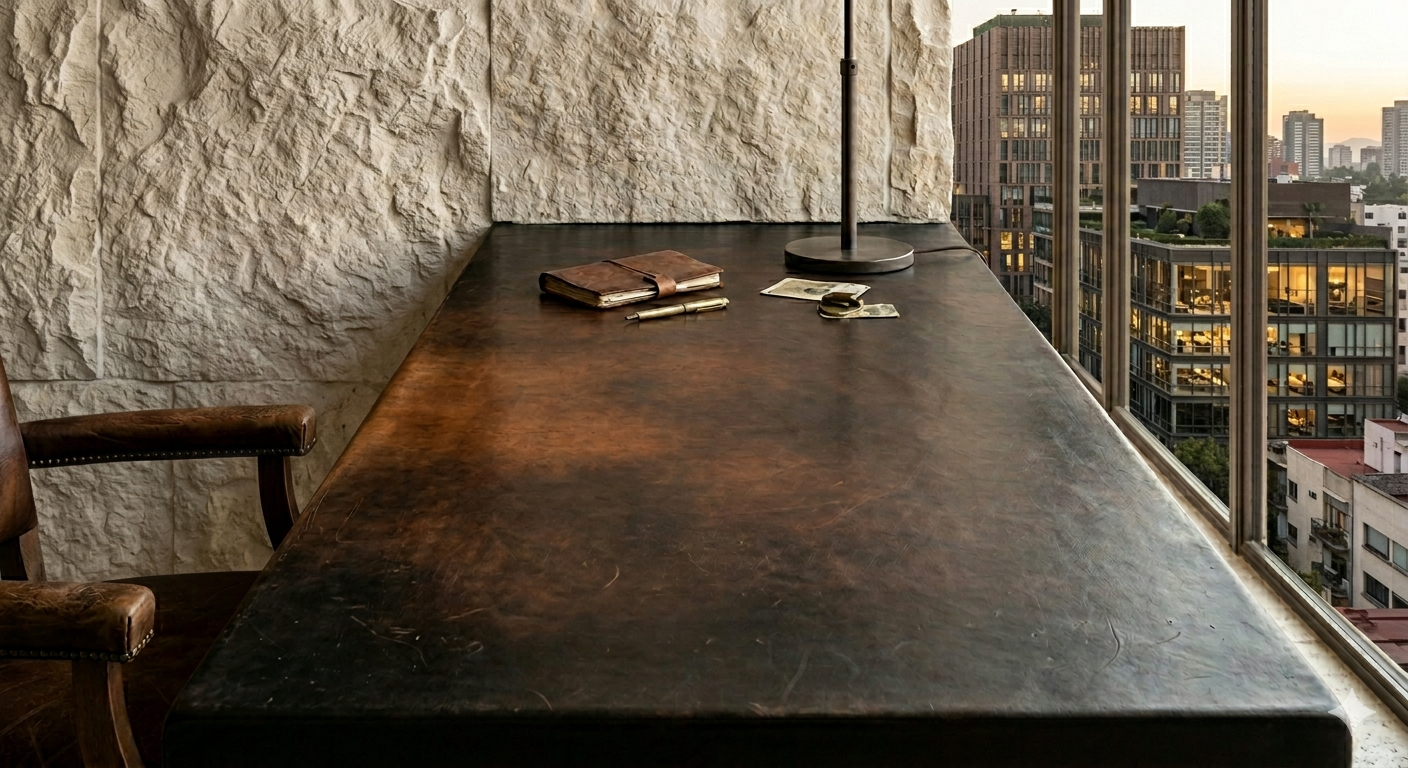
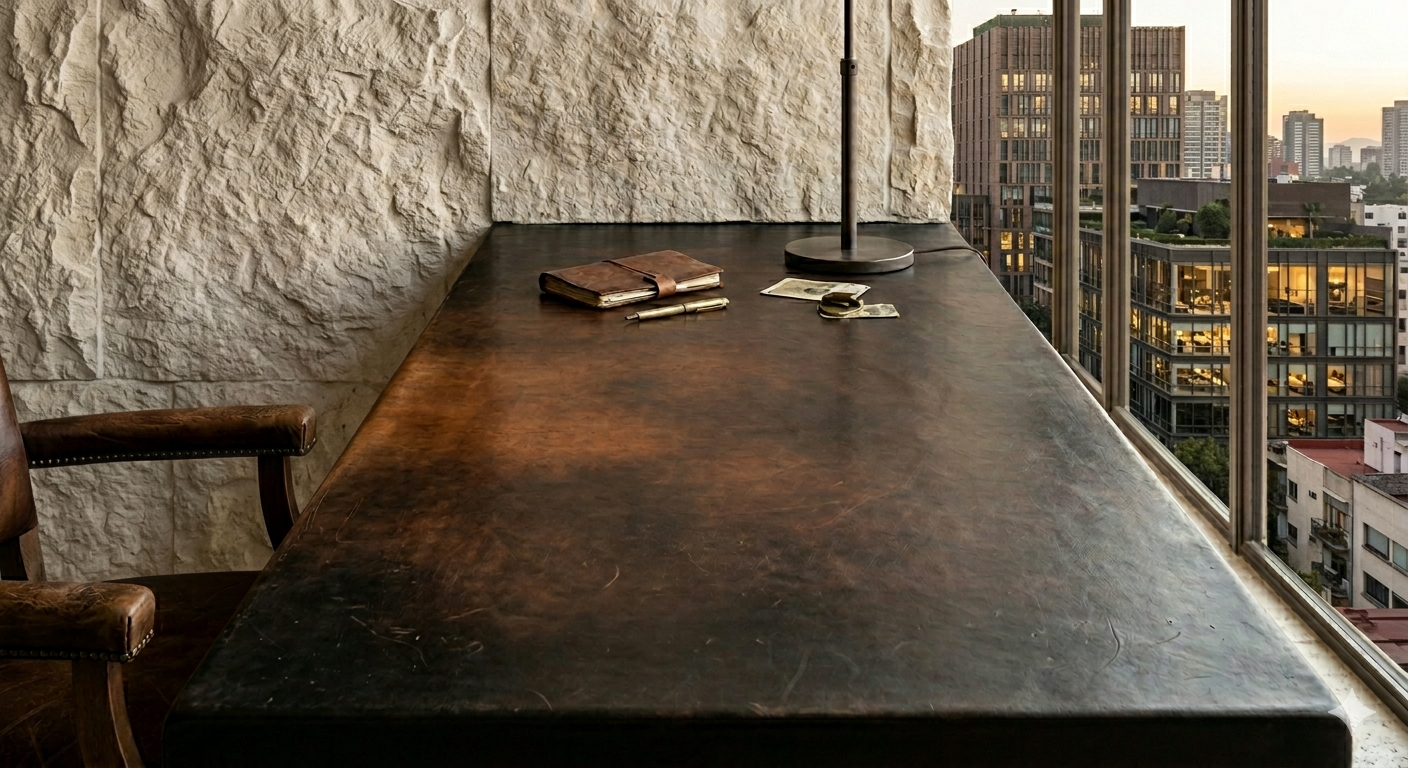
Dark leather wrapped desk.
The Hide That's Allowed to Show Its Age
The leather I use for the surfaces you actually touch, desk tops, door pulls, bench seating, is dyed with soluble aniline dyes rather than coated in pigment. Nothing sits on top of the hide to hide it. Scars, insect bites, faint wrinkles from the animal's own skin stay visible, because there's no artificial layer built to cover them. That openness is also why the surface can keep changing for decades after it leaves the tannery. Corrected leather, sanded, embossed, and finished with a coat of pigment, is what fills most standard showrooms. The layer reacting to your hand there is a manufactured skin sitting on top of the real one.
What Touch Actually Does
Rest your hand on a leather desktop often enough and something starts happening to it that goes deeper than the surface. The oils in your skin work into the open pore structure and deepen the color underneath your palm. Sunlight slowly oxidizes the natural tannins across the whole surface, warming a lighter hide toward amber over a matter of years, not days. And the physical contact itself, the pull of a handle, the drag of a forearm across a desk, polishes the surface smooth at a level you'd need a microscope to actually see happening.
Tanned to Age, Not Just to Last
The leathers that do this best are tanned with bark tannins, oak, chestnut, quebracho, in a process that hasn't changed much in centuries. The tannins bind directly to the hide's fibers, which is why vegetable tanned leather darkens and softens with use instead of simply wearing out. Chrome tanned leather, treated with mineral salts, gets soft faster on the shelf but never develops that same depth of color. It stays close to whatever shade it started at.
For the pieces built to carry real weight, a desk edge, a bench seat, a stair railing, I look for saddle leather specifically, hide cut thick from the sturdiest part of the animal, historically reserved for harness and tack because it had to hold up under load for years without failing. The palette stays narrow on purpose. A pale tan can read as merely faded after a few years of light. A deep, cured hide in burnt honey or blackened espresso reads as older instead, which is a different thing entirely.
Leather merchants in Florence have an old habit. They leave new wallets in the shop window for weeks before selling them, so the sun starts the aging process before a buyer ever touches it. Nobody asked them to do that. It's just what the material rewards.
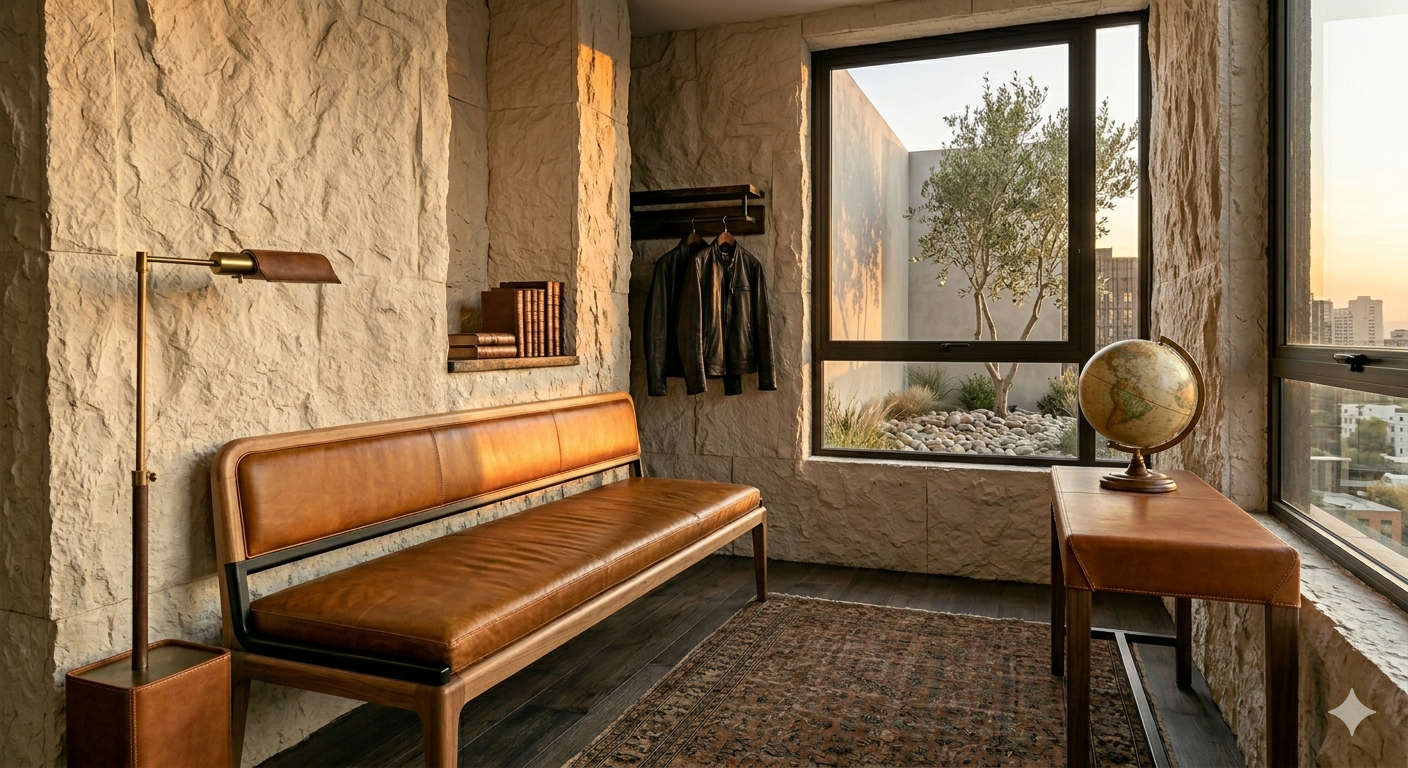
Leather sitting bench in a burnt honey color.
Wear It In
Most of the industry still treats a decade of scuffing as something to hide. I treat it as the whole point. A leather railing or library chair that's been used hard for a decade develops a depth of color no tannery can replicate in a vat, no matter how good the dye. It stops behaving like a product somewhere in that decade and starts behaving like an heirloom, the kind of object a house accumulates rather than furnishes with. Choosing this leather means treating your own house like something you live in, not something you're borrowing. Your life is what finishes the piece.
The Two Decisions That Actually Change How a Bed Feels
Explore the materials, weaves, and layered systems that define a calm sleep sanctuary. This guide breaks down how refined bedding choices—cotton, linen, silk, percale, and sateen—shape comfort, texture, and long-term quality in the bedroom.
Ask ten showrooms what makes a sheet luxurious and eight will point to thread count. That number tells you almost nothing. I stopped trusting it years ago, back when I started handling raw greige goods before they ever hit a finishing mill. What actually changes how a bed feels comes down to two decisions: the weave, and the fill. Everything else is marketing dressed up as specification.
Two matching ivory cotton swatches side by side, showing a matte one over percale weave on the left and sateen weave on the right.
Thread Count Was Never the Real Number
Thread count measures density, not quality. Above roughly 400, manufacturers start plying multiple thin threads together and counting each strand separately, inflating the number without improving the fabric. You end up with a heavier, less breathable sheet sold as more luxurious. A well made 300 count percale will generally outperform an inflated 800 count sateen once it's actually on a bed.
The number worth asking about instead is weave.
Percale and Sateen Are Doing Different Jobs
Percale is a plain weave, one thread over, one thread under, in a tight grid. That structure is what gives it a crisp, matte hand and a cool surface. It's the weave behind most hospitality bedding for a reason: it holds up to industrial laundering without pilling, and it softens gradually with wear while keeping more of its structure than sateen does over the same years of use.
Sateen uses a four over, one under float weave, which puts more thread surface facing up. That's what creates the sheen and the softer, heavier drape. It runs warmer than percale, which is exactly the reason a client in Vermont and a client in Scottsdale should never be handed the same recommendation.
The Fill Is a Separate System Entirely
Duvet and pillow performance has nothing to do with the shell fabric. It comes down to fill power and construction.
Fill power measures loft, the volume one ounce of down occupies. European white goose down typically runs 600 to 800 fill power. Below 600, you're paying for warmth without much loft, and the duvet will feel flat and heavy rather than full. Above 700, you start getting genuine insulation with real weight savings, which is the difference a client actually feels when they pull a duvet up.
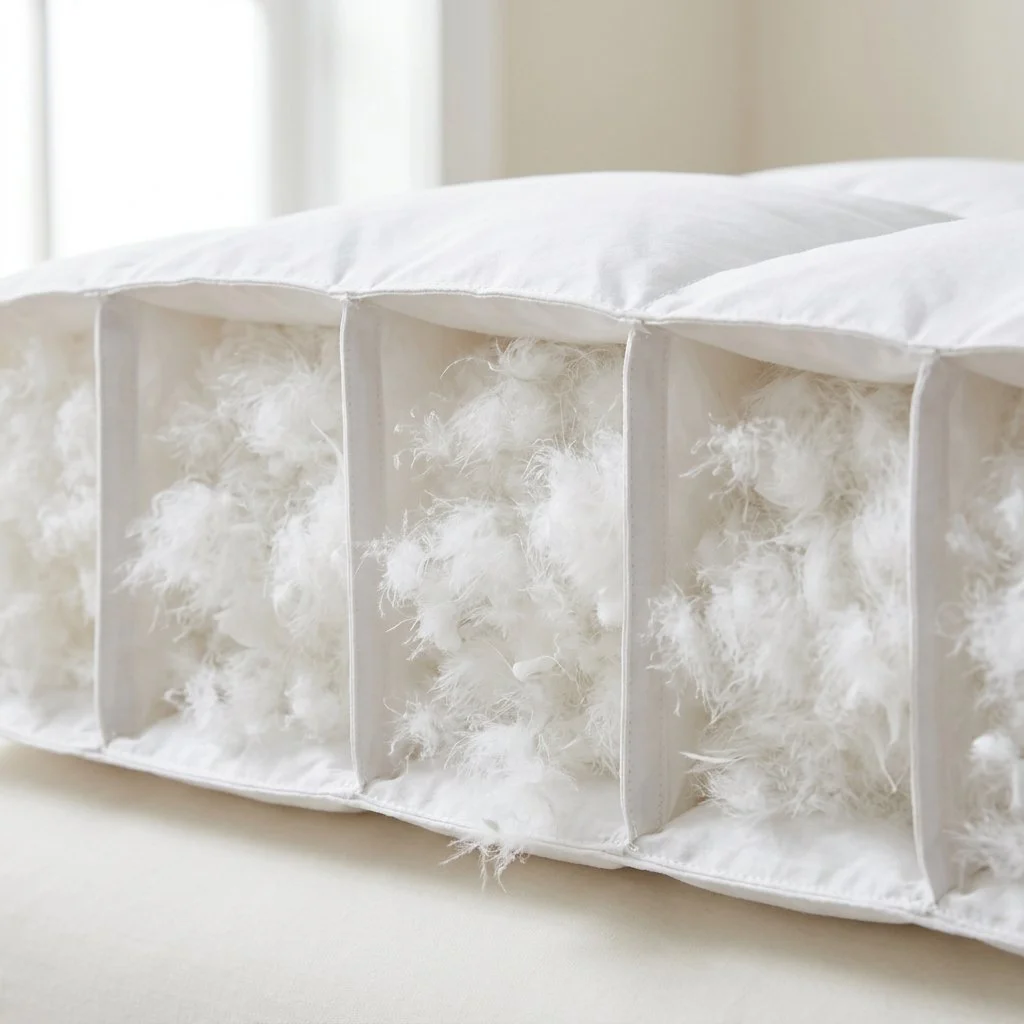
Construction matters just as much as the fill itself. A sewn through duvet, where the top and bottom fabric are stitched directly together in a grid, creates cold spots at every seam because there's no down there. A baffled construction, with internal fabric walls creating box shaped chambers, lets the down loft fully and stay put instead of shifting to the corners after six months of use. If a client is paying for a real down duvet, baffled construction is not optional.
Silk fill, less common but worth knowing, is measured in GSM rather than fill power, grams per square meter of the loose floss itself. A lightweight silk duvet runs around 175 to 250 GSM. A genuine winter weight runs 350 to 400 GSM or higher. This is a different number from momme, which measures woven silk fabric like a pillowcase or sheet, not loose fill, and the two get confused constantly in how these products are marketed. Silk fill is the better recommendation for a client who runs hot or has a wool allergy that rules out down entirely.
Cross section view of a baffle box duvet construction displaying individual fabric chambers filled with airy white down clusters.
Restraint Isn't the Same as Absence
The palette question comes after the material question, not before it. Ivory, oatmeal, sand, sage, softened charcoal, these read as restrained because they let the weave's texture do the visual work instead of competing with it. A sateen in oatmeal shows its sheen. A percale in the same tone shows its crispness. The color isn't the design decision. It's what makes the material decision visible.
Care technique for these fibers lives in its own place on this site rather than repeated here.
What a Trade Buyer Should Actually Specify
Start with weave, matched to the client's climate and hand feel preference. From there, ask what the fill actually is and how it's measured, since a duvet described only as "down" or "silk" with no fill power or GSM attached is a duvet nobody has actually specified. Thread count is the last thing worth checking, mainly as a sanity check against whatever weave and fill claims came with it. Get the weave and the fill right and the palette takes care of itself.
Why a Fabric's Weave Matters More Than Its Color
Luxury is felt through the intentional interplay of materials. Discover the Madison Prime rules for layering textures, from the contrast of stone and fiber to the balance of matte and luster, to create a home with depth, warmth, and permanence.
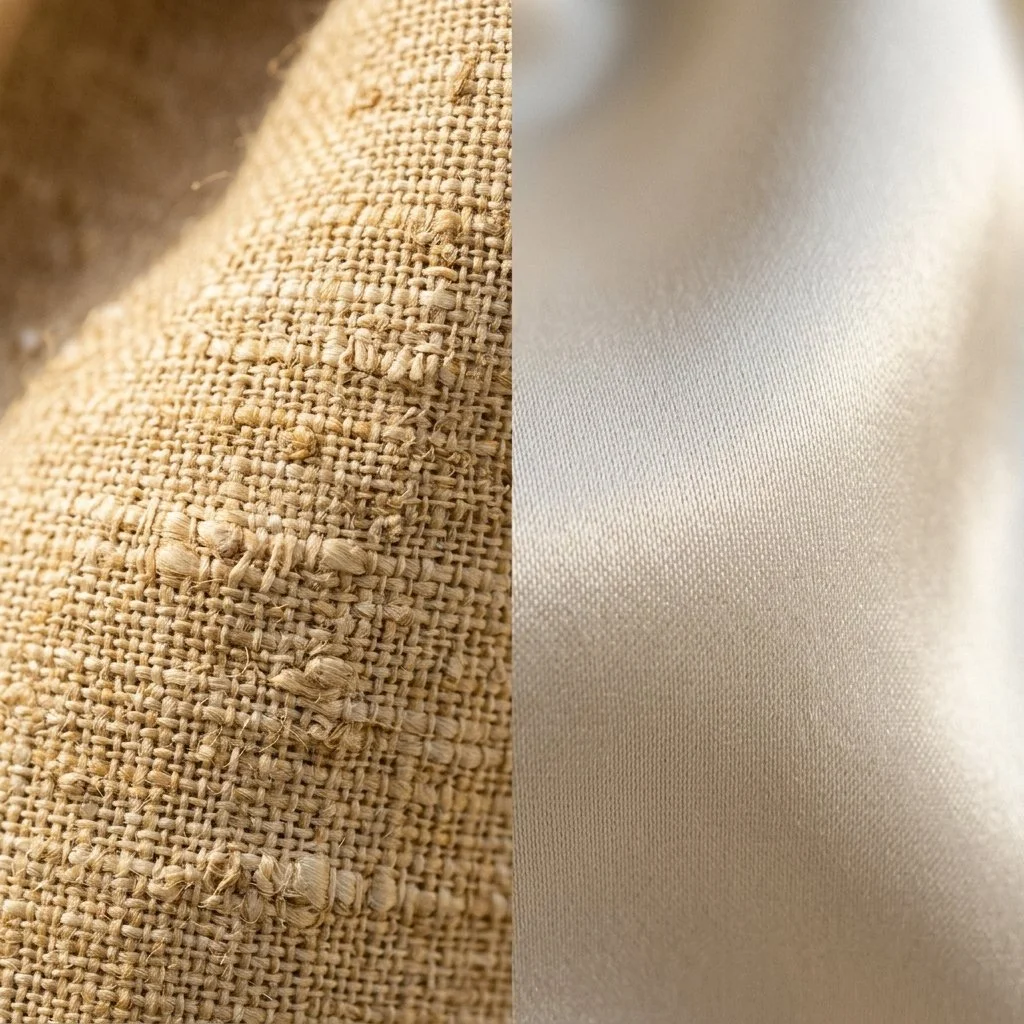
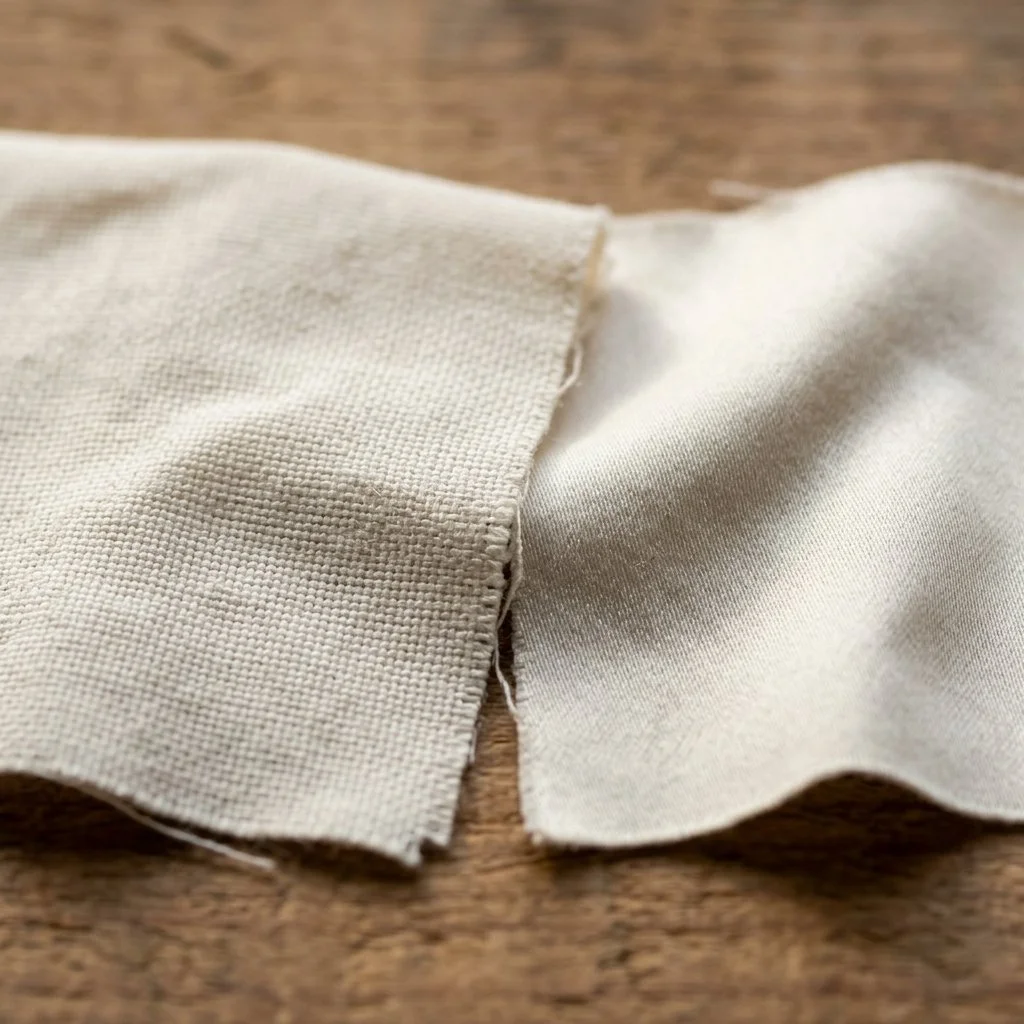
A split macro view showing the textured, slubby weave of matte honey gold tussar silk on the left alongside the smooth, lustrous weave of ivory white mulberry silk on the right.
Hold a piece of tussar silk next to a length of cultivated mulberry silk and the difference is immediate. Tussar comes from wild silkworms that feed on forest trees like sal and arjun across Jharkhand, Bihar, and West Bengal, spun by tribal communities who have worked this material for generations. Its fibers are short and irregular, which gives it a coarse, matte texture and a dull gold sheen. Mulberry silk comes from silkworms raised in controlled conditions on mulberry leaves. Its long, even fibers produce the smooth, reflective surface most people picture when they hear the word silk.
Neither is a lesser version of the other. They're simply built from different textures. Bhagalpur, in Bihar, earned the nickname Silk City almost entirely through tussar weaving, and that region's silk still carries the same rough, honest hand it always has, matte because the fiber holds onto light instead of throwing it back.
That's the real test for any fabric, not just silk. A raw linen works the same way. Run a finger along a woven line and the weave catches slightly rather than sliding smooth, which is exactly why it never throws back a shine no matter how it's pressed. A polished sateen does the opposite. The thread lies so flat and even that light glides straight off it instead of catching on anything at all. Most rooms only reach for one of these behaviors, which is what actually flattens a space, more than color ever does.
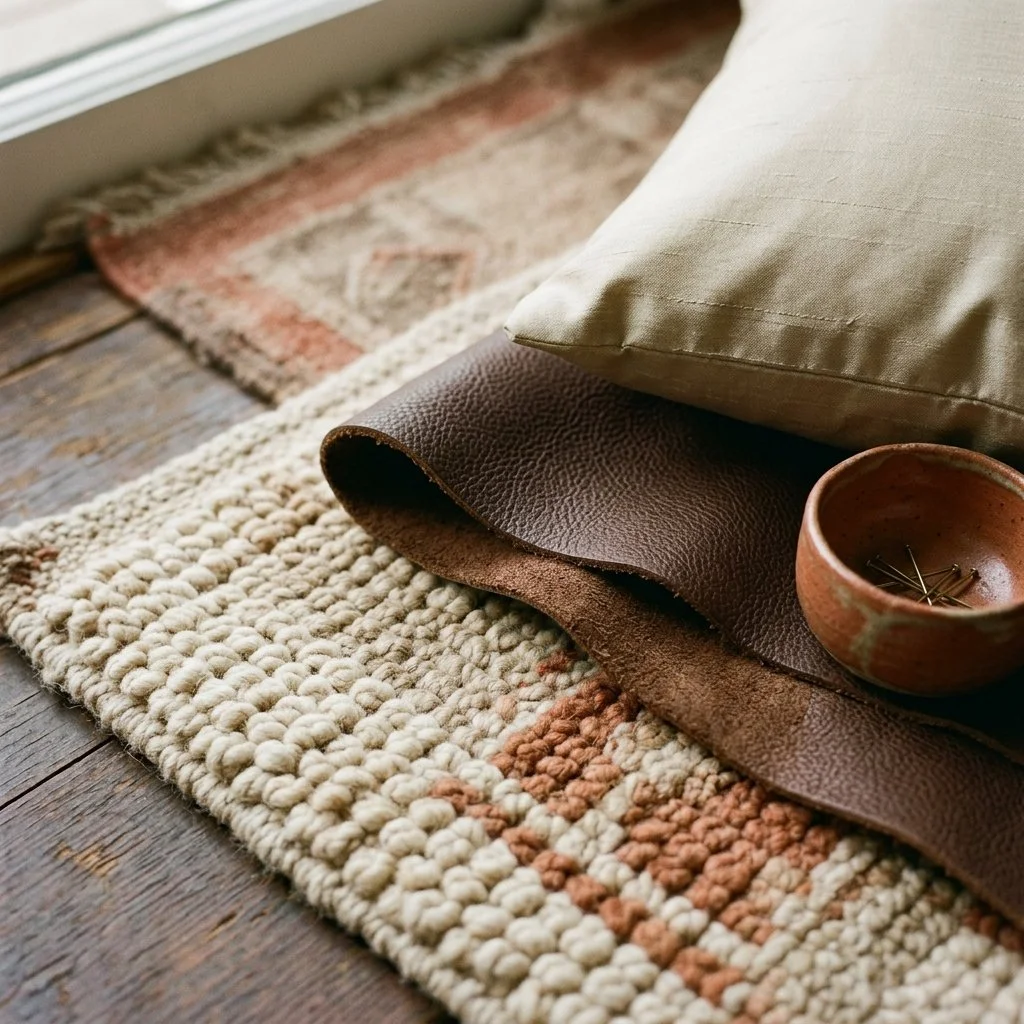
A coarse, hand knotted wool rug corner layered under folded espresso brown leather, topped with a parchment silk blend cushion.
Building a real hierarchy
Start large. A rug knotted by hand sets the base layer everything else in the room eventually sits on top of, and its quality has an actual number behind it. Flip it over and count the knots in a single square inch. Below 80 reads as coarse, tribal work built for durability over detail. Past 160, the density supports the kind of curved, intricate pattern a geometric weave never could. Move to the middle layer next, a good leather chair, a woven storage basket, pieces with real feel in the hand but without the largest physical presence in the space. Finish with the smallest scale, ceramics, a pillow with real silk in the blend, a single piece of hardware someone touches without ever really looking at it twice.
Choosing on purpose
Three fibers, chosen with real intention, do more for a room than six competing for the same attention. Once you can actually feel the difference between what you're touching, rather than just registering that texture exists somewhere in the room, that becomes obvious on its own.
No rulebook needed
The real test doesn't need a lab. Run a hand across a silk sample and watch what happens to the light. That takes about as long as reading a tag, and tells you more.