Sourcing Tonalá Burnished Pottery
Tonalá burnished pottery, barro bruñido, is unglazed earthenware from Tonalá, Jalisco, rubbed with stone and then pyrite until the clay itself shines. It was a luxury in Europe long before it was a souvenir, and today the town sells two very different things under the same name, work from master workshops and market stock made to a price. What separates them is the maker, and a maker’s record can be checked.
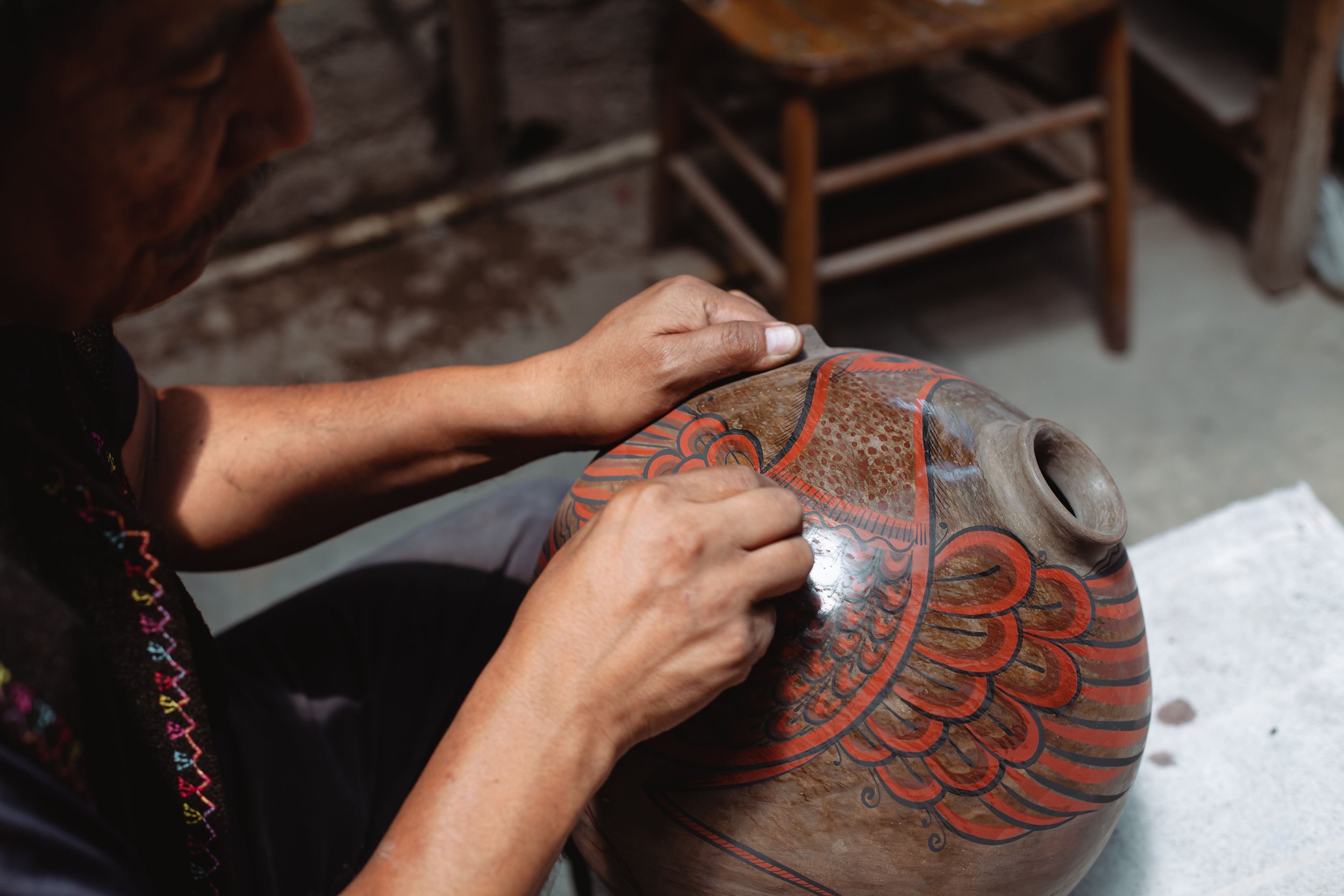
Unglazed earthenware vessel from Tonalá, Jalisco, painted by hand.
A Water Jar for the Spanish Court
In the 1600s and 1700s, Tonalá water vessels called búcaros de Indias were among the most prized objects in elite European households. Collectors valued them for the aroma and taste the clay gave the water inside. The Denver Art Museum notes that some owners kept them in wooden boxes scented with spices and oils, so the absorbent clay would carry more fragrance. The clay was also thought to be medicinal, and fashionable women in Spain and Italy ate fragments of it, which the Metropolitan Museum of Art says left their complexions pale. In Velázquez’s Las Meninas, painted in 1656, the Infanta Margarita is offered a small búcaro of water on a silver tray. The V&A holds dimpled Tonalá vessels from that century and notes that potters in Tonalá still work in the búcaro tradition.
How Burnished Clay Is Made
The clay is dug from the hills around Tonalá, then ground, sifted, wetted and left covered for months to ferment, according to a profile of the Jimón family published by the Feria Maestros del Arte. Once a piece is shaped and dry, it is smoothed with stone. A slip seals the pores and lays down the background color, and the decoration is painted in clays mixed with earth pigments. The final shine most sources describe comes from a burnisher made of pyrite, a metallic mineral. Agustín Jimón Barba, whose family has worked clay for more than seven generations, finishes with tallow instead, by the fair’s account. The piece is then fired once in an open kiln.
Is Tonalá Pottery Glazed?
Burnished Tonalá ware has no glaze. The San Antonio Museum of Art’s label for a Tonalá vase from about 1930 says it plainly, the shine comes from rubbing the clay. Even dealers confuse the two. One vintage listing describes a duck’s “glossy glaze” and in the next lines presents it as typical of barro bruñido. A glaze is a layer of glass fused onto the surface. A burnished surface is the clay itself, polished. Because it stays slightly porous, most burnished work made today is decorative rather than functional, as Ceramics Monthly noted in its profile of two Tonalá potters. Before specifying a piece to hold water for flowers, ask the maker whether it will.
Reading the Ground Color
Burnished work in Tonalá runs in family lines, and the background color often points to one. A 2017 La Jornada column on an exhibition of Ángel Santos’s work named the grounds he had drawn on. Earthy orange went with Jorge Wilmot and Salvador Vázquez Carmona, and gray with the Galván and Jimón families. The Mateos Ortega family worked in black sgraffito. The gray line has carried on, Guadalajara’s Museo de Artes Populares gave the Jimón López family a show of burnished and bandera clay in 2026. Bandera and canelo are burnished too, each with its own look. Bandera paints white and green over a red ground, the colors of the flag, and canelo fires to shades of cinnamon. A seller should be able to tell you which clay a piece is.
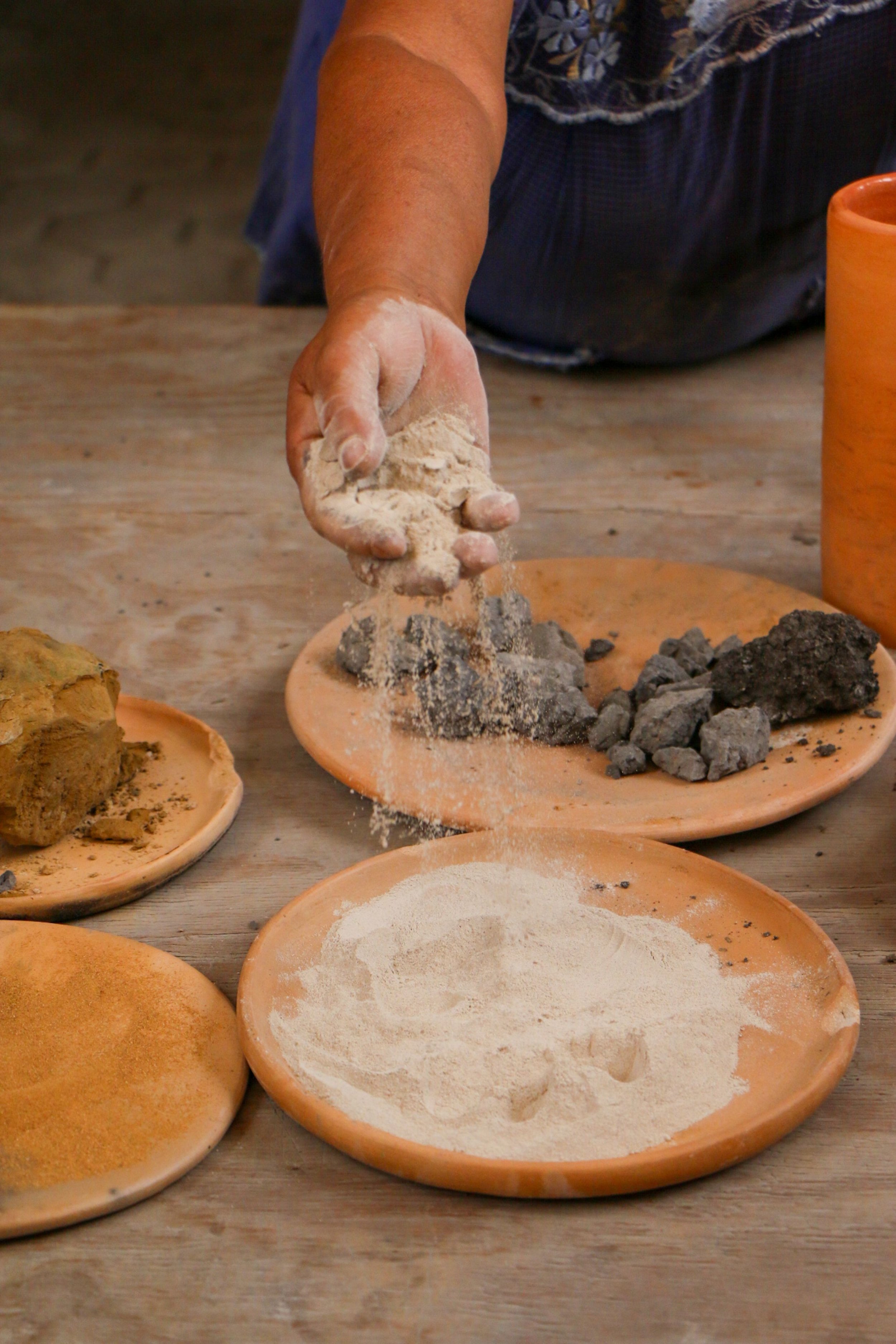
Pyrite, stones and fine sand in clay bowls on a workshop table.
Tonalá Pottery Signatures and Prize Records
Vintage dealers often identify Tonalá pieces by a mark on the base, sometimes a family name, sometimes initials. A signature tells you whose work to ask about. On its own it proves little. The stronger record is the Premio Nacional de la Cerámica, Mexico’s national ceramics competition, seated in Tlaquepaque in the Guadalajara metropolitan area. Its traditional ceramics category names burnishing among the techniques it judges, and its top prize is presented by the president of Mexico. Vázquez Carmona won the presidential award in 1999, and Santos won it in 2014. Ask whether a maker has placed there, and in what year. That question separates a workshop from a stall better than anything you can see on a shelf.
Fewer Hands Burnish It Now
The craft Spanish collectors once paid for has been shrinking. In 2016, Tonalá potters speaking at the University of Guadalajara said the number of burnished clay artisans in the town center had fallen to about 100, from hundreds in the 1970s, and that new housing was covering the clay deposits. In 2024, a Santa Fe museum shop described the technique as made by only a few artisans in Tonalá. The vice president of retail for the foundation behind that shop has said vintage Tonalá turns up in the US, while new work rarely does. Two routes lead to it. The juried Feria Maestros del Arte near Lake Chapala, where Tonalá potters including members of the Jimón family have exhibited, has offered packing and international shipping on site. The other route is the workshops themselves in Tonalá, found through the prize records above. If you make burnished work in Tonalá and want designers to find you, I’d like to hear from you.
